
BuddhistCatholicContemplativeEvangelicalGeneral ChristianHinduJewishLatter-day SaintMuslimNew VisionsProgressive Christian
Beliefs
- Buddhist
- Catholic
- Contemplative
- Evangelical
- General Christian
- Hindu
- Jewish
- Latter-day Saint
- More Voices
- Muslim
- New Visions
- Pagan
- Progressive Christian
Topics
- Religion News
- Food and Religion
- Sports and Religion
- Religious Art
- Religious Music and Entertainment
- Religious Events
- History and Religion
- Style and Religion
- Politics and Religion
- Women in Religion
- Recreation Outdoors and Religion
- Business Finance and Religion
- Careers Workplace and Religion
- Education and Religion
- Family Parenting and Religion
- Health Fitness and Religion
- Home and Religion
- Relationships and Religion
- Technology and Religion
- Travel and Religion
Columnists
- Buddhist Columnists
- Business Finance and Religion Columnists
- Careers Workplace and Religion Columnists
- Catholic Columnists
- Contemplative Columnists
- Education and Religion Columnists
- Evangelists Columnists
- Family Parenting and Religion Columnists
- General Christian Columnists
- Health Fitness and Religion Columnists
- Hindu Columnists
- History and Religion Columnists
- Home and Religion Columnists
- Jewish Columnists
- More Voices Columnists
- Latter Day Columnists
- Muslim Columnists
- New Visions Columnists
- Nonreligious Columnists
- Pagan Columnists
- Politics and Religion Columnists
- Progressive Columnists
- Recreation Outdoors and Religion Columnists
- Relationships and Religion Columnists
- Religion News Columnists
- Religious Art Columnists
- Religious Events Columnists
- Religious Music and Entertainment Columnists
- Sports and Religion Columnists
- Style and Religion Columnists
- Technology and Religion Columnists
- Travel and Religion Columnists
- Women in Religion Columnists
Resource Library
- 2026 Calendar
- Library of World Religions
- The 100 Most Holy Places on Earth
- Patheos Answers
- Podcasts
- Videos
- Faith Leaders Database
- Anglican Episcopalian
- Bahai
- Baptist
- Buddhism
- Christianity
- Confucianism
- Eastern Orthodoxy
- Hinduism
- Holiness and Pentecostal
- ISKCON
- Islam
- Judaism
- Lutheran
- Methodist
- The Church of Jesus Christ of Latter-day Saints
- New Age
- Paganism
- Presbytarian and Reformed
- Protestantism
- Religion Behind the Scenes
- Roman Catholic
- Scientology
- Shia Islam
- Sikhism
- Sufism
- Sunni Islam
- Taoism
- Zen
- See all religions
Research Tools
 Ad-Free & Subscriber Log-In Subscription Support
Ad-Free & Subscriber Log-In Subscription Support
Follow Patheos 

- Trending:
- Forgiveness
- |
- Marriage
- |
- Consciousness
- |
- Death Penalty
- |
- Election
- |
- Halloween

- Home
- Pagan
- Yes, Belief Matters!
Yes, Belief Matters!
Last updated on: June 11, 2013 at 6:00 pm by John Beckett
Yes, Belief Matters! 2013-06-11T18:00:16-06:00 John Beckett
Patheos Explore the world's faith through different perspectives on religion and spirituality! Patheos has the views of the prevalent religions and spiritualities of the world.
 Paganism is known as a religion of orthopraxy, not orthodoxy – what matters most is that you do what’s right, not that you believe what’s right. While the majority culture usually thinks of religion primarily in terms of beliefs, that idea is actually very modern, very Western, and very Protestant. I frequently mention this in terms of caring for the Earth: it doesn’t matter if you care for the Earth because you see it as the body of the Goddess or because you see it as God’s creation or because you see it as the only planet we’ve got. What matters is that you care for the Earth.
With this emphasis on action over belief, it is not surprising that the on-line theological discussions of the past few weeks have generated a backlash. In particular, two prominent Pagans have published essays downplaying the importance of belief.
Thorn Coyle has an essay on Huffington Post with the title “Why I Am Not a Believer.” She quotes Feri founder Victor Anderson, who said “perceive first, believe later” and she paraphrases Joseph Campbell: “I don’t need belief because I have experience.” In fairness to Thorn, most of her essay is devoted to holding beliefs lightly and remaining open to new experiences as well as new interpretations. Those are good ideas, but the title and the quotes send a strong message that belief doesn’t matter.
There is no such nuance in Galina Krasskova’s PaganSquare essay titled “We Don’t Need No Stinkin’ Theories.” Here’s a key quote:
As I was discussing this on Facebook, noting that as a result of this debate, I intended to write a series of articles on what I think are the fundamentals of polytheism, Teo Bishop asked me if I would be expanding on the ‘nature of real-ness’ of the Gods in my upcoming articles, if I would be positing a theory, what he (and I believe Halstead also) termed a theory of the ontological nature of the Gods.
The question really left me flabbergasted and I’m glad he asked it. I think it highlights a crucial, very crucial difference between polytheists and Neo-pagans. My theological approach is not based on theory. As a polytheist practicing my ancestral traditions, rooted in deeply engaged experience with the Gods and ancestors, I don’t need theories. They’re rendered irrelevant.
I’m in strong agreement with Galina that engaging with the gods is more important than theorizing about the gods. Again, orthopraxy is more important than orthodoxy. But her dismissal of theory simply doesn’t work for me, and I suspect it isn’t helpful to the average Pagan and/or polytheist.
Galina looks back to a glorious pagan past where “the reality of the Gods would have been taken as a given;” where theories about the gods would have been hardwired into a community.
I grew up in a community like that. Only it wasn’t Pagan or pagan, it was fundamentalist Christian. “God said it, I believe it, that settles it.” The men of the church might argue about the meaning of a particular passage of scripture, but that it was anything other than the inerrant Word of God was not open to debate. The saved were going to heaven, the unsaved (which included just about everyone but conservative low-church Protestants) were going to hell, and only a fool would believe otherwise.
Unexamined axiomatic beliefs didn’t work for me then and they don’t work for me now. I can’t simply take the reality of gods and goddesses as a given. I need a theory, a framework of belief. I don’t need proof, but I do need reason.
And I think most Pagans and would-be Pagans do too.
Religious experience is important. But experience by itself is literally meaningless – it has no meaning until we interpret it, and we interpret our experiences based on our beliefs. Put a Wiccan, a Baptist and an atheist on a beach at sunset. They will feel the same breeze, smell the same smells, gaze at the same horizon and hear the same waves. They will have the same experience, but they will interpret that experience in very different ways based on their beliefs about Nature, the god(s) of Nature, and their place in Nature.
Some people have intimate experiences of the gods that leave no doubts in their hearts and minds. Others – myself included – have experiences that are absolutely real in the moment, but afterwards, doubts begin to creep in. Perhaps my experience wasn’t strong enough. Perhaps I’m too rooted in the mainstream culture. Perhaps the fundamentalist religion of my childhood isn’t as gone as I think it is. Perhaps I’m simply too skeptical.
What are we to do? Are we to ignore the call of the gods? Are we to lie to ourselves and insist our experiences are more than what they really are?
No.
We reinforce our experiences with beliefs. As Thorn says:
We humans are storytellers. Stories apply meaning to our experiences. This is a good thing. There is truth in our stories, as well as exploration, and a connection to the line of past and future.
We draw on the wisdom of others who have had similar experiences, both ancient and contemporary. We compare our experiences to theirs, we compare them to what we know of the Universe and the way it works. We form hypotheses of belief and we test those hypotheses with further practice, and that practice generates further experiences. As our experiences grow, we refine our hypotheses into theories – ideas about who and what the gods are and how we relate to them.
My experiences of the gods I serve may not be as strong as the experiences of some Pagans, but it’s been strong enough to give me a clear sense of direction. And a big part of that direction is introducing the gods to the people. Oh, the gods can speak to whoever they like – but will those people hear them? Or will they dismiss what they hear as fantasies, delusions, and mixed up brain chemistry?
People will only hear what they’re prepared to hear. People will only see what they’re prepared to see.
If I have heard nothing else from the deities I serve, it’s this: “make them ready.”
In order to be ready to hear and see the gods, people must first believe that such things as gods might actually exist and that we can interact with them. That’s a tall order for a culture where the loudest voices on one side scream there is only one god and the loudest voices on the other side scream there are no gods. People need stories, theories and beliefs.
Here’s what I wrote last year:
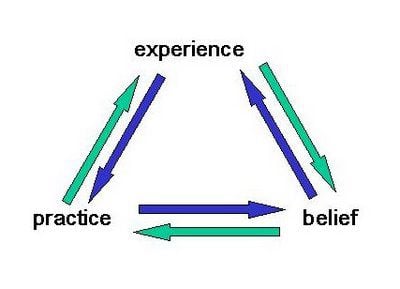
Belief comes as we try to interpret our experiences. What do they tell us about ourselves and our place in the grand order of things? What do they tell us about our place in the community? What do they tell us about how we should live our lives – what is of ultimate importance and what is trivial? Why did this practice generate this experience?
The meaning we take from our beliefs motivates us to practice deeper and more frequently. More and deeper practice generates more and deeper experiences. More and deeper experiences further reinforce our beliefs.
Practice, experience and belief are a virtuous circle.
I am envious of Pagans whose experience is so strong they don’t need belief. I’m not one of them. So I’ll continue to interpret my experiences and tell my stories. I’ll continue to discuss my theories with other Pagans. I’ll continue to refine those theories, trying to understand the gods intellectually as well as spiritually. I’ll do my best to avoid getting so caught up in thinking that I forget doing. Right action is still more important than right belief.
But I need belief. And I think most people do too.
Previous Post

June 9, 2013
Acadia
Next Post

June 13, 2013 A Polytheistic Look at the Devil
Browse Our Archives
Select a Category Books Community CUUPS Druidry Foundations and Context Gods and Goddesses Magic Myth Nature Ritual Spiritual Practice Theology Travel Uncategorized Videos
Select a Month October 2026 September 2026 August 2026 July 2026 June 2026 May 2026 April 2026 March 2026 February 2026 January 2026 December 2025 November 2025 October 2025 September 2025 August 2025 July 2025 June 2025 May 2025 April 2025 March 2025 February 2025 January 2025 December 2024 November 2024 October 2024 September 2024 August 2024 July 2024 June 2024 May 2024 April 2024 March 2024 February 2024 January 2024 December 2023 November 2023 October 2023 September 2023 August 2023 July 2023 June 2023 May 2023 April 2023 March 2023 February 2023 January 2023 December 2022 November 2022 October 2022 September 2022 August 2022 July 2022 June 2022 May 2022 April 2022 March 2022 February 2022 January 2022 December 2021 November 2021 October 2021 September 2021 August 2021 July 2021 June 2021 May 2021 April 2021 March 2021 February 2021 January 2021 December 2020 November 2020 October 2020 September 2020 August 2020 July 2020 June 2020 May 2020 April 2020 March 2020 February 2020 January 2020 December 2019 November 2019 October 2019 September 2019 August 2019 July 2019 June 2019 May 2019 April 2019 March 2019 February 2019 January 2019 December 2018 November 2018 October 2018 September 2018 August 2018 July 2018 June 2018 May 2018 April 2018 March 2018 February 2018 January 2018 December 2017 November 2017 October 2017 September 2017 August 2017 July 2017 June 2017 May 2017 April 2017 March 2017 February 2017 January 2017 December 2016 November 2016 October 2016 September 2016 August 2016 July 2016 June 2016 May 2016 April 2016 March 2016 February 2016 January 2016 December 2015 November 2015 October 2015 September 2015 August 2015 July 2015 June 2015 May 2015 April 2015 March 2015 February 2015 January 2015 December 2014 November 2014 October 2014 September 2014 August 2014 July 2014 June 2014 May 2014 April 2014 March 2014 February 2014 January 2014 December 2013 November 2013 October 2013 September 2013 August 2013 July 2013 June 2013 May 2013 April 2013 March 2013 February 2013 January 2013 December 2012 November 2012 October 2012 September 2012 August 2012 July 2012 June 2012 May 2012 April 2012 March 2012 February 2012 January 2012 December 2011 November 2011 October 2011 September 2011 August 2011 July 2011 June 2011 May 2011 April 2011 March 2011 February 2011 January 2011 December 2010 November 2010 October 2010 September 2010 August 2010 July 2010 June 2010 May 2010 April 2010 March 2010 February 2010 January 2010 December 2009 November 2009 October 2009 September 2009 August 2009 July 2009 June 2009 May 2009 April 2009 March 2009 February 2009 January 2009 December 2008 November 2008 October 2008 September 2008 August 2008 July 2008 June 2008
Follow Us!
TAKE THE
Religious Wisdom Quiz
How many people did Jesus feed with five loaves of bread and two fish?
Select your answer to see how you score.
5,000 1,000 2,500 500
Related posts from John Beckett




What We Lose When “Ask AI” Becomes A...
TRENDING AT PATHEOS Pagan

The Sermon on the Mount, Part I: Matthew...
The Sermon on the Mount, Part I (Matthew 4:12-5:12) St. Matthew moves...

What's up from Crossway: Reviewing some of their latest A few weeks...

Janie Learns the Way of the Cross: A...
Teaching children about Jesus' Passion can be challenging. Many parents and educators...

Looking For Good Catholic Writing - October 2026
He alone extends the heavens, and he walks upon the waves of...

In "Irreplaceable," our book on vocation and technology, Trevor Sutton and I...

I was strolling through the top floor of the brand new Parthenon...
view all Pagan blogs
Ad-Free & Subscriber Log-In Subscription Support
- About Us
- 2026 Calendar
- Videos
- Podcasts
- Library of World Religions
- Faith In Media Tracker
- Advertise With Us
- Write for Us
- Privacy Policy
- Terms of Service
- Do Not Sell My Data
- Contact Us
- Radiant Digital
- Manage Newsletter Subscriptions
- Unsubscribe From Notifications
- Sitemap
Copyright 2008-2026, Patheos. All rights reserved.
Subscription Support Ad-Free & Subscriber Log-In
Follow Patheos