
BuddhistCatholicContemplativeEvangelicalGeneral ChristianHinduJewishLatter-day SaintMuslimNew VisionsProgressive Christian
Beliefs
- Buddhist
- Catholic
- Contemplative
- Evangelical
- General Christian
- Hindu
- Jewish
- Latter-day Saint
- More Voices
- Muslim
- New Visions
- Pagan
- Progressive Christian
Topics
- Religion News
- Food and Religion
- Sports and Religion
- Religious Art
- Religious Music and Entertainment
- Religious Events
- History and Religion
- Style and Religion
- Politics and Religion
- Women in Religion
- Recreation Outdoors and Religion
- Business Finance and Religion
- Careers Workplace and Religion
- Education and Religion
- Family Parenting and Religion
- Health Fitness and Religion
- Home and Religion
- Relationships and Religion
- Technology and Religion
- Travel and Religion
Columnists
- Buddhist Columnists
- Business Finance and Religion Columnists
- Careers Workplace and Religion Columnists
- Catholic Columnists
- Contemplative Columnists
- Education and Religion Columnists
- Evangelists Columnists
- Family Parenting and Religion Columnists
- General Christian Columnists
- Health Fitness and Religion Columnists
- Hindu Columnists
- History and Religion Columnists
- Home and Religion Columnists
- Jewish Columnists
- More Voices Columnists
- Latter Day Columnists
- Muslim Columnists
- New Visions Columnists
- Nonreligious Columnists
- Pagan Columnists
- Politics and Religion Columnists
- Progressive Columnists
- Recreation Outdoors and Religion Columnists
- Relationships and Religion Columnists
- Religion News Columnists
- Religious Art Columnists
- Religious Events Columnists
- Religious Music and Entertainment Columnists
- Sports and Religion Columnists
- Style and Religion Columnists
- Technology and Religion Columnists
- Travel and Religion Columnists
- Women in Religion Columnists
Resource Library
- 2026 Calendar
- Library of World Religions
- The 100 Most Holy Places on Earth
- Patheos Answers
- Podcasts
- Videos
- Faith Leaders Database
- Anglican Episcopalian
- Bahai
- Baptist
- Buddhism
- Christianity
- Confucianism
- Eastern Orthodoxy
- Hinduism
- Holiness and Pentecostal
- ISKCON
- Islam
- Judaism
- Lutheran
- Methodist
- The Church of Jesus Christ of Latter-day Saints
- New Age
- Paganism
- Presbytarian and Reformed
- Protestantism
- Religion Behind the Scenes
- Roman Catholic
- Scientology
- Shia Islam
- Sikhism
- Sufism
- Sunni Islam
- Taoism
- Zen
- See all religions
Research Tools
 Ad-Free & Subscriber Log-In Subscription Support
Ad-Free & Subscriber Log-In Subscription Support
Follow Patheos 

- Trending:
- Forgiveness
- |
- Marriage
- |
- Consciousness
- |
- Death Penalty
- |
- Election
- |
- Halloween

- Home
- Pagan
- Spiritual Practice Techniques: Writing
Spiritual Practice Techniques: Writing
Last updated on: April 12, 2014 at 3:28 pm by John Beckett
Spiritual Practice Techniques: Writing 2014-04-12T15:28:58-06:00 John Beckett
Patheos Explore the world's faith through different perspectives on religion and spirituality! Patheos has the views of the prevalent religions and spiritualities of the world.
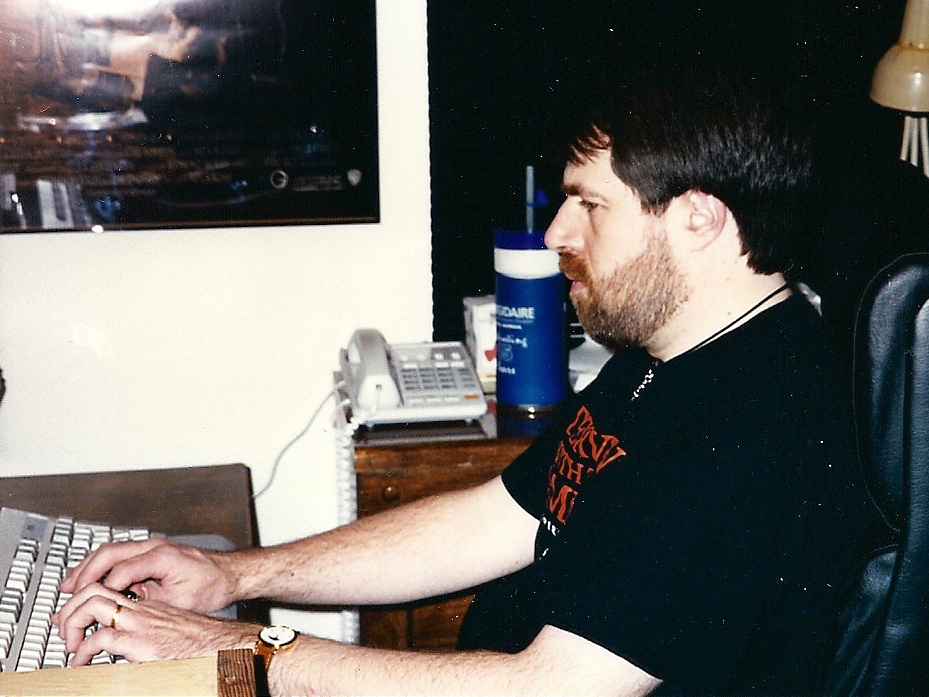
Writing at the computer, circa 1996 – one of the darker periods of my life. Writing helped get me through a difficult time.
This is the third in an occasional series on spiritual practice techniques.
I have practiced writing as a spiritual discipline for most of my life, far longer than I’ve been a Pagan or a Unitarian Universalist. I think this is the engineer in me coming through: I had issues to deal with or religious questions to consider and my first impulse was to define the problem as clearly and objectively as I could. It helped – some times more than others – but it always helped.
Writing as a spiritual practice serves three main purposes.
Writing promotes objectivity. Our daily lives are filled with emotions and emotional reactions. This is a good thing – we are humans, not Vulcans. But many factors can influence how we feel about a given issue: what we were taught as children, old beliefs we haven’t quite overcome, stress at work or at home, even things as mundane as what we had for dinner last night. Writing forces us to distill all those feelings into a few words. Once those words are on paper, they are no longer completely within us – we can evaluate them with more detachment. It becomes easier to realize that what we think is the problem may only be a symptom of a deeper problem. Once we recognize the root cause or the core issue, we can address it directly instead of constantly dealing with symptoms.
Writing provides records. In elementary school science class I was taught that scientists keep journals of all their experiments – the experimental hypothesis, elements, methods, test conditions, and results. Your life is an on-going experiment of one. Regular writing generates records of what you did, how it worked, and how you felt about it. There are many times when I face a problem I know I’ve faced before. I can go back to my writings and see what I did in similar situations. Sometimes that tells me what I can do this time, other times it tells me what I shouldn’t do. Memories are very fallible – don’t count on remembering everything.
There are times when I really wish I had found this spiritual path much earlier in life. But then I read some of the stuff I wrote in my 20s and early 30s and I realize I wasn’t ready for it – I had to go down a lot of dead end streets before I was able to understand and accept that what I was yearning for wasn’t what society was telling me I “should” want. Sometimes you don’t appreciate how far you’ve come till you stop and look back at where you used to be.
Writing promotes discipline. Unlike eating and sleeping and sex, there is no evolutionary urge for spiritual practice. There are so many demands on our time – we have to make time for doing the things that align us with our highest goals and beliefs. We can neglect to meditate day after day and think it’s been a week when it’s really been a month. But with writing, it’s all there – quite literally – in black and white. The discipline we develop in this practice will carry over and help us in other techniques and practices.
Keeping this blog has been a tremendous discipline for me. I know that if I don’t get something up at least once or twice a week, many of you folks will quit reading. So I’m more regular with my writing than I ever was before.
How should we write? My essays end up on the blog, while I keep my more personal notes in a plain text file – that makes it easy to keep copies at home and at work, and to search when I can remember “what” but not “when.” In the years BC (Before Computers) I wrote things out on notebook paper and stuffed them in a manila folder. In the Spiritual Practice workshop at Pagan Pride Day a participant said that physically writing on paper was a magical act for him.
Whether you write longhand in a leather-bound diary or type into a word processor or anything in between, the important thing is that you write regularly – at least a couple times a week.
Twitter and Facebook don’t count – they’re too brief and mostly too shallow.
If you aren’t already keeping a diary or journal, start. If you struggling with decisions or directions or beliefs, try writing through them. And look back every so often to see just how far you’ve come.
Previous Post

September 22, 2010
Daily Spiritual Practice
Next Post
September 28, 2010 Pagan Identity
Browse Our Archives
Select a Category Books Community CUUPS Druidry Foundations and Context Gods and Goddesses Magic Myth Nature Ritual Spiritual Practice Theology Travel Uncategorized Videos
Select a Month October 2026 September 2026 August 2026 July 2026 June 2026 May 2026 April 2026 March 2026 February 2026 January 2026 December 2025 November 2025 October 2025 September 2025 August 2025 July 2025 June 2025 May 2025 April 2025 March 2025 February 2025 January 2025 December 2024 November 2024 October 2024 September 2024 August 2024 July 2024 June 2024 May 2024 April 2024 March 2024 February 2024 January 2024 December 2023 November 2023 October 2023 September 2023 August 2023 July 2023 June 2023 May 2023 April 2023 March 2023 February 2023 January 2023 December 2022 November 2022 October 2022 September 2022 August 2022 July 2022 June 2022 May 2022 April 2022 March 2022 February 2022 January 2022 December 2021 November 2021 October 2021 September 2021 August 2021 July 2021 June 2021 May 2021 April 2021 March 2021 February 2021 January 2021 December 2020 November 2020 October 2020 September 2020 August 2020 July 2020 June 2020 May 2020 April 2020 March 2020 February 2020 January 2020 December 2019 November 2019 October 2019 September 2019 August 2019 July 2019 June 2019 May 2019 April 2019 March 2019 February 2019 January 2019 December 2018 November 2018 October 2018 September 2018 August 2018 July 2018 June 2018 May 2018 April 2018 March 2018 February 2018 January 2018 December 2017 November 2017 October 2017 September 2017 August 2017 July 2017 June 2017 May 2017 April 2017 March 2017 February 2017 January 2017 December 2016 November 2016 October 2016 September 2016 August 2016 July 2016 June 2016 May 2016 April 2016 March 2016 February 2016 January 2016 December 2015 November 2015 October 2015 September 2015 August 2015 July 2015 June 2015 May 2015 April 2015 March 2015 February 2015 January 2015 December 2014 November 2014 October 2014 September 2014 August 2014 July 2014 June 2014 May 2014 April 2014 March 2014 February 2014 January 2014 December 2013 November 2013 October 2013 September 2013 August 2013 July 2013 June 2013 May 2013 April 2013 March 2013 February 2013 January 2013 December 2012 November 2012 October 2012 September 2012 August 2012 July 2012 June 2012 May 2012 April 2012 March 2012 February 2012 January 2012 December 2011 November 2011 October 2011 September 2011 August 2011 July 2011 June 2011 May 2011 April 2011 March 2011 February 2011 January 2011 December 2010 November 2010 October 2010 September 2010 August 2010 July 2010 June 2010 May 2010 April 2010 March 2010 February 2010 January 2010 December 2009 November 2009 October 2009 September 2009 August 2009 July 2009 June 2009 May 2009 April 2009 March 2009 February 2009 January 2009 December 2008 November 2008 October 2008 September 2008 August 2008 July 2008 June 2008
Follow Us!
TAKE THE
Religious Wisdom Quiz
What proportion of lepers healed by Jesus returned to thank Him?
Select your answer to see how you score.
Five All ten One out of ten None
Related posts from John Beckett
Toward a Sense of Peace and Well-Being
Putting the Remnants of Toxic Religion Where They...


Five Messages on Walpurgisnacht
TRENDING AT PATHEOS Pagan

Letters on Living the Faith by C.S. Lewis
Most of us met C.S. Lewis as a public intellectual. Mere Christianity....

When Halloween Unmasks Married Hearts
Written by Dr. David K. Ewen from Eternal Truth Bible College Behind...

Aristotle. He’s been called the father of logic, the father of the...

Methodist Central Hall and Westminster Abbey
Situated on the same square is Methodist Central Hall and Westminster Abbey. ...

57th Dove Awards Honor Dolly Parton, Crown New...
On gospel music’s biggest night, the 57th annual GMA Dove Awards honored...

The First Eucharistic Controversy: Christ’s Real Presence
For Catholics, the Eucharist is the source and summit of the Christian...
view all Pagan blogs
Ad-Free & Subscriber Log-In Subscription Support
- About Us
- 2026 Calendar
- Videos
- Podcasts
- Library of World Religions
- Faith In Media Tracker
- Advertise With Us
- Write for Us
- Privacy Policy
- Terms of Service
- Do Not Sell My Data
- Contact Us
- Radiant Digital
- Manage Newsletter Subscriptions
- Unsubscribe From Notifications
- Sitemap
Copyright 2008-2026, Patheos. All rights reserved.
Subscription Support Ad-Free & Subscriber Log-In
Follow Patheos