
BuddhistCatholicContemplativeEvangelicalGeneral ChristianHinduJewishLatter-day SaintMuslimNew VisionsProgressive Christian
Beliefs
- Buddhist
- Catholic
- Contemplative
- Evangelical
- General Christian
- Hindu
- Jewish
- Latter-day Saint
- More Voices
- Muslim
- New Visions
- Pagan
- Progressive Christian
Topics
- Religion News
- Food and Religion
- Sports and Religion
- Religious Art
- Religious Music and Entertainment
- Religious Events
- History and Religion
- Style and Religion
- Politics and Religion
- Women in Religion
- Recreation Outdoors and Religion
- Business Finance and Religion
- Careers Workplace and Religion
- Education and Religion
- Family Parenting and Religion
- Health Fitness and Religion
- Home and Religion
- Relationships and Religion
- Technology and Religion
- Travel and Religion
Columnists
- Buddhist Columnists
- Business Finance and Religion Columnists
- Careers Workplace and Religion Columnists
- Catholic Columnists
- Contemplative Columnists
- Education and Religion Columnists
- Evangelists Columnists
- Family Parenting and Religion Columnists
- General Christian Columnists
- Health Fitness and Religion Columnists
- Hindu Columnists
- History and Religion Columnists
- Home and Religion Columnists
- Jewish Columnists
- More Voices Columnists
- Latter Day Columnists
- Muslim Columnists
- New Visions Columnists
- Nonreligious Columnists
- Pagan Columnists
- Politics and Religion Columnists
- Progressive Columnists
- Recreation Outdoors and Religion Columnists
- Relationships and Religion Columnists
- Religion News Columnists
- Religious Art Columnists
- Religious Events Columnists
- Religious Music and Entertainment Columnists
- Sports and Religion Columnists
- Style and Religion Columnists
- Technology and Religion Columnists
- Travel and Religion Columnists
- Women in Religion Columnists
Resource Library
- 2026 Calendar
- Library of World Religions
- The 100 Most Holy Places on Earth
- Patheos Answers
- Podcasts
- Videos
- Faith Leaders Database
- Anglican Episcopalian
- Bahai
- Baptist
- Buddhism
- Christianity
- Confucianism
- Eastern Orthodoxy
- Hinduism
- Holiness and Pentecostal
- ISKCON
- Islam
- Judaism
- Lutheran
- Methodist
- The Church of Jesus Christ of Latter-day Saints
- New Age
- Paganism
- Presbytarian and Reformed
- Protestantism
- Religion Behind the Scenes
- Roman Catholic
- Scientology
- Shia Islam
- Sikhism
- Sufism
- Sunni Islam
- Taoism
- Zen
- See all religions
Research Tools
 Ad-Free & Subscriber Log-In Subscription Support
Ad-Free & Subscriber Log-In Subscription Support
Follow Patheos 

- Trending:
- Forgiveness
- |
- Marriage
- |
- Consciousness
- |
- Death Penalty
- |
- Election
- |
- Halloween
 Joel J. Miller
-
Joel's Books
-
Article Categories
- Home
- Evangelical
- Read this before you burn that picture of Jesus
Read this before you burn that picture of Jesus
Last updated on: December 19, 2013 at 4:58 am by Joel J. Miller
Read this before you burn that picture of Jesus 2013-12-19T04:58:46-06:00 Joel J. Miller
Patheos Explore the world's faith through different perspectives on religion and spirituality! Patheos has the views of the prevalent religions and spiritualities of the world.
Around Christmas time it’s impossible to avoid pictures of Jesus. But Megan Hill is still trying.
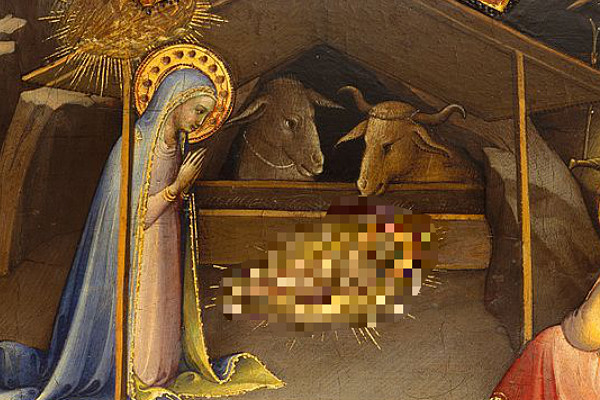
‘Um, where’s Jesus?’ Lorenzo Monaco, Wikimedia Commons.
According to her recent post in Her*meneutics, Hill has asked teachers to excuse her kids from coloring nativity scenes and says she covers books depicting Christ in brown paper. To be clear, Hill has nothing against Jesus. She seems quite devout. Rather, her beef with his image comes from a conviction that Christ should never be depicted.
Arguing for her view, Hill says her “objection to visually representing the second person of the Trinity is not a new position. Until the late 4th century, the Christian church universally condemned images of Christ.”
Oh, bother.
This statement is false — on many levels. For starters, Roman catacombs featured icons of Christ, Mary, and many other biblical figures more than century before her “late 4th century” date. And while there is an absence of such iconographic depictions before 200 AD, they exist shortly thereafter — their absence being for reasons other than religious scruples, according to such scholars as Paul Corby Finney (The Invisible God).
What’s more, the idea of a universal ban is absurd. No church-wide council ever pronounced such a rule. And the fact that icons, frescoes, and mosaics exist in all the ancient Christian traditions to this day (Orthodox, Catholic, Coptic, Syriac, Ethiopian, Malankara, etc.) indicates an early and widespread adoption of divine depictions.
Even if there were bans, they came much later during the iconoclastic controversy in the East, and such bans were far from universal. “Controversy” indicates less than universal agreement, and, importantly, the icon-smashers lost the argument.
Hill skips that entire episode and goes straight to the Reformation. “[I]n the 16th century, many of the Protestant Reformers revived this practice [of banning images].”
That’s exactly right, as anyone unfortunate enough to get in the way could have attested. It’s one of the darker moments of the movement, evoking images of the Taliban, rather than erudite theologians and biblical scholars. Protestants swept churches clean of images, scraping frescoes off church walls, smashing icons, toppling statues, and destroying altarpieces (see Carlos Eire’s War Against the Idols and Eamon Duffy’s Stripping the Altars).
The argument for doing so then (as now) goes back to the Second Commandment — but an interpretation of that commandment divorced from over a millennium of Christian teaching and practice. From Ireland to India, Ethiopia to Denmark, Christians depicted Christ and his saints.
And none of these believers were ignoring the Second Commandment. They just understood it differently than do Hill and other Protestants. John Damascene’s Three Treatises on the Divine Images, for instance, deals explicitly with the commandment — and strongly upholds the use of images of Christ and the saints. (You can read a bit from that here.)
There is also a wooden literalism at play. The preference for the “word” of God to the exclusion of images of Christ misses the fact that dabar (Hebrew) and logos (Greek) both mean more than mere words; they can indicate an act, a way of being, an ordering principle. In other words, more than mere text.
And even text is more than mere text, as I’ve heard Fr. Stephen Freeman argue. What are letters and words but icons themselves? An icon points to a reality beyond itself. An icon of Jesus is not Jesus, but a window to him. Similarly, the word “Jesus” on a page isn’t Jesus, but a sign that points to him. It might be easy to forget this point since our alphabet is rather abstracted, but remember that the letters we use originated several thousand years ago as pictographs.
Beyond that, of course, when we speak of the word of God we are ultimately speaking of more than mere text anyway. We are speaking of Jesus, the icon of the invisible God (Col 1.15).
If we don’t want our children drawing him or book covers depicting him, that’s one thing. To marshall the history of the church to make your defense is, however, a sad errand and one that will largely disappoint.
Sidenote 1
Earlier this year, Steven Wedgeworth penned a post called “The Patristic Critique of Icons,” which attempted to show that the church fathers were opposed to images. Here’s my friend Gabe Martini’s wonderful, in-depth response. You can also listen to it at Ancient Faith.
Sidenote 2
For what it’s worth, I used to agree with Hill. Here are two iconoclastic pieces I wrote over a decade ago: “Get the Jesus Action-Figure” and “The First Coming of Huggy Jesus.” Maybe you’ll wince as much as I do.
Previous Post

December 15, 2013
Why it's good to remember our sins
Next Post

December 20, 2013 Duck, duck, goose: The real story behind the Duck Dynasty uproar
Browse Our Archives
Select a Category Books Church Life Family Life Misc Prayer Quotes Society Spiritual Growth Theology Uncategorized Video
Select a Month April 2014 March 2014 January 2014 December 2013 November 2013 August 2013 July 2013 June 2013 May 2013 April 2013 March 2013 February 2013 January 2013 December 2012 November 2012 October 2012 September 2012 August 2012 July 2012 June 2012 May 2012 April 2012 March 2012 February 2012 December 2011 November 2011 October 2011 August 2011 July 2011 June 2011 March 2011 February 2011 January 2011 December 2010 October 2010 September 2010 August 2010 July 2010 June 2010 May 2010 September 2009 August 2009 July 2009 May 2009 April 2009 March 2009 November 2008 October 2008 July 2008 June 2008 April 2008 March 2008 February 2008 January 2008 August 2007 June 2007 October 2002 July 2002 November 1999 October 1999
Follow Us!
TAKE THE
Religious Wisdom Quiz
What did Aaron make for the people while Moses was on the mountain?
Select your answer to see how you score.
A silver snake A golden calf A wooden idol An altar
Related posts from Joel J. Miller

Is the Resurrection essential to Christian belief?

What Barton and Copeland get wrong about war...

George Orwell and bending the Bible for our...

Doh! Archbishop of Canterbury forgets what it means...
TRENDING AT PATHEOS Evangelical

The REST of Your Life: A Creative Wrestles...
This week I had a conversation with a good friend from church....

How the author of the world's best hymn...
I've been working with John Newton for a while now. This makes...

Long before this Lectio Divina, Psalm 130 - the song - started...

What About the Trees? Another Living Parable
After I finished writing the last article about falling leaves as a...

Why Classical Education Is a Conversation, Not a...
Come and Read: Joy in Classical Education When I was a little...

Cornell University has received a great deal of negative publicity and intense...
view all Evangelical blogs
Ad-Free & Subscriber Log-In Subscription Support
- About Us
- 2026 Calendar
- Videos
- Podcasts
- Library of World Religions
- Faith In Media Tracker
- Advertise With Us
- Write for Us
- Privacy Policy
- Terms of Service
- Do Not Sell My Data
- Contact Us
- Radiant Digital
- Manage Newsletter Subscriptions
- Unsubscribe From Notifications
- Sitemap
Copyright 2008-2026, Patheos. All rights reserved.
Subscription Support Ad-Free & Subscriber Log-In
Follow Patheos