
BuddhistCatholicContemplativeEvangelicalGeneral ChristianHinduJewishLatter-day SaintMuslimNew VisionsProgressive Christian
Beliefs
- Buddhist
- Catholic
- Contemplative
- Evangelical
- General Christian
- Hindu
- Jewish
- Latter-day Saint
- More Voices
- Muslim
- New Visions
- Pagan
- Progressive Christian
Topics
- Religion News
- Food and Religion
- Sports and Religion
- Religious Art
- Religious Music and Entertainment
- Religious Events
- History and Religion
- Style and Religion
- Politics and Religion
- Women in Religion
- Recreation Outdoors and Religion
- Business Finance and Religion
- Careers Workplace and Religion
- Education and Religion
- Family Parenting and Religion
- Health Fitness and Religion
- Home and Religion
- Relationships and Religion
- Technology and Religion
- Travel and Religion
Columnists
- Buddhist Columnists
- Business Finance and Religion Columnists
- Careers Workplace and Religion Columnists
- Catholic Columnists
- Contemplative Columnists
- Education and Religion Columnists
- Evangelists Columnists
- Family Parenting and Religion Columnists
- General Christian Columnists
- Health Fitness and Religion Columnists
- Hindu Columnists
- History and Religion Columnists
- Home and Religion Columnists
- Jewish Columnists
- More Voices Columnists
- Latter Day Columnists
- Muslim Columnists
- New Visions Columnists
- Nonreligious Columnists
- Pagan Columnists
- Politics and Religion Columnists
- Progressive Columnists
- Recreation Outdoors and Religion Columnists
- Relationships and Religion Columnists
- Religion News Columnists
- Religious Art Columnists
- Religious Events Columnists
- Religious Music and Entertainment Columnists
- Sports and Religion Columnists
- Style and Religion Columnists
- Technology and Religion Columnists
- Travel and Religion Columnists
- Women in Religion Columnists
Resource Library
- 2026 Calendar
- Library of World Religions
- The 100 Most Holy Places on Earth
- Patheos Answers
- Podcasts
- Videos
- Faith Leaders Database
- Anglican Episcopalian
- Bahai
- Baptist
- Buddhism
- Christianity
- Confucianism
- Eastern Orthodoxy
- Hinduism
- Holiness and Pentecostal
- ISKCON
- Islam
- Judaism
- Lutheran
- Methodist
- The Church of Jesus Christ of Latter-day Saints
- New Age
- Paganism
- Presbytarian and Reformed
- Protestantism
- Religion Behind the Scenes
- Roman Catholic
- Scientology
- Shia Islam
- Sikhism
- Sufism
- Sunni Islam
- Taoism
- Zen
- See all religions
Research Tools
 Ad-Free & Subscriber Log-In Subscription Support
Ad-Free & Subscriber Log-In Subscription Support
Follow Patheos 

- Trending:
- Forgiveness
- |
- Marriage
- |
- Consciousness
- |
- Death Penalty
- |
- Election
- |
- Halloween
 Joel J. Miller
-
Joel's Books
-
Article Categories
- Home
- Evangelical
- What I read about when I read Rob Bell
What I read about when I read Rob Bell
Last updated on: March 27, 2013 at 4:10 am by Joel J. Miller
What I read about when I read Rob Bell 2013-03-27T04:10:44-06:00 Joel J. Miller
Patheos Explore the world's faith through different perspectives on religion and spirituality! Patheos has the views of the prevalent religions and spiritualities of the world.
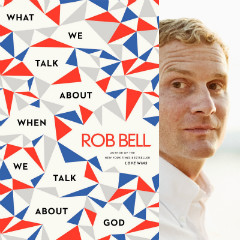
Rob Bell, What We Talk About When We Talk About God
Any book of theology that starts with a epigraph by Tom Waits is arguably worth looking at. Such is Rob Bell’s What We Talk About When We Talk About God.
Since the 2011 publication of Love Wins, Bell’s name has doubled as a lighting rod, the controversy having merely cooled, not diminished. I have no interest in revisiting that here. Nor do I have any interest in writing a negative review of his newest, aspects of which certainly could use the discerning squint of a jeweler’s eye.
Here I want rather to highlight three praiseworthy facets I encounter when I read What We Talk About When We Talk About God.
1. I read about transcendence
I’ve written here before about the materialist, naturalist reduction by which our world today is widely understood. I should say widely misunderstood. But Bell, writing for the benefit of both religious and irreligious skeptics, reminds us that naturalism can only take us so far.
“Science does an excellent job of telling me why I don’t have a tail,” he says, “but it can’t explain why I find that interesting” (75). Delving into quantum mechanics and more, he offers a picture of the world in which mystery and majesty possess more sway than we might otherwise realize at first glance. If only we would look longer.
“[W]hen people object to the idea of God, to the idea that there is more beyond our tangible, provable-with-hard-evidence observations and experiences of the world, they aren’t taking the entire world into account,” he writes (49). When you do that, faith becomes not only reasonable; it becomes natural.
But faith in what?
2. I read about God’s love
Bell doesn’t draw lines as clear as a creed. He offers at least one reason for this: “Whatever we say about God always rests within the larger reality of what we can’t say. . . ” (90). While some might fault him here, the apophatic approach has at least one virtue. It does not overspeak; it does not say more than can be said.
What Bell does say positively is that God stands with us an for us. He points us to the incarnation to get the fuller picture:
The Christmas story . . . is a deeply subversive account, coming in just under the radar, giving us a picture of a God who is not distant or detached or indifferent to our pain or uninterested in our condition or uninvolved in our very real struggles in this world, but instead is present among us in Jesus to teach us and help us and suffer with us and give us hope because this God is for us.
So when we talk about Jesus being divine and human, what we’re saying is that Jesus in a unique, singular, and historic way, shows us what God is like. (131-132)
He continues:
Gospel is the shocking, provocative, revolutionary, subversive, counterintuitive good news that in your moments of greatest despair, failure, sin, weakness, losing, failing, frustration, inability, helplessness, wandering, and falling short, God meets you there — right there — right exactly there — in that place, and announces, I am on your side. (135-136)
We can trust this is so because God in Christ emptied himself and took our humanity down to the last jot of DNA and suffered alongside us (Phil 2:5-8, Heb 2.14-18). This willingness to humiliate himself and join himself to our suffering is evidence of God’s love for us. You know how it goes: “For God so loved the world. . . .”
3. I read about life’s sacramentality
Another thing I read about when I read Rob Bell is how God fills this world he loves with his energies, with his presence.
If all things consist in God (Col 1.16-17), then God is in all things. The Orthodox say of the Holy Spirit that he is “everywhere present and fills all things” (Prayer to the Holy Spirit). All of creation contains within it the possibility of communion with God, of connection, of conveying his grace. Bread, as Bell says, is never just bread, nor wine merely wine.
So, he says, “When we talk about God, we’re talking about the Jesus who comes to reunite and reconnect us with the sacred depth, holiness, significance, and meaning of every day” (185).
This awareness of life’s sacramentality offers a way forward for Bell and anyone who appreciates his approach in What We Talk About When We Talk About God. When discussing the eucharist, Bell mentions in his notes Ephraim the Syrian, as well as the book by Orthodox priest Stephen Freeman, Everywhere Present. Further exploration into the Orthodox understanding of the sacraments — perhaps starting with (or rereading?) Alexander Schmemann’s For the Life of the World — could provide helpful direction on the journey.
Bell has a useful discussion, for instance, about how our “secrets, sins, doubts, regrets, and crippling fears” can divide our hearts and rend our spirits and how the Holy Spirit brings us to wholeness again (187-192). It could only be improved by elaborating on the sacrament of confession.
While I do have reservations about and criticisms of the book, I think these three facets alone make it worthy of serious consideration.
What We Talk About When We Talk About God
Previous Post

March 18, 2013
How to cultivate spiritual peace at work

Browse Our Archives
Select a Category Books Church Life Family Life Misc Prayer Quotes Society Spiritual Growth Theology Uncategorized Video
Select a Month April 2014 March 2014 January 2014 December 2013 November 2013 August 2013 July 2013 June 2013 May 2013 April 2013 March 2013 February 2013 January 2013 December 2012 November 2012 October 2012 September 2012 August 2012 July 2012 June 2012 May 2012 April 2012 March 2012 February 2012 December 2011 November 2011 October 2011 August 2011 July 2011 June 2011 March 2011 February 2011 January 2011 December 2010 October 2010 September 2010 August 2010 July 2010 June 2010 May 2010 September 2009 August 2009 July 2009 May 2009 April 2009 March 2009 November 2008 October 2008 July 2008 June 2008 April 2008 March 2008 February 2008 January 2008 August 2007 June 2007 October 2002 July 2002 November 1999 October 1999
Follow Us!
TAKE THE
Religious Wisdom Quiz
True or False: Romans teaches that whoever calls on the name of the Lord will be saved.
Select your answer to see how you score.
TRUE FALSE
Related posts from Joel J. Miller

One resource every pastor, scholar, and student needs

Cormac McCarthy and all the broken children of...

One (hard) reason God gives us families

What is Christian literature? God's truth, wherever you...
TRENDING AT PATHEOS Evangelical

The REST of Your Life: A Creative Wrestles...
This week I had a conversation with a good friend from church....

How the author of the world's best hymn...
I've been working with John Newton for a while now. This makes...

Long before this Lectio Divina, Psalm 130 - the song - started...

What About the Trees? Another Living Parable
After I finished writing the last article about falling leaves as a...

Why Classical Education Is a Conversation, Not a...
Come and Read: Joy in Classical Education When I was a little...

Cornell University has received a great deal of negative publicity and intense...
view all Evangelical blogs
Ad-Free & Subscriber Log-In Subscription Support
- About Us
- 2026 Calendar
- Videos
- Podcasts
- Library of World Religions
- Faith In Media Tracker
- Advertise With Us
- Write for Us
- Privacy Policy
- Terms of Service
- Do Not Sell My Data
- Contact Us
- Radiant Digital
- Manage Newsletter Subscriptions
- Unsubscribe From Notifications
- Sitemap
Copyright 2008-2026, Patheos. All rights reserved.
Subscription Support Ad-Free & Subscriber Log-In
Follow Patheos