
BuddhistCatholicContemplativeEvangelicalGeneral ChristianHinduJewishLatter-day SaintMuslimNew VisionsProgressive Christian
Beliefs
- Buddhist
- Catholic
- Contemplative
- Evangelical
- General Christian
- Hindu
- Jewish
- Latter-day Saint
- More Voices
- Muslim
- New Visions
- Pagan
- Progressive Christian
Topics
- Religion News
- Food and Religion
- Sports and Religion
- Religious Art
- Religious Music and Entertainment
- Religious Events
- History and Religion
- Style and Religion
- Politics and Religion
- Women in Religion
- Recreation Outdoors and Religion
- Business Finance and Religion
- Careers Workplace and Religion
- Education and Religion
- Family Parenting and Religion
- Health Fitness and Religion
- Home and Religion
- Relationships and Religion
- Technology and Religion
- Travel and Religion
Columnists
- Buddhist Columnists
- Business Finance and Religion Columnists
- Careers Workplace and Religion Columnists
- Catholic Columnists
- Contemplative Columnists
- Education and Religion Columnists
- Evangelists Columnists
- Family Parenting and Religion Columnists
- General Christian Columnists
- Health Fitness and Religion Columnists
- Hindu Columnists
- History and Religion Columnists
- Home and Religion Columnists
- Jewish Columnists
- More Voices Columnists
- Latter Day Columnists
- Muslim Columnists
- New Visions Columnists
- Nonreligious Columnists
- Pagan Columnists
- Politics and Religion Columnists
- Progressive Columnists
- Recreation Outdoors and Religion Columnists
- Relationships and Religion Columnists
- Religion News Columnists
- Religious Art Columnists
- Religious Events Columnists
- Religious Music and Entertainment Columnists
- Sports and Religion Columnists
- Style and Religion Columnists
- Technology and Religion Columnists
- Travel and Religion Columnists
- Women in Religion Columnists
Resource Library
- 2026 Calendar
- Library of World Religions
- The 100 Most Holy Places on Earth
- Patheos Answers
- Podcasts
- Videos
- Faith Leaders Database
- Anglican Episcopalian
- Bahai
- Baptist
- Buddhism
- Christianity
- Confucianism
- Eastern Orthodoxy
- Hinduism
- Holiness and Pentecostal
- ISKCON
- Islam
- Judaism
- Lutheran
- Methodist
- The Church of Jesus Christ of Latter-day Saints
- New Age
- Paganism
- Presbytarian and Reformed
- Protestantism
- Religion Behind the Scenes
- Roman Catholic
- Scientology
- Shia Islam
- Sikhism
- Sufism
- Sunni Islam
- Taoism
- Zen
- See all religions
Research Tools
 Ad-Free & Subscriber Log-In Subscription Support
Ad-Free & Subscriber Log-In Subscription Support
Follow Patheos 

- Trending:
- Forgiveness
- |
- Marriage
- |
- Consciousness
- |
- Death Penalty
- |
- Election
- |
- Halloween
 Joel J. Miller
-
Joel's Books
-
Article Categories
- Home
- Evangelical
- How to cultivate spiritual peace at work
How to cultivate spiritual peace at work
Last updated on: June 13, 2013 at 6:23 pm by Joel J. Miller
How to cultivate spiritual peace at work 2013-06-13T18:23:40-05:00 Joel J. Miller
Patheos Explore the world's faith through different perspectives on religion and spirituality! Patheos has the views of the prevalent religions and spiritualities of the world.
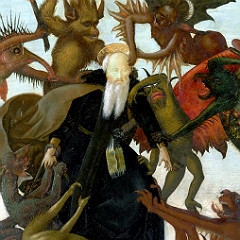
The Torment of Saint Anthony, Michelangelo. Wikimedia Commons
Things today seem more fragmented than ever. Try focusing on your job, for instance, amid the alerts for incoming email, social media updates, and meeting invites. Add to that phone calls, interrupting coworkers, and elastic tasks stretching past allotted times and squeezing into others. Nice knowing you, margin. And that’s just what outsiders impose.
Inside the mind there are — at least for me — forty-two stray thoughts trying to push to the fore, some succeeding and distracting me while I try to chase them down before returning to the job at hand. Oy vey. But maybe things are really not more fragmented today. Maybe people have always struggled with distraction and finding singleness of mind.
What the monk learned
After retreating to the desert, one of the very first monastics, Anthony the Great, fell into a spiritual “weariness and confusion of thought,” as it says in The Sayings of the Fathers. The frustrated Anthony could not abide this and turned to God for help. “Lord,” he prayed, “I would be made whole and my thoughts will not suffer me. What shall I do in this tribulation, how shall I be whole?”
The answer in the third century is the same for us in the twenty-first. God sent an angel to model something for Anthony. He imagined seeing a man that looked like him working. As the man worked, he suddenly stopped, stood, and prayed. Then he sat back down to work, rising again after a time to pray. And so on. “This do,” said the angel, “and thou shalt be whole.” Anthony did and “found the deliverance he sought” (7.1).
When our thoughts are fragmented, it’s difficult to find meaning in them beyond the instant. There is no way to contemplate the whole because there is no whole, merely a jumble of particulars. Light comes in sharp flashes rather than a steady glow. As Anthony found, this state can be spiritually taxing. The heart longs for meaning, for an end to which all the particulars point. It is only when the particulars resolve into a larger pattern that the soul can rest.
What the angel revealed to Anthony is that prayer becomes the end, prayer becomes the point. We give the endless tasks and distractions meaning when we pause for thanksgiving, when we turn to reflect on God’s grace, when we plead for his mercy. Prayer takes up the shards, and God exchanges them for an unbroken whole.
The necessity of patience
The text doesn’t say how quickly this worked for Anthony. He was a spiritual master. I’m nothing of the sort. So it should come as no surprise that I still struggle with this. Still, I would wager that he did as well. No matter the practitioner, prayer is a discipline that requires patience.
When Isaac prayed for his barren wife, Genesis says that God answered his prayer. It also says that Rebekah gave birth twenty years later. Patience is similarly a prerequisite for spiritual growth. If we don’t cultivate patience, we might as well give up the rest too.
The Sayings of the Fathers offers us a picture of this as well. A young monk went to an elder and said he was troubled and could find no peace. The old monk gave him advice, which proved futile — and then more advice which similarly proved futile. Wait a minute, said the elder. How long have you been suffering? Eight years, came the answer. That’s nothing, the elder responded. “I have been in this habit seventy years, and not for one day could I find peace: and you would have peace in eight?” (7.5) We can excuse the exaggeration and appreciate the sentiment. The point is not that peace is impossible; rather that it’s not instantaneous. The young monk was coming at the problem from the wrong angle.
Me too, most of the time.
Prayer gives us a path to walk as much as a point to seek. It shapes our hearts as we work toward peace, and that shaping is an essential part of the process. There are no corners to cut here, though we want to do so when the phone chirps or the laptop dings. Let them be for the moment, and offer the hour to the Lord, who is the only one able to make sense for us of every hour.
What would happen today if you could step away from the crises and chaos several times and refer it all to the Lord?
Side note: Aids to prayer
Prayer is simple. And like a lot of simple things, it can be extremely challenging. Thankfully, the church offers many aids to prayer. Here are three:
First, a prayer book. Liturgical churches often employ service books for private and corporate worship. I use a few different Orthodox prayer books. They offer morning and evening prayer services, along with prayers for different occasions. The benefit is that they train my prayer life and provide the words I most need to say — that’s particularly helpful when I don’t have words of my own or feel spiritually at a loss.
Second, the Psalms. The Psalter is the first prayer book, and it’s words refer every human emotion, doubt, and question to their maker. When we read them Christologically, we are reminded that Christ experienced these emotions and exigencies just like us — and that he prays with us in and through the Psalms.
Third, a prayer rope or beads. I use a small fifty-knot prayer rope. It gives me a physical reminder to pray. Whenever I reach into my pocket, it’s a tactile trigger to pray. I sometimes wear it around my wrist for the same reason.
Previous Post

March 13, 2013
So why should I care about monks?
Next Post

March 24, 2013 What I read about when I read Rob Bell
Browse Our Archives
Select a Category Books Church Life Family Life Misc Prayer Quotes Society Spiritual Growth Theology Uncategorized Video
Select a Month April 2014 March 2014 January 2014 December 2013 November 2013 August 2013 July 2013 June 2013 May 2013 April 2013 March 2013 February 2013 January 2013 December 2012 November 2012 October 2012 September 2012 August 2012 July 2012 June 2012 May 2012 April 2012 March 2012 February 2012 December 2011 November 2011 October 2011 August 2011 July 2011 June 2011 March 2011 February 2011 January 2011 December 2010 October 2010 September 2010 August 2010 July 2010 June 2010 May 2010 September 2009 August 2009 July 2009 May 2009 April 2009 March 2009 November 2008 October 2008 July 2008 June 2008 April 2008 March 2008 February 2008 January 2008 August 2007 June 2007 October 2002 July 2002 November 1999 October 1999
Follow Us!
TAKE THE
Religious Wisdom Quiz
What was the name of the Jewish ruling council in Jesus’ time?
Select your answer to see how you score.
Sadducees Sanhedrin Pharisees Essenes
Related posts from Joel J. Miller

'Without embittering and embarrassing others'

God can handle your anger--and your confusion, fear...

Read this before you pray for that Mercedes

Porn and the contemplative life
TRENDING AT PATHEOS Evangelical

The REST of Your Life: A Creative Wrestles...
This week I had a conversation with a good friend from church....

How the author of the world's best hymn...
I've been working with John Newton for a while now. This makes...

Long before this Lectio Divina, Psalm 130 - the song - started...

What About the Trees? Another Living Parable
After I finished writing the last article about falling leaves as a...

Why Classical Education Is a Conversation, Not a...
Come and Read: Joy in Classical Education When I was a little...

Cornell University has received a great deal of negative publicity and intense...
view all Evangelical blogs
Ad-Free & Subscriber Log-In Subscription Support
- About Us
- 2026 Calendar
- Videos
- Podcasts
- Library of World Religions
- Faith In Media Tracker
- Advertise With Us
- Write for Us
- Privacy Policy
- Terms of Service
- Do Not Sell My Data
- Contact Us
- Radiant Digital
- Manage Newsletter Subscriptions
- Unsubscribe From Notifications
- Sitemap
Copyright 2008-2026, Patheos. All rights reserved.
Subscription Support Ad-Free & Subscriber Log-In
Follow Patheos