
BuddhistCatholicContemplativeEvangelicalGeneral ChristianHinduJewishLatter-day SaintMuslimNew VisionsProgressive Christian
Beliefs
- Buddhist
- Catholic
- Contemplative
- Evangelical
- General Christian
- Hindu
- Jewish
- Latter-day Saint
- More Voices
- Muslim
- New Visions
- Pagan
- Progressive Christian
Topics
- Religion News
- Food and Religion
- Sports and Religion
- Religious Art
- Religious Music and Entertainment
- Religious Events
- History and Religion
- Style and Religion
- Politics and Religion
- Women in Religion
- Recreation Outdoors and Religion
- Business Finance and Religion
- Careers Workplace and Religion
- Education and Religion
- Family Parenting and Religion
- Health Fitness and Religion
- Home and Religion
- Relationships and Religion
- Technology and Religion
- Travel and Religion
Columnists
- Buddhist Columnists
- Business Finance and Religion Columnists
- Careers Workplace and Religion Columnists
- Catholic Columnists
- Contemplative Columnists
- Education and Religion Columnists
- Evangelists Columnists
- Family Parenting and Religion Columnists
- General Christian Columnists
- Health Fitness and Religion Columnists
- Hindu Columnists
- History and Religion Columnists
- Home and Religion Columnists
- Jewish Columnists
- More Voices Columnists
- Latter Day Columnists
- Muslim Columnists
- New Visions Columnists
- Nonreligious Columnists
- Pagan Columnists
- Politics and Religion Columnists
- Progressive Columnists
- Recreation Outdoors and Religion Columnists
- Relationships and Religion Columnists
- Religion News Columnists
- Religious Art Columnists
- Religious Events Columnists
- Religious Music and Entertainment Columnists
- Sports and Religion Columnists
- Style and Religion Columnists
- Technology and Religion Columnists
- Travel and Religion Columnists
- Women in Religion Columnists
Resource Library
- 2026 Calendar
- Library of World Religions
- The 100 Most Holy Places on Earth
- Patheos Answers
- Podcasts
- Videos
- Faith Leaders Database
- Anglican Episcopalian
- Bahai
- Baptist
- Buddhism
- Christianity
- Confucianism
- Eastern Orthodoxy
- Hinduism
- Holiness and Pentecostal
- ISKCON
- Islam
- Judaism
- Lutheran
- Methodist
- The Church of Jesus Christ of Latter-day Saints
- New Age
- Paganism
- Presbytarian and Reformed
- Protestantism
- Religion Behind the Scenes
- Roman Catholic
- Scientology
- Shia Islam
- Sikhism
- Sufism
- Sunni Islam
- Taoism
- Zen
- See all religions
Research Tools
 Ad-Free & Subscriber Log-In Subscription Support
Ad-Free & Subscriber Log-In Subscription Support
Follow Patheos 

- Trending:
- Forgiveness
- |
- Marriage
- |
- Consciousness
- |
- Death Penalty
- |
- Election
- |
- Halloween
 Joel J. Miller
-
Joel's Books
-
Article Categories
- Home
- Evangelical
- Why celebrate the conception of Mary?
Why celebrate the conception of Mary?
Last updated on: December 9, 2012 at 6:39 am by Joel J. Miller
Why celebrate the conception of Mary? 2012-12-09T06:39:53-06:00 Joel J. Miller
Patheos Explore the world's faith through different perspectives on religion and spirituality! Patheos has the views of the prevalent religions and spiritualities of the world.
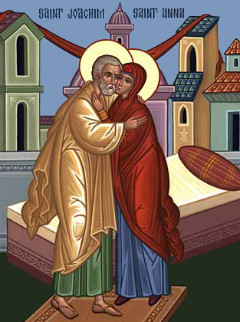
Icon of the Conception of the Theotokos, OCA.
Rare is the religious image depicting a couple hugging tenderly by their bed before lovemaking, but today Orthodox Christians celebrate the conception of Mary, and the icon of the feast frankly captures her parents embracing bedside.
An icon? A feast? Because someone got pregnant? Obviously the church considers Mary’s conception of great importance. Here’s why.
Scripture repeatedly presents special children as unlikely children. Isaac, Samson, and Samuel were all miraculously born to women who long suffered the grief and disappointment of barrenness.
It’s the same with Mary.
Joachim and Anna grieved their childlessness. Eventually, their pain and frustration became acute and, according to The Protoevangelium of James, a second-century book read and circulated in the early church, Joachim fled to the wilderness to pray.
Unfortunately, Joachim was too distraught to tell his wife his plans. In her husband’s prolonged absence Anna feared the worst, leaving her to mourn both her barrenness and her presumed widowhood.
Anna’s grief became oppressive to the house, until an apparently insensitive maidservant finally urged her to get out for a walk. Anna took her advice and left for an afternoon stroll through the garden, eventually finding a seat beneath a laurel tree.
“O God of my fathers,” she prayed, “bless me and listen to my prayer, just as you blessed the womb of Sarah and gave her a son, Isaac” (Proto. 2.4).
Anna’s prayer reveals a devoted heart, one familiar with the history and tradition of her people. Anna self-consciously identified with Sarah and hoped that God would bring her a child the same way. Her hope was not in vain.
Along with Sarah, the scene of barren Anna sitting in her garden calls to mind the wife of Manoah, Samson’s mother. Scripture does not offer the woman’s name, but her story anticipates tearful Anna’s. On two separate occasions we find Manoah’s wife sitting alone in a field, her husband off elsewhere. Both times an angel appears to announce that she will bear a son.
Just as happened with Sarah and Manoah’s wife, an angel suddenly appeared while Anna rested in the shade of the laurel. Though unnamed in the Protoevangelium, the angel is traditionally understood to be Gabriel, which makes sense considering his announcing the conception of both John the Baptist and Christ.
“Anna, Anna,” said Gabriel, “the Lord God has heard your prayer. You will conceive and bear, and your child will be spoken of in all the inhabited world” (Proto. 4.1).
Anna was overjoyed. “As the Lord my God lives,” she said, perhaps rashly, “whether I bear a boy or a girl, I will bring it as an offering to the Lord my God. . . ” (Proto. 4.1).
Gabriel did not visit Samuel’s mother, Hannah — whose name is incidentally the same as Anna’s — but her story also anticipated Anna’s, particularly her vow.
Second wife to a man named Elkanah, Hannah suffered scorn for her years of childlessness. She made a vow to the Lord: “O Lord of hosts, if thou wilt . . . give to thy maidservant a son, then I will give him to the Lord all the days of his life. . . ” (1 Sam. 1.11). The long-sought gift from God would be returned to God.
Anna’s child would likewise be set aside for the Lord, holy and sacred, separate and special.
But before that could happen, the child must be conceived. To that end, Gabriel also came to Joachim in the wilderness. He told the man his prayers were answered. “Go down from here,” said Gabriel. “Anna your wife will conceive in her womb” (Proto. 4.2).
Anna — now aware Joachim was alive and well — waited for Her husband by the gate when he arrived. She ran to him and “threw her arms around his neck” (Proto. 4.3). The text next says that they went inside. It’s like an old Hollywood scene change. We know what happens next.
A hymn of the feast captures the significance for us:
Today the bonds of barrenness are broken,
God has heard the prayers of Joachim and Anna.
He has promised them beyond all their hopes,
To bear the Maiden of God
By whom the Uncircumscribed One was born as mortal man,
Who commanded an angel to cry to Her:
Rejoice, O Full of Grace, the Lord is with You!
Christ, the Second Person of the Trinity, the Uncircumcribed One will soon become circumscribed within the womb of this woman, the long-desired daughter of Anna. That is why we celebrate. Because “when the time had fully come, God sent forth his Son, born of woman. . .” (Gal. 4.4). And here, now, finally is the woman.
As with little Samuel, Joachim and Anna dedicated Mary to the temple and presented her there when she was old enough to go — an event also commemorated with a feast. There in the temple, Mary readied herself to become a temple in full and loving service to our great High Priest.
Mary is the woman who gave flesh to the Maker of her flesh. Mary’s humanity ensures Christ’s humanity, and we are confessing the true, full, and essential humanity of Christ when we reflect upon on the humanity of his mother.
While some Christians today find Mary a bit perplexing and even problematic, Christians have long honored her memory. She was not one of the twelve disciples, but she was the first disciple. She was not an apostle, but apostles revered her. She was not a preacher, but she brought forth the Word.
To celebrate the conception of Mary is to celebrate the ineffable mystery of God’s Incarnation. And so with Anna we can say as she said some nine months later — and what else could we say? — “This day my soul is magnified” (Proto. 5.2).
So of course we celebrate. The loving union of Joachim and Anna made possible our union with Christ. Quoting another hymn of the feast:
Today the universe rejoices,
For Anna has conceived the Theotokos through God’s dispensation,
For she has brought forth the One who is to bear the Ineffable Word!
Previous Post

December 8, 2012
The true state of Christian persecution in Iran
Next Post
December 11, 2012 Angels: Friends of the faithful
Browse Our Archives
Select a Category Books Church Life Family Life Misc Prayer Quotes Society Spiritual Growth Theology Uncategorized Video
Select a Month April 2014 March 2014 January 2014 December 2013 November 2013 August 2013 July 2013 June 2013 May 2013 April 2013 March 2013 February 2013 January 2013 December 2012 November 2012 October 2012 September 2012 August 2012 July 2012 June 2012 May 2012 April 2012 March 2012 February 2012 December 2011 November 2011 October 2011 August 2011 July 2011 June 2011 March 2011 February 2011 January 2011 December 2010 October 2010 September 2010 August 2010 July 2010 June 2010 May 2010 September 2009 August 2009 July 2009 May 2009 April 2009 March 2009 November 2008 October 2008 July 2008 June 2008 April 2008 March 2008 February 2008 January 2008 August 2007 June 2007 October 2002 July 2002 November 1999 October 1999
Follow Us!
TAKE THE
Religious Wisdom Quiz
What city did David capture and make his capital?
Select your answer to see how you score.
Hebron Gibeon Jerusalem Bethlehem
Related posts from Joel J. Miller

Does the adulterous woman belong in your Bible?

Why you need the church to read your...

Windows to heaven: Icons in church

The problem with virtual communion
TRENDING AT PATHEOS Evangelical

The REST of Your Life: A Creative Wrestles...
This week I had a conversation with a good friend from church....

How the author of the world's best hymn...
I've been working with John Newton for a while now. This makes...

Long before this Lectio Divina, Psalm 130 - the song - started...

What About the Trees? Another Living Parable
After I finished writing the last article about falling leaves as a...

Why Classical Education Is a Conversation, Not a...
Come and Read: Joy in Classical Education When I was a little...

Cornell University has received a great deal of negative publicity and intense...
view all Evangelical blogs
Ad-Free & Subscriber Log-In Subscription Support
- About Us
- 2026 Calendar
- Videos
- Podcasts
- Library of World Religions
- Faith In Media Tracker
- Advertise With Us
- Write for Us
- Privacy Policy
- Terms of Service
- Do Not Sell My Data
- Contact Us
- Radiant Digital
- Manage Newsletter Subscriptions
- Unsubscribe From Notifications
- Sitemap
Copyright 2008-2026, Patheos. All rights reserved.
Subscription Support Ad-Free & Subscriber Log-In
Follow Patheos