
BuddhistCatholicContemplativeEvangelicalGeneral ChristianHinduJewishLatter-day SaintMuslimNew VisionsProgressive Christian
Beliefs
- Buddhist
- Catholic
- Contemplative
- Evangelical
- General Christian
- Hindu
- Jewish
- Latter-day Saint
- More Voices
- Muslim
- New Visions
- Pagan
- Progressive Christian
Topics
- Religion News
- Food and Religion
- Sports and Religion
- Religious Art
- Religious Music and Entertainment
- Religious Events
- History and Religion
- Style and Religion
- Politics and Religion
- Women in Religion
- Recreation Outdoors and Religion
- Business Finance and Religion
- Careers Workplace and Religion
- Education and Religion
- Family Parenting and Religion
- Health Fitness and Religion
- Home and Religion
- Relationships and Religion
- Technology and Religion
- Travel and Religion
Columnists
- Buddhist Columnists
- Business Finance and Religion Columnists
- Careers Workplace and Religion Columnists
- Catholic Columnists
- Contemplative Columnists
- Education and Religion Columnists
- Evangelists Columnists
- Family Parenting and Religion Columnists
- General Christian Columnists
- Health Fitness and Religion Columnists
- Hindu Columnists
- History and Religion Columnists
- Home and Religion Columnists
- Jewish Columnists
- More Voices Columnists
- Latter Day Columnists
- Muslim Columnists
- New Visions Columnists
- Nonreligious Columnists
- Pagan Columnists
- Politics and Religion Columnists
- Progressive Columnists
- Recreation Outdoors and Religion Columnists
- Relationships and Religion Columnists
- Religion News Columnists
- Religious Art Columnists
- Religious Events Columnists
- Religious Music and Entertainment Columnists
- Sports and Religion Columnists
- Style and Religion Columnists
- Technology and Religion Columnists
- Travel and Religion Columnists
- Women in Religion Columnists
Resource Library
- 2026 Calendar
- Library of World Religions
- The 100 Most Holy Places on Earth
- Patheos Answers
- Podcasts
- Videos
- Faith Leaders Database
- Anglican Episcopalian
- Bahai
- Baptist
- Buddhism
- Christianity
- Confucianism
- Eastern Orthodoxy
- Hinduism
- Holiness and Pentecostal
- ISKCON
- Islam
- Judaism
- Lutheran
- Methodist
- The Church of Jesus Christ of Latter-day Saints
- New Age
- Paganism
- Presbytarian and Reformed
- Protestantism
- Religion Behind the Scenes
- Roman Catholic
- Scientology
- Shia Islam
- Sikhism
- Sufism
- Sunni Islam
- Taoism
- Zen
- See all religions
Research Tools
 Ad-Free & Subscriber Log-In Subscription Support
Ad-Free & Subscriber Log-In Subscription Support
Follow Patheos 

- Trending:
- Forgiveness
- |
- Marriage
- |
- Consciousness
- |
- Death Penalty
- |
- Election
- |
- Halloween
 Joel J. Miller
-
Joel's Books
-
Article Categories
- Home
- Evangelical
- St. Nick’s best gift
St. Nick’s best gift
Last updated on: December 5, 2013 at 9:24 pm by Joel J. Miller
St. Nick’s best gift 2013-12-05T21:24:26-06:00 Joel J. Miller
Patheos Explore the world's faith through different perspectives on religion and spirituality! Patheos has the views of the prevalent religions and spiritualities of the world.
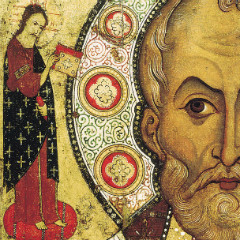
Detail from icon of St. Nicholas from Novgorod, Russia. Wikimedia Commons.
The memory of few saints is as cherished as that of St. Nicholas. Known as Nicholas the Wonderworker, he is remembered in the church on December 6 and closely associated with the Christmas season.
While the legends around this humble bishop have swollen beyond recognition, the popular picture of the jolly fat man circling the globe dropping gifts to worthy children has some slender basis in fact.
According to the tradition of the church, Nicholas was born at the end of the third century to a wealthy but long-barren couple in Patara, Lycia, a significant harbor town along Turkey’s Mediterranean coast. Because of his parents’ age, Nicholas was young when they passed and bequeathed him the family fortune.
Exceptionally devout, Nicholas now added almsgiving to his regular disciplines of fasting and prayer, generously helping the needy.
In one of the more famous stories about him, Nicholas heard of three young women whose destitute father could not muster dowries for their prospective husbands. Unable to marry, it seemed inevitable that slavery or even prostitution would be the girls’ only way forward.
On three successive nights Nicholas took enough gold coins for each of the girl’s needs and threw them into the family’s open window, whereupon they landed in their laundered stockings, drying over the hearth. He was eventually found out, but Nicholas tried to keep his gift-giving secret.
Many such stories about the saint have been embellished and even fabricated in the centuries since his earthly sojourn. But perhaps we haven’t paid enough attention to one simple gift he offered then and gives us still.
St. Nick’s best gift is prayer.
The commemorative hymn sung on his feast day closes with a line common all such songs: “Pray to Christ our God to save our souls.” The intercession of Nicholas and rest of the saints around God’s throne is one of the greatest gifts offered God’s people.
Some Christians no longer see it that way. In his Institutes, for instance, John Calvin calls the intercession of the saints a “fiction” and asks “what angel or devil ever announced one syllable to any human being concerning that fancied intercession of theirs? There is not a word on the subject in Scripture” (3.20.21).
Not exactly. In the second book of Maccabees, Judas Maccabeus has a vision of the high priest Onias and the prophet Jeremiah praying for Israel. Jeremiah is introduced as “a man who loves the brethren and prays much for the people of the holy city” (15.14).
Importantly, the Maccabean books were read and received by the early church — the same church in which and to which John wrote his Apocalypse, which likewise presents us a vivid picture of this intercession. In Revelation 5 we see the twenty-four elders (in heaven) offering the prayers of the saints (still on earth) at the throne of the Lord (v. 8), and then in the next chapter we see the martyrs crying out to God as well (6.9).
This sort of intercession was assumed by these biblical writers and assumed by the Christians who read and heard the biblical witness.
Not only do you find additional references affirming the doctrine in the writings of the ancient bishops and teachers of the church, but the belief was popularly held as well. Catacomb graffiti in Rome, for instance, features “prayer requests” to the Apostles Peter and Paul and many other saints and martyrs. Herbert A. Musurillo gives several examples in The Fathers of the Primitive Church:
Peter and Paul, pray for Victor!
Paul and Peter, remember Sozomen and whoever reads this!
Paul and Peter, pray for Nativus forever!
I’m with the early church on this one. I see the prayers of the saints in the scripture, observe its place in the experience and life of the church, and assume it’s true. I fear Calvin, overreacting to Rome, forfeited something of great value.
So where does this leave us with Nicholas?
Given his gracious and merciful character, demonstrated by his gifts to the needy, I imagine his prayers go far beyond just the worthy kids. Unlike Santa Claus, St. Nick gives his best gift to both the naughty and the nice, because we’re all needy.
Previous Post

December 1, 2012
Let the Bible elevate your mind
Next Post

December 5, 2012 It's the little sins that kill you
Browse Our Archives
Select a Category Books Church Life Family Life Misc Prayer Quotes Society Spiritual Growth Theology Uncategorized Video
Select a Month April 2014 March 2014 January 2014 December 2013 November 2013 August 2013 July 2013 June 2013 May 2013 April 2013 March 2013 February 2013 January 2013 December 2012 November 2012 October 2012 September 2012 August 2012 July 2012 June 2012 May 2012 April 2012 March 2012 February 2012 December 2011 November 2011 October 2011 August 2011 July 2011 June 2011 March 2011 February 2011 January 2011 December 2010 October 2010 September 2010 August 2010 July 2010 June 2010 May 2010 September 2009 August 2009 July 2009 May 2009 April 2009 March 2009 November 2008 October 2008 July 2008 June 2008 April 2008 March 2008 February 2008 January 2008 August 2007 June 2007 October 2002 July 2002 November 1999 October 1999
Follow Us!
TAKE THE
Religious Wisdom Quiz
Who said, "As for me and my house, we will serve the Lord"?
Select your answer to see how you score.
David Moses Joshua Samuel
Related posts from Joel J. Miller

Does the adulterous woman belong in your Bible?

Why you need the church to read your...

Windows to heaven: Icons in church

The problem with virtual communion
TRENDING AT PATHEOS Evangelical

The REST of Your Life: A Creative Wrestles...
This week I had a conversation with a good friend from church....

How the author of the world's best hymn...
I've been working with John Newton for a while now. This makes...

Long before this Lectio Divina, Psalm 130 - the song - started...

What About the Trees? Another Living Parable
After I finished writing the last article about falling leaves as a...

Why Classical Education Is a Conversation, Not a...
Come and Read: Joy in Classical Education When I was a little...

Cornell University has received a great deal of negative publicity and intense...
view all Evangelical blogs
Ad-Free & Subscriber Log-In Subscription Support
- About Us
- 2026 Calendar
- Videos
- Podcasts
- Library of World Religions
- Faith In Media Tracker
- Advertise With Us
- Write for Us
- Privacy Policy
- Terms of Service
- Do Not Sell My Data
- Contact Us
- Radiant Digital
- Manage Newsletter Subscriptions
- Unsubscribe From Notifications
- Sitemap
Copyright 2008-2026, Patheos. All rights reserved.
Subscription Support Ad-Free & Subscriber Log-In
Follow Patheos