
BuddhistCatholicContemplativeEvangelicalGeneral ChristianHinduJewishLatter-day SaintMuslimNew VisionsProgressive Christian
Beliefs
- Buddhist
- Catholic
- Contemplative
- Evangelical
- General Christian
- Hindu
- Jewish
- Latter-day Saint
- More Voices
- Muslim
- New Visions
- Pagan
- Progressive Christian
Topics
- Religion News
- Food and Religion
- Sports and Religion
- Religious Art
- Religious Music and Entertainment
- Religious Events
- History and Religion
- Style and Religion
- Politics and Religion
- Women in Religion
- Recreation Outdoors and Religion
- Business Finance and Religion
- Careers Workplace and Religion
- Education and Religion
- Family Parenting and Religion
- Health Fitness and Religion
- Home and Religion
- Relationships and Religion
- Technology and Religion
- Travel and Religion
Columnists
- Buddhist Columnists
- Business Finance and Religion Columnists
- Careers Workplace and Religion Columnists
- Catholic Columnists
- Contemplative Columnists
- Education and Religion Columnists
- Evangelists Columnists
- Family Parenting and Religion Columnists
- General Christian Columnists
- Health Fitness and Religion Columnists
- Hindu Columnists
- History and Religion Columnists
- Home and Religion Columnists
- Jewish Columnists
- More Voices Columnists
- Latter Day Columnists
- Muslim Columnists
- New Visions Columnists
- Nonreligious Columnists
- Pagan Columnists
- Politics and Religion Columnists
- Progressive Columnists
- Recreation Outdoors and Religion Columnists
- Relationships and Religion Columnists
- Religion News Columnists
- Religious Art Columnists
- Religious Events Columnists
- Religious Music and Entertainment Columnists
- Sports and Religion Columnists
- Style and Religion Columnists
- Technology and Religion Columnists
- Travel and Religion Columnists
- Women in Religion Columnists
Resource Library
- 2026 Calendar
- Library of World Religions
- The 100 Most Holy Places on Earth
- Patheos Answers
- Podcasts
- Videos
- Faith Leaders Database
- Anglican Episcopalian
- Bahai
- Baptist
- Buddhism
- Christianity
- Confucianism
- Eastern Orthodoxy
- Hinduism
- Holiness and Pentecostal
- ISKCON
- Islam
- Judaism
- Lutheran
- Methodist
- The Church of Jesus Christ of Latter-day Saints
- New Age
- Paganism
- Presbytarian and Reformed
- Protestantism
- Religion Behind the Scenes
- Roman Catholic
- Scientology
- Shia Islam
- Sikhism
- Sufism
- Sunni Islam
- Taoism
- Zen
- See all religions
Research Tools
 Ad-Free & Subscriber Log-In Subscription Support
Ad-Free & Subscriber Log-In Subscription Support
Follow Patheos 

- Trending:
- Forgiveness
- |
- Marriage
- |
- Consciousness
- |
- Death Penalty
- |
- Election
- |
- Halloween
 Joel J. Miller
-
Joel's Books
-
Article Categories
- Home
- Evangelical
- Is the virgin birth really predicted in the Old Testament?
Is the virgin birth really predicted in the Old Testament?
Last updated on: January 11, 2014 at 9:28 pm by Joel J. Miller
Is the virgin birth really predicted in the Old Testament? 2014-01-11T21:28:55-06:00 Joel J. Miller
Patheos Explore the world's faith through different perspectives on religion and spirituality! Patheos has the views of the prevalent religions and spiritualities of the world.
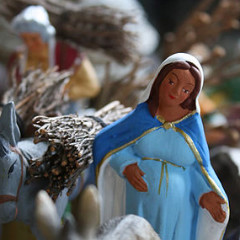
Guillaume Piolle, Wikimedia Commons
Did the Old Testament prophet Isaiah actually predict that Mary would conceive Christ while still a virgin?
In Guy Ritchie’s 2000 movie Snatch, Benicio Del Toro plays a diamond thief named Franky Four Fingers. As the story begins, Franky and his fellow workers of iniquity are in Antwerp for a heist, disguised as Hasidic Jews.
As part of the ruse, while guards check for weapons and surveillance cameras roll, Franky rambles on about the veracity of Scripture:
The Septuagint scholars mistranslated the Hebrew word for “young woman” into the Greek word for “virgin.” It was an easy mistake to make because there was only a subtle difference in the spelling.
So they came up with a prophecy: “Behold, a virgin shall conceive and bear us a son.” You understand this? It was the word “virgin” that caught people’s attention. It’s not everyday a virgin conceives and bears a son.
But leave that for a couple of hundred years to stew, and the next thing you know you have the Holy Catholic Church.
‘Virgin’ or ‘young woman’?
Franky is referencing Isaiah 7.14 and what Christians consider the prophecy of the virgin birth of Christ. “Behold,” as the English Standard Version renders it, “the virgin shall conceive and bear a son, and shall call his name Immanuel.”
This is the understanding picked up by Matthew in his gospel. “When Mary had been betrothed to Joseph, before they came together she was found to be with child of the Holy Spirit,” he explains. “All of this took place to fulfill what he Lord had spoken by the prophet: ‘Behold, a virgin shall conceive and bear a son. . .” (1.18, 22-23).
But, as per Franky, there is some controversy here. When you put several translations side by side and layer these two passages one atop the other, you’ll notice a significant discrepancy.
Though all translation use the word virgin when Matthew quotes Isaiah, not all employ it when translating Isaiah itself. The ESV and New King James employ virgin, while the Revised Standard and the New Revised Standard both use young woman. There has been some recent controversy with the revised New American Bible, a Roman Catholic translation, over the same point.
So why the discrepancy? It goes back to those Septuagint scholars in Franky’s complaint.
Greek to me
The Septuagint, the pre-Christian Greek translation of the Jewish Scriptures, took the Hebrew word almah, which can mean both young woman and virgin, and rendered it parthenos, which more explicitly and exclusively denotes virginity. It’s impossible to know exactly what the original hearers of Isaiah’s prophecy thought it meant, but it’s clear that the later translators thought the prophet meant virgin, not merely young woman.
By the time of Christ, Hebrew had been largely sidelined by Greek translations like the Septuagint, which both Jews and Christians used. You can imagine what the first Christians thought when they heard of Mary’s conception and squared it with Isaiah’s prophecy in Greek.
Driving home the point, Eugen J. Pentiuc of Holy Cross Greek Orthodox School of Theology in Brookline, Massachusetts, notes that Matthew shows evident familiarity with both the Greek and Hebrew text, indicating an intentional choice of the term virgin here.
As Christianity gained ascendancy, Jews began distancing themselves from the Septuagint — which contains other renderings favorable to Christian doctrine — and increased reliance on Hebrew texts, eventually establishing the Masoretic text tradition. Today the Old Testament in most English Bibles is translated from the Masoretic text, not the Septuagint, which is why the more specific, exclusive rendering virgin has been replaced in many instances with young woman.
So which is correct?
Would you believe both?
Engaged to be married
While it might seem that losing virgin for young woman is going the wrong direction, the Hebrew is actually stronger than the translation can muster. The Hebrew and Aramaic Lexicon of the Old Testament defines almah as a young woman ready and able to marry, or a woman who has not yet had her first child. Pentiuc adds, “We may mention that, given the ethical standards of the ancient Israelite society, the idea of virginity, though not distinctly stated, is nevertheless implied. . . .”
In his book The Messiah in the Old Testament, Walter Kaiser makes the same point: of the nine uses of almah in the Old Testament (in both singular and plural forms) all refer to unmarried women. Even though it does not say virgin, the implication is present. What’s more, says Kaiser, “the definite article on this word does speak not of any virgin, but of ‘the virgin’ — a special one whom God has in mind.”
Next, both Matthew and Luke’s narrative mention that Mary was betrothed to Joseph when she conceived. Pentiuc argues for a new etymology of almah that might well underscore this point — and thereby underscore the prophecy’s prediction of Mary’s virginity and even her identity. The lexical root of almah indicates something concealed or hidden, he says, explaining the significance:
During the period of betrothal, fiancés used to live in their parents’ homes, separated, secluded, forbidden from seeing one another. The feminine form, ‘almah, may also be rendered “the concealed one” or even “the veiled one.” This last rendition would reflect the custom of engaged women wearing veils over their faces as a sign of seclusion, or concealment, during the time of betrothal.
In other words, Isaiah was not just prophesying that a virgin would conceive. What’s more, he was not just prophesying the virgin would conceive. He was prophesying that the betrothed virgin would conceive.
Hello, Mary.
No mistake
Pentiuc draws out another fascinating difference between the Septuagint and the Masoretic text here. While the Septuagint’s Isaiah says the father will name the special child, the Hebrew/Masoretic text says the virgin will name the child, indicating that she is unmarried or that the father is absent.
However improbable a person might find the virgin birth, Franky Four Fingers is wrong.
The Septuagint scholars didn’t make a mistake. They were rendering as best they could what was obvious in the text: that a young, betrothed-but-unwed virgin would conceive and bear a son named Immanuel, which Matthew is kind enough to translate. The son of the virgin will be “God with us.”
Previous Post

December 12, 2012
Four books by C.S. Lewis you must read
Next Post

December 14, 2012 Pray for Egypt's Christians
Browse Our Archives
Select a Category Books Church Life Family Life Misc Prayer Quotes Society Spiritual Growth Theology Uncategorized Video
Select a Month April 2014 March 2014 January 2014 December 2013 November 2013 August 2013 July 2013 June 2013 May 2013 April 2013 March 2013 February 2013 January 2013 December 2012 November 2012 October 2012 September 2012 August 2012 July 2012 June 2012 May 2012 April 2012 March 2012 February 2012 December 2011 November 2011 October 2011 August 2011 July 2011 June 2011 March 2011 February 2011 January 2011 December 2010 October 2010 September 2010 August 2010 July 2010 June 2010 May 2010 September 2009 August 2009 July 2009 May 2009 April 2009 March 2009 November 2008 October 2008 July 2008 June 2008 April 2008 March 2008 February 2008 January 2008 August 2007 June 2007 October 2002 July 2002 November 1999 October 1999
Follow Us!
TAKE THE
Religious Wisdom Quiz
Which apostle was known as the "apostle to the Gentiles"?
Select your answer to see how you score.
Peter John Paul James
Related posts from Joel J. Miller

Is the Resurrection essential to Christian belief?

What Barton and Copeland get wrong about war...

George Orwell and bending the Bible for our...

Read the Bible if you're going to have...
TRENDING AT PATHEOS Evangelical

The REST of Your Life: A Creative Wrestles...
This week I had a conversation with a good friend from church....

How the author of the world's best hymn...
I've been working with John Newton for a while now. This makes...

Long before this Lectio Divina, Psalm 130 - the song - started...

What About the Trees? Another Living Parable
After I finished writing the last article about falling leaves as a...

Why Classical Education Is a Conversation, Not a...
Come and Read: Joy in Classical Education When I was a little...

Cornell University has received a great deal of negative publicity and intense...
view all Evangelical blogs
Ad-Free & Subscriber Log-In Subscription Support
- About Us
- 2026 Calendar
- Videos
- Podcasts
- Library of World Religions
- Faith In Media Tracker
- Advertise With Us
- Write for Us
- Privacy Policy
- Terms of Service
- Do Not Sell My Data
- Contact Us
- Radiant Digital
- Manage Newsletter Subscriptions
- Unsubscribe From Notifications
- Sitemap
Copyright 2008-2026, Patheos. All rights reserved.
Subscription Support Ad-Free & Subscriber Log-In
Follow Patheos