
BuddhistCatholicContemplativeEvangelicalGeneral ChristianHinduJewishLatter-day SaintMuslimNew VisionsProgressive Christian
Beliefs
- Buddhist
- Catholic
- Contemplative
- Evangelical
- General Christian
- Hindu
- Jewish
- Latter-day Saint
- More Voices
- Muslim
- New Visions
- Pagan
- Progressive Christian
Topics
- Religion News
- Food and Religion
- Sports and Religion
- Religious Art
- Religious Music and Entertainment
- Religious Events
- History and Religion
- Style and Religion
- Politics and Religion
- Women in Religion
- Recreation Outdoors and Religion
- Business Finance and Religion
- Careers Workplace and Religion
- Education and Religion
- Family Parenting and Religion
- Health Fitness and Religion
- Home and Religion
- Relationships and Religion
- Technology and Religion
- Travel and Religion
Columnists
- Buddhist Columnists
- Business Finance and Religion Columnists
- Careers Workplace and Religion Columnists
- Catholic Columnists
- Contemplative Columnists
- Education and Religion Columnists
- Evangelists Columnists
- Family Parenting and Religion Columnists
- General Christian Columnists
- Health Fitness and Religion Columnists
- Hindu Columnists
- History and Religion Columnists
- Home and Religion Columnists
- Jewish Columnists
- More Voices Columnists
- Latter Day Columnists
- Muslim Columnists
- New Visions Columnists
- Nonreligious Columnists
- Pagan Columnists
- Politics and Religion Columnists
- Progressive Columnists
- Recreation Outdoors and Religion Columnists
- Relationships and Religion Columnists
- Religion News Columnists
- Religious Art Columnists
- Religious Events Columnists
- Religious Music and Entertainment Columnists
- Sports and Religion Columnists
- Style and Religion Columnists
- Technology and Religion Columnists
- Travel and Religion Columnists
- Women in Religion Columnists
Resource Library
- 2026 Calendar
- Library of World Religions
- The 100 Most Holy Places on Earth
- Patheos Answers
- Podcasts
- Videos
- Faith Leaders Database
- Anglican Episcopalian
- Bahai
- Baptist
- Buddhism
- Christianity
- Confucianism
- Eastern Orthodoxy
- Hinduism
- Holiness and Pentecostal
- ISKCON
- Islam
- Judaism
- Lutheran
- Methodist
- The Church of Jesus Christ of Latter-day Saints
- New Age
- Paganism
- Presbytarian and Reformed
- Protestantism
- Religion Behind the Scenes
- Roman Catholic
- Scientology
- Shia Islam
- Sikhism
- Sufism
- Sunni Islam
- Taoism
- Zen
- See all religions
Research Tools
 Ad-Free & Subscriber Log-In Subscription Support
Ad-Free & Subscriber Log-In Subscription Support
Follow Patheos 

- Trending:
- Forgiveness
- |
- Marriage
- |
- Consciousness
- |
- Death Penalty
- |
- Election
- |
- Halloween
 Joel J. Miller
-
Joel's Books
-
Article Categories
- Home
- Evangelical
- There’s no such thing as private prayer
There’s no such thing as private prayer
Last updated on: November 6, 2012 at 12:05 pm by Joel J. Miller
There’s no such thing as private prayer 2012-11-06T11:59:49-06:00 Joel J. Miller
Patheos Explore the world's faith through different perspectives on religion and spirituality! Patheos has the views of the prevalent religions and spiritualities of the world.
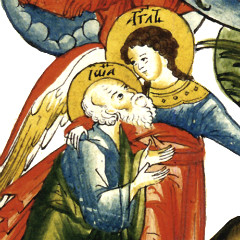
Tolkovy Apocalypse, Wikimedia Commons
Modern Christians have a tendency to view their prayer life as a private matter. But as I discovered while researching my book Lifted by Angels, our counterparts in the early church assumed the active participation of angels in believers’ prayer lives.
“[T]he angel of each of us prays alongside us,” wrote the third-century theologian Origen in his primer on prayer.
How do we know when angels are present? Feelings of comfort, humility, and joy indicate their presence. When those feelings come, according to monastic guide John Climacus in The Ladder of Divine Ascent, we should “hasten to prayer, for our good guardian has come to pray with us.”
Our awareness of the angel’s presence may grow as we pray. “If you feel sweetness or compunction at some word of your prayer, dwell on it,” said Climacus, “for then our guardian angel is praying with us.”
Angelic models for prayer
For ancient Christians like Origen, Climacus, and others, this angelic presence in prayer served as a model for prayer itself.
Their writings assumed a certain gravity to what Climacus termed “the work of angels.” Sometimes we pray as we stir in the morning; other times in the thick of the day or during the drowsy moments before sleep. In all settings, the ancient preachers and theologians of the church advised that believers be sober and watchful like the angels.
In one of his homilies on the Epistle to the Hebrews, John Chrysostom offered the unseemly picture of a man approaching God while “gaping and scratching himself,” as angels “stand by in fear and trembling.”
Fourth-century monastic Evagrius is less glib. “Arouse yourself, wretch; your Lord is speaking with you,” he said, apparently unworried about offending his listeners. “Do not wander off. His elect angels surround you, do not be dismayed; the ranks of the demons stand facing you, so do not grow lax.”
As the ancient Christians understood things, prayer is serious work and requires sober-minded practitioners. Our best bet is to imitate the watchfulness of the angels who pray with us.
Don’t ask for the dunghill
Knowing with whom and to whom we pray should also inform for what we pray.
Isaac the Syrian said that when we ask for frivolous and base things, it’s like a subject standing before his king and imploring him for a measure of manure. The request insults both the king and the subject.
As if to make the embarrassment all the more apparent, Isaac reminded us that “the King’s great officials”–angels and archangels–“are gazing steadfastly upon you at the time of your prayer to see what petition you will make of their Master; and they are astonished and exultant whenever they behold one who is made of earth forsake his dunghill and ask for what is heavenly.”
Swarms of demons
Importantly, as Evagrius said, it’s not just the good and holy angels who are present when we pray. Sometimes the fallen angels, the demons, are there as well, conjuring distraction, worry, and fear. Because of the power of prayer and its function of drawing us closer to God, demons are anxious to spoil our efforts.
Climacus wrote about the demon of grief that “tries to devastate our prayer” by making our sins seem great and God distant.
Another writer, Martyrius, related how Satan tries to bring slumber to our minds and eyes when he sees us “keeping vigil with our Lord . . . exhibiting the wakefulness of the angels.”
Our prayers, said Climacus, are followed by “swarms of demons,” who attempt to steal our spiritual gains. If we stay the course, their attacks amount to nothing. As believers press through the difficulties and grow in prayer, we find “the unholy spirits . . . flee as from fire when scourged by prayer.”
Perhaps all of this raises more questions than it answers. But it certainly serves to instruct us that prayer is anything but solitary. The work of angels is something in which we participate, carrying on the labor amid the company of a great and heavenly host.
Previous Post
November 3, 2012
Prayers of the persecuted church
Next Post

November 8, 2012 Celebrating Michael and the archangels
Browse Our Archives
Select a Category Books Church Life Family Life Misc Prayer Quotes Society Spiritual Growth Theology Uncategorized Video
Select a Month April 2014 March 2014 January 2014 December 2013 November 2013 August 2013 July 2013 June 2013 May 2013 April 2013 March 2013 February 2013 January 2013 December 2012 November 2012 October 2012 September 2012 August 2012 July 2012 June 2012 May 2012 April 2012 March 2012 February 2012 December 2011 November 2011 October 2011 August 2011 July 2011 June 2011 March 2011 February 2011 January 2011 December 2010 October 2010 September 2010 August 2010 July 2010 June 2010 May 2010 September 2009 August 2009 July 2009 May 2009 April 2009 March 2009 November 2008 October 2008 July 2008 June 2008 April 2008 March 2008 February 2008 January 2008 August 2007 June 2007 October 2002 July 2002 November 1999 October 1999
Follow Us!
TAKE THE
Religious Wisdom Quiz
What Christian holiday celebrates Jesus’ birth?
Select your answer to see how you score.
Good Friday Easter Pentecost Christmas
Related posts from Joel J. Miller

'Without embittering and embarrassing others'

Christianity: Use only as directed

What we can learn from Augustine's mom about...

Sinéad O’Connor, Anne Lamott, and the many names...
TRENDING AT PATHEOS Evangelical

The REST of Your Life: A Creative Wrestles...
This week I had a conversation with a good friend from church....

How the author of the world's best hymn...
I've been working with John Newton for a while now. This makes...

Long before this Lectio Divina, Psalm 130 - the song - started...

What About the Trees? Another Living Parable
After I finished writing the last article about falling leaves as a...

Why Classical Education Is a Conversation, Not a...
Come and Read: Joy in Classical Education When I was a little...

Cornell University has received a great deal of negative publicity and intense...
view all Evangelical blogs
Ad-Free & Subscriber Log-In Subscription Support
- About Us
- 2026 Calendar
- Videos
- Podcasts
- Library of World Religions
- Faith In Media Tracker
- Advertise With Us
- Write for Us
- Privacy Policy
- Terms of Service
- Do Not Sell My Data
- Contact Us
- Radiant Digital
- Manage Newsletter Subscriptions
- Unsubscribe From Notifications
- Sitemap
Copyright 2008-2026, Patheos. All rights reserved.
Subscription Support Ad-Free & Subscriber Log-In
Follow Patheos