
BuddhistCatholicContemplativeEvangelicalGeneral ChristianHinduJewishLatter-day SaintMuslimNew VisionsProgressive Christian
Beliefs
- Buddhist
- Catholic
- Contemplative
- Evangelical
- General Christian
- Hindu
- Jewish
- Latter-day Saint
- More Voices
- Muslim
- New Visions
- Pagan
- Progressive Christian
Topics
- Religion News
- Food and Religion
- Sports and Religion
- Religious Art
- Religious Music and Entertainment
- Religious Events
- History and Religion
- Style and Religion
- Politics and Religion
- Women in Religion
- Recreation Outdoors and Religion
- Business Finance and Religion
- Careers Workplace and Religion
- Education and Religion
- Family Parenting and Religion
- Health Fitness and Religion
- Home and Religion
- Relationships and Religion
- Technology and Religion
- Travel and Religion
Columnists
- Buddhist Columnists
- Business Finance and Religion Columnists
- Careers Workplace and Religion Columnists
- Catholic Columnists
- Contemplative Columnists
- Education and Religion Columnists
- Evangelists Columnists
- Family Parenting and Religion Columnists
- General Christian Columnists
- Health Fitness and Religion Columnists
- Hindu Columnists
- History and Religion Columnists
- Home and Religion Columnists
- Jewish Columnists
- More Voices Columnists
- Latter Day Columnists
- Muslim Columnists
- New Visions Columnists
- Nonreligious Columnists
- Pagan Columnists
- Politics and Religion Columnists
- Progressive Columnists
- Recreation Outdoors and Religion Columnists
- Relationships and Religion Columnists
- Religion News Columnists
- Religious Art Columnists
- Religious Events Columnists
- Religious Music and Entertainment Columnists
- Sports and Religion Columnists
- Style and Religion Columnists
- Technology and Religion Columnists
- Travel and Religion Columnists
- Women in Religion Columnists
Resource Library
- 2026 Calendar
- Library of World Religions
- The 100 Most Holy Places on Earth
- Patheos Answers
- Podcasts
- Videos
- Faith Leaders Database
- Anglican Episcopalian
- Bahai
- Baptist
- Buddhism
- Christianity
- Confucianism
- Eastern Orthodoxy
- Hinduism
- Holiness and Pentecostal
- ISKCON
- Islam
- Judaism
- Lutheran
- Methodist
- The Church of Jesus Christ of Latter-day Saints
- New Age
- Paganism
- Presbytarian and Reformed
- Protestantism
- Religion Behind the Scenes
- Roman Catholic
- Scientology
- Shia Islam
- Sikhism
- Sufism
- Sunni Islam
- Taoism
- Zen
- See all religions
Research Tools
 Ad-Free & Subscriber Log-In Subscription Support
Ad-Free & Subscriber Log-In Subscription Support
Follow Patheos 

- Trending:
- Forgiveness
- |
- Marriage
- |
- Consciousness
- |
- Death Penalty
- |
- Election
- |
- Halloween
 Joel J. Miller
-
Joel's Books
-
Article Categories
- Home
- Evangelical
- What the light of Christ teaches us
What the light of Christ teaches us
Last updated on: August 7, 2012 at 6:58 am by Joel J. Miller
What the light of Christ teaches us 2012-08-07T06:58:34-05:00 Joel J. Miller
Patheos Explore the world's faith through different perspectives on religion and spirituality! Patheos has the views of the prevalent religions and spiritualities of the world.
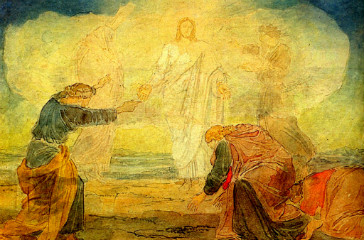
Alexander Andreyevich Ivanov’s Transfiguration
At the start of his gospel, John refers to Christ as “[t]he true light that enlightens every man.” He was likely an old man when he penned the line, and I can’t help but wonder if his mind traveled back to an experience of his youth, during the earthly ministry of Jesus, one in which he experienced that light in a supernatural way.
Jesus had at times a large entourage, but he revealed certain things to small and select group of disciples. Matthew, Mark, and Luke all tell about the time that Jesus took Peter, James, and the young John to pray on the mountain, traditionally Mount Tabor. While there, as the evangelists describe it, Jesus was majestically transfigured before their eyes.
Here’s how Mark described what happened: “[H]is garments became glistening, intensely white, as no fuller on earth could bleach them.” But the effect was more than external. “[H]is face shone like the sun,” said Matthew.
Divinity on display
The disciples were overwhelmed and overcome by the blazing light. Icons of the moment usually show the three falling back and covering their eyes from the glare. Totally stunned, Peter famously started mouthing inanities.
Interestingly, unlike Matthew, Mark, and Luke — the evangelists who record the event — John actually saw the Transfiguration in person. But he never wrote about it, at least not directly. Instead, he spoke of Jesus as “the life [that] was the light of men.”
While the other evangelists report events for theological purposes, the gospel of John is primarily a theological reflection from someone who beheld the “glory” of “the only Son from the Father” in person.
When God laid down his life
In celebrating the Feast of the Transfiguration, the Orthodox church sings this hymn:
You were transfigured on the mount,
And your disciples, insofar as they were able,
Beheld your glory, O Christ our God:
So that when they should see you crucified,
They would remember that your suffering was voluntary,
And could declare to all the world
That you are truly the effulgent splendor of the Father.
Note that line: “your suffering was voluntary.” In his book The Mystery of Christ, John Behr points out that theology begins when we can look past the bare events of the crucifixion to reflect upon its voluntary nature. Jesus gave himself up for our sakes. The Transfiguration helped the disciples see that.
John Chrysostom alludes to this when commenting on the event. The transfiguration worked “[t]o show the glory of the cross, and to console Peter and the others in their dread of the passion, and to raise up their minds,” he said.
When later reflecting on the crucifixion, the disciples would now do so in the context of the vision they’d seen of Christ in his divinity. The Transfiguration made it clear that God in Christ laid down his life, and that willingly.
The power of life and death
The light of Tabor helped sear that truth into the mind of the early church. The letter of Hebrews, for instance, speaks of Christ offering himself up for us. The letter to the Philippians speaks of his willing obedience unto death. The gospels give us various scenes and passages that communicate the same thought, perhaps none more powerfully than in the tenth chapter of John’s gospel.
“For this reason the Father loves me,” John quotes Jesus saying, “because I lay down my life, that I may take it again. No one takes it from me, but I lay it down of my own accord. I have power to lay it down, and I have power to take it again. . . .”
Christ had the power of life and death because Christ was evidently, glaringly, palpably divine — something John experienced first hand at the Transfiguration.
Appreciation
The church celebrated this from the start. For instance, one of its earliest liturgies, The Liturgy of Saint James, speaks of Jesus “being about to endure His voluntary and life-giving death by the cross. . . .” Immediately following that it references “the night in which He was betrayed, nay, rather delivered Himself up for the life and salvation of the world. . . .”
Catch that? The text comments on Christ’s betrayal to add that he “delivered Himself up.”
Theology is about more than understanding in the intellectual sense of the word. It’s about appreciation. The Transfiguration, as Chrysostom said, elevates our minds to the glory of a God who would lay down his life to raise up ours.
Previous Post

July 5, 2012
The sound of (blessed) silence
Next Post
August 9, 2012 Angels and the promise of a bigger world
Browse Our Archives
Select a Category Books Church Life Family Life Misc Prayer Quotes Society Spiritual Growth Theology Uncategorized Video
Select a Month April 2014 March 2014 January 2014 December 2013 November 2013 August 2013 July 2013 June 2013 May 2013 April 2013 March 2013 February 2013 January 2013 December 2012 November 2012 October 2012 September 2012 August 2012 July 2012 June 2012 May 2012 April 2012 March 2012 February 2012 December 2011 November 2011 October 2011 August 2011 July 2011 June 2011 March 2011 February 2011 January 2011 December 2010 October 2010 September 2010 August 2010 July 2010 June 2010 May 2010 September 2009 August 2009 July 2009 May 2009 April 2009 March 2009 November 2008 October 2008 July 2008 June 2008 April 2008 March 2008 February 2008 January 2008 August 2007 June 2007 October 2002 July 2002 November 1999 October 1999
Follow Us!
TAKE THE
Religious Wisdom Quiz
What city was Paul heading to when he encountered Jesus?
Select your answer to see how you score.
Rome Damascus Antioch Jerusalem
Related posts from Joel J. Miller

Is the Resurrection essential to Christian belief?

What Barton and Copeland get wrong about war...

George Orwell and bending the Bible for our...

Doh! Archbishop of Canterbury forgets what it means...
TRENDING AT PATHEOS Evangelical

The REST of Your Life: A Creative Wrestles...
This week I had a conversation with a good friend from church....

How the author of the world's best hymn...
I've been working with John Newton for a while now. This makes...

Long before this Lectio Divina, Psalm 130 - the song - started...

What About the Trees? Another Living Parable
After I finished writing the last article about falling leaves as a...

Why Classical Education Is a Conversation, Not a...
Come and Read: Joy in Classical Education When I was a little...

Cornell University has received a great deal of negative publicity and intense...
view all Evangelical blogs
Ad-Free & Subscriber Log-In Subscription Support
- About Us
- 2026 Calendar
- Videos
- Podcasts
- Library of World Religions
- Faith In Media Tracker
- Advertise With Us
- Write for Us
- Privacy Policy
- Terms of Service
- Do Not Sell My Data
- Contact Us
- Radiant Digital
- Manage Newsletter Subscriptions
- Unsubscribe From Notifications
- Sitemap
Copyright 2008-2026, Patheos. All rights reserved.
Subscription Support Ad-Free & Subscriber Log-In
Follow Patheos