
BuddhistCatholicContemplativeEvangelicalGeneral ChristianHinduJewishLatter-day SaintMuslimNew VisionsProgressive Christian
Beliefs
- Buddhist
- Catholic
- Contemplative
- Evangelical
- General Christian
- Hindu
- Jewish
- Latter-day Saint
- More Voices
- Muslim
- New Visions
- Pagan
- Progressive Christian
Topics
- Religion News
- Food and Religion
- Sports and Religion
- Religious Art
- Religious Music and Entertainment
- Religious Events
- History and Religion
- Style and Religion
- Politics and Religion
- Women in Religion
- Recreation Outdoors and Religion
- Business Finance and Religion
- Careers Workplace and Religion
- Education and Religion
- Family Parenting and Religion
- Health Fitness and Religion
- Home and Religion
- Relationships and Religion
- Technology and Religion
- Travel and Religion
Columnists
- Buddhist Columnists
- Business Finance and Religion Columnists
- Careers Workplace and Religion Columnists
- Catholic Columnists
- Contemplative Columnists
- Education and Religion Columnists
- Evangelists Columnists
- Family Parenting and Religion Columnists
- General Christian Columnists
- Health Fitness and Religion Columnists
- Hindu Columnists
- History and Religion Columnists
- Home and Religion Columnists
- Jewish Columnists
- More Voices Columnists
- Latter Day Columnists
- Muslim Columnists
- New Visions Columnists
- Nonreligious Columnists
- Pagan Columnists
- Politics and Religion Columnists
- Progressive Columnists
- Recreation Outdoors and Religion Columnists
- Relationships and Religion Columnists
- Religion News Columnists
- Religious Art Columnists
- Religious Events Columnists
- Religious Music and Entertainment Columnists
- Sports and Religion Columnists
- Style and Religion Columnists
- Technology and Religion Columnists
- Travel and Religion Columnists
- Women in Religion Columnists
Resource Library
- 2026 Calendar
- Library of World Religions
- The 100 Most Holy Places on Earth
- Patheos Answers
- Podcasts
- Videos
- Faith Leaders Database
- Anglican Episcopalian
- Bahai
- Baptist
- Buddhism
- Christianity
- Confucianism
- Eastern Orthodoxy
- Hinduism
- Holiness and Pentecostal
- ISKCON
- Islam
- Judaism
- Lutheran
- Methodist
- The Church of Jesus Christ of Latter-day Saints
- New Age
- Paganism
- Presbytarian and Reformed
- Protestantism
- Religion Behind the Scenes
- Roman Catholic
- Scientology
- Shia Islam
- Sikhism
- Sufism
- Sunni Islam
- Taoism
- Zen
- See all religions
Research Tools
 Ad-Free & Subscriber Log-In Subscription Support
Ad-Free & Subscriber Log-In Subscription Support
Follow Patheos 

- Trending:
- Forgiveness
- |
- Marriage
- |
- Consciousness
- |
- Death Penalty
- |
- Election
- |
- Halloween
 Joel J. Miller
-
Joel's Books
-
Article Categories
- Home
- Evangelical
- Angels in the architecture
Angels in the architecture
Last updated on: March 24, 2013 at 10:51 pm by Joel J. Miller
Angels in the architecture 2013-03-24T22:51:54-06:00 Joel J. Miller
Patheos Explore the world's faith through different perspectives on religion and spirituality! Patheos has the views of the prevalent religions and spiritualities of the world.
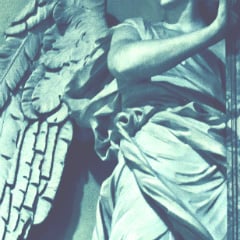
LocalTravelPhotos, Flickr
Paul Simon’s song “You Can Call Me Al” speaks of a man who sees “angels in the architecture.” The man’s vision is notable and different. He’s “a foreign man,” as the lyric goes, meaning that normal folk like you and me don’t see anything in the architecture but building supplies. So who has the better vision?
The word supernatural is a new one, at least relatively so. It started circulating around the middle of the sixteenth century, before scientific skepticism blew into vogue. It was an unfortunate coincidence. Before the advent of the word, a strange or spiritual occurrence — say, a miracle or a vision of angels — might seem wonderful or even weird. But this new term allowed us to split our world in two. Now the strange and spiritual was, as the word suggests, above or outside or apart from nature.
For an increasingly skeptical world, that became another way of dismissing something as unreal, no longer worthy of attention or contemplation. In this newly divided two-story universe, as Orthodox priest and author Stephen Freeman would call it, the enlightened skeptic was suddenly free to lock the door to the attic and pretend its contents didn’t exist. Reality stood on one side of the divide and fantasy on the other. The once-mystical became simply bogus. We invested the secular with meaning and relevance, and the religious we discounted as folly.
This was a major loss. It was like trying to see with only one eye. We could still make out light and color, angles and shapes. But our sight became flattened and two-dimensional. The new, purely naturalistic view lacked depth and distance. By segregating and ignoring the spiritual, we lost a way of seeing the natural in full, in the round.
C.S. Lewis noted that we think like our contemporaries, even those with whom we disagree. In fact that’s the most deceptive kind of likeness because we cannot imagine that we share assumptions, though we do. I fear this is true when it comes to this spiritual/natural divide. Many Christians are basically naturalists — materialists — like our neighbors. Of course, one small difference is that we pray. And sometimes, though surely not always, we even think there’s a god there listening, maybe even — dare we hope? — the God in whom we profess to believe.
It’s not supposed to be like that. Christians believe that there is nothing other or apart about the spiritual. It’s not strictly supernatural, not in the sense with which we use the word today. For the Christian, sacraments and miracles and angels are part of the natural order. They are ordinary. That is not to say the experience of an angel would be unaffecting, any more than seeing a lion walk by your path would leave you unflustered. You’re allowed to be terrified. You’re also allowed to believe.
To the extent that we think like naturalists, we wander like the blind. Unseen is unbelieved. What we miss we dismiss. But to the extent we reject naturalism, we can truly, consciously, and enthusiastically participate in the divine.
Previous Post
February 29, 2012
The church is room full of sisters
Next Post

March 5, 2012 Fighting Downton Abbey passions
Browse Our Archives
Select a Category Books Church Life Family Life Misc Prayer Quotes Society Spiritual Growth Theology Uncategorized Video
Select a Month April 2014 March 2014 January 2014 December 2013 November 2013 August 2013 July 2013 June 2013 May 2013 April 2013 March 2013 February 2013 January 2013 December 2012 November 2012 October 2012 September 2012 August 2012 July 2012 June 2012 May 2012 April 2012 March 2012 February 2012 December 2011 November 2011 October 2011 August 2011 July 2011 June 2011 March 2011 February 2011 January 2011 December 2010 October 2010 September 2010 August 2010 July 2010 June 2010 May 2010 September 2009 August 2009 July 2009 May 2009 April 2009 March 2009 November 2008 October 2008 July 2008 June 2008 April 2008 March 2008 February 2008 January 2008 August 2007 June 2007 October 2002 July 2002 November 1999 October 1999
Follow Us!
TAKE THE
Religious Wisdom Quiz
What is the last book of the Bible?
Select your answer to see how you score.
Revelation Genesis Matthew Exodus
Related posts from Joel J. Miller

Is the Resurrection essential to Christian belief?

Christianity: Use only as directed

What Barton and Copeland get wrong about war...

George Orwell and bending the Bible for our...
TRENDING AT PATHEOS Evangelical

The REST of Your Life: A Creative Wrestles...
This week I had a conversation with a good friend from church....

How the author of the world's best hymn...
I've been working with John Newton for a while now. This makes...

Long before this Lectio Divina, Psalm 130 - the song - started...

What About the Trees? Another Living Parable
After I finished writing the last article about falling leaves as a...

Why Classical Education Is a Conversation, Not a...
Come and Read: Joy in Classical Education When I was a little...

Cornell University has received a great deal of negative publicity and intense...
view all Evangelical blogs
Ad-Free & Subscriber Log-In Subscription Support
- About Us
- 2026 Calendar
- Videos
- Podcasts
- Library of World Religions
- Faith In Media Tracker
- Advertise With Us
- Write for Us
- Privacy Policy
- Terms of Service
- Do Not Sell My Data
- Contact Us
- Radiant Digital
- Manage Newsletter Subscriptions
- Unsubscribe From Notifications
- Sitemap
Copyright 2008-2026, Patheos. All rights reserved.
Subscription Support Ad-Free & Subscriber Log-In
Follow Patheos