
BuddhistCatholicContemplativeEvangelicalGeneral ChristianHinduJewishLatter-day SaintMuslimNew VisionsProgressive Christian
Beliefs
- Buddhist
- Catholic
- Contemplative
- Evangelical
- General Christian
- Hindu
- Jewish
- Latter-day Saint
- More Voices
- Muslim
- New Visions
- Pagan
- Progressive Christian
Topics
- Religion News
- Food and Religion
- Sports and Religion
- Religious Art
- Religious Music and Entertainment
- Religious Events
- History and Religion
- Style and Religion
- Politics and Religion
- Women in Religion
- Recreation Outdoors and Religion
- Business Finance and Religion
- Careers Workplace and Religion
- Education and Religion
- Family Parenting and Religion
- Health Fitness and Religion
- Home and Religion
- Relationships and Religion
- Technology and Religion
- Travel and Religion
Columnists
- Buddhist Columnists
- Business Finance and Religion Columnists
- Careers Workplace and Religion Columnists
- Catholic Columnists
- Contemplative Columnists
- Education and Religion Columnists
- Evangelists Columnists
- Family Parenting and Religion Columnists
- General Christian Columnists
- Health Fitness and Religion Columnists
- Hindu Columnists
- History and Religion Columnists
- Home and Religion Columnists
- Jewish Columnists
- More Voices Columnists
- Latter Day Columnists
- Muslim Columnists
- New Visions Columnists
- Nonreligious Columnists
- Pagan Columnists
- Politics and Religion Columnists
- Progressive Columnists
- Recreation Outdoors and Religion Columnists
- Relationships and Religion Columnists
- Religion News Columnists
- Religious Art Columnists
- Religious Events Columnists
- Religious Music and Entertainment Columnists
- Sports and Religion Columnists
- Style and Religion Columnists
- Technology and Religion Columnists
- Travel and Religion Columnists
- Women in Religion Columnists
Resource Library
- 2026 Calendar
- Library of World Religions
- The 100 Most Holy Places on Earth
- Patheos Answers
- Podcasts
- Videos
- Faith Leaders Database
- Anglican Episcopalian
- Bahai
- Baptist
- Buddhism
- Christianity
- Confucianism
- Eastern Orthodoxy
- Hinduism
- Holiness and Pentecostal
- ISKCON
- Islam
- Judaism
- Lutheran
- Methodist
- The Church of Jesus Christ of Latter-day Saints
- New Age
- Paganism
- Presbytarian and Reformed
- Protestantism
- Religion Behind the Scenes
- Roman Catholic
- Scientology
- Shia Islam
- Sikhism
- Sufism
- Sunni Islam
- Taoism
- Zen
- See all religions
Research Tools
 Ad-Free & Subscriber Log-In Subscription Support
Ad-Free & Subscriber Log-In Subscription Support
Follow Patheos 

- Trending:
- Forgiveness
- |
- Marriage
- |
- Consciousness
- |
- Death Penalty
- |
- Election
- |
- Halloween
 Joel J. Miller
-
Joel's Books
-
Article Categories
- Home
- Evangelical
- What child is this?
What child is this?
Last updated on: December 24, 2012 at 9:00 pm by Joel J. Miller
What child is this? 2012-12-24T21:00:35-06:00 Joel J. Miller
Patheos Explore the world's faith through different perspectives on religion and spirituality! Patheos has the views of the prevalent religions and spiritualities of the world.
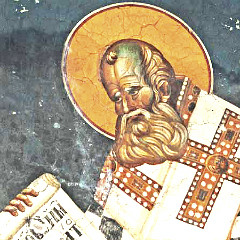
Athanasius the Great, Wikimedia Commons
“What child is this?” asks the famous nineteenth century Christmas carol. It’s a question posed since Christ first entered human history two thousand years ago and a question that sometimes provokes vitriolic and sometimes violent answers. We’ve seen it in recent public tiffs about Nativity displays and, far more seriously, in threats against Christians in the Middle East.
A glance to the distant past provides useful and sobering perspective. Few people exemplify and clarify the fight for the true meaning of Christmas as powerfully as does Athanasius of Alexandria.
Born in Egypt at the close of the third century, Athanasius thought deeply and seriously about the mysteries of the faith. While contemplating the purpose of Christ’s advent, he penned an enduring classic of Christian literature, On the Incarnation. “The Word of God came in His own Person, because it was He alone, the Image of the Father, Who could recreate man made after the Image,” said Athanasius.
This restoration of humanity by God himself in the person of Christ is the meaning of Christmas, and this understanding might have been lost had it not been for Athanasius.
Shortly after Athanasius penned his book, the popular and winsome priest Arius emerged, teaching that Christ was not actually God in the flesh. “What child is this?” Not God, answered Arius.
The emperor called a council, which Athanasius attended, to resolve the issue and keep the Church from splitting over Arius’s teaching. The atmosphere was tense and heated. St. Nicholas (yes, that St. Nick) famously socked Arius during one session. But from the turmoil arose agreement about the divine nature of Christ, validating the view that Athanasius advanced in On the Incarnation. Arius was anathematized and his supporters exiled. But despite appearances, the issue was unsettled.
Shortly after the council, the bishop of Alexandria died and Athanasius was ordained to the office. The weakened Arian faction worked against him almost from the start. After false charges were levied against him, Athanasius appealed to the emperor for help. But the balance of power was shifting, and the new bishop was banished.
This inaugurated many periods of exile for Athanasius, who tirelessly defended the orthodox view against the Arian heresy. It is impossible to adequately summarize the weight of opposition he faced. By political maneuvering and alliance with subsequent emperors, the Arians came to power and brought brutal persecution, the likes of which only pagan powers had ever before exercised.
One night in February 356 Athanasius presided at a midnight vigil. Other than the prayers and psalm-singing the room was quiet. Suddenly, armed men burst inside and, amid the flickering candlelight, fired arrows and slashed with their swords. Athanasius was almost killed in the struggle, but his supporters secreted him out of the church.
The ransacking was widespread. Churches were seized. Deacons and priests were killed. Widows were beaten. Taking refuge in the desert with monks, Athanasius led his fugitive church from hiding. In 357 he wrote his scattered and discouraged flock:
May God comfort you. I know . . . that not only this thing saddens you, but also the fact that while others have obtained the churches by violence, you are meanwhile cast out from your places. . . . They are, it is true, in the places, but outside of the true Faith; while you are outside the places indeed, but the Faith, within you.
The faith within you was the whole point. To betray it would reenact the betrayal of Adam, the very betrayal that Christ’s Incarnation reversed. Whatever evil and danger befall the faithful, Christ’s advent restored communion with God because God himself came and walked among us.
Enemies of that faith rage and seem at times to prevail, but the gift of Christmas is something they can never steal or destroy. Despite all odds, that faith eventually triumphed and Athanasius with it. Despite a lifetime of persecution for Christ, he died peacefully of natural causes in old age.
“What child is this?” It is God in the flesh, coming in love to restore his creation. And we can celebrate Christmas today because of the life and sacrifice of Athanasius the Great so many years ago.
Originally published at FoxNews.com in 2010.
Previous Post
November 21, 2011
Jesus: The sweetest name
Next Post
February 20, 2012 Grace and the blame game
Browse Our Archives
Select a Category Books Church Life Family Life Misc Prayer Quotes Society Spiritual Growth Theology Uncategorized Video
Select a Month April 2014 March 2014 January 2014 December 2013 November 2013 August 2013 July 2013 June 2013 May 2013 April 2013 March 2013 February 2013 January 2013 December 2012 November 2012 October 2012 September 2012 August 2012 July 2012 June 2012 May 2012 April 2012 March 2012 February 2012 December 2011 November 2011 October 2011 August 2011 July 2011 June 2011 March 2011 February 2011 January 2011 December 2010 October 2010 September 2010 August 2010 July 2010 June 2010 May 2010 September 2009 August 2009 July 2009 May 2009 April 2009 March 2009 November 2008 October 2008 July 2008 June 2008 April 2008 March 2008 February 2008 January 2008 August 2007 June 2007 October 2002 July 2002 November 1999 October 1999
Follow Us!
TAKE THE
Religious Wisdom Quiz
I saw my master taken up to heaven in a whirlwind and received a double portion of his spirit. Who am I?
Select your answer to see how you score.
Elisha Elijah Joshua Samuel
Related posts from Joel J. Miller

Is the Resurrection essential to Christian belief?

What Barton and Copeland get wrong about war...

George Orwell and bending the Bible for our...

Doh! Archbishop of Canterbury forgets what it means...
TRENDING AT PATHEOS Evangelical

The REST of Your Life: A Creative Wrestles...
This week I had a conversation with a good friend from church....

How the author of the world's best hymn...
I've been working with John Newton for a while now. This makes...

Long before this Lectio Divina, Psalm 130 - the song - started...

What About the Trees? Another Living Parable
After I finished writing the last article about falling leaves as a...

Why Classical Education Is a Conversation, Not a...
Come and Read: Joy in Classical Education When I was a little...

Cornell University has received a great deal of negative publicity and intense...
view all Evangelical blogs
Ad-Free & Subscriber Log-In Subscription Support
- About Us
- 2026 Calendar
- Videos
- Podcasts
- Library of World Religions
- Faith In Media Tracker
- Advertise With Us
- Write for Us
- Privacy Policy
- Terms of Service
- Do Not Sell My Data
- Contact Us
- Radiant Digital
- Manage Newsletter Subscriptions
- Unsubscribe From Notifications
- Sitemap
Copyright 2008-2026, Patheos. All rights reserved.
Subscription Support Ad-Free & Subscriber Log-In
Follow Patheos