
BuddhistCatholicContemplativeEvangelicalGeneral ChristianHinduJewishLatter-day SaintMuslimNew VisionsProgressive Christian
Beliefs
- Buddhist
- Catholic
- Contemplative
- Evangelical
- General Christian
- Hindu
- Jewish
- Latter-day Saint
- More Voices
- Muslim
- New Visions
- Pagan
- Progressive Christian
Topics
- Religion News
- Food and Religion
- Sports and Religion
- Religious Art
- Religious Music and Entertainment
- Religious Events
- History and Religion
- Style and Religion
- Politics and Religion
- Women in Religion
- Recreation Outdoors and Religion
- Business Finance and Religion
- Careers Workplace and Religion
- Education and Religion
- Family Parenting and Religion
- Health Fitness and Religion
- Home and Religion
- Relationships and Religion
- Technology and Religion
- Travel and Religion
Columnists
- Buddhist Columnists
- Business Finance and Religion Columnists
- Careers Workplace and Religion Columnists
- Catholic Columnists
- Contemplative Columnists
- Education and Religion Columnists
- Evangelists Columnists
- Family Parenting and Religion Columnists
- General Christian Columnists
- Health Fitness and Religion Columnists
- Hindu Columnists
- History and Religion Columnists
- Home and Religion Columnists
- Jewish Columnists
- More Voices Columnists
- Latter Day Columnists
- Muslim Columnists
- New Visions Columnists
- Nonreligious Columnists
- Pagan Columnists
- Politics and Religion Columnists
- Progressive Columnists
- Recreation Outdoors and Religion Columnists
- Relationships and Religion Columnists
- Religion News Columnists
- Religious Art Columnists
- Religious Events Columnists
- Religious Music and Entertainment Columnists
- Sports and Religion Columnists
- Style and Religion Columnists
- Technology and Religion Columnists
- Travel and Religion Columnists
- Women in Religion Columnists
Resource Library
- 2026 Calendar
- Library of World Religions
- The 100 Most Holy Places on Earth
- Patheos Answers
- Podcasts
- Videos
- Faith Leaders Database
- Anglican Episcopalian
- Bahai
- Baptist
- Buddhism
- Christianity
- Confucianism
- Eastern Orthodoxy
- Hinduism
- Holiness and Pentecostal
- ISKCON
- Islam
- Judaism
- Lutheran
- Methodist
- The Church of Jesus Christ of Latter-day Saints
- New Age
- Paganism
- Presbytarian and Reformed
- Protestantism
- Religion Behind the Scenes
- Roman Catholic
- Scientology
- Shia Islam
- Sikhism
- Sufism
- Sunni Islam
- Taoism
- Zen
- See all religions
Research Tools
 Ad-Free & Subscriber Log-In Subscription Support
Ad-Free & Subscriber Log-In Subscription Support
Follow Patheos 

- Trending:
- Forgiveness
- |
- Marriage
- |
- Consciousness
- |
- Death Penalty
- |
- Election
- |
- Halloween
 Joel J. Miller
-
Joel's Books
-
Article Categories
- Home
- Evangelical
- Our true identity in Christ and the momentum of holiness
Our true identity in Christ and the momentum of holiness
Last updated on: December 20, 2012 at 2:03 pm by Joel J. Miller
Our true identity in Christ and the momentum of holiness 2012-12-20T14:03:10-06:00 Joel J. Miller
Patheos Explore the world's faith through different perspectives on religion and spirituality! Patheos has the views of the prevalent religions and spiritualities of the world.
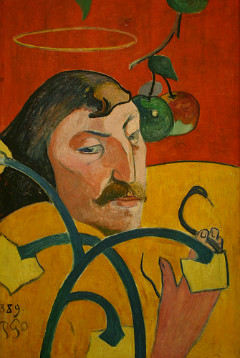
Paul Gauguin, Self-Portrait (cliff1066, Flickr)
What can Paul Gauguin and Paul the Apostle teach us about our identity in Christ?
Born in France and raised partially in Peru, Paul Gauguin’s early years were marked by the death of his father, domestic upheaval, and sweeping cultural shifts. After returning to France to live with his grandfather, he joined the merchant marines, served a stint in the navy, took work as a stockbroker, married, and had several kids. His tumultuous life could have settled into middle-class ease, but then Gauguin went spectacularly off the rails.
I’ll leave it to the biographers and historians to explain it all. Suffice it to say that his obsession for art drove a wedge between him and family, and they eventually became estranged. Submerged in his art, his life became dissolute.
While his achievements are noteworthy, his decline is as well. An alcoholic and a syphilitic, he died in 1903 at age 54.
Two self-portraits
Take that as prelude to the painting. Gauguin painted the above self-portrait in 1889. It’s been widely discussed over the years, but here’s what stands out for me, particularly against the tragic backdrop of his life:
Gauguin puts himself in the place of Adam, the fruit of the tree within tempting reach. The halo overhead indicates his propensity toward good, while the snake he handles shows the lure away. The stark red-yellow contrast above and below makes the divide all the more apparent. He stands in between, straddling both worlds. His eyes look away from the fruit and the serpent, as if he’s considering an action. The decision is his. He can go either way.
It’s true so far as it goes, and we know what Gauguin chose. But the painting also lies about something, at least for some of us. For those who desire to follow the upward call, to possess the halo the artist discarded, the great and weighty fact is that we are in Christ, not Adam.
In the seventh chapter of Romans, Paul gives us a self portrait as well. The apostle stands between his own red-yellow divide, his own stark choice. And he has trouble choosing the better path. He confesses inability to do the right thing and self-loathing for choosing the wrong. It’s a wrenching passage, one all-too familiar and deeply personal for many of us.
But unlike Paul Guaguin, the Apostle Paul points the way out.
The truer picture
“There is therefore now no condemnation to those who are in Christ Jesus, who do not walk according to the flesh, but according to the Spirit,” Paul says at the start of chapter eight. “For the law of the Spirit of life in Christ Jesus has made me free from the law of sin and death.”
Don’t overlook the phrase “Spirit of life.” Paul picks up the theme of life and resurrection a few sentences later. “[I]f the Spirit of Him who raised Jesus from the dead dwells in you, He who raised Christ from the dead will also give life to your mortal bodies through His Spirit who dwells in you,” the same spirit, the Holy Spirit, who as Paul says, “helps [us] in our weakness.”
We are not like Gauguin, stranded alone between holiness and evil. We are now in Christ and have the Holy Spirit. And we receive a certain momentum toward holiness.
Icons of the Resurrection show the enlivened Christ rising from the grave. They portray energy and power and dynamism. The scene is vivid and alive, not the staid scape of Gauguin’s choice. And this is the truer image. The image of Christ is our real self-portrait because our identity is no longer in Adam. And the momentum of Christ erupting from the grave, the momentum of life, the momentum of the Spirit, is the same momentum that lifts us on our way toward God.
Previous Post

July 11, 2011
How to wreck your life
Next Post

July 15, 2011 The books you come back to
Browse Our Archives
Select a Category Books Church Life Family Life Misc Prayer Quotes Society Spiritual Growth Theology Uncategorized Video
Select a Month April 2014 March 2014 January 2014 December 2013 November 2013 August 2013 July 2013 June 2013 May 2013 April 2013 March 2013 February 2013 January 2013 December 2012 November 2012 October 2012 September 2012 August 2012 July 2012 June 2012 May 2012 April 2012 March 2012 February 2012 December 2011 November 2011 October 2011 August 2011 July 2011 June 2011 March 2011 February 2011 January 2011 December 2010 October 2010 September 2010 August 2010 July 2010 June 2010 May 2010 September 2009 August 2009 July 2009 May 2009 April 2009 March 2009 November 2008 October 2008 July 2008 June 2008 April 2008 March 2008 February 2008 January 2008 August 2007 June 2007 October 2002 July 2002 November 1999 October 1999
Follow Us!
TAKE THE
Religious Wisdom Quiz
"God called to him out of the bush, 'Moses, Moses!' And Moses replied, '_______.'"
Select your answer to see how you score.
Who speaks to me? I hear and obey What is your name? Here I am
Related posts from Joel J. Miller

Is the Resurrection essential to Christian belief?

What Barton and Copeland get wrong about war...

George Orwell and bending the Bible for our...

Doh! Archbishop of Canterbury forgets what it means...
TRENDING AT PATHEOS Evangelical

The REST of Your Life: A Creative Wrestles...
This week I had a conversation with a good friend from church....

How the author of the world's best hymn...
I've been working with John Newton for a while now. This makes...

Long before this Lectio Divina, Psalm 130 - the song - started...

What About the Trees? Another Living Parable
After I finished writing the last article about falling leaves as a...

Why Classical Education Is a Conversation, Not a...
Come and Read: Joy in Classical Education When I was a little...

Cornell University has received a great deal of negative publicity and intense...
view all Evangelical blogs
Ad-Free & Subscriber Log-In Subscription Support
- About Us
- 2026 Calendar
- Videos
- Podcasts
- Library of World Religions
- Faith In Media Tracker
- Advertise With Us
- Write for Us
- Privacy Policy
- Terms of Service
- Do Not Sell My Data
- Contact Us
- Radiant Digital
- Manage Newsletter Subscriptions
- Unsubscribe From Notifications
- Sitemap
Copyright 2008-2026, Patheos. All rights reserved.
Subscription Support Ad-Free & Subscriber Log-In
Follow Patheos