
BuddhistCatholicContemplativeEvangelicalGeneral ChristianHinduJewishLatter-day SaintMuslimNew VisionsProgressive Christian
Beliefs
- Buddhist
- Catholic
- Contemplative
- Evangelical
- General Christian
- Hindu
- Jewish
- Latter-day Saint
- More Voices
- Muslim
- New Visions
- Pagan
- Progressive Christian
Topics
- Religion News
- Food and Religion
- Sports and Religion
- Religious Art
- Religious Music and Entertainment
- Religious Events
- History and Religion
- Style and Religion
- Politics and Religion
- Women in Religion
- Recreation Outdoors and Religion
- Business Finance and Religion
- Careers Workplace and Religion
- Education and Religion
- Family Parenting and Religion
- Health Fitness and Religion
- Home and Religion
- Relationships and Religion
- Technology and Religion
- Travel and Religion
Columnists
- Buddhist Columnists
- Business Finance and Religion Columnists
- Careers Workplace and Religion Columnists
- Catholic Columnists
- Contemplative Columnists
- Education and Religion Columnists
- Evangelists Columnists
- Family Parenting and Religion Columnists
- General Christian Columnists
- Health Fitness and Religion Columnists
- Hindu Columnists
- History and Religion Columnists
- Home and Religion Columnists
- Jewish Columnists
- More Voices Columnists
- Latter Day Columnists
- Muslim Columnists
- New Visions Columnists
- Nonreligious Columnists
- Pagan Columnists
- Politics and Religion Columnists
- Progressive Columnists
- Recreation Outdoors and Religion Columnists
- Relationships and Religion Columnists
- Religion News Columnists
- Religious Art Columnists
- Religious Events Columnists
- Religious Music and Entertainment Columnists
- Sports and Religion Columnists
- Style and Religion Columnists
- Technology and Religion Columnists
- Travel and Religion Columnists
- Women in Religion Columnists
Resource Library
- 2026 Calendar
- Library of World Religions
- The 100 Most Holy Places on Earth
- Patheos Answers
- Podcasts
- Videos
- Faith Leaders Database
- Anglican Episcopalian
- Bahai
- Baptist
- Buddhism
- Christianity
- Confucianism
- Eastern Orthodoxy
- Hinduism
- Holiness and Pentecostal
- ISKCON
- Islam
- Judaism
- Lutheran
- Methodist
- The Church of Jesus Christ of Latter-day Saints
- New Age
- Paganism
- Presbytarian and Reformed
- Protestantism
- Religion Behind the Scenes
- Roman Catholic
- Scientology
- Shia Islam
- Sikhism
- Sufism
- Sunni Islam
- Taoism
- Zen
- See all religions
Research Tools
 Ad-Free & Subscriber Log-In Subscription Support
Ad-Free & Subscriber Log-In Subscription Support
Follow Patheos 

- Trending:
- Forgiveness
- |
- Marriage
- |
- Consciousness
- |
- Death Penalty
- |
- Election
- |
- Halloween
 Joel J. Miller
-
Joel's Books
-
Article Categories
- Home
- Evangelical
- Where we turn to model our lives
Where we turn to model our lives
Last updated on: December 15, 2012 at 7:11 pm by Joel J. Miller
Where we turn to model our lives 2012-12-15T19:11:30-06:00 Joel J. Miller
Patheos Explore the world's faith through different perspectives on religion and spirituality! Patheos has the views of the prevalent religions and spiritualities of the world.
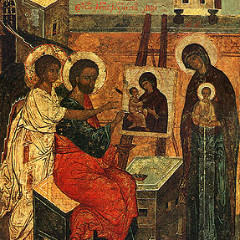
Luke the Evangelist 'writing' the icon of Mary (Pskov Museum, Wikimedia Commons).
According to tradition, the first icon-painter in the Church was the evangelist Luke, and the first icon he painted was of Mary. This is a big deal, so, naturally, there’s an icon of it. In that icon of an icon Mary stands with the baby Jesus to the side, while Luke sits, studies, and paints. I was reminded of this image when reading something in a letter from Basil about models for Christian living.
Basil’s point is that we should look to the Scriptures for examples of Christian virtues, to see them in action. “For in them are not only found the precepts of conduct,” he says, “but also the lives of saintly men, recorded and handed down to us, lie before us like living images . . . for our imitation of their good works.” There’s the virtue—and the virtue in practice. To successfully live grow in our faith, we need to study both, and we turn to the Scriptures for models.
Looking to Mary we learn, among other things, obedience. Faced with the announcement from Gabriel, she says, as Luke records, “Behold, I am the servant of the Lord; let it be to me according to your word.”
Looking to Paul we learn zeal. John the Baptist, humility. The Apostle John, devotion.
Basil similarly offers several examples from the Old Testament. From Joseph’s example we learn to appreciate chastity and flee sin. From Job we learn fortitude and constancy. From David and Moses we learn how we can be both valiant for God’s truth and also meek in spirit, a rare and precious combination.
To these and other models we must continually turn, says Basil. “[J]ust as painters in working from models constantly gaze at their exemplar and thus strive to transfer the expression of the original to their own artistry, so too he who is anxious to make himself perfect in all the kinds of virtue must gaze up on the lives of the saints . . . and must make their excellence his own by imitation.”
Basil connects prayer to this effort. Hinting at the same point, the icon of Luke and Mary reveals an angel leaning over his shoulder providing direction. We must remember that we cannot undertake the imitation of virtue without the help and power of God. We study the Scriptures, apply them in prayer, and trust God’s direction.
What would happen in our lives if we focused on gathering all we could glean from the life of just one of the saints and putting it into practice? What if you focused on Mary, or Joseph, or David? What qualities do they model that you could benefit from imitating?
Previous Post

February 7, 2011
Marriage and the sacrament of joint checking
Next Post
February 14, 2011 Fear and the stories we tell ourselves
Browse Our Archives
Select a Category Books Church Life Family Life Misc Prayer Quotes Society Spiritual Growth Theology Uncategorized Video
Select a Month April 2014 March 2014 January 2014 December 2013 November 2013 August 2013 July 2013 June 2013 May 2013 April 2013 March 2013 February 2013 January 2013 December 2012 November 2012 October 2012 September 2012 August 2012 July 2012 June 2012 May 2012 April 2012 March 2012 February 2012 December 2011 November 2011 October 2011 August 2011 July 2011 June 2011 March 2011 February 2011 January 2011 December 2010 October 2010 September 2010 August 2010 July 2010 June 2010 May 2010 September 2009 August 2009 July 2009 May 2009 April 2009 March 2009 November 2008 October 2008 July 2008 June 2008 April 2008 March 2008 February 2008 January 2008 August 2007 June 2007 October 2002 July 2002 November 1999 October 1999
Follow Us!
TAKE THE
Religious Wisdom Quiz
Ecclesiastes 3:1 says, "To everything there is a ______."
Select your answer to see how you score.
Season Blessing Purpose Time limit
Related posts from Joel J. Miller

How internet porn explains the decline of American...

Revenge and the simplistic morality of Hollywood

How God uses work to fashion our souls

Read the Bible if you're going to have...
TRENDING AT PATHEOS Evangelical

The REST of Your Life: A Creative Wrestles...
This week I had a conversation with a good friend from church....

How the author of the world's best hymn...
I've been working with John Newton for a while now. This makes...

Long before this Lectio Divina, Psalm 130 - the song - started...

What About the Trees? Another Living Parable
After I finished writing the last article about falling leaves as a...

Why Classical Education Is a Conversation, Not a...
Come and Read: Joy in Classical Education When I was a little...

Cornell University has received a great deal of negative publicity and intense...
view all Evangelical blogs
Ad-Free & Subscriber Log-In Subscription Support
- About Us
- 2026 Calendar
- Videos
- Podcasts
- Library of World Religions
- Faith In Media Tracker
- Advertise With Us
- Write for Us
- Privacy Policy
- Terms of Service
- Do Not Sell My Data
- Contact Us
- Radiant Digital
- Manage Newsletter Subscriptions
- Unsubscribe From Notifications
- Sitemap
Copyright 2008-2026, Patheos. All rights reserved.
Subscription Support Ad-Free & Subscriber Log-In
Follow Patheos