
BuddhistCatholicContemplativeEvangelicalGeneral ChristianHinduJewishLatter-day SaintMuslimNew VisionsProgressive Christian
Beliefs
- Buddhist
- Catholic
- Contemplative
- Evangelical
- General Christian
- Hindu
- Jewish
- Latter-day Saint
- More Voices
- Muslim
- New Visions
- Pagan
- Progressive Christian
Topics
- Religion News
- Food and Religion
- Sports and Religion
- Religious Art
- Religious Music and Entertainment
- Religious Events
- History and Religion
- Style and Religion
- Politics and Religion
- Women in Religion
- Recreation Outdoors and Religion
- Business Finance and Religion
- Careers Workplace and Religion
- Education and Religion
- Family Parenting and Religion
- Health Fitness and Religion
- Home and Religion
- Relationships and Religion
- Technology and Religion
- Travel and Religion
Columnists
- Buddhist Columnists
- Business Finance and Religion Columnists
- Careers Workplace and Religion Columnists
- Catholic Columnists
- Contemplative Columnists
- Education and Religion Columnists
- Evangelists Columnists
- Family Parenting and Religion Columnists
- General Christian Columnists
- Health Fitness and Religion Columnists
- Hindu Columnists
- History and Religion Columnists
- Home and Religion Columnists
- Jewish Columnists
- More Voices Columnists
- Latter Day Columnists
- Muslim Columnists
- New Visions Columnists
- Nonreligious Columnists
- Pagan Columnists
- Politics and Religion Columnists
- Progressive Columnists
- Recreation Outdoors and Religion Columnists
- Relationships and Religion Columnists
- Religion News Columnists
- Religious Art Columnists
- Religious Events Columnists
- Religious Music and Entertainment Columnists
- Sports and Religion Columnists
- Style and Religion Columnists
- Technology and Religion Columnists
- Travel and Religion Columnists
- Women in Religion Columnists
Resource Library
- 2026 Calendar
- Library of World Religions
- The 100 Most Holy Places on Earth
- Patheos Answers
- Podcasts
- Videos
- Faith Leaders Database
- Anglican Episcopalian
- Bahai
- Baptist
- Buddhism
- Christianity
- Confucianism
- Eastern Orthodoxy
- Hinduism
- Holiness and Pentecostal
- ISKCON
- Islam
- Judaism
- Lutheran
- Methodist
- The Church of Jesus Christ of Latter-day Saints
- New Age
- Paganism
- Presbytarian and Reformed
- Protestantism
- Religion Behind the Scenes
- Roman Catholic
- Scientology
- Shia Islam
- Sikhism
- Sufism
- Sunni Islam
- Taoism
- Zen
- See all religions
Research Tools
 Ad-Free & Subscriber Log-In Subscription Support
Ad-Free & Subscriber Log-In Subscription Support
Follow Patheos 

- Trending:
- Forgiveness
- |
- Marriage
- |
- Consciousness
- |
- Death Penalty
- |
- Election
- |
- Halloween
 Joel J. Miller
-
Joel's Books
-
Article Categories
- Home
- Evangelical
- A model for real social justice
A model for real social justice
Last updated on: January 1, 2013 at 6:24 pm by Joel J. Miller
A model for real social justice 2013-01-01T18:24:04-06:00 Joel J. Miller
Patheos Explore the world's faith through different perspectives on religion and spirituality! Patheos has the views of the prevalent religions and spiritualities of the world.
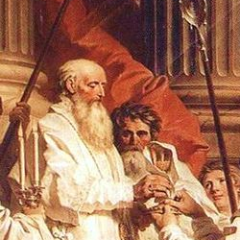
The Mass of St. Basil by Pierre Hubert Subleyras (Wikimedia Commons).
A rich young ruler comes to Christ and asks what it takes to inherit eternal life. Jesus says, “Sell all that you have and distribute to the poor. . . .”
Christ is enthroned in glory and he divides the crowds to his right and left. He welcomes those on his right, saying that they ministered to him when he was hungry, thirsty, lonely, naked, sick, and imprisoned. They’re surprised. “When did we do these things?” they ask. Christ answers, “Truly, I say to you, as you did it to one of the least of these my brothers, you did it to me.” It’s a different story, as we know, for those on his left.
When Basil of Caesarea (today known as Kayseri in Turkey) grappled with these passages, he was convicted to act.
Born in the year 330 to a wealthy family, his early life was marked by privilege and, as he termed it, vanity. His family was devout—the number of saints from under his roof is rather astounding—but like many young men he lacked an appreciation of his Christian heritage and upbringing. Then after studies in Constantinople and Athens, he had an awakening. The year was 356.
Basil reencountered the gospels (specifically the passages like those above) and was floored by the message of radical charity and asceticism. His father had died by then, and Basil took his considerable inheritance and began giving to the poor. He next traveled to the deserts of Egypt, Palestine, and Syria to learn from the ascetic and monastic communities there. He soon founded his own monastery at home, and his sister Macrina, widowed mother Emily, and brother Peter all joined him there to aid in prayer and charitable labors.
Basil’s life was not lived in seclusion despite is ascetical focus. He participated in the theological controversies and social crises of his times, eventually leaving the monastery and becoming a priest in 365 and then bishop in 370.
These were difficult days. Divisive heresies challenged the unity of the Church, and a major drought and subsequent famine hit the region. While diligently working to defend the faith and hold together his congregation, Basil also challenged the privileged and powerful. He preached several sermons on what today we term social justice. They were strong indictments of the selfishness of some in light of the widespread need of others.
From one sermon: “You gorgeously array your walls, but do not clothe your fellow human being; you adorn horses, but turn away from the shameful plight of your brother or sister; you allow grain to rot in your barns, but do not feed those who are starving; you hide gold in the earth, but ignore the oppressed.”
From another: “If we all took only what was necessary to satisfy our own needs, giving the rest to those who lack, no one would be rich, no one would be poor, and no one would be in need.”
It perhaps sounds extreme or simplistic, but just as Basil was earlier convicted to act so was his congregation. During the time of crisis, Basil sold and distributed what was left of his inheritance, and many of his people parted with their wealth and goods as well. Together by the gates of the city of Caesarea they founded a place of refuge for the hungry, the poor, the homeless, and the infirm. Because of all the food and aid delivered by Basil’s efforts, his friend, St. Gregory Nazianzen, called him a “second Joseph.”
All of this merely scratches the surface. But the life and influence of St. Basil the Great stands as a powerful reminder that true and effective social justice is grounded in the Gospel and comes from a place of prayer and self-sacrifice.
To read St. Basil’s sermons for yourself, check out C. Paul Schroeder’s translation: St. Basil the Great, On Social Justice.
Previous Post
December 30, 2010
Celebrating the circumcision of Christ
Next Post

January 3, 2011 Simplicity is not all it’s cracked up to be
Browse Our Archives
Select a Category Books Church Life Family Life Misc Prayer Quotes Society Spiritual Growth Theology Uncategorized Video
Select a Month April 2014 March 2014 January 2014 December 2013 November 2013 August 2013 July 2013 June 2013 May 2013 April 2013 March 2013 February 2013 January 2013 December 2012 November 2012 October 2012 September 2012 August 2012 July 2012 June 2012 May 2012 April 2012 March 2012 February 2012 December 2011 November 2011 October 2011 August 2011 July 2011 June 2011 March 2011 February 2011 January 2011 December 2010 October 2010 September 2010 August 2010 July 2010 June 2010 May 2010 September 2009 August 2009 July 2009 May 2009 April 2009 March 2009 November 2008 October 2008 July 2008 June 2008 April 2008 March 2008 February 2008 January 2008 August 2007 June 2007 October 2002 July 2002 November 1999 October 1999
Follow Us!
TAKE THE
Religious Wisdom Quiz
How was the New Covenant different from the Old Covenant?
Select your answer to see how you score.
It was only for priests It required more sacrifices It would be written on their hearts It abolished God’s law
Related posts from Joel J. Miller

Christianity: Use only as directed

What's missing in our conversation about marriage decline

I guess they redid the math: World Vision...
What's so bad about incinerating 15,000 babies?
TRENDING AT PATHEOS Evangelical

The REST of Your Life: A Creative Wrestles...
This week I had a conversation with a good friend from church....

How the author of the world's best hymn...
I've been working with John Newton for a while now. This makes...

Long before this Lectio Divina, Psalm 130 - the song - started...

What About the Trees? Another Living Parable
After I finished writing the last article about falling leaves as a...

Why Classical Education Is a Conversation, Not a...
Come and Read: Joy in Classical Education When I was a little...

Cornell University has received a great deal of negative publicity and intense...
view all Evangelical blogs
Ad-Free & Subscriber Log-In Subscription Support
- About Us
- 2026 Calendar
- Videos
- Podcasts
- Library of World Religions
- Faith In Media Tracker
- Advertise With Us
- Write for Us
- Privacy Policy
- Terms of Service
- Do Not Sell My Data
- Contact Us
- Radiant Digital
- Manage Newsletter Subscriptions
- Unsubscribe From Notifications
- Sitemap
Copyright 2008-2026, Patheos. All rights reserved.
Subscription Support Ad-Free & Subscriber Log-In
Follow Patheos