
BuddhistCatholicContemplativeEvangelicalGeneral ChristianHinduJewishLatter-day SaintMuslimNew VisionsProgressive Christian
Beliefs
- Buddhist
- Catholic
- Contemplative
- Evangelical
- General Christian
- Hindu
- Jewish
- Latter-day Saint
- More Voices
- Muslim
- New Visions
- Pagan
- Progressive Christian
Topics
- Religion News
- Food and Religion
- Sports and Religion
- Religious Art
- Religious Music and Entertainment
- Religious Events
- History and Religion
- Style and Religion
- Politics and Religion
- Women in Religion
- Recreation Outdoors and Religion
- Business Finance and Religion
- Careers Workplace and Religion
- Education and Religion
- Family Parenting and Religion
- Health Fitness and Religion
- Home and Religion
- Relationships and Religion
- Technology and Religion
- Travel and Religion
Columnists
- Buddhist Columnists
- Business Finance and Religion Columnists
- Careers Workplace and Religion Columnists
- Catholic Columnists
- Contemplative Columnists
- Education and Religion Columnists
- Evangelists Columnists
- Family Parenting and Religion Columnists
- General Christian Columnists
- Health Fitness and Religion Columnists
- Hindu Columnists
- History and Religion Columnists
- Home and Religion Columnists
- Jewish Columnists
- More Voices Columnists
- Latter Day Columnists
- Muslim Columnists
- New Visions Columnists
- Nonreligious Columnists
- Pagan Columnists
- Politics and Religion Columnists
- Progressive Columnists
- Recreation Outdoors and Religion Columnists
- Relationships and Religion Columnists
- Religion News Columnists
- Religious Art Columnists
- Religious Events Columnists
- Religious Music and Entertainment Columnists
- Sports and Religion Columnists
- Style and Religion Columnists
- Technology and Religion Columnists
- Travel and Religion Columnists
- Women in Religion Columnists
Resource Library
- 2026 Calendar
- Library of World Religions
- The 100 Most Holy Places on Earth
- Patheos Answers
- Podcasts
- Videos
- Faith Leaders Database
- Anglican Episcopalian
- Bahai
- Baptist
- Buddhism
- Christianity
- Confucianism
- Eastern Orthodoxy
- Hinduism
- Holiness and Pentecostal
- ISKCON
- Islam
- Judaism
- Lutheran
- Methodist
- The Church of Jesus Christ of Latter-day Saints
- New Age
- Paganism
- Presbytarian and Reformed
- Protestantism
- Religion Behind the Scenes
- Roman Catholic
- Scientology
- Shia Islam
- Sikhism
- Sufism
- Sunni Islam
- Taoism
- Zen
- See all religions
Research Tools
 Ad-Free & Subscriber Log-In Subscription Support
Ad-Free & Subscriber Log-In Subscription Support
Follow Patheos 

- Trending:
- Forgiveness
- |
- Marriage
- |
- Consciousness
- |
- Death Penalty
- |
- Election
- |
- Halloween
 Joel J. Miller
-
Joel's Books
-
Article Categories
- Home
- Evangelical
- Parenting as evangelism
Parenting as evangelism
Last updated on: September 15, 2010 at 11:33 am by Joel J. Miller
Parenting as evangelism 2010-09-15T11:33:39-05:00 Joel J. Miller
Patheos Explore the world's faith through different perspectives on religion and spirituality! Patheos has the views of the prevalent religions and spiritualities of the world.
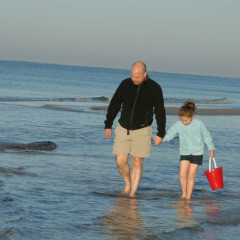
Walking the beach, Joel and daughter Felicity (photo by Megan Miller)
If you have kids, you know that discipline is inescapable. Without discipline they will talk with their mouths full, smart-talk their elders, punch their siblings, wear their underwear three days in a row, play in busy streets, tease animals, ignore their homework, and tell off-color jokes.
At least that’s what I did.
Because children can be so foolish (childish?), Dr. D. Ross Campbell says that many parents “conclude that discipline is the basic and primary way of treating a child.” I gave my parents plenty of reasons to think so. But in his now-classic parenting book, How to Really Love Your Child, Campbell challenges that notion and argues that the basic and primary way of treating a child is with love. “A child is the most needy person in our society,” he says, “and the greatest need is love.”
This may seem obvious, but it’s also a bit tricky. Our children are not blank slates. They have their own temperamental dispositions, whether they are, for instance, more positive, adaptable, distractable, etc. Loving parents can positively shape and influence these dispositions. But, as the cliché goes, love is a verb, not a feeling. Campbell suggests that too many parents feel lovingly about their children and feel as if they are exhibiting this love but are in fact not very successful in doing so.
He says that parents (particularly men) must take the initiative in demonstrating unconditional love. “By our behavior a child sees our love.” Childrearing is fundamentally an interactive and dynamic enterprise. Kids learn what we exhibit, so if we fail in demonstrating love, then they learn behaviors that negatively condition their natural temperamental dispositions.
Campbell says that love should be demonstrated by three emotionally-gratifying means: eye contact, physical contact, and focused attention. My kids are both very affectionate, and the first two are not difficult for us, but I personally find the third one a challenge. I’ve written before about Gordon MacDonald’s book Ordering Your Private World; budgeting time is as crucial in parenting as it is on the job or anywhere else. The tyranny of the urgent (or the tyranny of the tired) can squelch almost any opportunity to demonstrate love if given the chance.
What really hit me about Campbell’s argument is how it ties into a serious concern of mine—passing on my faith to my children and having it take root in their hearts. It’s the concern of almost every Christian parent. I’ve written before about how cultivating virtue protects against unbelief. Here’s another angle: Parenting is more about evangelism than it is about discipline. And, as is true for evangelism, love is the key.
This isn’t a question of permissive parenting so much as perspective and priorities. “A child who does not feel genuinely loved and accepted,” says Campbell, “has real difficulty identifying with parents and their values. Without a strong, healthy love-bond, a child reacts to parental guidance with anger, hostility, and resentment.” What if by inadequately demonstrating love I am actually acting as an impediment to my children’s belief? What if they have “real difficulty identifying” with my faith because of me?
Thinking about those questions makes one thing very clear and certain: Good parenting isn’t just a question of making sure kids are respectful and well-mannered. It’s loving them into the arms of Christ.
Previous Post

September 13, 2010
Remember why we work
Next Post
September 17, 2010 One trait every Christian leader needs
Browse Our Archives
Select a Category Books Church Life Family Life Misc Prayer Quotes Society Spiritual Growth Theology Uncategorized Video
Select a Month April 2014 March 2014 January 2014 December 2013 November 2013 August 2013 July 2013 June 2013 May 2013 April 2013 March 2013 February 2013 January 2013 December 2012 November 2012 October 2012 September 2012 August 2012 July 2012 June 2012 May 2012 April 2012 March 2012 February 2012 December 2011 November 2011 October 2011 August 2011 July 2011 June 2011 March 2011 February 2011 January 2011 December 2010 October 2010 September 2010 August 2010 July 2010 June 2010 May 2010 September 2009 August 2009 July 2009 May 2009 April 2009 March 2009 November 2008 October 2008 July 2008 June 2008 April 2008 March 2008 February 2008 January 2008 August 2007 June 2007 October 2002 July 2002 November 1999 October 1999
Follow Us!
TAKE THE
Religious Wisdom Quiz
What is the distinctive cup used in receiving communion in many traditions?
Select your answer to see how you score.
Jug Bowl Chalice Plate
Related posts from Joel J. Miller

When our kids hurt and offend us

One (hard) reason God gives us families

The one thing kids need to hear most...

Want to see how un-Christlike you are? Try...
TRENDING AT PATHEOS Evangelical

The REST of Your Life: A Creative Wrestles...
This week I had a conversation with a good friend from church....

How the author of the world's best hymn...
I've been working with John Newton for a while now. This makes...

Long before this Lectio Divina, Psalm 130 - the song - started...

What About the Trees? Another Living Parable
After I finished writing the last article about falling leaves as a...

Why Classical Education Is a Conversation, Not a...
Come and Read: Joy in Classical Education When I was a little...

Cornell University has received a great deal of negative publicity and intense...
view all Evangelical blogs
Ad-Free & Subscriber Log-In Subscription Support
- About Us
- 2026 Calendar
- Videos
- Podcasts
- Library of World Religions
- Faith In Media Tracker
- Advertise With Us
- Write for Us
- Privacy Policy
- Terms of Service
- Do Not Sell My Data
- Contact Us
- Radiant Digital
- Manage Newsletter Subscriptions
- Unsubscribe From Notifications
- Sitemap
Copyright 2008-2026, Patheos. All rights reserved.
Subscription Support Ad-Free & Subscriber Log-In
Follow Patheos