
BuddhistCatholicContemplativeEvangelicalGeneral ChristianHinduJewishLatter-day SaintMuslimNew VisionsProgressive Christian
Beliefs
- Buddhist
- Catholic
- Contemplative
- Evangelical
- General Christian
- Hindu
- Jewish
- Latter-day Saint
- More Voices
- Muslim
- New Visions
- Pagan
- Progressive Christian
Topics
- Religion News
- Food and Religion
- Sports and Religion
- Religious Art
- Religious Music and Entertainment
- Religious Events
- History and Religion
- Style and Religion
- Politics and Religion
- Women in Religion
- Recreation Outdoors and Religion
- Business Finance and Religion
- Careers Workplace and Religion
- Education and Religion
- Family Parenting and Religion
- Health Fitness and Religion
- Home and Religion
- Relationships and Religion
- Technology and Religion
- Travel and Religion
Columnists
- Buddhist Columnists
- Business Finance and Religion Columnists
- Careers Workplace and Religion Columnists
- Catholic Columnists
- Contemplative Columnists
- Education and Religion Columnists
- Evangelists Columnists
- Family Parenting and Religion Columnists
- General Christian Columnists
- Health Fitness and Religion Columnists
- Hindu Columnists
- History and Religion Columnists
- Home and Religion Columnists
- Jewish Columnists
- More Voices Columnists
- Latter Day Columnists
- Muslim Columnists
- New Visions Columnists
- Nonreligious Columnists
- Pagan Columnists
- Politics and Religion Columnists
- Progressive Columnists
- Recreation Outdoors and Religion Columnists
- Relationships and Religion Columnists
- Religion News Columnists
- Religious Art Columnists
- Religious Events Columnists
- Religious Music and Entertainment Columnists
- Sports and Religion Columnists
- Style and Religion Columnists
- Technology and Religion Columnists
- Travel and Religion Columnists
- Women in Religion Columnists
Resource Library
- 2026 Calendar
- Library of World Religions
- The 100 Most Holy Places on Earth
- Patheos Answers
- Podcasts
- Videos
- Faith Leaders Database
- Anglican Episcopalian
- Bahai
- Baptist
- Buddhism
- Christianity
- Confucianism
- Eastern Orthodoxy
- Hinduism
- Holiness and Pentecostal
- ISKCON
- Islam
- Judaism
- Lutheran
- Methodist
- The Church of Jesus Christ of Latter-day Saints
- New Age
- Paganism
- Presbytarian and Reformed
- Protestantism
- Religion Behind the Scenes
- Roman Catholic
- Scientology
- Shia Islam
- Sikhism
- Sufism
- Sunni Islam
- Taoism
- Zen
- See all religions
Research Tools
 Ad-Free & Subscriber Log-In Subscription Support
Ad-Free & Subscriber Log-In Subscription Support
Follow Patheos 

- Trending:
- Forgiveness
- |
- Marriage
- |
- Consciousness
- |
- Death Penalty
- |
- Election
- |
- Halloween
 Joel J. Miller
-
Joel's Books
-
Article Categories
- Home
- Evangelical
- On using a prayer book
On using a prayer book
Last updated on: July 15, 2010 at 11:44 am by Joel J. Miller
On using a prayer book 2010-07-15T11:44:20-05:00 Joel J. Miller
Patheos Explore the world's faith through different perspectives on religion and spirituality! Patheos has the views of the prevalent religions and spiritualities of the world.
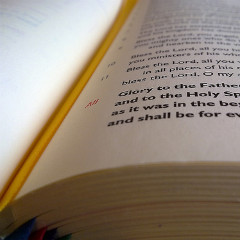
Photo by James Ogley, Flickr
For the past several years my prayer life has included the use of a prayer book. I started with the Anglican Book of Common Prayer and eventually came to use various Eastern Orthodox manuals.
I have experienced three basic reactions to my practice: (1) support, (2) curiosity, and (3) disapproval. Many have already discovered how useful prayer books can be, and some are lifelong users who cannot imagine a full prayer life without one. Others have few reference points for use of prewritten prayers but are intrigued and desire to know more. For some, however, prewritten prayers strike them as inauthentic and unspiritual. Their take seems to be that only spontaneously composed prayer is real prayer and that props like prayer manuals get in the way of true communication with God.
I grant that the use of a preformulated collection of prayers is uncommon to evangelical practice—but only sort of. Presbyterian, Reformed, and Lutheran believers often use prewritten prayers in their liturgies, particularly public confession of sin. Devotionals frequently feature prayers or suggestions for prayer. And what is the Sinner’s Prayer if not a precomposed formula designed to cover all the needful points in leading someone through a plea for salvation?
Looking at worship services might make for a useful comparison. We use psalms, hymns, and choruses that were written anywhere in the last three millennia (give or take). If spontaneity is the truest form of communication with God, then why aren’t all worship services jam sessions?
We write hymns and other worship songs because they communicate well the disposition of our hearts or help lead us to that disposition if we’re not there already, a place of worship where we stand before God and show gratitude for his love, mercy, and saving activity in our lives. They also allow people to join corporately in this holy undertaking. Prayer books serve the same three function vis-à-vis prayer.
Confessing truth before God requires ideas and words. Sometimes (perhaps oftentimes) I do not have ideas and words that are accessible or acceptable. I must reach outside myself. The church provides the ideas and words in prayer manuals. They involve confession of sin, extolling the mercies of God, petitions for his outpouring of grace, and several other aspects of the devoted life that do not come naturally to me. What’s more these prayers are beautifully composed and express well the thoughts that they are trying to communicate—much the same as an Isaac Watts hymn.
By communicating well the thoughts, they help bring my mind and heart into alignment with my confession. If I am not feeling particularly prayerful, just starting to read the prayers begins to bring things in line with what God desires of me. By the time I’m done I have truly prayed and truly worshipped—because men composed prayers more than a thousand years ago that I can access today even when I’m not feeling particularly prayerful or worshipful. The idea follows St. Benedict’s formula, mens nostra concordet voci nostrae, “Our minds must agree with our voices.” To feel prayerful, start saying your prayers; the prayer book can get you into the spirit.
Finally, by following the prayers the church offers in its manuals, I am doing something hinted at in the title of the Anglican manual; I am sharing something in common with my fellow believers. Like a massive congregation of worshippers singing one heavenly chorus to the Lord—many hearts linked by one faith and one voice—so the diverse peoples of God offer up prayer in unison, bearing one another’s burdens.
I want to participate in that glorious endeavor, but I am not up to that task on my own. And so I am grateful beyond words that God through his church offers me help, my worn and wonderful prayer book.
Previous Post

July 12, 2010
Forgetting ourselves
Next Post
July 20, 2010 The saintly imperative
Browse Our Archives
Select a Category Books Church Life Family Life Misc Prayer Quotes Society Spiritual Growth Theology Uncategorized Video
Select a Month April 2014 March 2014 January 2014 December 2013 November 2013 August 2013 July 2013 June 2013 May 2013 April 2013 March 2013 February 2013 January 2013 December 2012 November 2012 October 2012 September 2012 August 2012 July 2012 June 2012 May 2012 April 2012 March 2012 February 2012 December 2011 November 2011 October 2011 August 2011 July 2011 June 2011 March 2011 February 2011 January 2011 December 2010 October 2010 September 2010 August 2010 July 2010 June 2010 May 2010 September 2009 August 2009 July 2009 May 2009 April 2009 March 2009 November 2008 October 2008 July 2008 June 2008 April 2008 March 2008 February 2008 January 2008 August 2007 June 2007 October 2002 July 2002 November 1999 October 1999
Follow Us!
TAKE THE
Religious Wisdom Quiz
True or False: Hebrews states that without holiness no one will see the Lord.
Select your answer to see how you score.
TRUE FALSE
Related posts from Joel J. Miller

'Without embittering and embarrassing others'

God can handle your anger--and your confusion, fear...

How to cultivate spiritual peace at work

Read this before you pray for that Mercedes
TRENDING AT PATHEOS Evangelical

The REST of Your Life: A Creative Wrestles...
This week I had a conversation with a good friend from church....

How the author of the world's best hymn...
I've been working with John Newton for a while now. This makes...

Long before this Lectio Divina, Psalm 130 - the song - started...

What About the Trees? Another Living Parable
After I finished writing the last article about falling leaves as a...

Why Classical Education Is a Conversation, Not a...
Come and Read: Joy in Classical Education When I was a little...

Cornell University has received a great deal of negative publicity and intense...
view all Evangelical blogs
Ad-Free & Subscriber Log-In Subscription Support
- About Us
- 2026 Calendar
- Videos
- Podcasts
- Library of World Religions
- Faith In Media Tracker
- Advertise With Us
- Write for Us
- Privacy Policy
- Terms of Service
- Do Not Sell My Data
- Contact Us
- Radiant Digital
- Manage Newsletter Subscriptions
- Unsubscribe From Notifications
- Sitemap
Copyright 2008-2026, Patheos. All rights reserved.
Subscription Support Ad-Free & Subscriber Log-In
Follow Patheos