
BuddhistCatholicContemplativeEvangelicalGeneral ChristianHinduJewishLatter-day SaintMuslimNew VisionsProgressive Christian
Beliefs
- Buddhist
- Catholic
- Contemplative
- Evangelical
- General Christian
- Hindu
- Jewish
- Latter-day Saint
- More Voices
- Muslim
- New Visions
- Pagan
- Progressive Christian
Topics
- Religion News
- Food and Religion
- Sports and Religion
- Religious Art
- Religious Music and Entertainment
- Religious Events
- History and Religion
- Style and Religion
- Politics and Religion
- Women in Religion
- Recreation Outdoors and Religion
- Business Finance and Religion
- Careers Workplace and Religion
- Education and Religion
- Family Parenting and Religion
- Health Fitness and Religion
- Home and Religion
- Relationships and Religion
- Technology and Religion
- Travel and Religion
Columnists
- Buddhist Columnists
- Business Finance and Religion Columnists
- Careers Workplace and Religion Columnists
- Catholic Columnists
- Contemplative Columnists
- Education and Religion Columnists
- Evangelists Columnists
- Family Parenting and Religion Columnists
- General Christian Columnists
- Health Fitness and Religion Columnists
- Hindu Columnists
- History and Religion Columnists
- Home and Religion Columnists
- Jewish Columnists
- More Voices Columnists
- Latter Day Columnists
- Muslim Columnists
- New Visions Columnists
- Nonreligious Columnists
- Pagan Columnists
- Politics and Religion Columnists
- Progressive Columnists
- Recreation Outdoors and Religion Columnists
- Relationships and Religion Columnists
- Religion News Columnists
- Religious Art Columnists
- Religious Events Columnists
- Religious Music and Entertainment Columnists
- Sports and Religion Columnists
- Style and Religion Columnists
- Technology and Religion Columnists
- Travel and Religion Columnists
- Women in Religion Columnists
Resource Library
- 2026 Calendar
- Library of World Religions
- The 100 Most Holy Places on Earth
- Patheos Answers
- Podcasts
- Videos
- Faith Leaders Database
- Anglican Episcopalian
- Bahai
- Baptist
- Buddhism
- Christianity
- Confucianism
- Eastern Orthodoxy
- Hinduism
- Holiness and Pentecostal
- ISKCON
- Islam
- Judaism
- Lutheran
- Methodist
- The Church of Jesus Christ of Latter-day Saints
- New Age
- Paganism
- Presbytarian and Reformed
- Protestantism
- Religion Behind the Scenes
- Roman Catholic
- Scientology
- Shia Islam
- Sikhism
- Sufism
- Sunni Islam
- Taoism
- Zen
- See all religions
Research Tools
 Ad-Free & Subscriber Log-In Subscription Support
Ad-Free & Subscriber Log-In Subscription Support
Follow Patheos 

- Trending:
- Forgiveness
- |
- Marriage
- |
- Consciousness
- |
- Death Penalty
- |
- Election
- |
- Halloween
 Joel J. Miller
-
Joel's Books
-
Article Categories
- Home
- Evangelical
- Forgetting ourselves
Forgetting ourselves
Last updated on: December 31, 2012 at 6:30 pm by Joel J. Miller
Forgetting ourselves 2012-12-31T18:30:21-06:00 Joel J. Miller
Patheos Explore the world's faith through different perspectives on religion and spirituality! Patheos has the views of the prevalent religions and spiritualities of the world.
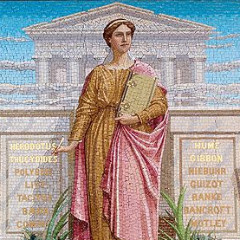
Mosaic 'History' by Frederick Dielman (Library of Congress, Wikimedia Commons).
To know who you are, you have to know from where you came. As philosopher Richard Weaver put it, “there is no identity without historicity.” The bad news is that Americans—and Westerners in general—are increasingly befogged and amnesic about our past. We are losing our history, particularly touch points to our shared Christian past.
This loss is particularly noticeable in our public life. In a recent piece for the Detroit News Fr. Robert Sirico of the Acton Institute points to several unfortunate signs of this. One is the European Union’s refusal to mention God and church in its constitution, regardless of the fact that Europe would be utterly unrecognizable today without every previous generations’ belief in both.
Another is our current presidential administration’s use of “freedom of worship” rather than “freedom of religion.” Sirico admits that this last change is subtle but says the import is significant. “It is freedom of religion, not merely worship that has been venerated since the American founding,” he says. Keeping “only one dimension of religion (worship) . . . set[s] the stage to curtail its public witness.”
In both cases a denial or depreciation of the past leads to a present denigration of the faith.
So back to Richard Weaver. In his landmark book, Ideas Have Consequences, he says that because humans “are creatures of reflection, we have only the past. The present is a line, without width; the future only a screen in our minds on which we project combinations of memory.”
Realizing this, the past takes on serious substance. It is the stuff of which our present and future is composed. But as Weaver says, we want to act without the hassle of “read[ing] the minutes of the last meeting.” Rather than taking the past into account, we endeavor to “create a new world out of good will and ignorance.”
We will fail at the job. Forget shibboleths like whether America was founded as a Christian nation, which regardless of its veracity is often a source of more heat than light. Focus instead on the West’s debt to Christianity for developments in science, political liberty, literature, music, tolerance, financial institutions, our legal systems, and technology.
You can contest or protest Christianity’s role in these developments, but they are facts of our shared history. They’re in the minutes of the last meeting. Rodney Stark’s The Victory of Reason provides an easy entry to this rich past, but regardless of how we access it, if we do not then a tremendous heritage will be squandered.
Part of this loss will be institutional. Says Sirico, tying back to Weaver’s comment about identity, it “would be an inestimable loss to the sense of who we are as a people and to any real hope we might have of building a just and tolerant future.”
And it will also be personal. History is, after all, the story of people. Speaking of developments in art and economics and technology is useful if we also remember the developers. People make history. If we cut ourselves off from our past, we are cutting ourselves off from other people. A true sense of Christian community requires that we realize our debt to the believers who have gone before us. They are crucial in many ways to our salvation and growth in the faith.
To knit together a full picture of ourselves, a true identity, we have to incorporate our past. That is true for both our culture and ourselves. And that means we also must get wise about protecting and proclaiming it for our culture and ourselves.
Previous Post

July 9, 2010
Weeding and cultivating life
Next Post
July 15, 2010 On using a prayer book
Browse Our Archives
Select a Category Books Church Life Family Life Misc Prayer Quotes Society Spiritual Growth Theology Uncategorized Video
Select a Month April 2014 March 2014 January 2014 December 2013 November 2013 August 2013 July 2013 June 2013 May 2013 April 2013 March 2013 February 2013 January 2013 December 2012 November 2012 October 2012 September 2012 August 2012 July 2012 June 2012 May 2012 April 2012 March 2012 February 2012 December 2011 November 2011 October 2011 August 2011 July 2011 June 2011 March 2011 February 2011 January 2011 December 2010 October 2010 September 2010 August 2010 July 2010 June 2010 May 2010 September 2009 August 2009 July 2009 May 2009 April 2009 March 2009 November 2008 October 2008 July 2008 June 2008 April 2008 March 2008 February 2008 January 2008 August 2007 June 2007 October 2002 July 2002 November 1999 October 1999
Follow Us!
TAKE THE
Religious Wisdom Quiz
Who was the ruler of Egypt during Joseph's time?
Select your answer to see how you score.
Nebuchadnezzar Caesar Pharaoh Cyrus
Related posts from Joel J. Miller

Christianity: Use only as directed

What's missing in our conversation about marriage decline

I guess they redid the math: World Vision...
What's so bad about incinerating 15,000 babies?
TRENDING AT PATHEOS Evangelical

The REST of Your Life: A Creative Wrestles...
This week I had a conversation with a good friend from church....

How the author of the world's best hymn...
I've been working with John Newton for a while now. This makes...

Long before this Lectio Divina, Psalm 130 - the song - started...

What About the Trees? Another Living Parable
After I finished writing the last article about falling leaves as a...

Why Classical Education Is a Conversation, Not a...
Come and Read: Joy in Classical Education When I was a little...

Cornell University has received a great deal of negative publicity and intense...
view all Evangelical blogs
Ad-Free & Subscriber Log-In Subscription Support
- About Us
- 2026 Calendar
- Videos
- Podcasts
- Library of World Religions
- Faith In Media Tracker
- Advertise With Us
- Write for Us
- Privacy Policy
- Terms of Service
- Do Not Sell My Data
- Contact Us
- Radiant Digital
- Manage Newsletter Subscriptions
- Unsubscribe From Notifications
- Sitemap
Copyright 2008-2026, Patheos. All rights reserved.
Subscription Support Ad-Free & Subscriber Log-In
Follow Patheos