
BuddhistCatholicContemplativeEvangelicalGeneral ChristianHinduJewishLatter-day SaintMuslimNew VisionsProgressive Christian
Beliefs
- Buddhist
- Catholic
- Contemplative
- Evangelical
- General Christian
- Hindu
- Jewish
- Latter-day Saint
- More Voices
- Muslim
- New Visions
- Pagan
- Progressive Christian
Topics
- Religion News
- Food and Religion
- Sports and Religion
- Religious Art
- Religious Music and Entertainment
- Religious Events
- History and Religion
- Style and Religion
- Politics and Religion
- Women in Religion
- Recreation Outdoors and Religion
- Business Finance and Religion
- Careers Workplace and Religion
- Education and Religion
- Family Parenting and Religion
- Health Fitness and Religion
- Home and Religion
- Relationships and Religion
- Technology and Religion
- Travel and Religion
Columnists
- Buddhist Columnists
- Business Finance and Religion Columnists
- Careers Workplace and Religion Columnists
- Catholic Columnists
- Contemplative Columnists
- Education and Religion Columnists
- Evangelists Columnists
- Family Parenting and Religion Columnists
- General Christian Columnists
- Health Fitness and Religion Columnists
- Hindu Columnists
- History and Religion Columnists
- Home and Religion Columnists
- Jewish Columnists
- More Voices Columnists
- Latter Day Columnists
- Muslim Columnists
- New Visions Columnists
- Nonreligious Columnists
- Pagan Columnists
- Politics and Religion Columnists
- Progressive Columnists
- Recreation Outdoors and Religion Columnists
- Relationships and Religion Columnists
- Religion News Columnists
- Religious Art Columnists
- Religious Events Columnists
- Religious Music and Entertainment Columnists
- Sports and Religion Columnists
- Style and Religion Columnists
- Technology and Religion Columnists
- Travel and Religion Columnists
- Women in Religion Columnists
Resource Library
- 2026 Calendar
- Library of World Religions
- The 100 Most Holy Places on Earth
- Patheos Answers
- Podcasts
- Videos
- Faith Leaders Database
- Anglican Episcopalian
- Bahai
- Baptist
- Buddhism
- Christianity
- Confucianism
- Eastern Orthodoxy
- Hinduism
- Holiness and Pentecostal
- ISKCON
- Islam
- Judaism
- Lutheran
- Methodist
- The Church of Jesus Christ of Latter-day Saints
- New Age
- Paganism
- Presbytarian and Reformed
- Protestantism
- Religion Behind the Scenes
- Roman Catholic
- Scientology
- Shia Islam
- Sikhism
- Sufism
- Sunni Islam
- Taoism
- Zen
- See all religions
Research Tools
 Ad-Free & Subscriber Log-In Subscription Support
Ad-Free & Subscriber Log-In Subscription Support
Follow Patheos 

- Trending:
- Forgiveness
- |
- Marriage
- |
- Consciousness
- |
- Death Penalty
- |
- Election
- |
- Halloween
 Joel J. Miller
-
Joel's Books
-
Article Categories
- Home
- Evangelical
- No ideas in a vacuum
No ideas in a vacuum
Last updated on: January 15, 2013 at 7:22 am by Joel J. Miller
No ideas in a vacuum 2013-01-15T07:22:02-06:00 Joel J. Miller
Patheos Explore the world's faith through different perspectives on religion and spirituality! Patheos has the views of the prevalent religions and spiritualities of the world.
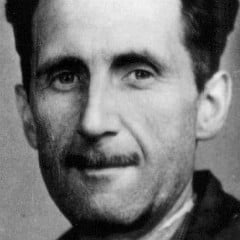
George Orwell
Ideas don’t exist in a vacuum. I was reminded of this while flipping through George Orwell’s collected essays and saw a jab he took at C.S. Lewis in a 1944 issue of the leftist Tribune. His beef was with Lewis’ collected radio talks, Beyond Personality, what eventually became the final portion of Mere Christianity.
Orwell characterized Lewis as enjoying some “vogue at this moment,” which permitted him to offer “chummy little wireless talks.” But Orwell saw these chummy talks and books as subversive. Lewis was a “reactionary”—conservative—and Orwell considered his apologetics as part of “an outflanking movement in the big counter-attack against the Left. . . .”
This perhaps does not rise to the level of great discovery, but it occurs to me that Orwell’s essay is a window through which to glimpse our basic intellectual limits (whether in theology, philosophy, economics, politics, sociology, biology, whatever).
Our ideas are not solely our own. We live in specific contexts and react to things in those contexts. What’s more, we usually have very little awareness of how dependent upon our context we truly are for what we assume to be true. My context includes living in Nashville, Tennessee, being married, having kids, being Christian, being Caucasian, being 34-years-old, balding, enjoying books, working for a publisher, driving a stick-shift, liking Tom Petty, and a million other particulars that uniquely form the matrix in which I live my life. That context conditions my thoughts and also limits them. (I, for instance, have no idea what it’s like to be a 54-year-old Muslim woman in Somalia.)
George Orwell had a context too, of course. He was a socialist at a time when fascism had ravaged Europe and was quick to see it wherever he looked, including in Lewis’ “chummy little wireless talks.” His context shaped his thoughts. To purposefully belabor the point, Lewis also had a context, and it shaped his views as much as Orwell’s affected his. But much of their contexts overlapped; they lived at the same time and interacted with the same problems and issues. And like mine, their contexts had built-in limitations.
Lewis himself helps us understand this in his famous (also 1944, by the way) introduction to St. Athanasius’ book, On The Incarnation. “Every age has its own outlook,” he writes. “It is specially good at seeing certain truths and specially liable to make certain mistakes. We all, therefore, need the books that will correct the characteristic mistakes of our own period. And that means the old books.” Why? Because “All contemporary writers share to some extent the contemporary outlook—even those, like myself, who seem most opposed to it.” He could have easily used Orwell’s name there.
The problem is that every period ends up sharing “a great mass of common assumptions” and contemporaries (or locals, etc.) have trouble thinking beyond those assumptions. Lewis offers one help: “to keep the clean sea breeze of the centuries [different contexts with different assumptions] blowing through our minds, and this can be done only by reading old books,” in his case then one by the great Alexandrian bishop Athanasius. (As Lewis suggests, future books would be great too, but Barnes and Noble doesn’t stock them yet.)
Old does not equate to good or right, of course. People were just as prone to follies and fumbles in the past. But, as Lewis says, they were prone to different ones than our own because their thinking was conditioned by different contexts. In a sense, it comes down to an application of crowdsourcing: “Two heads are better than one,” says Lewis, “not because either is infallible, but because they are unlikely to go wrong in the same direction.”
We can use ideas from different times and places to check our own. The trick is being aware enough of our contexts so that we can see the need to look outside them in the first place.
Previous Post

June 27, 2010
Encouraging belief
Next Post
June 30, 2010 Giving thanks always
Browse Our Archives
Select a Category Books Church Life Family Life Misc Prayer Quotes Society Spiritual Growth Theology Uncategorized Video
Select a Month April 2014 March 2014 January 2014 December 2013 November 2013 August 2013 July 2013 June 2013 May 2013 April 2013 March 2013 February 2013 January 2013 December 2012 November 2012 October 2012 September 2012 August 2012 July 2012 June 2012 May 2012 April 2012 March 2012 February 2012 December 2011 November 2011 October 2011 August 2011 July 2011 June 2011 March 2011 February 2011 January 2011 December 2010 October 2010 September 2010 August 2010 July 2010 June 2010 May 2010 September 2009 August 2009 July 2009 May 2009 April 2009 March 2009 November 2008 October 2008 July 2008 June 2008 April 2008 March 2008 February 2008 January 2008 August 2007 June 2007 October 2002 July 2002 November 1999 October 1999
Follow Us!
TAKE THE
Religious Wisdom Quiz
What was a biblical measurement of a span?
Select your answer to see how you score.
Full cubit Half a cubit Quarter cubit Third of a cubit
Related posts from Joel J. Miller

Christianity: Use only as directed

What's missing in our conversation about marriage decline

I guess they redid the math: World Vision...

What's so bad about incinerating 15,000 babies?
TRENDING AT PATHEOS Evangelical

The REST of Your Life: A Creative Wrestles...
This week I had a conversation with a good friend from church....

How the author of the world's best hymn...
I've been working with John Newton for a while now. This makes...

Long before this Lectio Divina, Psalm 130 - the song - started...

What About the Trees? Another Living Parable
After I finished writing the last article about falling leaves as a...

Why Classical Education Is a Conversation, Not a...
Come and Read: Joy in Classical Education When I was a little...

Cornell University has received a great deal of negative publicity and intense...
view all Evangelical blogs
Ad-Free & Subscriber Log-In Subscription Support
- About Us
- 2026 Calendar
- Videos
- Podcasts
- Library of World Religions
- Faith In Media Tracker
- Advertise With Us
- Write for Us
- Privacy Policy
- Terms of Service
- Do Not Sell My Data
- Contact Us
- Radiant Digital
- Manage Newsletter Subscriptions
- Unsubscribe From Notifications
- Sitemap
Copyright 2008-2026, Patheos. All rights reserved.
Subscription Support Ad-Free & Subscriber Log-In
Follow Patheos