
BuddhistCatholicContemplativeEvangelicalGeneral ChristianHinduJewishLatter-day SaintMuslimNew VisionsProgressive Christian
Beliefs
- Buddhist
- Catholic
- Contemplative
- Evangelical
- General Christian
- Hindu
- Jewish
- Latter-day Saint
- More Voices
- Muslim
- New Visions
- Pagan
- Progressive Christian
Topics
- Religion News
- Food and Religion
- Sports and Religion
- Religious Art
- Religious Music and Entertainment
- Religious Events
- History and Religion
- Style and Religion
- Politics and Religion
- Women in Religion
- Recreation Outdoors and Religion
- Business Finance and Religion
- Careers Workplace and Religion
- Education and Religion
- Family Parenting and Religion
- Health Fitness and Religion
- Home and Religion
- Relationships and Religion
- Technology and Religion
- Travel and Religion
Columnists
- Buddhist Columnists
- Business Finance and Religion Columnists
- Careers Workplace and Religion Columnists
- Catholic Columnists
- Contemplative Columnists
- Education and Religion Columnists
- Evangelists Columnists
- Family Parenting and Religion Columnists
- General Christian Columnists
- Health Fitness and Religion Columnists
- Hindu Columnists
- History and Religion Columnists
- Home and Religion Columnists
- Jewish Columnists
- More Voices Columnists
- Latter Day Columnists
- Muslim Columnists
- New Visions Columnists
- Nonreligious Columnists
- Pagan Columnists
- Politics and Religion Columnists
- Progressive Columnists
- Recreation Outdoors and Religion Columnists
- Relationships and Religion Columnists
- Religion News Columnists
- Religious Art Columnists
- Religious Events Columnists
- Religious Music and Entertainment Columnists
- Sports and Religion Columnists
- Style and Religion Columnists
- Technology and Religion Columnists
- Travel and Religion Columnists
- Women in Religion Columnists
Resource Library
- 2026 Calendar
- Library of World Religions
- The 100 Most Holy Places on Earth
- Patheos Answers
- Podcasts
- Videos
- Faith Leaders Database
- Anglican Episcopalian
- Bahai
- Baptist
- Buddhism
- Christianity
- Confucianism
- Eastern Orthodoxy
- Hinduism
- Holiness and Pentecostal
- ISKCON
- Islam
- Judaism
- Lutheran
- Methodist
- The Church of Jesus Christ of Latter-day Saints
- New Age
- Paganism
- Presbytarian and Reformed
- Protestantism
- Religion Behind the Scenes
- Roman Catholic
- Scientology
- Shia Islam
- Sikhism
- Sufism
- Sunni Islam
- Taoism
- Zen
- See all religions
Research Tools
 Ad-Free & Subscriber Log-In Subscription Support
Ad-Free & Subscriber Log-In Subscription Support
Follow Patheos 

- Trending:
- Forgiveness
- |
- Marriage
- |
- Consciousness
- |
- Death Penalty
- |
- Election
- |
- Halloween
 Joel J. Miller
-
Joel's Books
-
Article Categories
- Home
- Evangelical
- Sanity check for publishers
Sanity check for publishers
Last updated on: May 10, 2010 at 7:54 pm by Joel J. Miller
Sanity check for publishers 2010-05-10T19:54:58-05:00 Joel J. Miller
Patheos Explore the world's faith through different perspectives on religion and spirituality! Patheos has the views of the prevalent religions and spiritualities of the world.
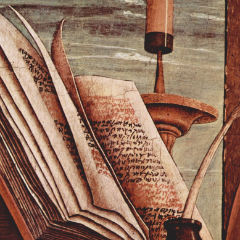
Detail from Carlo Crivelli's Pietà, Yorck Project.
In all the discussions about digital publishing, enhanced ebooks, and the future of publishing, let’s not forget that we publish books. We don’t design games, produce movies, or animate features. We publish books.
By “books” I do not mean a bunch of printed pages between covers, what is technically known as a codex. That format has been in wide use for the last nineteen hundred years or so. Before that the format of choice was the scroll. Today we have more format options—primarily audio and ebook—but the essence of what we do, regardless of format, is publish (to be necessarily redundant) books.
By books I mean sustained discussions or stories. The delivery mechanism is minimally relevant to what a book is. Tom Wolfe published Ambush at Fort Bragg as an audio book three years before it made its way to print, but it was still a book. In whatever format it comes, a book engages the mind and emotions in a rewarding and thoroughly unique way. God only knows why, but people in the publishing business seem increasingly intent on ignoring or dismissing this fact.
I sat through a recent trade event that featured several engaging speakers, one of whom said that traditional ebooks will be gone in two years. Apologies, but this is nonsense. We’ll still be printing books in twenty-four months, and there will be plenty of simple, unenhanced ebooks sold then too. Why? Because readers want books—sustained discussions and stories that immerse their hearts and minds in ways that only books can. Fragmented texts with splotches of audiovisual enhancement may make headway in the marketplace, but they will never replace books, nor will they provide the foundation for success in the future of publishing. But the speaker nonetheless advised us to move forward and innovate relentlessly.
In what direction? To what end?
What worries me is that publishers are losing touch with what God put them on earth to do. I have actually heard people say that we are no longer book publishers; we are “content providers.” I’ve heard this hundreds of times and spoken with all of the self-authenticating assurance of gospel. I recognize that statements like this come from the need to make sense of the tremendous change happening around us, but this language is unhelpful in the extreme.
Think about this: A company has a strategy to focus its efforts. Calling ourselves content providers is an unstrategy. It’s like Patton’s Third Army saying they’re about munitions instead of Berlin. It generalizes our efforts. Content is generic. Books are specific. Content is meaningless. Books have meaning. Content is data. Books are prose and poetry. As my wife likes to say, talking about content is like talking about ingredients. Any cook knows that cooking comes down to garlic, tomatoes, and onions. “Ingredients” is too vague to be useful. But that’s where we are headed.
Let me state the obvious. Bell South is content provider. So is Comcast, Wikipedia, Rick Warren, Sony Pictures, EMI, the San Diego Union Tribune, and Facebook. That’s a wide field. Can publishers compete with Jerry Bruckheimer, Xbox, Jimmy Wales, and Twitter? Forget about it. It’s a stupid question. But it’s the question we have to start asking if we insist on seeing ourselves as content providers instead of publishers.
It’s about books. Forget all the other crap and focus on books. Print, audio, electronic? Yes, sure, definitely—but don’t forget what it is that we are doing. We talk about the need to know our customers. We have it easy. They’re readers. We know that much. And we know something else. Readers don’t want content. They want books.
In conversations about this subject, the analogy of the music business is brought up time and again. The music business went through comparable disruptions, and publishers like to think of these colleagues as the first frog to cross the street. The comparisons are mostly unhelpful (there is, for instance, nothing truly comparable about listening to a song and a reading a book). But here’s one that actually means something: books are like symphonies or concertos—lengthy compositions, usually highly integrated with repeating themes and ideas, designed to carry the listener aloft by creating tensions that mount and release and intensify as the piece develops and grows. They represent sustained concepts, elaborate trains of thought that require attention and focus—attention and focus that are rewarded for their use.
Analogizing books to pop songs is wrong. Ditto for comparisons involving YouTube, video games, blogs, and magazines. They are not mutually exclusive, but the audience for one is not the same as the audience for the other.
We live in an age when data is abundant and content is free. Synthesis and analysis are not. A book provides a reader what they cannot get for free. It provides a symphony of words. The composer/author arranges an argument or story in way that is engaging, pleasing, infuriating, fascinating, and in a way that can only be truly or effectively delivered as a book. Various enhancements might supplement this experience, but they will not supplant it.
Fragmented information is everywhere. Elaborate, composed, immersive information is not. It’s in books. As publishers, we are about books.
Previous Post

May 5, 2010
Impact of the King James Bible
Next Post

May 14, 2010 What goes into a man
Browse Our Archives
Select a Category Books Church Life Family Life Misc Prayer Quotes Society Spiritual Growth Theology Uncategorized Video
Select a Month April 2014 March 2014 January 2014 December 2013 November 2013 August 2013 July 2013 June 2013 May 2013 April 2013 March 2013 February 2013 January 2013 December 2012 November 2012 October 2012 September 2012 August 2012 July 2012 June 2012 May 2012 April 2012 March 2012 February 2012 December 2011 November 2011 October 2011 August 2011 July 2011 June 2011 March 2011 February 2011 January 2011 December 2010 October 2010 September 2010 August 2010 July 2010 June 2010 May 2010 September 2009 August 2009 July 2009 May 2009 April 2009 March 2009 November 2008 October 2008 July 2008 June 2008 April 2008 March 2008 February 2008 January 2008 August 2007 June 2007 October 2002 July 2002 November 1999 October 1999
Follow Us!
TAKE THE
Religious Wisdom Quiz
What animal is mentioned in Proverbs as having little strength but great wisdom?
Select your answer to see how you score.
Ant Ox Lion Bear
Related posts from Joel J. Miller

That curious time when every pope wore a...


Why moving stinks and staying is better

Read the Bible if you're going to have...
TRENDING AT PATHEOS Evangelical

The REST of Your Life: A Creative Wrestles...
This week I had a conversation with a good friend from church....

How the author of the world's best hymn...
I've been working with John Newton for a while now. This makes...

Long before this Lectio Divina, Psalm 130 - the song - started...

What About the Trees? Another Living Parable
After I finished writing the last article about falling leaves as a...

Why Classical Education Is a Conversation, Not a...
Come and Read: Joy in Classical Education When I was a little...

Cornell University has received a great deal of negative publicity and intense...
view all Evangelical blogs
Ad-Free & Subscriber Log-In Subscription Support
- About Us
- 2026 Calendar
- Videos
- Podcasts
- Library of World Religions
- Faith In Media Tracker
- Advertise With Us
- Write for Us
- Privacy Policy
- Terms of Service
- Do Not Sell My Data
- Contact Us
- Radiant Digital
- Manage Newsletter Subscriptions
- Unsubscribe From Notifications
- Sitemap
Copyright 2008-2026, Patheos. All rights reserved.
Subscription Support Ad-Free & Subscriber Log-In
Follow Patheos