
BuddhistCatholicContemplativeEvangelicalGeneral ChristianHinduJewishLatter-day SaintMuslimNew VisionsProgressive Christian
Beliefs
- Buddhist
- Catholic
- Contemplative
- Evangelical
- General Christian
- Hindu
- Jewish
- Latter-day Saint
- More Voices
- Muslim
- New Visions
- Pagan
- Progressive Christian
Topics
- Religion News
- Food and Religion
- Sports and Religion
- Religious Art
- Religious Music and Entertainment
- Religious Events
- History and Religion
- Style and Religion
- Politics and Religion
- Women in Religion
- Recreation Outdoors and Religion
- Business Finance and Religion
- Careers Workplace and Religion
- Education and Religion
- Family Parenting and Religion
- Health Fitness and Religion
- Home and Religion
- Relationships and Religion
- Technology and Religion
- Travel and Religion
Columnists
- Buddhist Columnists
- Business Finance and Religion Columnists
- Careers Workplace and Religion Columnists
- Catholic Columnists
- Contemplative Columnists
- Education and Religion Columnists
- Evangelists Columnists
- Family Parenting and Religion Columnists
- General Christian Columnists
- Health Fitness and Religion Columnists
- Hindu Columnists
- History and Religion Columnists
- Home and Religion Columnists
- Jewish Columnists
- More Voices Columnists
- Latter Day Columnists
- Muslim Columnists
- New Visions Columnists
- Nonreligious Columnists
- Pagan Columnists
- Politics and Religion Columnists
- Progressive Columnists
- Recreation Outdoors and Religion Columnists
- Relationships and Religion Columnists
- Religion News Columnists
- Religious Art Columnists
- Religious Events Columnists
- Religious Music and Entertainment Columnists
- Sports and Religion Columnists
- Style and Religion Columnists
- Technology and Religion Columnists
- Travel and Religion Columnists
- Women in Religion Columnists
Resource Library
- 2026 Calendar
- Library of World Religions
- The 100 Most Holy Places on Earth
- Patheos Answers
- Podcasts
- Videos
- Faith Leaders Database
- Anglican Episcopalian
- Bahai
- Baptist
- Buddhism
- Christianity
- Confucianism
- Eastern Orthodoxy
- Hinduism
- Holiness and Pentecostal
- ISKCON
- Islam
- Judaism
- Lutheran
- Methodist
- The Church of Jesus Christ of Latter-day Saints
- New Age
- Paganism
- Presbytarian and Reformed
- Protestantism
- Religion Behind the Scenes
- Roman Catholic
- Scientology
- Shia Islam
- Sikhism
- Sufism
- Sunni Islam
- Taoism
- Zen
- See all religions
Research Tools
 Ad-Free & Subscriber Log-In Subscription Support
Ad-Free & Subscriber Log-In Subscription Support
Follow Patheos 

- Trending:
- Forgiveness
- |
- Marriage
- |
- Consciousness
- |
- Death Penalty
- |
- Election
- |
- Halloween
 Joel J. Miller
-
Joel's Books
-
Article Categories
- Home
- Evangelical
- Angels have we heard on high?
Angels have we heard on high?
Last updated on: January 5, 2013 at 3:37 pm by Joel J. Miller
Angels have we heard on high? 2013-01-05T15:37:31-06:00 Joel J. Miller
Patheos Explore the world's faith through different perspectives on religion and spirituality! Patheos has the views of the prevalent religions and spiritualities of the world.

Mosaic detail, Saint Sophia Cathedral in Kiev, Wikimedia Commons.
Last Wednesday Pope Benedict talked a bit about the spill he took earlier in July and the broken wrist he suffered.
“Unfortunately, my own guardian angel did not prevent my injury,” he said. The angel didn’t fall down on the job. He was “certainly following superior orders.” The upbeat pope added, “Perhaps the Lord wanted to teach me more patience and humility, give me more time for prayer and meditation.”
I’ve not really thought much about guardian angels since I was a kid, but I’ve been thinking a lot about them lately — probably why the pope story stuck out for me. In my prayers each day I recite Psalm 91, which says this about guardian angels:
Because you have made the Lord your dwelling place —
the Most High, who is my refuge —
no evil shall be allowed to befall you,
no plague come near your tent.
For he will command his angels concerning you
to guard you in all your ways.
On their hands they will bear you up,
lest you strike your foot against a stone.
They may not have borne up the pope in his recent tumble but, like he said, they were “following superior orders.” From various passages in scripture it’s clear that angels are sent by God to help accomplish his purposes in our lives. Here’s another example from the Psalms, the thirty-fourth:
This poor man cried, and the Lord heard him
and saved him out of all his troubles.
The angel of the Lord encamps
around those who fear him, and delivers them.
Angels feature in several Old Testament accounts. Take the story in Genesis 24 when Abraham sends his steward to fetch a wife for Isaac. Abraham tells him “The Lord … will send his angel before you, and you shall take a wife for my son….” And this one from Exodus 23, God speaking: “Behold, I send an angel before you to guard you on the way and to bring you to the place that I have prepared. Pay careful attention to him and obey his voice; do not rebel against him, for he will not pardon your transgression, for my name is in him. But if you carefully obey his voice and do all that I say, then I will be an enemy to your enemies and an adversary to your adversaries.”
The angels’ role in protection is again seen in the Gospels, when Jesus pulls a child to him to settle a dispute among the disciples about who was greatest in the kingdom of heaven. “See that you do not despise one of these little ones,” he says. “For I tell you that in heaven their angels always see the face of my Father who is in heaven” (Matthew 18).
The church fathers also talk about angels. In the sixth of his Miscellanies, Clement of Alexandria, who was born in 153 AD, mentions “regiments of angels … distributed over the nations and cities,” adding that some are “perchance … assigned to individuals.” Gregory of Neocaesarea, born in 205, spoke of “those beings who are not seen, but yet are more godlike, and who have a special care for men.” Riffing on the theme of the angel guiding and directing God’s people, as in Exodus 23, Gregory mentions that his angel “sustains, and instructs, and conducts me….” And Basil, more than a hundred years after Gregory, speaks in his book On The Spirit about angels being “set over men as tutors and guardians.”
Reading ancient Christian texts like these can also help trace the source of popular modern ideas — like the idea that we all have an angel on one shoulder and a devil on the other. Maybe the earliest example of this idea is from the second century book, The Shepherd of Hermas, which was regarded for a long time by some as scripture. It says, “there are two angels with a man, one of righteousness and the other of iniquity.”
John Cassian, born in 360, echoes the thought. “For Holy Scripture bears witness that two angels, a good and a bad one, cling to each one of us,” he says. For the good, Cassian cites the above passages from Matthew and Psalm 34 and alludes to the story from Acts when Peter was imprisoned by Herod, rescued, and came to stand at the gate of Mary’s house. The other disciples were convinced of his death. Herod had, after all, just killed James. So when the servant girl answered and came to tell the others that Peter was standing at the door, they replied: “It is his angel!” As for the angel on the other shoulder, Cassian cites Hermas, Satan’s tempting of Job, as well as Psalm 109, which he reads as a reference to Judas: “And let the devil stand at his right hand” (some translations say “accuser”).
I want to do a lot more reading on this subject, but for now my main takeaway is that God has not left us alone. Not only is he everywhere present, but his servants and messengers are with us too. So maybe the pope’s fall happened so he could have more time for meditation and prayer, like he said — and so that others of us could be reminded that there really still are, as Paul Simon put it, angels in the architecture.
Previous Post
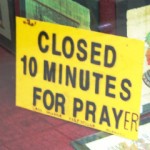
August 3, 2009
Prayer and the workday
Next Post

August 10, 2009 Sex and food
Browse Our Archives
Select a Category Books Church Life Family Life Misc Prayer Quotes Society Spiritual Growth Theology Uncategorized Video
Select a Month April 2014 March 2014 January 2014 December 2013 November 2013 August 2013 July 2013 June 2013 May 2013 April 2013 March 2013 February 2013 January 2013 December 2012 November 2012 October 2012 September 2012 August 2012 July 2012 June 2012 May 2012 April 2012 March 2012 February 2012 December 2011 November 2011 October 2011 August 2011 July 2011 June 2011 March 2011 February 2011 January 2011 December 2010 October 2010 September 2010 August 2010 July 2010 June 2010 May 2010 September 2009 August 2009 July 2009 May 2009 April 2009 March 2009 November 2008 October 2008 July 2008 June 2008 April 2008 March 2008 February 2008 January 2008 August 2007 June 2007 October 2002 July 2002 November 1999 October 1999
Follow Us!
TAKE THE
Religious Wisdom Quiz
What question did Jesus ask Saul on the road to Damascus?
Select your answer to see how you score.
Saul, Saul, why do you persecute me? Why do you hate me? Why do you persecute my followers? Do you not know who I am?
Related posts from Joel J. Miller

Is the Resurrection essential to Christian belief?

Christianity: Use only as directed

What Barton and Copeland get wrong about war...

George Orwell and bending the Bible for our...
TRENDING AT PATHEOS Evangelical

The REST of Your Life: A Creative Wrestles...
This week I had a conversation with a good friend from church....

How the author of the world's best hymn...
I've been working with John Newton for a while now. This makes...

Long before this Lectio Divina, Psalm 130 - the song - started...

What About the Trees? Another Living Parable
After I finished writing the last article about falling leaves as a...

Why Classical Education Is a Conversation, Not a...
Come and Read: Joy in Classical Education When I was a little...

Cornell University has received a great deal of negative publicity and intense...
view all Evangelical blogs
Ad-Free & Subscriber Log-In Subscription Support
- About Us
- 2026 Calendar
- Videos
- Podcasts
- Library of World Religions
- Faith In Media Tracker
- Advertise With Us
- Write for Us
- Privacy Policy
- Terms of Service
- Do Not Sell My Data
- Contact Us
- Radiant Digital
- Manage Newsletter Subscriptions
- Unsubscribe From Notifications
- Sitemap
Copyright 2008-2026, Patheos. All rights reserved.
Subscription Support Ad-Free & Subscriber Log-In
Follow Patheos