
BuddhistCatholicContemplativeEvangelicalGeneral ChristianHinduJewishLatter-day SaintMuslimNew VisionsProgressive Christian
Beliefs
- Buddhist
- Catholic
- Contemplative
- Evangelical
- General Christian
- Hindu
- Jewish
- Latter-day Saint
- More Voices
- Muslim
- New Visions
- Pagan
- Progressive Christian
Topics
- Religion News
- Food and Religion
- Sports and Religion
- Religious Art
- Religious Music and Entertainment
- Religious Events
- History and Religion
- Style and Religion
- Politics and Religion
- Women in Religion
- Recreation Outdoors and Religion
- Business Finance and Religion
- Careers Workplace and Religion
- Education and Religion
- Family Parenting and Religion
- Health Fitness and Religion
- Home and Religion
- Relationships and Religion
- Technology and Religion
- Travel and Religion
Columnists
- Buddhist Columnists
- Business Finance and Religion Columnists
- Careers Workplace and Religion Columnists
- Catholic Columnists
- Contemplative Columnists
- Education and Religion Columnists
- Evangelists Columnists
- Family Parenting and Religion Columnists
- General Christian Columnists
- Health Fitness and Religion Columnists
- Hindu Columnists
- History and Religion Columnists
- Home and Religion Columnists
- Jewish Columnists
- More Voices Columnists
- Latter Day Columnists
- Muslim Columnists
- New Visions Columnists
- Nonreligious Columnists
- Pagan Columnists
- Politics and Religion Columnists
- Progressive Columnists
- Recreation Outdoors and Religion Columnists
- Relationships and Religion Columnists
- Religion News Columnists
- Religious Art Columnists
- Religious Events Columnists
- Religious Music and Entertainment Columnists
- Sports and Religion Columnists
- Style and Religion Columnists
- Technology and Religion Columnists
- Travel and Religion Columnists
- Women in Religion Columnists
Resource Library
- 2026 Calendar
- Library of World Religions
- The 100 Most Holy Places on Earth
- Patheos Answers
- Podcasts
- Videos
- Faith Leaders Database
- Anglican Episcopalian
- Bahai
- Baptist
- Buddhism
- Christianity
- Confucianism
- Eastern Orthodoxy
- Hinduism
- Holiness and Pentecostal
- ISKCON
- Islam
- Judaism
- Lutheran
- Methodist
- The Church of Jesus Christ of Latter-day Saints
- New Age
- Paganism
- Presbytarian and Reformed
- Protestantism
- Religion Behind the Scenes
- Roman Catholic
- Scientology
- Shia Islam
- Sikhism
- Sufism
- Sunni Islam
- Taoism
- Zen
- See all religions
Research Tools
 Ad-Free & Subscriber Log-In Subscription Support
Ad-Free & Subscriber Log-In Subscription Support
Follow Patheos 

- Trending:
- Forgiveness
- |
- Marriage
- |
- Consciousness
- |
- Death Penalty
- |
- Election
- |
- Halloween
 Joel J. Miller
-
Joel's Books
-
Article Categories
- Home
- Evangelical
- More customers, fewer consumers
More customers, fewer consumers
Last updated on: March 12, 2009 at 4:54 am by Joel J. Miller
More customers, fewer consumers 2009-03-12T04:54:50-06:00 Joel J. Miller
Patheos Explore the world's faith through different perspectives on religion and spirituality! Patheos has the views of the prevalent religions and spiritualities of the world.
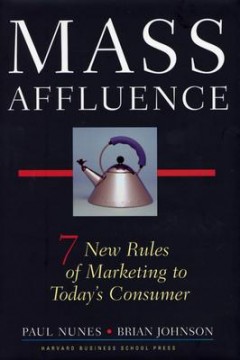
Mass Affluence
To succeed in business you need to “meet the needs of consumers,” right? It’s so hackneyed it must be true. It’s so true it must be wrong.
To get what I mean, see how this strikes you. It’s from the jacket copy of Paul Nunes and Brian Johnson’s book Mass Affluence: Seven New Rules of Marketing to Today’s Consumer (Harvard Business School Press):
Millions of consumers can now afford to pay more for everything—from household cleaning products to clothing to automobiles. Yet these “moneyed masses” are not spending nearly what their disposable incomes allow. This lack of spending translates into a huge, unspoken-for portion of affluent customers’ paychecks—a bounty waiting to be won by today’s marketers.
The book was published in 2004. In those halcyon days before our present woes, we weren’t spending enough? Yeah. Sure. Onetime Linens ‘n Things employee Debbie Jeffries said this after mentioning people at her cash register, their wallets ablossom with more credit cards than a Chase Manhattan spring: “That people can pull out that many credit cards—that’s insane. You say, whoa, maybe that’s why we’re here. We have so much debt.” Safer to say we were spending far too much.
What Jeffries saw anecdotally is borne out by the numbers. As a percentage of disposable income consumer and mortgage debt rose from 77% in 1990 to 127% in 2008, according to the Economist.
When Nunes and Johnson published, it was well over 100%. People are shoveling deeper and deeper holes and somehow these guys miss all the dirt flying through the air? It wasn’t just them. It has to do with how the wider culture pictures people engaged in buying and selling.
Words like consumer or customer have deeper meanings than our offhanded ways of tossing them about might indicate. Those deeper meanings affect how we think. In the blockquoted graf above these mythic people with gobs of money are not customers. They’re targets, opportunities. The term customer is used, but it’s an editorial choice. Mr. Roget was given breath precisely to prevent copywriters from having to repeat themselves.
The trouble is this. Use of the word consumer tends to debase, even dehumanize, the business relationship. It reduces people to the lowest level of identification in the transaction. Look at the etymology; the root means to take. Taking is certainly occurring. But it’s the most basic thing. There is nothing elevated about it. There is nothing that assumes value beyond what the person is doing in the transaction. There’s nothing transcendent or reflective of human dignity. People are what we can sell them.
Customer gets at something richer and fuller. It implies ongoing, interpersonal relationship, not merely a transaction. A customer is accustomed to your business. The word’s Latin parent means to make one’s own. Your business becomes the customer’s concern, and vice versa. There’s something personal and relational built into the concept.
The difference for business is this. You can use a consumer. You can think of them as a mere target for your wares and services, an opportunity for a sale. Not so with a customer. There is a relational responsibility inherent to treating people like customers, something more fulfilling, more affirming of the other’s humanity, and ultimately better for business. Such a picture of people strengthens social bonds (and the trust that trade depends upon) rather than looking for yet more inventive ways to extract their financial worth with no regard for social consequence.
Perhaps another way to think of it is this: Consumers are means to an end. Customers are ends in themselves.
Previous Post

March 11, 2009
Authentic growth vs. trash and waste
Next Post

March 20, 2009 Working in uncertainty
Browse Our Archives
Select a Category Books Church Life Family Life Misc Prayer Quotes Society Spiritual Growth Theology Uncategorized Video
Select a Month April 2014 March 2014 January 2014 December 2013 November 2013 August 2013 July 2013 June 2013 May 2013 April 2013 March 2013 February 2013 January 2013 December 2012 November 2012 October 2012 September 2012 August 2012 July 2012 June 2012 May 2012 April 2012 March 2012 February 2012 December 2011 November 2011 October 2011 August 2011 July 2011 June 2011 March 2011 February 2011 January 2011 December 2010 October 2010 September 2010 August 2010 July 2010 June 2010 May 2010 September 2009 August 2009 July 2009 May 2009 April 2009 March 2009 November 2008 October 2008 July 2008 June 2008 April 2008 March 2008 February 2008 January 2008 August 2007 June 2007 October 2002 July 2002 November 1999 October 1999
Follow Us!
TAKE THE
Religious Wisdom Quiz
Who said, "We must go through many hardships to enter the kingdom of God"?
Select your answer to see how you score.
Stephen Paul Peter John
Related posts from Joel J. Miller

Christianity: Use only as directed

What's missing in our conversation about marriage decline

I guess they redid the math: World Vision...

What's so bad about incinerating 15,000 babies?
TRENDING AT PATHEOS Evangelical

The REST of Your Life: A Creative Wrestles...
This week I had a conversation with a good friend from church....

How the author of the world's best hymn...
I've been working with John Newton for a while now. This makes...

Long before this Lectio Divina, Psalm 130 - the song - started...

What About the Trees? Another Living Parable
After I finished writing the last article about falling leaves as a...

Why Classical Education Is a Conversation, Not a...
Come and Read: Joy in Classical Education When I was a little...

Cornell University has received a great deal of negative publicity and intense...
view all Evangelical blogs
Ad-Free & Subscriber Log-In Subscription Support
- About Us
- 2026 Calendar
- Videos
- Podcasts
- Library of World Religions
- Faith In Media Tracker
- Advertise With Us
- Write for Us
- Privacy Policy
- Terms of Service
- Do Not Sell My Data
- Contact Us
- Radiant Digital
- Manage Newsletter Subscriptions
- Unsubscribe From Notifications
- Sitemap
Copyright 2008-2026, Patheos. All rights reserved.
Subscription Support Ad-Free & Subscriber Log-In
Follow Patheos