
BuddhistCatholicContemplativeEvangelicalGeneral ChristianHinduJewishLatter-day SaintMuslimNew VisionsProgressive Christian
Beliefs
- Buddhist
- Catholic
- Contemplative
- Evangelical
- General Christian
- Hindu
- Jewish
- Latter-day Saint
- More Voices
- Muslim
- New Visions
- Pagan
- Progressive Christian
Topics
- Religion News
- Food and Religion
- Sports and Religion
- Religious Art
- Religious Music and Entertainment
- Religious Events
- History and Religion
- Style and Religion
- Politics and Religion
- Women in Religion
- Recreation Outdoors and Religion
- Business Finance and Religion
- Careers Workplace and Religion
- Education and Religion
- Family Parenting and Religion
- Health Fitness and Religion
- Home and Religion
- Relationships and Religion
- Technology and Religion
- Travel and Religion
Columnists
- Buddhist Columnists
- Business Finance and Religion Columnists
- Careers Workplace and Religion Columnists
- Catholic Columnists
- Contemplative Columnists
- Education and Religion Columnists
- Evangelists Columnists
- Family Parenting and Religion Columnists
- General Christian Columnists
- Health Fitness and Religion Columnists
- Hindu Columnists
- History and Religion Columnists
- Home and Religion Columnists
- Jewish Columnists
- More Voices Columnists
- Latter Day Columnists
- Muslim Columnists
- New Visions Columnists
- Nonreligious Columnists
- Pagan Columnists
- Politics and Religion Columnists
- Progressive Columnists
- Recreation Outdoors and Religion Columnists
- Relationships and Religion Columnists
- Religion News Columnists
- Religious Art Columnists
- Religious Events Columnists
- Religious Music and Entertainment Columnists
- Sports and Religion Columnists
- Style and Religion Columnists
- Technology and Religion Columnists
- Travel and Religion Columnists
- Women in Religion Columnists
Resource Library
- 2026 Calendar
- Library of World Religions
- The 100 Most Holy Places on Earth
- Patheos Answers
- Podcasts
- Videos
- Faith Leaders Database
- Anglican Episcopalian
- Bahai
- Baptist
- Buddhism
- Christianity
- Confucianism
- Eastern Orthodoxy
- Hinduism
- Holiness and Pentecostal
- ISKCON
- Islam
- Judaism
- Lutheran
- Methodist
- The Church of Jesus Christ of Latter-day Saints
- New Age
- Paganism
- Presbytarian and Reformed
- Protestantism
- Religion Behind the Scenes
- Roman Catholic
- Scientology
- Shia Islam
- Sikhism
- Sufism
- Sunni Islam
- Taoism
- Zen
- See all religions
Research Tools
 Ad-Free & Subscriber Log-In Subscription Support
Ad-Free & Subscriber Log-In Subscription Support
Follow Patheos 

- Trending:
- Forgiveness
- |
- Marriage
- |
- Consciousness
- |
- Death Penalty
- |
- Election
- |
- Halloween
 Joel J. Miller
-
Joel's Books
-
Article Categories
- Home
- Evangelical
- Jesus, we hardly knew thee?
Jesus, we hardly knew thee?
Last updated on: January 11, 2014 at 9:34 pm by Joel J. Miller
Jesus, we hardly knew thee? 2014-01-11T21:34:03-06:00 Joel J. Miller
Patheos Explore the world's faith through different perspectives on religion and spirituality! Patheos has the views of the prevalent religions and spiritualities of the world.
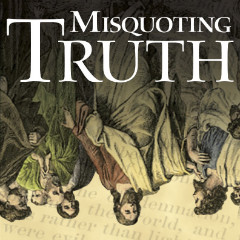
Cover detail from Timothy Paul Jones' 'Misquoting Truth.'
Since the publication of Dan Brown’s spiritual thriller The Da Vinci Code popular buzz about alternative Christianities has been relentless. Otherwise dry bibilical scholars have seen miracles — such as their tombly academic tomes climbing the bestseller lists. That’s what happened to Bart D. Ehrman and his 2005 book Misquoting Jesus, which has sold more than 160,000 copies to date.
Ehrman argues that New Testament documents are error-ridden to the point of unreliability and that one early Christian sect squashed competing sects who proffered alternate perspectives on Jesus and the Gospel. Not so fast, says Timothy Paul Jones, author of the just-released Ehrman rebuttle, Misquoting Truth (IVP Books, 2007). Jones’ book, written for a popular audience and billed as “A Guide to the Fallacies of Bart Ehrman’s Misquoting Jesus,” handily addresses Ehrman’s major complaints and criticisms in an approach that is unusually irenic and a style that is surprisingly breezy. But Jones’ cool zephyr packs a destructive wallop.
He, for instance, acknowledges the widespread errors in the New Testament documents and provides several examples of copyists and scribes altering the texts by adding to, subtracting from, or simply mangling them. “[T]he 5,700 or so New Testament manuscripts that are available to us may differ from one another in as many as 400,000 places — and there are only 138,000 or so words in the Greek New Testament in the first place!” But then he convincingly demonstrates that:
- most errors have no bearing at all upon key Christian doctrines
- the majority are typographical anomalies that have no discernable impact on the meaning of the texts
- employing textual criticism to compare the 5,700 copies reveals where and when errors were introduced, thereby correcting most
- copyists were by and large concerned with preserving texts, not altering them to advance their own agendas
In short, contra Ehrman, the New Testament texts appear to be highly reliable.
Jones deals just as efficiently with Ehrman’s contention that the early Church suppressed competing Christian sects such as the Ebionites, Docetics, and Gnostics. The early Church — proto-orthodox, as Ehrman calls them — valued first-hand accounts of the life of Jesus and esteemed them as authoritative. Jones demonstrates that the four received gospels, Matthew, Mark, Luke, and John, all had strong oral traditions that linked them to apostolic eyewitness accounts of Christ and his work. Others such as The Gospel of Peter did not and were rejected.
“Even among the earliest Christians,” writes Jones, “testimony that could be connected to eyewitnesses of the risen Lord was uniquely authoritative. That’s why the supposed ‘lost Scriptures’ were lost. . . . In most cases, early Christians knew that these documents came too late to represent eyewitness testimony about Jesus. That’s why they rejected these texts as authoritative accounts of Jesus’ life.” These “lost Christianities” were less suppressed than they were simply dismissed and ignored. The process was protracted and messy, but that is why they eventually faded into obscurity.
An unexpected bonus in Misquoting Truth is a biographical comparison of these two authors. Ehrman, who started out a believer, lost his faith as he grappled with the problems that he and Jones cover in their respective books. Jones almost went the same route. Faced with errors in the New Testament documents, Jones began to doubt the whole Christian story. Careful and dogged study led him out of his doubts and he emerged with a renewed and stronger faith — but not by ignoring the issues raised by scholars such as Ehrman. “Though I mourn the death of Ehrman’s faith,” writes Jones, “I must admit that he has raised many fruitful questions — questions that cannot be blithely ignored.”
Rather, they should be answered, something Misquoting Truth admirably does.
Previous Post

June 20, 2007
Adam Smith for dummies
Next Post

January 6, 2008 To the ends of the earth
Browse Our Archives
Select a Category Books Church Life Family Life Misc Prayer Quotes Society Spiritual Growth Theology Uncategorized Video
Select a Month April 2014 March 2014 January 2014 December 2013 November 2013 August 2013 July 2013 June 2013 May 2013 April 2013 March 2013 February 2013 January 2013 December 2012 November 2012 October 2012 September 2012 August 2012 July 2012 June 2012 May 2012 April 2012 March 2012 February 2012 December 2011 November 2011 October 2011 August 2011 July 2011 June 2011 March 2011 February 2011 January 2011 December 2010 October 2010 September 2010 August 2010 July 2010 June 2010 May 2010 September 2009 August 2009 July 2009 May 2009 April 2009 March 2009 November 2008 October 2008 July 2008 June 2008 April 2008 March 2008 February 2008 January 2008 August 2007 June 2007 October 2002 July 2002 November 1999 October 1999
Follow Us!
TAKE THE
Religious Wisdom Quiz
How long did Persian empire rule?
Select your answer to see how you score.
250 years 150 years 200 years 180 years
Related posts from Joel J. Miller

One resource every pastor, scholar, and student needs

What Barton and Copeland get wrong about war...

George Orwell and bending the Bible for our...

Read the Bible if you're going to have...
TRENDING AT PATHEOS Evangelical

The REST of Your Life: A Creative Wrestles...
This week I had a conversation with a good friend from church....

How the author of the world's best hymn...
I've been working with John Newton for a while now. This makes...

Long before this Lectio Divina, Psalm 130 - the song - started...

What About the Trees? Another Living Parable
After I finished writing the last article about falling leaves as a...

Why Classical Education Is a Conversation, Not a...
Come and Read: Joy in Classical Education When I was a little...

Cornell University has received a great deal of negative publicity and intense...
view all Evangelical blogs
Ad-Free & Subscriber Log-In Subscription Support
- About Us
- 2026 Calendar
- Videos
- Podcasts
- Library of World Religions
- Faith In Media Tracker
- Advertise With Us
- Write for Us
- Privacy Policy
- Terms of Service
- Do Not Sell My Data
- Contact Us
- Radiant Digital
- Manage Newsletter Subscriptions
- Unsubscribe From Notifications
- Sitemap
Copyright 2008-2026, Patheos. All rights reserved.
Subscription Support Ad-Free & Subscriber Log-In
Follow Patheos