
BuddhistCatholicContemplativeEvangelicalGeneral ChristianHinduJewishLatter-day SaintMuslimNew VisionsProgressive Christian
Beliefs
- Buddhist
- Catholic
- Contemplative
- Evangelical
- General Christian
- Hindu
- Jewish
- Latter-day Saint
- More Voices
- Muslim
- New Visions
- Pagan
- Progressive Christian
Topics
- Religion News
- Food and Religion
- Sports and Religion
- Religious Art
- Religious Music and Entertainment
- Religious Events
- History and Religion
- Style and Religion
- Politics and Religion
- Women in Religion
- Recreation Outdoors and Religion
- Business Finance and Religion
- Careers Workplace and Religion
- Education and Religion
- Family Parenting and Religion
- Health Fitness and Religion
- Home and Religion
- Relationships and Religion
- Technology and Religion
- Travel and Religion
Columnists
- Buddhist Columnists
- Business Finance and Religion Columnists
- Careers Workplace and Religion Columnists
- Catholic Columnists
- Contemplative Columnists
- Education and Religion Columnists
- Evangelists Columnists
- Family Parenting and Religion Columnists
- General Christian Columnists
- Health Fitness and Religion Columnists
- Hindu Columnists
- History and Religion Columnists
- Home and Religion Columnists
- Jewish Columnists
- More Voices Columnists
- Latter Day Columnists
- Muslim Columnists
- New Visions Columnists
- Nonreligious Columnists
- Pagan Columnists
- Politics and Religion Columnists
- Progressive Columnists
- Recreation Outdoors and Religion Columnists
- Relationships and Religion Columnists
- Religion News Columnists
- Religious Art Columnists
- Religious Events Columnists
- Religious Music and Entertainment Columnists
- Sports and Religion Columnists
- Style and Religion Columnists
- Technology and Religion Columnists
- Travel and Religion Columnists
- Women in Religion Columnists
Resource Library
- 2026 Calendar
- Library of World Religions
- The 100 Most Holy Places on Earth
- Patheos Answers
- Podcasts
- Videos
- Faith Leaders Database
- Anglican Episcopalian
- Bahai
- Baptist
- Buddhism
- Christianity
- Confucianism
- Eastern Orthodoxy
- Hinduism
- Holiness and Pentecostal
- ISKCON
- Islam
- Judaism
- Lutheran
- Methodist
- The Church of Jesus Christ of Latter-day Saints
- New Age
- Paganism
- Presbytarian and Reformed
- Protestantism
- Religion Behind the Scenes
- Roman Catholic
- Scientology
- Shia Islam
- Sikhism
- Sufism
- Sunni Islam
- Taoism
- Zen
- See all religions
Research Tools
 Ad-Free & Subscriber Log-In Subscription Support
Ad-Free & Subscriber Log-In Subscription Support
Follow Patheos 

- Trending:
- Forgiveness
- |
- Marriage
- |
- Consciousness
- |
- Death Penalty
- |
- Election
- |
- Halloween
 Joel J. Miller
-
Joel's Books
-
Article Categories
- Home
- Evangelical
- Miles from the truth
Miles from the truth
Last updated on: June 6, 2013 at 8:32 am by Joel J. Miller
Miles from the truth 2013-06-06T08:32:03-05:00 Joel J. Miller
Patheos Explore the world's faith through different perspectives on religion and spirituality! Patheos has the views of the prevalent religions and spiritualities of the world.

God: A Biography
In 1995 author Jack Miles touched off a theological tempest in a teapot with his publication of God: A Biography, in which he attempts to tell the story of God by reading the Hebrew Scriptures as “imaginative literature.” With the 2001 publication of Christ: A Crisis in the Life of God, Miles uses the same approach to explore the life and significance of Jesus, and the tempest is again brewing.
The result of the Pulitzer-winning God was a radical revisionist take on its subject, imaging God as something of an all-powerful tot in the beginning, who, as a babe playing with fragile toys, plunges his creation into ruin. Like process theology taken to the nth degree, in Miles’ scheme God explores, experiments, and toys through life with the rest of his creatures. He’s learning his own ropes.
Powerful ignoramus
“The Lord God at the start of the Tanakh [the Jewish canon] is a being in whom self-ignorance is joined to immense power,” but God begins to doubt and falter as he is “immediately surprised by the consequences of his actions,” says Miles. People don’t act the way he thinks they should. They rebel, and he overreacts. Miles, for instance, refers to God’s post-Fall treatment of Adam and Eve as a “vindictive reaction.” But Miles sees God as mellowing over time.
The Tanakh arranges the Scriptures differently than does the Christian Old Testament. Tucked in the back are books like Psalms, Job, Ezra, Nehemiah, and Esther. Using this arrangement, Miles reads the Tanakh in one start-to-finish, organic chunk and concludes that God, excited and powerful in the beginning of the “narrative,” trades his omnipotence for omniscience as he goes along. Increasingly he learns his own limitations and becomes humble, even reclusive. Miles quotes David’s “Why do you sleep, O Lord?” as evidence of God’s disengagement. With Lamentations God is sitting back and watching, but not acting.
By the time we get to Esther, God doesn’t even make an appearance. As God comes to learn more and more, he “understands what motivated him at the start, [thus] his motivation to continue is undercut.” In short, God gets bored with creation. He quits.
God lets Judah get sacked, whereas in previous times he would have sent a host of angels to thwart the attackers of his people. His restoration of the captives is only partial. Nehemiah and Ezra live out of Persia’s pocket. Zerubbabel, of David’s line, is not like his kingly forebears, but rather Babylon’s appointed governor of Judea; his name means simply “born in Babylon.” It’s almost as if God just doesn’t care anymore.
In Christ, Miles describes him as “a white-haired sage seated on a throne, burdened with his own knowledge and emotionally detached.”
But by the time we get to the New Testament, as Miles spins the yarn, there is a switch. God has grown up and, now older and wiser, wants to fix the disaster he’s made of creation. He’s no self-justifying King Lear (“I am a man more sinned against than sinning”). Rather, God in Christ fesses up and wants to set things right.
God repents
Mentioning that Jesus’ ministry begins with John’s baptism, Miles is quick to note the “remarkable fact that God Incarnate has begun his redemptive work with an act of public repentance. Everything that will follow . . . will be preformed under the sign of this repentance. The observation bears repeating: God has repented! But of what?” Turn back a few pages for the answer. “The world is a great crime,” he explains, “and someone must be made to pay for it.” Ah, but “who is to be blamed for our expulsion from Eden? It is the Lord himself who cursed what he created.” Thus, he says, “Mythologically read, the New Testament is the story of how someone, the right someone, does pay for it.”
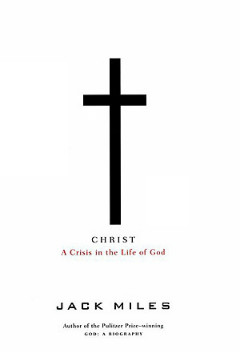
Christ: A Crisis in the Life of God
Miles’ theography in a nutshell: God fouls things up. God as Christ repents. Christ pays for his sins on the cross — what Miles refers to as a “sacred suicide.”
Whereas in the Old Testament, God “was ignorant of his own power” and “had to discover it by using and by misusing it,” in the New Testament, Christ “was blind to his own weakness” and “had to discover by succumbing to it. At length, he chose to undergo a human death in order to prove to himself and to reveal to the world the full, mixed truth about himself.”
Ignoring basic critiques about Miles’ methodology, which is more than a little suspect, one question juts to prominence: Why would anyone buy into such an upended gospel? According to Miles himself, readers’ initial reactions have been, “How dare you?” Big surprise. “But then,” he told the Los Angeles Times, “they tried to identify with what is inspiring in it. The notion that God repents is unorthodox. But in the gospel, when Jesus is baptized at the Jordan River, he goes through the ritual of repentance. If at first people say, ‘How dare you?’ they then say, ‘Can’t we be inspired by a God who does repent?'”
Not really.
Broken promises
In an online discussion of Christ at Slate with New America Foundation fellow Debra Dickerson, Nation columnist Katha Pollitt points out that Miles’ thesis does little to inspire or encourage.
[B]y New Testament times God seems to have lost his old military magic he not only knows he won’t rescue the Jews from the Roman oppressors but perhaps could not do so even if he wanted to. Becoming human, sharing the fate he imposed on humanity, is God’s atonement and also his triumphant second act: The material blessings hitherto promised to the Jews become the supernatural blessings — life after death — promised to all. Clever of God, isn’t it? He obviously failed to deliver on his part of the covenant with the Jews. But who can say whether God is keeping his new covenant with believers? By the time we find out, we’ll be dead.
In other words, instead of inspiring, all Miles does is throw salvation into jeopardy. If God can’t save, if he falls short and fails the Jews, then who knows if he can save New Covenant believers?
Miles stands against the orthodox view that God is mighty to save, full of power, and capable of achieving his aims. For Miles, God is a failure. Take his appraisal of Christ’s table-turning trip to the temple: “As for the Temple that Jesus now visits, though Jewish taxes have paid for it, is it the Lord’s or Herod’s? Observing its commercialization, Jesus feels shame. If the chosen people have to conduct their very worship as junior partners in a foreign-owned enterprise, the blame is not theirs. He had promised it would not be so, and he has not kept his promise” (emphasis added).
Here Miles shows that he didn’t get much out of his previous study of the Tanakh. He completely misses the concept of covenant. God blesses when Israel obeys, curses when it rebels (Dt. 28).
Israel’s pummeling by the nations was not a failing of God. It was God’s doing, spurred by Israel’s recalcitrance. “But if you will not obey the voice of the Lord your God to do all his commandments and his statutes that I command you today, then you shall be only oppressed and crushed continually” (Dt. 28.15, 33). God is not obligated to bless or protect Israel if it breaks its end of the bargain. Says God in Ezekiel, “I will deal with you has you have done, you who have despised the oath in breaking the covenant” (16.59). Jesus did not feel shame because he had not kept his promise. He was released from any obligation by Israel’s unfaithfulness.
But in the midst of that unfaithfulness there is also hope: “I will establish my covenant with you, and you shall know that I am the Lord, that you may remember and be confounded, and never open your mouth again because of your shame, when I atone for you for all that you have done, declares the Lord God” (Ez. 16.62-63).
God restores
Early in Christ Miles notes, “If God had to suffer and die, then God had to inflict suffering and death upon himself. But why would God do this?” Miles says it’s because God is a sinner, because God slipped up. But the better answer is right there in Ezekiel. God wants communion with his people. He wants intimacy with them. Thus when they break faith with him, he must redeem and atone for them. Largely ignoring the writings of Paul, Miles misses Romans 8.20: “For the creation was subjected to futility, not willingly, but because of him who subjected it in hope that the creation itself will be set free from its bondage to decay and obtain freedom of the glory of the children of God.”
God didn’t subject the world to futility in ignorance, as Miles supposes. He did it in hope of redemption and restoration. Miles’ mix-up starts right at the beginning: God is a character in the story, yes. In fact, he is the hero who rescues his damsel, the Bride as she is called in Revelation 19. He atones for her sins, not his own. But as much as he is the hero, he is also the author. God writes the story. God says what happens in it. God decrees it. He makes it so. In short, he is not some heavenly goof-up, for whom we are to feel pity as if he were some well-meaning figure in a piece of pulp fiction or a tragic character like Hamlet. He is almighty. He is sovereign.
And, as far as I can tell, he’s not Jack Miles’ God.
Christ: A Crisis in the Life of God
Previous Post

July 10, 2002
Learning from tragedy: Blow
Next Post

June 20, 2007 Adam Smith for dummies
Browse Our Archives
Select a Category Books Church Life Family Life Misc Prayer Quotes Society Spiritual Growth Theology Uncategorized Video
Select a Month April 2014 March 2014 January 2014 December 2013 November 2013 August 2013 July 2013 June 2013 May 2013 April 2013 March 2013 February 2013 January 2013 December 2012 November 2012 October 2012 September 2012 August 2012 July 2012 June 2012 May 2012 April 2012 March 2012 February 2012 December 2011 November 2011 October 2011 August 2011 July 2011 June 2011 March 2011 February 2011 January 2011 December 2010 October 2010 September 2010 August 2010 July 2010 June 2010 May 2010 September 2009 August 2009 July 2009 May 2009 April 2009 March 2009 November 2008 October 2008 July 2008 June 2008 April 2008 March 2008 February 2008 January 2008 August 2007 June 2007 October 2002 July 2002 November 1999 October 1999
Follow Us!
TAKE THE
Religious Wisdom Quiz
Who tricked Jacob into marrying Leah instead of Rachel?
Select your answer to see how you score.
Reuben Esau Laban Joseph
Related posts from Joel J. Miller

One resource every pastor, scholar, and student needs

Cormac McCarthy and all the broken children of...

One (hard) reason God gives us families

What is Christian literature? God's truth, wherever you...
TRENDING AT PATHEOS Evangelical

The REST of Your Life: A Creative Wrestles...
This week I had a conversation with a good friend from church....

How the author of the world's best hymn...
I've been working with John Newton for a while now. This makes...

Long before this Lectio Divina, Psalm 130 - the song - started...

What About the Trees? Another Living Parable
After I finished writing the last article about falling leaves as a...

Why Classical Education Is a Conversation, Not a...
Come and Read: Joy in Classical Education When I was a little...

Cornell University has received a great deal of negative publicity and intense...
view all Evangelical blogs
Ad-Free & Subscriber Log-In Subscription Support
- About Us
- 2026 Calendar
- Videos
- Podcasts
- Library of World Religions
- Faith In Media Tracker
- Advertise With Us
- Write for Us
- Privacy Policy
- Terms of Service
- Do Not Sell My Data
- Contact Us
- Radiant Digital
- Manage Newsletter Subscriptions
- Unsubscribe From Notifications
- Sitemap
Copyright 2008-2026, Patheos. All rights reserved.
Subscription Support Ad-Free & Subscriber Log-In
Follow Patheos