
BuddhistCatholicContemplativeEvangelicalGeneral ChristianHinduJewishLatter-day SaintMuslimNew VisionsProgressive Christian
Beliefs
- Buddhist
- Catholic
- Contemplative
- Evangelical
- General Christian
- Hindu
- Jewish
- Latter-day Saint
- More Voices
- Muslim
- New Visions
- Pagan
- Progressive Christian
Topics
- Religion News
- Food and Religion
- Sports and Religion
- Religious Art
- Religious Music and Entertainment
- Religious Events
- History and Religion
- Style and Religion
- Politics and Religion
- Women in Religion
- Recreation Outdoors and Religion
- Business Finance and Religion
- Careers Workplace and Religion
- Education and Religion
- Family Parenting and Religion
- Health Fitness and Religion
- Home and Religion
- Relationships and Religion
- Technology and Religion
- Travel and Religion
Columnists
- Buddhist Columnists
- Business Finance and Religion Columnists
- Careers Workplace and Religion Columnists
- Catholic Columnists
- Contemplative Columnists
- Education and Religion Columnists
- Evangelists Columnists
- Family Parenting and Religion Columnists
- General Christian Columnists
- Health Fitness and Religion Columnists
- Hindu Columnists
- History and Religion Columnists
- Home and Religion Columnists
- Jewish Columnists
- More Voices Columnists
- Latter Day Columnists
- Muslim Columnists
- New Visions Columnists
- Nonreligious Columnists
- Pagan Columnists
- Politics and Religion Columnists
- Progressive Columnists
- Recreation Outdoors and Religion Columnists
- Relationships and Religion Columnists
- Religion News Columnists
- Religious Art Columnists
- Religious Events Columnists
- Religious Music and Entertainment Columnists
- Sports and Religion Columnists
- Style and Religion Columnists
- Technology and Religion Columnists
- Travel and Religion Columnists
- Women in Religion Columnists
Resource Library
- 2026 Calendar
- Library of World Religions
- The 100 Most Holy Places on Earth
- Patheos Answers
- Podcasts
- Videos
- Faith Leaders Database
- Anglican Episcopalian
- Bahai
- Baptist
- Buddhism
- Christianity
- Confucianism
- Eastern Orthodoxy
- Hinduism
- Holiness and Pentecostal
- ISKCON
- Islam
- Judaism
- Lutheran
- Methodist
- The Church of Jesus Christ of Latter-day Saints
- New Age
- Paganism
- Presbytarian and Reformed
- Protestantism
- Religion Behind the Scenes
- Roman Catholic
- Scientology
- Shia Islam
- Sikhism
- Sufism
- Sunni Islam
- Taoism
- Zen
- See all religions
Research Tools
 Ad-Free & Subscriber Log-In Subscription Support
Ad-Free & Subscriber Log-In Subscription Support
Follow Patheos 

- Trending:
- Forgiveness
- |
- Marriage
- |
- Consciousness
- |
- Death Penalty
- |
- Election
- |
- Halloween
 Joel J. Miller
-
Joel's Books
-
Article Categories
- Home
- Evangelical
- The scary birth of Hal Lindsey
The scary birth of Hal Lindsey
Last updated on: July 4, 2002 at 12:05 am by Joel J. Miller
The scary birth of Hal Lindsey 2002-07-04T00:05:19-05:00 Joel J. Miller
Patheos Explore the world's faith through different perspectives on religion and spirituality! Patheos has the views of the prevalent religions and spiritualities of the world.
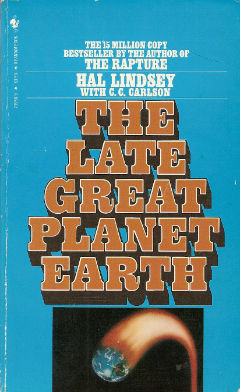
Hal Lindsey's 'The Late Great Planet Earth'
The late 1960s and ’70s were a time of fear. Paul Ehrlich told us the world would run out of food and natural resources due to overpopulation. Popular movies like Soylent Green and long lines at the gas pump only seemed to confirm the grim forecasts of his 1968 jeremiad, The Population Bomb.
Environmentalists felt the chills of an oncoming ice age and magazines as well regarded as Science gave credence to the notion that “a full-blown 100,000-year ice age” was “a real possibility.” Said Nigel Calder, former editor of New Scientist, “the threat of an ice age must now stand alongside nuclear war as a likely source of wholesale death and misery for mankind.”
Nukes were no small worry then, either. Growing up in the 1950s, school kids across the country regularly practiced bomb drills the way they today practice fire drills — only more often. Throw in Kruschev’s banging shoe and the Cuban missile crisis, and Americans were prepped to think and fear the imminent worst. Barry Goldwater’s chances at the White House were ultimately nixed by a single Lyndon Johnson TV ad which led viewers to believe that electing the Arizona Republican would install a wildcat with an itchy trigger finger behind the launch computers. Movies like Dr. Strangelove played on the fears. The first Planet of the Apes film assumed we already had blown ourselves to smithereens; part two blasted us again for good measure.
Even something as beneficial to humankind as technological advancement was pooh-poohed by some and became the cause of nail-biting for others, worried the information boom would lead to societal destabilization.
Regardless of the fact that such concerns seem naïve and absurd today, 30 years ago the prospect of being hit by a hydrogen bomb while hungrily waiting in the cold for a gallon of gas left a decade of Americans very afraid and fretting the nastiest.
“The uncertainty prevalent in the world today, now that the international order is so unstable, drives people to look for something to hold on to,” wrote church historian and biblical scholar Cornelis Vanderwaal in 1978. What millions reached for was “prophecy.”
In the midst of the nuttiness and screwball insanity of the come-apart-at-any-minute world, people were itching for answers. It was this chaos that painted the necessary backdrop for the scene that was already beginning to unfold in the 1970 publication of Hal Lindsey’s book, The Late Great Planet Earth.
In an age marked by its increasing secularism and New Age, Easterny, powder-puff religions, the publishing world was hardly ready for a small fundamentalist paperback to assault the bestseller lists like the charge of the Four Horsemen — neither did it anticipate Lindsey’s staying power. Plenty of premillennial dispensationalist books had been published before Late Great, but most to meager success — especially when stacked against Lindsey.
In the book’s first seven years it sold 10 million copies. The New York Times named the former tugboat captain the bestselling author of the decade. Before the close of the millennium, Lindsey’s book had sold over 35 million copies and had been translated into more than 50 languages.
The reason for the runaway success?
“If I had been writing 15 years earlier, I wouldn’t have had an audience,” Lindsey told Publisher’s Weekly in 1977. “But a tremendous number of people were beginning to worry about the future, and they were looking everywhere for answers. The turn to the occult, astrology, Eastern religions, and other movements reflected the fear of what was going to happen in the future. And I’m just part of that phenomenon” (emphasis added).
Lindsey’s message was born from a womb of fear and continues to thrive on a diet of international unrest — especially anything unpleasant in the Mideast. The swell has likewise picked up scads of hangers-on. Since the publication of Late Great, doom peddlers have been surfing on a wave-crest of crisis and terror. Despite his fright-flinging forebears and the current clutch of catastrophe-mongers, however, Lindsey is the alpha of the end-times omega.
premillennial dispensationalism
Previous Post
November 4, 1999
The Funky Western Civilization
Next Post

July 10, 2002 Learning from tragedy: Blow
Browse Our Archives
Select a Category Books Church Life Family Life Misc Prayer Quotes Society Spiritual Growth Theology Uncategorized Video
Select a Month April 2014 March 2014 January 2014 December 2013 November 2013 August 2013 July 2013 June 2013 May 2013 April 2013 March 2013 February 2013 January 2013 December 2012 November 2012 October 2012 September 2012 August 2012 July 2012 June 2012 May 2012 April 2012 March 2012 February 2012 December 2011 November 2011 October 2011 August 2011 July 2011 June 2011 March 2011 February 2011 January 2011 December 2010 October 2010 September 2010 August 2010 July 2010 June 2010 May 2010 September 2009 August 2009 July 2009 May 2009 April 2009 March 2009 November 2008 October 2008 July 2008 June 2008 April 2008 March 2008 February 2008 January 2008 August 2007 June 2007 October 2002 July 2002 November 1999 October 1999
Follow Us!
TAKE THE
Religious Wisdom Quiz
Which was the day that God ended His creation and rested?
Select your answer to see how you score.
On the 7th day On the 5th day On the 6th day He never rested
Related posts from Joel J. Miller

One resource every pastor, scholar, and student needs

When good things happen to bad people
Cormac McCarthy and all the broken children of...

One (hard) reason God gives us families
TRENDING AT PATHEOS Evangelical

The REST of Your Life: A Creative Wrestles...
This week I had a conversation with a good friend from church....

How the author of the world's best hymn...
I've been working with John Newton for a while now. This makes...

Long before this Lectio Divina, Psalm 130 - the song - started...

What About the Trees? Another Living Parable
After I finished writing the last article about falling leaves as a...

Why Classical Education Is a Conversation, Not a...
Come and Read: Joy in Classical Education When I was a little...

Cornell University has received a great deal of negative publicity and intense...
view all Evangelical blogs
Ad-Free & Subscriber Log-In Subscription Support
- About Us
- 2026 Calendar
- Videos
- Podcasts
- Library of World Religions
- Faith In Media Tracker
- Advertise With Us
- Write for Us
- Privacy Policy
- Terms of Service
- Do Not Sell My Data
- Contact Us
- Radiant Digital
- Manage Newsletter Subscriptions
- Unsubscribe From Notifications
- Sitemap
Copyright 2008-2026, Patheos. All rights reserved.
Subscription Support Ad-Free & Subscriber Log-In
Follow Patheos