
BuddhistCatholicContemplativeEvangelicalGeneral ChristianHinduJewishLatter-day SaintMuslimNew VisionsProgressive Christian
Beliefs
- Buddhist
- Catholic
- Contemplative
- Evangelical
- General Christian
- Hindu
- Jewish
- Latter-day Saint
- More Voices
- Muslim
- New Visions
- Pagan
- Progressive Christian
Topics
- Religion News
- Food and Religion
- Sports and Religion
- Religious Art
- Religious Music and Entertainment
- Religious Events
- History and Religion
- Style and Religion
- Politics and Religion
- Women in Religion
- Recreation Outdoors and Religion
- Business Finance and Religion
- Careers Workplace and Religion
- Education and Religion
- Family Parenting and Religion
- Health Fitness and Religion
- Home and Religion
- Relationships and Religion
- Technology and Religion
- Travel and Religion
Columnists
- Buddhist Columnists
- Business Finance and Religion Columnists
- Careers Workplace and Religion Columnists
- Catholic Columnists
- Contemplative Columnists
- Education and Religion Columnists
- Evangelists Columnists
- Family Parenting and Religion Columnists
- General Christian Columnists
- Health Fitness and Religion Columnists
- Hindu Columnists
- History and Religion Columnists
- Home and Religion Columnists
- Jewish Columnists
- More Voices Columnists
- Latter Day Columnists
- Muslim Columnists
- New Visions Columnists
- Nonreligious Columnists
- Pagan Columnists
- Politics and Religion Columnists
- Progressive Columnists
- Recreation Outdoors and Religion Columnists
- Relationships and Religion Columnists
- Religion News Columnists
- Religious Art Columnists
- Religious Events Columnists
- Religious Music and Entertainment Columnists
- Sports and Religion Columnists
- Style and Religion Columnists
- Technology and Religion Columnists
- Travel and Religion Columnists
- Women in Religion Columnists
Resource Library
- 2026 Calendar
- Library of World Religions
- The 100 Most Holy Places on Earth
- Patheos Answers
- Podcasts
- Videos
- Faith Leaders Database
- Anglican Episcopalian
- Bahai
- Baptist
- Buddhism
- Christianity
- Confucianism
- Eastern Orthodoxy
- Hinduism
- Holiness and Pentecostal
- ISKCON
- Islam
- Judaism
- Lutheran
- Methodist
- The Church of Jesus Christ of Latter-day Saints
- New Age
- Paganism
- Presbytarian and Reformed
- Protestantism
- Religion Behind the Scenes
- Roman Catholic
- Scientology
- Shia Islam
- Sikhism
- Sufism
- Sunni Islam
- Taoism
- Zen
- See all religions
Research Tools
 Ad-Free & Subscriber Log-In Subscription Support
Ad-Free & Subscriber Log-In Subscription Support
Follow Patheos 

- Trending:
- Forgiveness
- |
- Marriage
- |
- Consciousness
- |
- Death Penalty
- |
- Election
- |
- Halloween

- Home
- Evangelical
- A Christian’s Response to Religious Liberty
A Christian’s Response to Religious Liberty
Last updated on: July 3, 2018 at 5:32 pm by Jim Erwin
A Christian’s Response to Religious Liberty 2018-07-03T17:32:41-05:00 Jim Erwin
Patheos Explore the world's faith through different perspectives on religion and spirituality! Patheos has the views of the prevalent religions and spiritualities of the world.
A Christian’s Response to Religious Liberty
A Christian’s Response to Religious Liberty is the fourth sermon from Matthew 22:15-22 in the series on Counter Culture Christianity about the importance of religious liberty.
Let me share with you two different significant historical figures who shaped the Baptist influence on religious liberty in American history. First, there was Roger Williams:
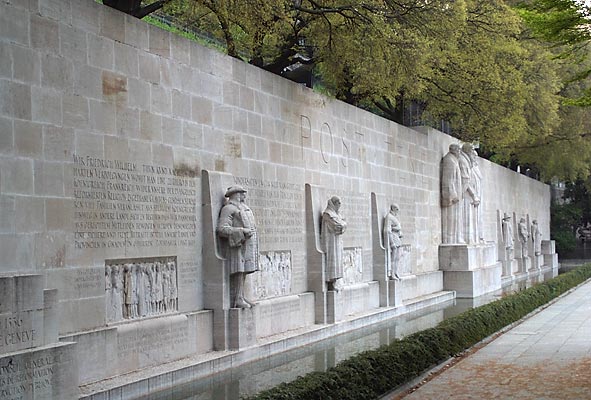
On a wall in Geneva Switzerland, there stands the Reformation Wall. This wall commemorated the people who extended religious liberty and freedom around the world during a time we call the Protestant Reformation. There are engraved statues of important people who influenced the Protestant Reformation in various parts of the world. The lifespans extend from 1489 to 1684. The last person on that wall, as one walks from left to right, is Roger Williams.
Thank God for Roger Williams, a humble Baptist preacher, who was deeply committed to religious freedom and separation of church and state. The Rhode Island colony was the first political state to allow total religious freedom to all faiths, Catholics, Protestants, Jews, Moslems, Atheists, pagans, etc. Other colonial leaders vigorously opposed total religious freedom, because they were convinced that without a state religion, anarchy and unbridled crime would lead to a complete break down of society and government. Instead, the Rhode Island colony became a model of efficiency and peacefulness. The example of Rhode Island greatly influenced the development of religious liberty at the beginning of the United States. A favorite quote from Roger Williams is: “If you force people to practice a religion that they don’t believe, you make them into hypocrites, which is worse than no religion at all!”
Second, there was John Leland:
The first amendment to our nation’s constitution states, “Congress shall make no law respecting the establishment of religion or prohibiting the free exercise thereof.”
In Virginia James Monroe, James Madison and John Leland were candidates for election to the ratifying Congress which was to vote on ratification of the Constitution of the United States. James Monroe opposed the Constitution; James Madison supported it and John Leland, a Baptist preacher, opposed the Constitution without an added “Bill of Rights”. When Madison agreed to support the “Bill of Rights” Leland withdrew and supported Madison, who was then elected.
Dr. Hugh Wamble wrote:
“Religious liberty and separation of church and state are Baptist gifts to the American people.”1
Both of these men are examples of Christians who have a response to religious liberty. They spoke out for religious freedom, which was the basis for this country’s independence. The first amendment protects many liberties, but the first freedom was the freedom to worship God as we choose.
We approach another anniversary of this country’s independence, when we celebrate the freedom we have as Americans. The greatest freedom that we celebrate is religious liberty. As Christians, we have a response to freedom or religious liberty. From this text, I want to share five foundations of religious liberty. These five foundations form the way that we respond to others about our religious liberty or freedom that we have as Christians to worship.
FIVE FOUNDATIONS OF RELIGIOUS LIBERTY
1. Civility
“Then the Pharisees went and plotted how to trap him by what he said. So they sent their disciples to him, along with the Herodians. “Teacher,” they said, “we know that you are truthful and teach truthfully the way of God. You don’t care what anyone thinks nor do you show partiality. Tell us, then, what you think. Is it lawful to pay taxes to Caesar or not?”” (Matthew 22:15–17, CSB)
The first and probably most important foundation of religious liberty for the Christian is civility. Here, we see that two completely different groups of people, political groups who have completely different agendas, have come together against Jesus. With this question, these groups questioned Jesus’ loyalty to Rome, a foreign power. That’s like questioning Obama’s citizenship and Trump’s loyalty to Russia.
Jesus didn’t post on Facebook His hatred of the Scribes and Pharisees. He didn’t question their Jewish citizenship and loyalty to Israel. The problem is this: these were religious people making callous political comments and that’s what Jesus saw as evil. Why? Because it limits the effectiveness of the Gospel. Their evil hearts are a mirror to our own. We live in a country with unparalleled freedom in history. But who complains the worst? Christians…pastors…American religious leaders. Do you see the parallel?
As Christians, sometimes we act like Dr. Bruce Banner. We are nice-mannered. We share how we love Jesus and go to church. But then when it comes to our political beliefs, we turn into The Hulk online. We need to remember that when Christians engage in the political process, we need to be civil with one another.
By the way, this means that when we come together as a church, we are all Christians. I realize that many people here, including myself, have more conservative values. But as church members and as Christians, we can’t demonize people who have different political opinions than ourselves. We know that there will be people who have different views that we do, even if they are Christians, but especially if they are lost. That leads me to the next foundation of religious liberty: courage.
2. Courage
“Perceiving their malicious intent, Jesus said, “Why are you testing me, hypocrites?” (Matthew 22:18, CSB)
The second foundation of religious liberty for the Christian is courage. Jesus spoke out against who the religious leaders really were: hypocrites.
For the Christian, it is important to have courage, especially with people who have an evil intent. It would take courage for Jesus to speak out. It will take courage for you and me as Christians to speak out.
There are people who have evil intent against other people. They are out there looking for the worst in others. Many use religion to attack other people. They manipulate religion for selfish purposes.
3. Contribution
“Show me the coin used for the tax.” They brought him a denarius. “Whose image and inscription is this?” he asked them. “Caesar’s,” they said to him. Then he said to them, “Give, then, to Caesar the things that are Caesar’s…”” (Matthew 22:19–21, CSB)
The third foundation of religious liberty for the Christian is the contribution. This reflects the importance of participation. Here, the dilemma for Jesus was contrasting loyalties. “Do I ignore the government and only focus on God?” “Do I ignore God and focus on the government?” The difference between Jesus’ day and today is the fact that the people in Jesus’ day didn’t have a say in how their government works. They could protest and put some political pressure. Yet, the Jews were living under Roman rule. They could not elect a new emperor. But they could still participate in their governmental system. They could pay taxes. Jesus made important statements about religious liberty in this exchange:
When a government is allowing religious freedom of any sort for you, you participate in that government. Even though the Roman Empire put restrictions on how the Jews could practice their religion, the Jews could still worship God in their Temple. As a matter of fact, the Roman government paid to expand the Jewish temple. It would be as if the American government helped pay for our church’s expansion. This was one of the benefits of the taxes they paid. The Roman government was helping the Jews in some ways but limiting them in others.
There is a difference between a government that limits religious liberty and one which opposes religious liberty. In Romans 13, we have a government that allows religious freedom but limits it.
“And for this reason you pay taxes, since the authorities are God’s servants, continually attending to these tasks.” (Romans 13:6, CSB)
In Revelation 13, we have a government that forbids religious freedom.
“The beast was given a mouth to utter boasts and blasphemies. It was allowed to exercise authority for forty-two months. It began to speak blasphemies against God: to blaspheme his name and his dwelling—those who dwell in heaven. And it was permitted to wage war against the saints and to conquer them. It was also given authority over every tribe, people, language, and nation. All those who live on the earth will worship it, everyone whose name was not written from the foundation of the world in the book of life of the Lamb who was slaughtered.” (Revelation 13:5–8, CSB)
The relationship between religion and government is personal and individual. It is right for the people of God to serve in government (remember Daniel and Joseph). But it is wrong for the government to control the church, or for the church to control government.2
4. Conviction
…Then he said to them, “Give, then…to God the things that are God’s.”” (Matthew 22:21, CSB)
Dr. James Montgomery Boice made the following observation:
Jesus asked for a coin. When they produced it, he asked whose portrait was on the coin and whose inscription. “Caesar’s,” they replied. “Give to Caesar what is Caesar’s,” Jesus said. However, as he continued, I think Jesus must have flipped the coin over, exposing the back on which there would have been a portrait of one of the Roman gods or goddesses, making the contrast, “and to God what is God’s”.3
The fourth foundation of religious liberty for the Christian is conviction. Jesus spoke about the need for conviction. In other words, Jesus said, “Because coins are stamped with the image of Caesar, they belong to Caesar. But because man is made in the image of God, man belongs to God.”4
Jesus was challenging the religious leaders, and everyone else, and even you and me, about our convictions. Religious freedom is not worth having without convictions.
Paval Pozel, who was exiled from Russia in 1987, said the following about Christians:
In Russia, Christians are tested by hardship, but in America you are tested by freedom. And testing by freedom is much harder. “Nobody pressures you about your religion. So you relax and are not so concentrated on Christ, on His teaching, how He wants you to live.”5
5. Communication
“When they heard this, they were amazed. So they left him and went away.” (Matthew 22:22, CSB)
The fifth foundation of religious liberty for the Christian is communication. I have said this many times before and I will say it again: Everyone has the right to hear about Jesus Christ. You have the right as a Christian to speak about Jesus Christ. That is a fundamental understanding of our first amendment right as a Christian in American society. Religious liberty means that every person can believe what they want to believe. I know that some people believe that this country is a Christian nation. I don’t believe that is true. We live in an increasingly post-Christian era. I believe that Christianity as a faith had a fundamental influence on the development of our country. Yet, today, we assume that this nation is consistently Christian.
A quarter of Americans have noted that have no religious preference. They don’t subscribe to any religion. You know what I call them? Lost people. This means that we can’t just assume that just because our evangelical leaders tell us that this is a Christian nation, that we can accept it as true. We can’t just in our pews and assume that people are going to know Jesus Christ because we say we are a Christian nation. Reciting historical evidence of a Christian worldview in our American history is not going to bring people to Jesus.
We have to go away from just spouting off and saying that we are Christians to actually telling others about the Jesus we serve. Arguing in the pews and online about the fate of our Christian heritage will never be effective in sharing the Gospel with others. Instead, we need to communicate the Gospel to those around us. That is our right as Christians and a freedom that should exercise every day.
1 “Religious Liberty Are Baptists Gifts to the American People,” Internet, https://www.facebook.com/bill.dudley.50/posts/10217227525539363, accessed on 29 June 2018.
2 Warren W. Wiersbe, The Bible Exposition Commentary, vol. 1 (Wheaton, IL: Victor Books, 1996), 80.
3 James Montgomery Boice, The Gospel of Matthew (Grand Rapids, MI: Baker Books, 2001), 474.
4 Jon Courson, Jon Courson’s Application Commentary (Nashville, TN: Thomas Nelson, 2003), 163.
5 Galaxie Software, 10,000 Sermon Illustrations (Biblical Studies Press, 2002), from Moody Monthly, April 1989.
Photo by Roland Zumbühl – www.picswiss.ch. (http://www.picswiss.ch/Genf/GE-05-02.html) [GFDL or CC-BY-SA-3.0], via Wikimedia Commons

Other Posts:
Jeremiah 34:12-17 Proclaiming Freedom
Thank God for Freedom in Jesus Christ
Christian Freedom, Denominational Walls, and Offending Others
Hebrews 10:16-25 The Key to Freedom to Fulfill My Purpose
Previous Post

June 24, 2018
A Christian’s Response to Children
Next Post

July 10, 2018 A Christian’s Response to Sexual Morality
Browse Our Archives
Select a Category 1 Chronicles 1 Corinthians 1 John 1 Kings 1 Peter 1 Samuel 1 Thessalonians 1 Timothy 2 Chronicles 2 Corinthians 2 John 2 Kings 2 Peter 2 Samuel 2 Thessalonians 2 Timothy 3 John Acts Advent Amos Book Review Colossians Comics Culture Watch Daniel Deuteronomy Ecclesiastes Ephesians Esther Exodus Ezekiel Ezra Galatians Genesis Guest Post Habakkuk Haggai Hebrews Hosea Humor Inspiritational Isaiah James Jeremiah Job Joel John Jonah Joshua Jude Judges Lamentations Lectionary Lent Leviticus Link Love Luke Malachi Mark Matthew Micah Movie Review Nahum Nehemiah Numbers Philippians Political Watch Prophecy Watch Proverbs Psalm Revelation Reviews Romans Ruth Science Watch Sermon Series Sermons Simple Thoughts Song of Solomon Titus Top Ten Uncategorized Video Review Zechariah Zephaniah
Select a Month May 2026 October 2025 September 2025 June 2025 February 2025 January 2025 November 2024 October 2024 September 2024 July 2024 June 2024 April 2024 March 2024 January 2024 November 2023 October 2023 September 2023 June 2023 May 2023 March 2023 February 2023 January 2023 December 2022 October 2022 September 2022 August 2022 July 2022 June 2022 May 2022 January 2022 June 2021 January 2021 October 2020 July 2020 May 2020 April 2020 March 2020 February 2020 January 2020 December 2019 November 2019 October 2019 September 2019 August 2019 July 2019 June 2019 May 2019 April 2019 March 2019 February 2019 January 2019 December 2018 November 2018 October 2018 September 2018 August 2018 July 2018 June 2018 May 2018 April 2018 March 2018 February 2018 January 2018 December 2017 November 2017 October 2017 September 2017 August 2017 July 2017 June 2017 May 2017 April 2017 March 2017 February 2017 January 2017 December 2016 November 2016 October 2016 September 2016 August 2016 July 2016 June 2016 May 2016 April 2016 March 2016 February 2016 January 2016 December 2015 November 2015 October 2015 September 2015 August 2015 July 2015 June 2015 May 2015 April 2015 March 2015 February 2015 January 2015 December 2014 November 2014 October 2014 September 2014 August 2014 July 2014 June 2014 May 2014 April 2014 March 2014 February 2014 January 2014 December 2013 November 2013 October 2013 September 2013 August 2013 July 2013 June 2013 May 2013 April 2013 February 2013 January 2013 December 2012 November 2012 October 2012 September 2012 August 2012 July 2012 June 2012 May 2012 April 2009 June 2008 October 2007 September 2007 August 2007 July 2007 June 2007 May 2007 April 2007 March 2007 February 2007 January 2007 December 2006 October 2006 September 2006 May 2006 April 2006 March 2006 February 2006 January 2006 December 2005 September 2005
Follow Us!
TAKE THE
Religious Wisdom Quiz
What book of the Bible tells about Jesus’ birth?
Select your answer to see how you score.
Luke Revelation Acts Hebrews
Related posts from Jim Erwin


The Obedient Servant in Suffering


The Global Mission of the Servant
TRENDING AT PATHEOS Evangelical

Letters on Living the Faith by C.S. Lewis
Most of us met C.S. Lewis as a public intellectual. Mere Christianity....

When Halloween Unmasks Married Hearts
Written by Dr. David K. Ewen from Eternal Truth Bible College Behind...

Aristotle. He’s been called the father of logic, the father of the...

Methodist Central Hall and Westminster Abbey
Situated on the same square is Methodist Central Hall and Westminster Abbey. ...

57th Dove Awards Honor Dolly Parton, Crown New...
On gospel music’s biggest night, the 57th annual GMA Dove Awards honored...

The First Eucharistic Controversy: Christ’s Real Presence
For Catholics, the Eucharist is the source and summit of the Christian...
view all Evangelical blogs
Ad-Free & Subscriber Log-In Subscription Support
- About Us
- 2026 Calendar
- Videos
- Podcasts
- Library of World Religions
- Faith In Media Tracker
- Advertise With Us
- Write for Us
- Privacy Policy
- Terms of Service
- Do Not Sell My Data
- Contact Us
- Radiant Digital
- Manage Newsletter Subscriptions
- Unsubscribe From Notifications
- Sitemap
Copyright 2008-2026, Patheos. All rights reserved.
Subscription Support Ad-Free & Subscriber Log-In
Follow Patheos