
BuddhistCatholicContemplativeEvangelicalGeneral ChristianHinduJewishLatter-day SaintMuslimNew VisionsProgressive Christian
Beliefs
- Buddhist
- Catholic
- Contemplative
- Evangelical
- General Christian
- Hindu
- Jewish
- Latter-day Saint
- More Voices
- Muslim
- New Visions
- Pagan
- Progressive Christian
Topics
- Religion News
- Food and Religion
- Sports and Religion
- Religious Art
- Religious Music and Entertainment
- Religious Events
- History and Religion
- Style and Religion
- Politics and Religion
- Women in Religion
- Recreation Outdoors and Religion
- Business Finance and Religion
- Careers Workplace and Religion
- Education and Religion
- Family Parenting and Religion
- Health Fitness and Religion
- Home and Religion
- Relationships and Religion
- Technology and Religion
- Travel and Religion
Columnists
- Buddhist Columnists
- Business Finance and Religion Columnists
- Careers Workplace and Religion Columnists
- Catholic Columnists
- Contemplative Columnists
- Education and Religion Columnists
- Evangelists Columnists
- Family Parenting and Religion Columnists
- General Christian Columnists
- Health Fitness and Religion Columnists
- Hindu Columnists
- History and Religion Columnists
- Home and Religion Columnists
- Jewish Columnists
- More Voices Columnists
- Latter Day Columnists
- Muslim Columnists
- New Visions Columnists
- Nonreligious Columnists
- Pagan Columnists
- Politics and Religion Columnists
- Progressive Columnists
- Recreation Outdoors and Religion Columnists
- Relationships and Religion Columnists
- Religion News Columnists
- Religious Art Columnists
- Religious Events Columnists
- Religious Music and Entertainment Columnists
- Sports and Religion Columnists
- Style and Religion Columnists
- Technology and Religion Columnists
- Travel and Religion Columnists
- Women in Religion Columnists
Resource Library
- 2026 Calendar
- Library of World Religions
- The 100 Most Holy Places on Earth
- Patheos Answers
- Podcasts
- Videos
- Faith Leaders Database
- Anglican Episcopalian
- Bahai
- Baptist
- Buddhism
- Christianity
- Confucianism
- Eastern Orthodoxy
- Hinduism
- Holiness and Pentecostal
- ISKCON
- Islam
- Judaism
- Lutheran
- Methodist
- The Church of Jesus Christ of Latter-day Saints
- New Age
- Paganism
- Presbytarian and Reformed
- Protestantism
- Religion Behind the Scenes
- Roman Catholic
- Scientology
- Shia Islam
- Sikhism
- Sufism
- Sunni Islam
- Taoism
- Zen
- See all religions
Research Tools
 Ad-Free & Subscriber Log-In Subscription Support
Ad-Free & Subscriber Log-In Subscription Support
Follow Patheos 

- Trending:
- Forgiveness
- |
- Marriage
- |
- Consciousness
- |
- Death Penalty
- |
- Election
- |
- Halloween

- Home
- Evangelical
- Contemporary Churches by Rev. Louis F. Kavar, Ph.D.
Contemporary Churches by Rev. Louis F. Kavar, Ph.D.
Last updated on: May 9, 2017 at 9:39 pm by Jim Erwin
Contemporary Churches by Rev. Louis F. Kavar, Ph.D. 2017-05-09T21:39:32-05:00 Jim Erwin
Patheos Explore the world's faith through different perspectives on religion and spirituality! Patheos has the views of the prevalent religions and spiritualities of the world.
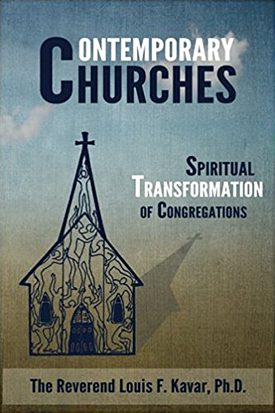
Contemporary Churches by Rev. Louis F. Kavar, Ph.D.
Contemporary Churches by Louis F. Kavar, is another book that addresses the problem of the church’s inability to engage the culture. The answer, Kavar claims is a “Spiritual Transformation of the Congregation.” Kavar states that “As culture changes, so should the church. However, the church has been one place where change has been slow to happen” (8). Kavar begins his book by diagnosing the problem with the local church. For example, he notes:
“Perhaps the most perplexing dimension of congregational revitalization is the way that American culture has changed in the last fifty years…In the midst of these changes, the local church on the corner has been a fixed institution, often a stone edifice constructed by a past generation. As society and culture has changed, the church has, by and large, stayed the same.”(22-23)
I looked forward to Kavar’s analysis and how he thought that the church should change to address the cultural changes. He mentioned that decline is happening in every church (Protestant, Mainline, and Evangelical.) Kavar reviews George Barna’s book Revolution (37) in beginning his analysis.
Kavar then summarizes another book to point to his assertion about how contemporary church should change to address the culture. Kavar uses David Kinnaman’s book, Unchristian: What a New Generation Really Thinks about Christianity and Why It Matters, as the basis for his assertion for congregational change. Kavar rightly notes (88):
“In the 21st century, organizations and institutions play a very different role. No longer do people work for only one company over their life time let alone over several generations. Many families have members living in various parts of the country. Wherever we live, we participate in any number of groups or organizations and gather in a variety of settings including health clubs, coffee shops, and community rooms in shopping malls or condominium complexes…Perhaps the biggest challenge for churches today is to understand how this cultural shift impacts them. It requires moving from the understanding of the institution as a significant hub of life which encompasses family and community to understanding that individual people and their families have a wide variety of organizational connections, each of which are significant.”
This is the most significant shift in American culture. The church is not the only hub of life. Instead, it is now just one of many optional hubs (88). Kavar notes the change that many churches are making to address this shift (90):
Kavar rightly suggests that just shifting to a Progressive Christian theology is not enough. A church must also shift the way it works (90-92). Kavar uses Walter Brueggemann’s work Prayer in the Psalms as a transition point to explain that churches are also disoriented by the culture and need to take the time to reorient (96-97).
In “Chapter 2: From Death to Life,” Kavar compares the death of a church to the stages of dying by Kubler-Ross in On Death and Dying (105-107). He makes a startling conclusion: “In fact, some projections are that up to 50% of congregations in the United States will close their doors in the next five to ten years. We are facing the death of the institutional church as we know it.”
He describes the stages of the church as they go through the process of bereavement. They are mourning the change and ultimate death of the old way of doing church (105). This process is not linear. Churches can go through many of these at the same time. They can also go through them in reverse. Kavar states that Jesus went through the stages of grief before He went to the cross (112-113).
Kavar takes the reader to the death of the church and suggests the possibility of a resurrection. Even though church life changes, it doesn’t mean that it has to end (146). He describes this process in Chapter 3. In this chapter, he gives a history of the shifts from modernism to postmodernism in America (153-155). Kavar shows sow postmodernism affects church membership (156-157). Kavar shifts to describe these new congregations as postmodern communities (161). Kavar gives a great explanation why the church struggles in the postmodern era. He shares insights from Brian Sanders’ book Life After Church: God’s Call to Disillusioned Christians (172):
“In addition to these reasons for leaving, Sanders also addresses the perspective of post-modern culture. In the post-modern era in which we live, there is a distinction between absolute truth and relative possibilities. In previous eras, science was viewed as providing facts about the world. Today, our understanding of physics and other sciences is that scientific knowledge provides probable information based on certain conditions. For instance, we know that there is matter and dark matter, that gravity pulls while other forces in the cosmos push for expansion, and that things we once thought were constant are no longer viewed as constants. In the context of a worldview which held that certain truths were unchanging, traditional Christianity articulated its beliefs as fact or dogma. Traditional Christianity holds the view that there is absolute truth. However, this absolutist view does not fit with the post-modern understanding of knowledge in which truth is no longer understood as a constant but as relative.”
Kavar suggests that emergent and progressive Christian theologies and churches can address the postmodern culture better because: “Progressive and emergent Christian theologies do not view faith as fact. Instead, faith is a conviction of what is hoped for.”(169). Borrowing from Sanders’ book, Kavar suggests three elements necessary for a new model of the church: worship, community, and mission (171).
In Chapter 4, Kavar describes why it is difficult for the church to change so that it can to reach the postmodern culture. “The model of the local church as the hub for life was true for my immigrant grandparents.” (209) “This model of the church as the center of both one’s life and activities and for the life and activities of a community is very American.” (211) “American lifestyle continued to change even more following the 1950’s.” (213) “In the 1980’s, American Evangelical churches took this traditional model of church and attempted to re-tool it” (215) “At the other end, 50% of Christian churches have no more than 75 people in attendance each Sunday.” (216)
“In the first decade of the 21st Century, Sunday morning is a time for so much more than the church. Local schools now schedule sporting events on Sunday mornings. Friends meet at coffee shops to socialize or just to relax by reading the Sunday paper. Health club parking lots are more crowded on Sunday mornings than at any other four hour period of the week. In many suburbs, Sunday morning is a good time to complete yard work and other chores before pursuing leisure activities.” (216-217)
“American culture has changed radically over the last two generations. Yet, the model for the American church has remained the same.” (218) Kavar relies on Robin Trebilcock and his book The Small Church At Large as a model for a new paradigm shift that is needed to revitalize churches which are dying.
Kavan is correct in his conclusion that people today learn about religion and spirituality from a variety of sources (224-227). He concludes with the following instruction for change in the church in the postmodern era:
“The challenge facing the local church is whether or not it can make a transition from one model to another. This change isn’t just about doing things differently, like singing contemporary music, ordering worship differently, or having more young people do things that the older generation has done. Those kinds of changes are really superficial changes. The heart of the matter for congregational transformation is changing the way the organization functions both internally and externally.” (228-229)
Kavan advocates shifting away from an attractional model of church growth where the church is the center hub of life (230). Instead of worship service that starts small groups, we would have small groups that start to come together for worship (240-241). Kavan promotes basic small group multiplication principles (242-244). A church needs to develop a community, a place to belong, where people can share one’s deepest experiences (248). Kavan notes:
“In America’s post-modern culture, perhaps the single greatest thing a congregation can offer to urban people is a community, a place to belong, a place to be with others in an unconditional way and share one’s deepest experiences. That is the heart of a community of faith.” (248)
It is at this point where Kavan diverges from the traditional Christian church growth model. He suggests (250):
“In addition to the service being bilingual, in English and Spanish, each service included readings from both the Bible and other sacred texts. There was also an extended period for a guided meditation following the sermon. These two elements helped Hindus, Buddhists, and Jews to find a place to connect in the worship experience.”
I personally believe that this was a risky move to make a Sunday evening service ecumenical. Inviting Buddhists, Jews, and other faiths (and reading from their texts) can create people who believe everything but are not committed to any one faith (250).
Kavar continues:
“Instead, in this gathering place, people who were already on a journey came together and shared what was sacred to them from the journey. Because of this, the congregation was peppered with a wide variety of folks unlikely to join together: a few retired Jewish women who lived in a residential hotel; a former Buddhist monk/artist; devotees of Hindu teacher Ma Jayasati Bhagavati; and individuals from every continent on the globe.” (252)
The model that Kavar suggests requires that people who come from different faiths and backgrounds interact and share their experiences. This would be an ecumenical worship service – one which I could not endorse (252).
Kavar shares the testimony of a Buddhist who decided to be baptized but not become a Christian, during one these services “His response was perhaps the most theologically sound description of Baptism I have ever heard.” There is nothing theologically sound about a baptism of a Buddhist who doesn’t want to be a Christian (261).
Kavar is willing to let people come together from various faiths as long as they walk away with an insight that was “sacred.” And that supported their spiritual journey (262-263). How can you say that you a building a new model of church when the focus of the church is not exclusively Jesus Christ (262-263). This is not church but simply a postmodern multi-spiritual gathering. That might be fine if you want to share experiences as group, but don’t call it church. It’s not a new model of church, but no church at all.
Kavan opens Chapter 5 with the following question: “What is a church if it isn’t a spiritual community?” (264) I agree that a church is a spiritual community. However, a spiritual community does not by itself make it a church. Christ must be the Head in order for the spiritual community to be a church (264). While Kavar notes that spiritual growth is the goal of spiritual communities, I would state that the goal of a Christian’s spiritual growth is to be like Christ. One must be interested in Jesus Christ, not just some divine being.
Kavar has correctly diagnosed the church’s current problem and the culture’s difficulty. Yet, his solution is not tenable. It won’t work because Christ builds the church (Matthew 16:18), not spiritual communities. The book provides needed analysis of the postmodern culture. However, the solution is providing a Christian community, not just a spiritual community.
Disclosure of Material Connection: I received this book free from the author and/or publisher through the Speakeasy blogging book review network. I was not required to write a positive review. The opinions I have expressed are my own. I am disclosing this in accordance with the Federal Trade Commission’s 16 CFR,Part 255.
Previous Post

May 8, 2017
Daniel 1:1-21 How to Live Life Without Compromising My Faith
Next Post

May 10, 2017 7 Better Things in Life
Browse Our Archives
Select a Category 1 Chronicles 1 Corinthians 1 John 1 Kings 1 Peter 1 Samuel 1 Thessalonians 1 Timothy 2 Chronicles 2 Corinthians 2 John 2 Kings 2 Peter 2 Samuel 2 Thessalonians 2 Timothy 3 John Acts Advent Amos Book Review Colossians Comics Culture Watch Daniel Deuteronomy Ecclesiastes Ephesians Esther Exodus Ezekiel Ezra Galatians Genesis Guest Post Habakkuk Haggai Hebrews Hosea Humor Inspiritational Isaiah James Jeremiah Job Joel John Jonah Joshua Jude Judges Lamentations Lectionary Lent Leviticus Link Love Luke Malachi Mark Matthew Micah Movie Review Nahum Nehemiah Numbers Philippians Political Watch Prophecy Watch Proverbs Psalm Revelation Reviews Romans Ruth Science Watch Sermon Series Sermons Simple Thoughts Song of Solomon Titus Top Ten Uncategorized Video Review Zechariah Zephaniah
Select a Month May 2026 October 2025 September 2025 June 2025 February 2025 January 2025 November 2024 October 2024 September 2024 July 2024 June 2024 April 2024 March 2024 January 2024 November 2023 October 2023 September 2023 June 2023 May 2023 March 2023 February 2023 January 2023 December 2022 October 2022 September 2022 August 2022 July 2022 June 2022 May 2022 January 2022 June 2021 January 2021 October 2020 July 2020 May 2020 April 2020 March 2020 February 2020 January 2020 December 2019 November 2019 October 2019 September 2019 August 2019 July 2019 June 2019 May 2019 April 2019 March 2019 February 2019 January 2019 December 2018 November 2018 October 2018 September 2018 August 2018 July 2018 June 2018 May 2018 April 2018 March 2018 February 2018 January 2018 December 2017 November 2017 October 2017 September 2017 August 2017 July 2017 June 2017 May 2017 April 2017 March 2017 February 2017 January 2017 December 2016 November 2016 October 2016 September 2016 August 2016 July 2016 June 2016 May 2016 April 2016 March 2016 February 2016 January 2016 December 2015 November 2015 October 2015 September 2015 August 2015 July 2015 June 2015 May 2015 April 2015 March 2015 February 2015 January 2015 December 2014 November 2014 October 2014 September 2014 August 2014 July 2014 June 2014 May 2014 April 2014 March 2014 February 2014 January 2014 December 2013 November 2013 October 2013 September 2013 August 2013 July 2013 June 2013 May 2013 April 2013 February 2013 January 2013 December 2012 November 2012 October 2012 September 2012 August 2012 July 2012 June 2012 May 2012 April 2009 June 2008 October 2007 September 2007 August 2007 July 2007 June 2007 May 2007 April 2007 March 2007 February 2007 January 2007 December 2006 October 2006 September 2006 May 2006 April 2006 March 2006 February 2006 January 2006 December 2005 September 2005
Follow Us!
TAKE THE
Religious Wisdom Quiz
Which Christian holiday is celebrated on December 25th in most Western churches?
Select your answer to see how you score.
Epiphany Advent Christmas Pentecost
Related posts from Jim Erwin


Using ChatGPT in Sermon Preparation


Can I Ask You a Question by Preston...
TRENDING AT PATHEOS Evangelical

In one sense walking into Westminster Abbey is like walking down the...

'Super Scam Me' Exposes AI Jon Bon Jovi...
Leslie Pickett believed she was in a relationship with Jon Bon Jovi....

The Brazilian Remake of Kendricks' 'Flywheel' Opens in...
“Flywheel,” the story that launched the Kendrick Brothers’ filmmaking career is getting...

The Dangers of Gradual Accommodation (Winking at Sin)
Recently, the “law of gradualness” resurfaced during the opening of a weeklong,...

The Iron Gates and the Lion of the...
Yesterday, I didn't finish my report about, well, yesterday. So I'll...

The Image: On the Horror of Capitalism and...
The Image Then went the Pharisees, and took counsel how they might...
view all Evangelical blogs
Ad-Free & Subscriber Log-In Subscription Support
- About Us
- 2026 Calendar
- Videos
- Podcasts
- Library of World Religions
- Faith In Media Tracker
- Advertise With Us
- Write for Us
- Privacy Policy
- Terms of Service
- Do Not Sell My Data
- Contact Us
- Radiant Digital
- Manage Newsletter Subscriptions
- Unsubscribe From Notifications
- Sitemap
Copyright 2008-2026, Patheos. All rights reserved.
Subscription Support Ad-Free & Subscriber Log-In
Follow Patheos