
BuddhistCatholicContemplativeEvangelicalGeneral ChristianHinduJewishLatter-day SaintMuslimNew VisionsProgressive Christian
Beliefs
- Buddhist
- Catholic
- Contemplative
- Evangelical
- General Christian
- Hindu
- Jewish
- Latter-day Saint
- More Voices
- Muslim
- New Visions
- Pagan
- Progressive Christian
Topics
- Religion News
- Food and Religion
- Sports and Religion
- Religious Art
- Religious Music and Entertainment
- Religious Events
- History and Religion
- Style and Religion
- Politics and Religion
- Women in Religion
- Recreation Outdoors and Religion
- Business Finance and Religion
- Careers Workplace and Religion
- Education and Religion
- Family Parenting and Religion
- Health Fitness and Religion
- Home and Religion
- Relationships and Religion
- Technology and Religion
- Travel and Religion
Columnists
- Buddhist Columnists
- Business Finance and Religion Columnists
- Careers Workplace and Religion Columnists
- Catholic Columnists
- Contemplative Columnists
- Education and Religion Columnists
- Evangelists Columnists
- Family Parenting and Religion Columnists
- General Christian Columnists
- Health Fitness and Religion Columnists
- Hindu Columnists
- History and Religion Columnists
- Home and Religion Columnists
- Jewish Columnists
- More Voices Columnists
- Latter Day Columnists
- Muslim Columnists
- New Visions Columnists
- Nonreligious Columnists
- Pagan Columnists
- Politics and Religion Columnists
- Progressive Columnists
- Recreation Outdoors and Religion Columnists
- Relationships and Religion Columnists
- Religion News Columnists
- Religious Art Columnists
- Religious Events Columnists
- Religious Music and Entertainment Columnists
- Sports and Religion Columnists
- Style and Religion Columnists
- Technology and Religion Columnists
- Travel and Religion Columnists
- Women in Religion Columnists
Resource Library
- 2026 Calendar
- Library of World Religions
- The 100 Most Holy Places on Earth
- Patheos Answers
- Podcasts
- Videos
- Faith Leaders Database
- Anglican Episcopalian
- Bahai
- Baptist
- Buddhism
- Christianity
- Confucianism
- Eastern Orthodoxy
- Hinduism
- Holiness and Pentecostal
- ISKCON
- Islam
- Judaism
- Lutheran
- Methodist
- The Church of Jesus Christ of Latter-day Saints
- New Age
- Paganism
- Presbytarian and Reformed
- Protestantism
- Religion Behind the Scenes
- Roman Catholic
- Scientology
- Shia Islam
- Sikhism
- Sufism
- Sunni Islam
- Taoism
- Zen
- See all religions
Research Tools
 Ad-Free & Subscriber Log-In Subscription Support
Ad-Free & Subscriber Log-In Subscription Support
Follow Patheos 

- Trending:
- Forgiveness
- |
- Marriage
- |
- Consciousness
- |
- Death Penalty
- |
- Election
- |
- Halloween

- Home
- Evangelical
- Reclaiming Your Story by Merle R. Jordan
Reclaiming Your Story by Merle R. Jordan
Last updated on: December 15, 2016 at 1:21 pm by Jim Erwin
Reclaiming Your Story by Merle R. Jordan 2016-12-15T13:21:46-05:00 Jim Erwin
Patheos Explore the world's faith through different perspectives on religion and spirituality! Patheos has the views of the prevalent religions and spiritualities of the world.
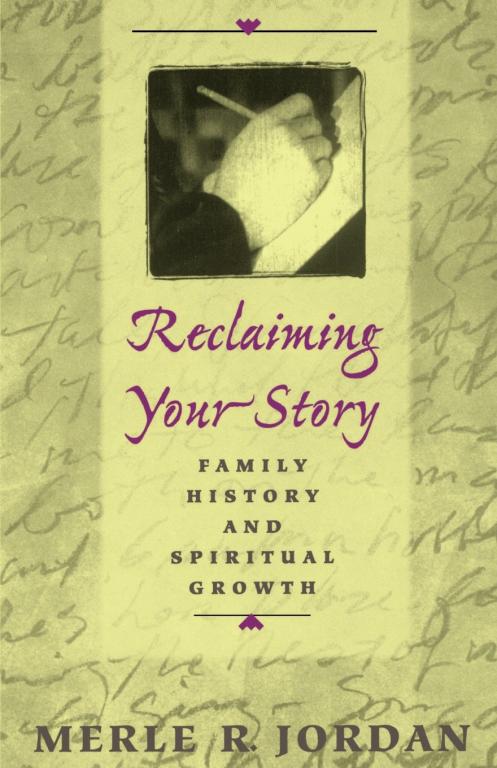
Reclaiming Your Story by Merle R. Jordan
Reclaiming Your Story by Merle R. Jordan is about as the subtitle states: family history and spiritual growth. The central premise of the book is that (1):
“deep spiritual transformation may occur when you have differentiated from your family of origin so that you harbor no ultimate loyalties that would block a total commitment to God in Christ.”
Jordan offers his spiritual biography as an example of one person who has “reclaimed his story.” He states that when one understands their family origins and how it has shaped them, they can take charge of the “leftovers” to create the life that a person wants. This is ultimately the purpose of the book. Jordan shows the reader how this is done. He does this by taking the reader on a personal journey.
In the chapter “Whose Are You,” Jordan uses his own spiritual autobiography to explain how one’s family origin can influence a person’s life. In his own family, Jordan noticed how the negative signals of a conspiracy of silence, blame, and smother love, can really shape a person and hinder their relationship with God. He ends that stating that he had to (10) “wrestle with the will of God.”
His clinical work led him to understand that separation anxiety (caused by the death of his mother) prevented him from doing the work he was called to do. This caused him to realize that he needed the love of an eternal Parent (15-16). In psychological terms, every child needs “object constancy.” In spiritual terms, everyone needs an everlasting love. He states that Psalm 139 perfectly illustrates the object constancy of the Divine. Jordan ends this topic as he explores the nature of object constancy and death. He states that because of the fear of death, we develop self-atonement strategies.
Jordan describes the communication patterns which one may learn from their families and which one may use with God. He describes the communication defenses that may use to protect oneself from the difficult emotions one experiences. Then he states that these vulnerable emotions may be used to grow spiritually in one’s relationship to God, to others and to the self. Jordan shows how one can use hurt, fear, anger, guilt and love to grow spiritually (30-38). He then encourages one to write a spiritual autobiography and a genogram to lay out one’s family history.
Jordan then shares about how to face the lasting effects of one’s family origin. I would state this chapter addresses the lasting negative effects. Jordan explores how one usually deal with the trauma of abuse. It is here that he shares valuable wisdom. The defense of the victim of abuse shows itself in the following ways (44-48):
1. The relentless living of abusive relationships, either as victim or as perpetrator.
2. The reliance on identification with the aggressor as a basic mode of psychological defense.
3. The unshakable conviction of being the cause of the abuse, deserving the abuse, and being utterly bad.
4. The seeking of object contact through physical violence, sexuality, or some combination of the two.
There are other negative effects which must be overcome such as erroneous beliefs, oppressive inner voices, and psychic idolatry. Ultimately, the goal is for an inner bonding of the internal loving parent with the inner child. This can only come through through a proper relationship with a higher source of love and truth (a Divine Parent) which one can internalize. Along with confessing the emotional truth of the meaninglessness of one’s symptoms goes a long way toward healing. The final step is to move toward a solution-focused orientation. Along with using a narrative approach to one’s life, this solution-focused orientation can bring real healing to the hurts of one’s past.
Jordan shares how to “rewrite the script” of one’s life. This process takes time and requires tools that many people would not normally use. One can choose to overcome the “hot buttons” that push emotional reactivity by learning different approaches. One can learn to use spiritual direction combined with counseling. Jordan suggests “voicing your own judge and critic” to benefit yourself. He suggests using the “empty chair,” letter writing, and graveside conversations to help one heal from trauma and difficult experiences. He suggests giving a name to my inner child and to learn to be a parent to that inner child. He also lists ways to reflect on one’s patterns of relationship with authority (95-99).
I was assigned to read this book for my second Clinical Pastoral Education course at Mercy Hospital in Springfield, Missouri. Like another book I was assigned, Healing Through the Dark Emotions, this book explores the emotional side of spirituality. Jordan does not give a theological explanation for God’s love. Instead, he gives a psychological explanation. Occasionally, he references the Bible. But many times he doesn’t need to because the basic premise is found clearly in the Bible. God is love. Jordan shows how my past – specifically my past with my family can inhibit my ability to see God as love. Thankfully, Jordan gives a variety of tools to help the reader come to see God as the Divine (and loving) Parent that He is. For those who have struggled with their past and want to see a different take without all of the theology, I highly recommend this book.
Previous Post

December 14, 2016
James 5:7-12 Exercising My Patience During the Christmas Season
Next Post

December 19, 2016 Top Ten Events of the Year 2016
Browse Our Archives
Select a Category 1 Chronicles 1 Corinthians 1 John 1 Kings 1 Peter 1 Samuel 1 Thessalonians 1 Timothy 2 Chronicles 2 Corinthians 2 John 2 Kings 2 Peter 2 Samuel 2 Thessalonians 2 Timothy 3 John Acts Advent Amos Book Review Colossians Comics Culture Watch Daniel Deuteronomy Ecclesiastes Ephesians Esther Exodus Ezekiel Ezra Galatians Genesis Guest Post Habakkuk Haggai Hebrews Hosea Humor Inspiritational Isaiah James Jeremiah Job Joel John Jonah Joshua Jude Judges Lamentations Lectionary Lent Leviticus Link Love Luke Malachi Mark Matthew Micah Movie Review Nahum Nehemiah Numbers Philippians Political Watch Prophecy Watch Proverbs Psalm Revelation Reviews Romans Ruth Science Watch Sermon Series Sermons Simple Thoughts Song of Solomon Titus Top Ten Uncategorized Video Review Zechariah Zephaniah
Select a Month May 2026 October 2025 September 2025 June 2025 February 2025 January 2025 November 2024 October 2024 September 2024 July 2024 June 2024 April 2024 March 2024 January 2024 November 2023 October 2023 September 2023 June 2023 May 2023 March 2023 February 2023 January 2023 December 2022 October 2022 September 2022 August 2022 July 2022 June 2022 May 2022 January 2022 June 2021 January 2021 October 2020 July 2020 May 2020 April 2020 March 2020 February 2020 January 2020 December 2019 November 2019 October 2019 September 2019 August 2019 July 2019 June 2019 May 2019 April 2019 March 2019 February 2019 January 2019 December 2018 November 2018 October 2018 September 2018 August 2018 July 2018 June 2018 May 2018 April 2018 March 2018 February 2018 January 2018 December 2017 November 2017 October 2017 September 2017 August 2017 July 2017 June 2017 May 2017 April 2017 March 2017 February 2017 January 2017 December 2016 November 2016 October 2016 September 2016 August 2016 July 2016 June 2016 May 2016 April 2016 March 2016 February 2016 January 2016 December 2015 November 2015 October 2015 September 2015 August 2015 July 2015 June 2015 May 2015 April 2015 March 2015 February 2015 January 2015 December 2014 November 2014 October 2014 September 2014 August 2014 July 2014 June 2014 May 2014 April 2014 March 2014 February 2014 January 2014 December 2013 November 2013 October 2013 September 2013 August 2013 July 2013 June 2013 May 2013 April 2013 February 2013 January 2013 December 2012 November 2012 October 2012 September 2012 August 2012 July 2012 June 2012 May 2012 April 2009 June 2008 October 2007 September 2007 August 2007 July 2007 June 2007 May 2007 April 2007 March 2007 February 2007 January 2007 December 2006 October 2006 September 2006 May 2006 April 2006 March 2006 February 2006 January 2006 December 2005 September 2005
Follow Us!
TAKE THE
Religious Wisdom Quiz
What does 1 Peter say believers are being built into?
Select your answer to see how you score.
Living stones A spiritual house God's temple A holy nation
Related posts from Jim Erwin


Can I Ask You a Question by Preston...

The Interfaith Family Journal by Susan Katz Miller
TRENDING AT PATHEOS Evangelical

The Iron Gates and the Lion of the...
Yesterday, I didn't finish my report about, well, yesterday. So I'll...

Dolly Parton’s Last Song Wins Dove Award with...
Bluegrass band The Grascals, speaking on the red carpet at the 57th...

The Image: On the Horror of Capitalism and...
The Image Then went the Pharisees, and took counsel how they might...

We are approaching the date of our new American national holiday: October...

Letters on Living the Faith by C.S. Lewis
Most of us met C.S. Lewis as a public intellectual. Mere Christianity....

When Halloween Unmasks Married Hearts
Written by Dr. David K. Ewen from Eternal Truth Bible College Behind...
view all Evangelical blogs
Ad-Free & Subscriber Log-In Subscription Support
- About Us
- 2026 Calendar
- Videos
- Podcasts
- Library of World Religions
- Faith In Media Tracker
- Advertise With Us
- Write for Us
- Privacy Policy
- Terms of Service
- Do Not Sell My Data
- Contact Us
- Radiant Digital
- Manage Newsletter Subscriptions
- Unsubscribe From Notifications
- Sitemap
Copyright 2008-2026, Patheos. All rights reserved.
Subscription Support Ad-Free & Subscriber Log-In
Follow Patheos