
BuddhistCatholicContemplativeEvangelicalGeneral ChristianHinduJewishLatter-day SaintMuslimNew VisionsProgressive Christian
Beliefs
- Buddhist
- Catholic
- Contemplative
- Evangelical
- General Christian
- Hindu
- Jewish
- Latter-day Saint
- More Voices
- Muslim
- New Visions
- Pagan
- Progressive Christian
Topics
- Religion News
- Food and Religion
- Sports and Religion
- Religious Art
- Religious Music and Entertainment
- Religious Events
- History and Religion
- Style and Religion
- Politics and Religion
- Women in Religion
- Recreation Outdoors and Religion
- Business Finance and Religion
- Careers Workplace and Religion
- Education and Religion
- Family Parenting and Religion
- Health Fitness and Religion
- Home and Religion
- Relationships and Religion
- Technology and Religion
- Travel and Religion
Columnists
- Buddhist Columnists
- Business Finance and Religion Columnists
- Careers Workplace and Religion Columnists
- Catholic Columnists
- Contemplative Columnists
- Education and Religion Columnists
- Evangelists Columnists
- Family Parenting and Religion Columnists
- General Christian Columnists
- Health Fitness and Religion Columnists
- Hindu Columnists
- History and Religion Columnists
- Home and Religion Columnists
- Jewish Columnists
- More Voices Columnists
- Latter Day Columnists
- Muslim Columnists
- New Visions Columnists
- Nonreligious Columnists
- Pagan Columnists
- Politics and Religion Columnists
- Progressive Columnists
- Recreation Outdoors and Religion Columnists
- Relationships and Religion Columnists
- Religion News Columnists
- Religious Art Columnists
- Religious Events Columnists
- Religious Music and Entertainment Columnists
- Sports and Religion Columnists
- Style and Religion Columnists
- Technology and Religion Columnists
- Travel and Religion Columnists
- Women in Religion Columnists
Resource Library
- 2026 Calendar
- Library of World Religions
- The 100 Most Holy Places on Earth
- Patheos Answers
- Podcasts
- Videos
- Faith Leaders Database
- Anglican Episcopalian
- Bahai
- Baptist
- Buddhism
- Christianity
- Confucianism
- Eastern Orthodoxy
- Hinduism
- Holiness and Pentecostal
- ISKCON
- Islam
- Judaism
- Lutheran
- Methodist
- The Church of Jesus Christ of Latter-day Saints
- New Age
- Paganism
- Presbytarian and Reformed
- Protestantism
- Religion Behind the Scenes
- Roman Catholic
- Scientology
- Shia Islam
- Sikhism
- Sufism
- Sunni Islam
- Taoism
- Zen
- See all religions
Research Tools
 Ad-Free & Subscriber Log-In Subscription Support
Ad-Free & Subscriber Log-In Subscription Support
Follow Patheos 

- Trending:
- Forgiveness
- |
- Marriage
- |
- Consciousness
- |
- Death Penalty
- |
- Election
- |
- Halloween

- Home
- Evangelical
- Unchurching by Richard Jacobson
Unchurching by Richard Jacobson
Last updated on: August 13, 2016 at 9:49 pm by Jim Erwin
Unchurching by Richard Jacobson 2016-08-13T21:49:57-05:00 Jim Erwin
Patheos Explore the world's faith through different perspectives on religion and spirituality! Patheos has the views of the prevalent religions and spiritualities of the world.
Unchurching by Richard Jacobson
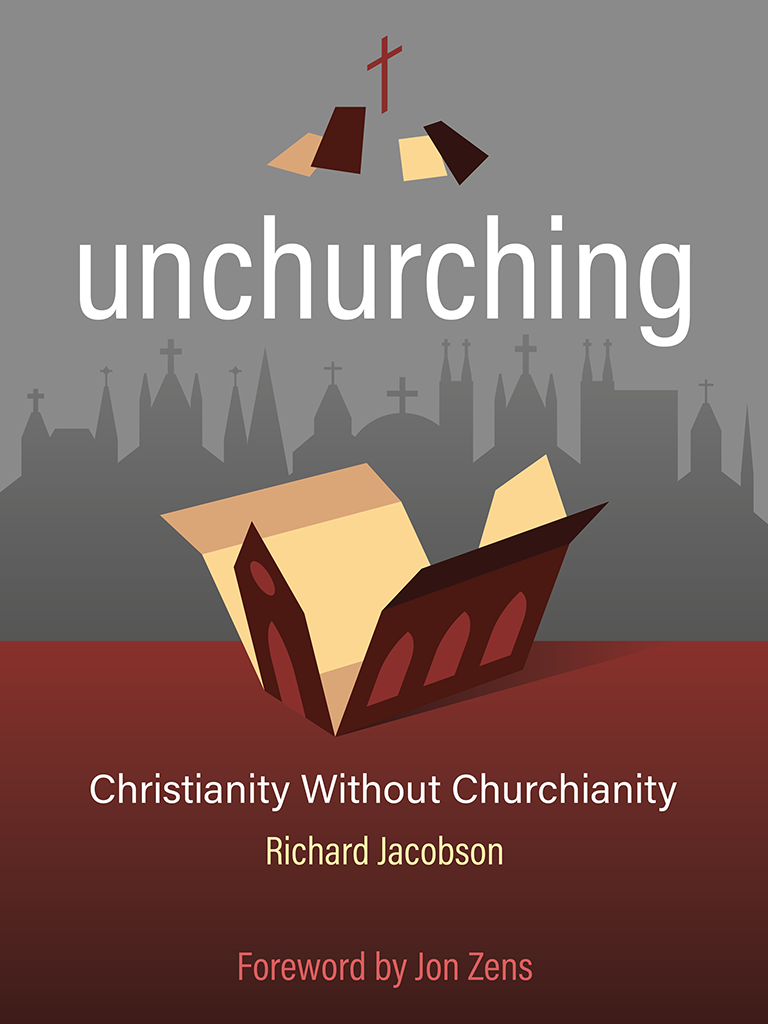
Unchurching by Richard Jacobson defines the purpose of the book with the subtitle: “Christianity without Churchanity.” He opens with the appropriate quote from Richard Halverson, former chaplain of the United States Senate (10):
In the beginning the church was a fellowship of men and women centering on the living Christ. Then the church moved to Greece, where it became a philosophy. Then it moved to Rome, where it became an institution. Next, it moved to Europe, where it became a culture. And, finally, it moved to America, where it became an enterprise.
Jacobson, a self-described church anarchist, used an animated blog to help him on his journey of faith. He had a self-described crisis of faith, which caused him to re-evaluate the meaning of church. In Part One, Jacobson describes the theological reasons why the church should be as a spiritual community. He came to the conclusion that the church is not a building, not a tradition, but a people of faith, a community. He bases his belief of a church as community on the community of God the Father, God the Son, and God the Holy Spirit in eternity. Like the Trinity, the church should be a redemptive community, sharing resources and roles, and reflect unity in the world.
In Part Two, Jacobson reveals the importance of Christians in the church community as spiritual parents (45). In his argument about church leadership, Jacobson insists that the gender of the leader of the church does not matter. He says that the original Greek contains no article to suggest male leaders. He insists that modern translations reflect a gender bias based upon tradition (49). Even if the masculine pronoun is not in the Greek in 1 Timothy 3:1, the word used for husband in 1 Timothy 3:2 (andra, meaning “married man” used in a majority of cases as the man or male in the New Testament) clearly defines the gender of the pastor. Jacobson counters with the following argument (49):
The only requirement for overseers that is specifically directed toward men is the requirement for overseers to be faithful to their wives. Because of this, translators often assumed this entire passage is specifically directed toward men. But it is equally possible this one requirement was specifically directed to the male overseers and the rest of the requirements were directed toward both men and women.
Frankly, I consider this explanation weak. The translators did not “assume” the entire passage. They used the rules of context to guide their translation. The argument lays with someone like Jacobson to prove his argument is true, than to assume that the original argument used by translators is false. This brings me to my concern with a book like this. I agree, the culture of church is restrictive and difficult at times. Yet, Jacobson’s argument is internally consistent. In Part Two, he performs eisigesis (he inserts his beliefs into the Biblical text). He does not spend time arguing the same point about gender with other verses such as Hebrews 13:7 or 1 Peter 5:2-3 (51-52). I would agree with his modern assessment about the role of church leaders (52):
Based on the requirements we find in scripture, we now know the original overseers were not church administrators who held some kind of office but spiritual parents who lived day-by-day alongside their spiritual children like shepherds, not unlike Jesus, the Good Shepherd.
Jacobson promotes the idea of a plurality of elders. He wants to suggest that it would bring back the purest form of Biblical community. The problem is that we don’t live in a perfect world, much less perfect churches. Contextualization dictates that smaller churches may not be able to be led by a plurality of elders. He continues in his analysis of the Greek about the role of leadership of the church. Throughout, he inserts the potential for female leadership. He uses the Old Testament prophecy in Joel 2:28-29 as a prescription for female leadership. While I agree that church pastors should function as “spiritual parents” (56), and if these roles are a “reflection of the Father,” then the argument’s logical conclusion should be that pastors are male.
Jacobson continues his gender-neutral argument for deacons, where he makes a more logically consistent, Biblical position. There is the possibility for deacons to be female. The case can be made for female deacons (based on Romans 16:1) One could conclude that Paul’s instruction for the deacon also includes requirements for a deacon’s wife (1 Timothy 3:11). One could further conclude based on the Greek word that the wife could be a deacon. Yet, I maintain that one should not perform Biblical gymnastics to try to prove a point that the Bible never teaches. Instead, one must maintain that perhaps the role of the women (whether it is the pastor’s wife or the deacon’s wife) is to support the husband.
Jacobson continues his gender-neutral argument for deacons, where he makes a more logically consistent, Biblical position. There is the possibility for deacons to be female. The case can be made for female deacons (based on Romans 16:1) One could conclude that Paul’s instruction for the deacon also includes requirements for a deacon’s wife (1 Timothy 3:11). One could further conclude based on the Greek word that the wife could be a deacon. Yet, I maintain that one should not perform Biblical gymnastics to try to prove a point that the Bible never teaches. Instead, one must maintain that perhaps the role of the women (whether it is the pastor’s wife or the deacon’s wife) is to support the husband.
Jacobson correctly identifies the roles of certain ministers in Ephesians 4:11-13 as people who equip other members of the church to maturity (64-65). He explores the dangers of organizational hierarchy in the church. He states a valid critique of the current church management system (69):
Such a church model is designed to produce many life-long learners but very few teachers. Or to put it another way: Sunday School is the only school from which no one ever graduates. But Christ wants us to graduate and become a true priesthood of all believers, empowered to exercise genuine spiritual authority.
Jacobson does a great job explaining the importance of spiritual authority in the church (71). He wisely warns the church about adopting corporate structures as the primary way of organizing in the church. This leads us to Part Three: Church Incorporated.
Jacobson begins by comparing our present church worship structure to the time of Ezra in Nehemiah 8:2-4, Nehemiah 8:6, Nehemiah 8:8, and Nehemiah 8:12 (76-77). He warns that the New Testament church does not contain the same elements. He explains his reasoning in the following way (78):
The reason why we cannot find any examples of our current church model in the New Testament is the same reason we cannot find any details about early church programs, policies or procedures. The fact that these details are noticeably lacking is actually one of the biggest clues about the way the early church functioned.
Jacobson insists that the early New Testament churches were just communities made up of families. He insists that the church is a family (Galatians 6:10). It functions like a family (1 Timothy 5:1-2). He warns the reader that the church as a congregation (a family) should not give up their true identity with an Americanized one: the corporation. A Corporation is designed as a legal entity to protect people. The corporation as a legal entity should never replace the church as a faith community (82).
Jacobson addresses organizational hierarchy in the Old Testament and compares it with what Jesus instituted. He compares the command and control structure presented by Jethro in Exodus 18:21-22 (90) to the alternative presented by Jesus (Matthew 18:15-17). Jesus suggested that people resolve their differences in circles of community. Jethro urged Moses to use higher forms of hierarchy. Jesus urges us to reach outward to the wider community.
Jacobson extends this idea to gender roles in the church. He believes in egalitarianism. He believes that Paul was egalitarian, even though there are Bible verses that seem to show otherwise. Slaves and freemen have equal status and standing in the church. In the same way, men and women have equal standing in the church. Jacobson tries to deal with the difficult passage that speaks against his claim (like 1 Corinthians 14:35 where women are told be silent in church.) Jacobson explains rightly that God’s ultimate goal is to restore all things. God is a God of reconciliation. Jacobson states that gender inequality came as a result of sin. God’s plan would be gender equality in the church (101). He states that Joel 2 prophesies that there would soon be no gender inequality. His point is one to consider (101):
If the subjugation of women was not part of God’s original plan for creation, then how can it be part of his ultimate plan for the church? His ultimate plan was to create a priesthood of all believers. How is that even possible if 50% of the church is ineligible to truly function as fellow priests because of their gender? It seems somewhat paradoxical that the early church was counter-culture precisely because they embraced gender equality yet many of today’s churches are becoming counter-culture precisely because they oppose it.
Jacobson compares the ministry of the megachurch and the house church (104). He states that the house church ministry models the work of Jesus – going from a few to the crowds. Books like The Purpose-Driven Church by Rick Warren (which I reviewed) seem to prove his point. However, I believe that a church can work through both directions, because I believe Jesus addressed three different groups: (1) the disciples, (2) the congregation, and (3) the crowd.
Jacobson confronts the modern “storefront” model for church growth and effectively argues that the family illustrates the natural growth of the church. He uses the illustration of the family to show important characteristics of the church (106). Jacobson advocates for the complete participation of all of the people in the church. He compares to the lack of this participation to raising veal. In his illustration, he shows that the veal (and by extension the people in the church) die when they are overfed but not given a chance to exercise (114).
In Part Four: Church Outside the Box, Jacobson encourages a paradigm shift. Again, he strongly suggests that churches pursue community (122), experience worship (124), and share power (126). He strongly believes in the idea of the “priesthood of believers” that breaks down barriers and hierarchy in the church. Jacobson shares a brief defense of the questions he raises (135). He reminds us that there are many people who are leaving the church. Jacobson explains that (138):
This book wasn’t written to try to convince anyone to leave the institutional church; it was simply written to validate and empower those who already have a growing conviction to do so.
With this statement, he joins other postmodern church leaders like David Hayward. I can appreciate the frustration that Jacobson feels, even if I am a pastor of a church. He gives statistics to defend his position (139):
According to a recent survey by The Barna Group, over the past 10 years, the number of non-churchgoers in America has grown by 38 million which is an increase of more than 30%. To put this in perspective, that is more people than the entire population of Australia (24 million) or the entire population of Canada (36 million).
Jacobson states that these statistics are bad if you want to maintain the status quo, because membership is declining. These stats are good news if you believe that the organized church model needs to be discarded (139). Jacobson doesn’t advocate isolation. Instead, he suggests that church community as we know it must change (141). While Jacobson encourages Christians to make an exodus away from the organized church, he hands off the journey to the Promised Land to Milt Rodriguez, author of Starting Organic Churches.
Jacobson never promises how to operate the new church community he proposes (143). One reads of some vague characteristics of gender equality, and an equal playing field where everyone gets to participate. He says that we need to be followers of Jesus. In the end, the question of leadership in this church community is never addressed. Jacobson has grand ideas, but without a discussion of leadership, he will never show how to get these great ideas set in motion. As John Maxwell once said: “Everything rises and falls with leadership.”
Jacobson ends the book with a challenge to spread the word. He shares the Unchurching website, as well as his contact information. He has produced videos which complement this book. I was impressed how the videos explained his views in a simple and understanding way. I would recommend the book for people who want to see opportunities to learn how to return to how church should really be. Viewing his lessons on the website would be helpful as well.
Disclosure of Material Connection: I received this book free from the author and/or publisher through the Speakeasy blogging book review network. I was not required to write a positive review. The opinions I have expressed are my own. I am disclosing this in accordance with the Federal Trade Commission’s 16 CFR,Part 255.
Previous Post

August 9, 2016
Genesis 12:1-9 Faith and God’s Blessing
Next Post
August 14, 2016 Genesis 14:17-24 Giving and God’s Blessing
Browse Our Archives
Select a Category 1 Chronicles 1 Corinthians 1 John 1 Kings 1 Peter 1 Samuel 1 Thessalonians 1 Timothy 2 Chronicles 2 Corinthians 2 John 2 Kings 2 Peter 2 Samuel 2 Thessalonians 2 Timothy 3 John Acts Advent Amos Book Review Colossians Comics Culture Watch Daniel Deuteronomy Ecclesiastes Ephesians Esther Exodus Ezekiel Ezra Galatians Genesis Guest Post Habakkuk Haggai Hebrews Hosea Humor Inspiritational Isaiah James Jeremiah Job Joel John Jonah Joshua Jude Judges Lamentations Lectionary Lent Leviticus Link Love Luke Malachi Mark Matthew Micah Movie Review Nahum Nehemiah Numbers Philippians Political Watch Prophecy Watch Proverbs Psalm Revelation Reviews Romans Ruth Science Watch Sermon Series Sermons Simple Thoughts Song of Solomon Titus Top Ten Uncategorized Video Review Zechariah Zephaniah
Select a Month May 2026 October 2025 September 2025 June 2025 February 2025 January 2025 November 2024 October 2024 September 2024 July 2024 June 2024 April 2024 March 2024 January 2024 November 2023 October 2023 September 2023 June 2023 May 2023 March 2023 February 2023 January 2023 December 2022 October 2022 September 2022 August 2022 July 2022 June 2022 May 2022 January 2022 June 2021 January 2021 October 2020 July 2020 May 2020 April 2020 March 2020 February 2020 January 2020 December 2019 November 2019 October 2019 September 2019 August 2019 July 2019 June 2019 May 2019 April 2019 March 2019 February 2019 January 2019 December 2018 November 2018 October 2018 September 2018 August 2018 July 2018 June 2018 May 2018 April 2018 March 2018 February 2018 January 2018 December 2017 November 2017 October 2017 September 2017 August 2017 July 2017 June 2017 May 2017 April 2017 March 2017 February 2017 January 2017 December 2016 November 2016 October 2016 September 2016 August 2016 July 2016 June 2016 May 2016 April 2016 March 2016 February 2016 January 2016 December 2015 November 2015 October 2015 September 2015 August 2015 July 2015 June 2015 May 2015 April 2015 March 2015 February 2015 January 2015 December 2014 November 2014 October 2014 September 2014 August 2014 July 2014 June 2014 May 2014 April 2014 March 2014 February 2014 January 2014 December 2013 November 2013 October 2013 September 2013 August 2013 July 2013 June 2013 May 2013 April 2013 February 2013 January 2013 December 2012 November 2012 October 2012 September 2012 August 2012 July 2012 June 2012 May 2012 April 2009 June 2008 October 2007 September 2007 August 2007 July 2007 June 2007 May 2007 April 2007 March 2007 February 2007 January 2007 December 2006 October 2006 September 2006 May 2006 April 2006 March 2006 February 2006 January 2006 December 2005 September 2005
Follow Us!
TAKE THE
Religious Wisdom Quiz
Who said: "Anyone who listens to the word but does not do what it says is like someone who looks at his face in a mirror"?
Select your answer to see how you score.
Peter Jesus James Paul
Related posts from Jim Erwin


Using ChatGPT in Sermon Preparation


Can I Ask You a Question by Preston...
TRENDING AT PATHEOS Evangelical

Swimfan: Forgotten Aughts Pleasures
This is a recovery effort. In 2002, My Big Fat Greek Wedding...

Top Three Anti-Catholic Lies About Catholicism
This is my initial transcript for the video, "THE 3 WORST...

Pope Leo Celebrates Mass for Nurses & Docs...
I don't have any idea how he did it, but Pope Leo...

The Sermon on the Mount, Part I: Matthew...
The Sermon on the Mount, Part I (Matthew 4:12-5:12) St. Matthew moves...

What's up from Crossway: Reviewing some of their latest A few weeks...

Janie Learns the Way of the Cross: A...
Teaching children about Jesus' Passion can be challenging. Many parents and educators...
view all Evangelical blogs
Ad-Free & Subscriber Log-In Subscription Support
- About Us
- 2026 Calendar
- Videos
- Podcasts
- Library of World Religions
- Faith In Media Tracker
- Advertise With Us
- Write for Us
- Privacy Policy
- Terms of Service
- Do Not Sell My Data
- Contact Us
- Radiant Digital
- Manage Newsletter Subscriptions
- Unsubscribe From Notifications
- Sitemap
Copyright 2008-2026, Patheos. All rights reserved.
Subscription Support Ad-Free & Subscriber Log-In
Follow Patheos