
BuddhistCatholicContemplativeEvangelicalGeneral ChristianHinduJewishLatter-day SaintMuslimNew VisionsProgressive Christian
Beliefs
- Buddhist
- Catholic
- Contemplative
- Evangelical
- General Christian
- Hindu
- Jewish
- Latter-day Saint
- More Voices
- Muslim
- New Visions
- Pagan
- Progressive Christian
Topics
- Religion News
- Food and Religion
- Sports and Religion
- Religious Art
- Religious Music and Entertainment
- Religious Events
- History and Religion
- Style and Religion
- Politics and Religion
- Women in Religion
- Recreation Outdoors and Religion
- Business Finance and Religion
- Careers Workplace and Religion
- Education and Religion
- Family Parenting and Religion
- Health Fitness and Religion
- Home and Religion
- Relationships and Religion
- Technology and Religion
- Travel and Religion
Columnists
- Buddhist Columnists
- Business Finance and Religion Columnists
- Careers Workplace and Religion Columnists
- Catholic Columnists
- Contemplative Columnists
- Education and Religion Columnists
- Evangelists Columnists
- Family Parenting and Religion Columnists
- General Christian Columnists
- Health Fitness and Religion Columnists
- Hindu Columnists
- History and Religion Columnists
- Home and Religion Columnists
- Jewish Columnists
- More Voices Columnists
- Latter Day Columnists
- Muslim Columnists
- New Visions Columnists
- Nonreligious Columnists
- Pagan Columnists
- Politics and Religion Columnists
- Progressive Columnists
- Recreation Outdoors and Religion Columnists
- Relationships and Religion Columnists
- Religion News Columnists
- Religious Art Columnists
- Religious Events Columnists
- Religious Music and Entertainment Columnists
- Sports and Religion Columnists
- Style and Religion Columnists
- Technology and Religion Columnists
- Travel and Religion Columnists
- Women in Religion Columnists
Resource Library
- 2026 Calendar
- Library of World Religions
- The 100 Most Holy Places on Earth
- Patheos Answers
- Podcasts
- Videos
- Faith Leaders Database
- Anglican Episcopalian
- Bahai
- Baptist
- Buddhism
- Christianity
- Confucianism
- Eastern Orthodoxy
- Hinduism
- Holiness and Pentecostal
- ISKCON
- Islam
- Judaism
- Lutheran
- Methodist
- The Church of Jesus Christ of Latter-day Saints
- New Age
- Paganism
- Presbytarian and Reformed
- Protestantism
- Religion Behind the Scenes
- Roman Catholic
- Scientology
- Shia Islam
- Sikhism
- Sufism
- Sunni Islam
- Taoism
- Zen
- See all religions
Research Tools
 Ad-Free & Subscriber Log-In Subscription Support
Ad-Free & Subscriber Log-In Subscription Support
Follow Patheos 

- Trending:
- Forgiveness
- |
- Marriage
- |
- Consciousness
- |
- Death Penalty
- |
- Election
- |
- Halloween

- Home
- Evangelical
- The UNKingdom of God by Mark Van Steenwyk
The UNKingdom of God by Mark Van Steenwyk
Last updated on: December 28, 2015 at 4:12 pm by Jim Erwin
The UNKingdom of God by Mark Van Steenwyk 2015-12-28T16:12:24-05:00 Jim Erwin
Patheos Explore the world's faith through different perspectives on religion and spirituality! Patheos has the views of the prevalent religions and spiritualities of the world.
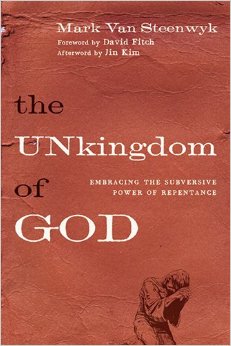
The UNKingdom of God by Mark Van Steenwyk
The UNKingdom of God by Mark Van Steenwyk is a guide to a self-described Christian anarchy. Van Steenwyk questions the meaning of “American Christian fidelity. He claims that Christianity became Christiandom in America and makes the following argument (27):
“The argument that Christianity is intrinsically oppressive is nothing new, but it persists. I believe that the dominant form of Christianity, as understood by the majority of Christians throughout the ages, is inherently oppressive and will inevitably lead to empire. There are, of course, expressions of Christianity that resist imperialism. But a Christianity that is willing to use the sword will always nurture empire.”
He contends that the Christian faith made a mistake when it become the official religion of the Roman Empire. The subversive elements were downplayed. Since that time, Christianity has been overtaken by the political group that joins it. Whether it is the Republican Party of the United States or the Emperor’s court of the Roman Empire, the church loses its influence, power, and effectiveness when the powers of the church join the powers of the state.
Van Steenwyk shows how American Christians have weaponized the Word of God and used it against people. He cites the example of Genesis 1:28 as an example of using Scripture to misuse natural resources. Land should have been developed for the next generation, not for short-term gain (33). He cites other verses which shows consequences of misusing natural resources as a dangerous policy (Isaiah 37:24, Ezekiel 32).
He describes other misuses: the subjugation of nations by a Christian using the fact that everyone will bow to Christ (Philippians 2:9-11), as well as the use of evangelism as a form of conquest (Mark 16:15-16). But it gets worse (43):
“Christianity not only injected some of its DNA into empire (thus Christianizing it), but empire has injected its DNA into Christianity, thus imperializing our Christianity.”
Van Steenwyk explores how this imperialization of Christianity functions. He discusses the use of power to promote this imperialization (44-55). Part of this includes making Jesus into someone we like or we can tame, instead of Who He really is (57-63). He explores a faith through the eyes of French activist Simone Weil (68):
“It is not for man to seek, or even to believe in God. He has only to refuse to believe in everything that is not God.”
Van Steenwyk contends from his personal experience that “Our notion of God can keep us from God. One knows Christ when one lets go of Christ”. One needs to repent of one’s Christianity to follow Christ (70). He makes the point that Christianity is a set of ideas and traditions. Peter and Paul disagreed just as denominations do so today.
Van Steenwyk states that some people will “opt out” by simply rejecting Christianity, or joining some radical Christian enclave, or simply going numb as a response to crushing shame. Instead, we need to repent of Christianity.
By repentance, Van Steenwyk means that we let go of beliefs and structures and institutions and buildings and money and stories—everything that we put upon Jesus—and ask “Is this the way of love?” or “Is this separating me from God and my neighbor?” (77) – what he calls a form of Gelassenheit or “giving up.”
He promotes a mystic approach to Christianity (81-92). Jesus is the UNKing leading an UNKingdom (93-112). This UNKingdom is in opposition to the world system. Van Steenwyk re-examines passages which speak about the relationship between the church and the state (Romans 13:1-7 as well as the anti-imperial statements in Revelation, and Jesus’ words about Caesar in Mark 12:13-17.)
After examining the Scriptures and the premise of his book, Van Steenwyk spends the rest of the book answering the question: “So now what?” In Chapter 7, he suggests a set of spiritual formation practices, which he describes as mystical (115-127). I don’t consider reading the Bible, silence and prayer as mystical. Instead, I consider them useful. In Chapter 8, he returns to the idea of Gelassenheit (128-138). Van Steenwyk suggests deepening our compassion in three ways: (1) localizing our imaginations, (2) paying attention to what is happening in front of us, and (3) learning in the margins. In Chapter 9, Van Steenwyk describes the Holy Spirit as subversive (139-149). He explains that as Christians we need to let the Holy Spirit overthrow us, or turn us upside down. He shares three practices that will invite the Holy Spirit to do this, including: (1) engaging in “open worship” a practice devised from 1 Corinthians 14, (2) naming and resisting, and (3) arguing with Jesus – which isn’t what it sounds like.
Van Steenwyk continues in this abrasive form through the rest of the book. In Chapter 10, he reflects again on the relationship between American Christianity, politics and poverty (150-162). He advocates a form of economic socialism that was devised by God for the nation of Israel. He thinks that America should use the Year of Jubilee as their economic system. He rightly assesses that the church first advocated this form in Acts 2. He embraces the notion of returning to this system. However, asking the rich to release their wealth to give to others will be hard in this political environment. In Chapter 11, Van Steenwyk notes the offensive nature of Jesus’ words to the people who heard them (163-174). He advocates including people who have been shunned, instead of excluding people. He advocates that Christian should so hospitality to those strangers, to be inviting to those who want to hear. He suggests that we should invite people to the “table of Christ”. Although people need to repent, Van Steenwyk rightly states that people first need to be invited, no matter of race, creed, or status in society.
The UNKingdom of God is a good read for those who want to examine their Christian faith from another perspective. Van Steenwyk presents a postmodern critique of the Christian faith. He does not (seem to) advocate a Progressive Christianity. Although there are elements of progressive Christianity in what he describes. I sense that he wants to challenge our beliefs so that we may see more than just the typical American evangelical perspective. Some of what he says is helpful. Much can be dismissed. However, the book is an interesting read for evangelicals who want to continue to share the faith, but are frustrated with the denominational system of Christianity in which they express their faith.
Disclosure of Material Connection: I received this book free from the author and/or publisher through the Speakeasy blogging book review network. I was not required to write a positive review. The opinions I have expressed are my own. I am disclosing this in accordance with the Federal Trade Commission’s 16 CFR,Part 255.
Previous Post

December 28, 2015
Healing Through the Dark Emotions by Miriam Greenspan
Next Post

December 30, 2015 Be Ready
Browse Our Archives
Select a Category 1 Chronicles 1 Corinthians 1 John 1 Kings 1 Peter 1 Samuel 1 Thessalonians 1 Timothy 2 Chronicles 2 Corinthians 2 John 2 Kings 2 Peter 2 Samuel 2 Thessalonians 2 Timothy 3 John Acts Advent Amos Book Review Colossians Comics Culture Watch Daniel Deuteronomy Ecclesiastes Ephesians Esther Exodus Ezekiel Ezra Galatians Genesis Guest Post Habakkuk Haggai Hebrews Hosea Humor Inspiritational Isaiah James Jeremiah Job Joel John Jonah Joshua Jude Judges Lamentations Lectionary Lent Leviticus Link Love Luke Malachi Mark Matthew Micah Movie Review Nahum Nehemiah Numbers Philippians Political Watch Prophecy Watch Proverbs Psalm Revelation Reviews Romans Ruth Science Watch Sermon Series Sermons Simple Thoughts Song of Solomon Titus Top Ten Uncategorized Video Review Zechariah Zephaniah
Select a Month May 2026 October 2025 September 2025 June 2025 February 2025 January 2025 November 2024 October 2024 September 2024 July 2024 June 2024 April 2024 March 2024 January 2024 November 2023 October 2023 September 2023 June 2023 May 2023 March 2023 February 2023 January 2023 December 2022 October 2022 September 2022 August 2022 July 2022 June 2022 May 2022 January 2022 June 2021 January 2021 October 2020 July 2020 May 2020 April 2020 March 2020 February 2020 January 2020 December 2019 November 2019 October 2019 September 2019 August 2019 July 2019 June 2019 May 2019 April 2019 March 2019 February 2019 January 2019 December 2018 November 2018 October 2018 September 2018 August 2018 July 2018 June 2018 May 2018 April 2018 March 2018 February 2018 January 2018 December 2017 November 2017 October 2017 September 2017 August 2017 July 2017 June 2017 May 2017 April 2017 March 2017 February 2017 January 2017 December 2016 November 2016 October 2016 September 2016 August 2016 July 2016 June 2016 May 2016 April 2016 March 2016 February 2016 January 2016 December 2015 November 2015 October 2015 September 2015 August 2015 July 2015 June 2015 May 2015 April 2015 March 2015 February 2015 January 2015 December 2014 November 2014 October 2014 September 2014 August 2014 July 2014 June 2014 May 2014 April 2014 March 2014 February 2014 January 2014 December 2013 November 2013 October 2013 September 2013 August 2013 July 2013 June 2013 May 2013 April 2013 February 2013 January 2013 December 2012 November 2012 October 2012 September 2012 August 2012 July 2012 June 2012 May 2012 April 2009 June 2008 October 2007 September 2007 August 2007 July 2007 June 2007 May 2007 April 2007 March 2007 February 2007 January 2007 December 2006 October 2006 September 2006 May 2006 April 2006 March 2006 February 2006 January 2006 December 2005 September 2005
Follow Us!
TAKE THE
Religious Wisdom Quiz
Who baptized Jesus?
Select your answer to see how you score.
John the Baptist Paul Peter James
Related posts from Jim Erwin


Using ChatGPT in Sermon Preparation


Can I Ask You a Question by Preston...
TRENDING AT PATHEOS Evangelical

Emotion in Early Christianity by Andrew Crislip
Andrew Crislip’s Emotion in Early Christianity examines an often overlooked dimension of...

16 Spiritual Touchstones for a More Grounded Life
After decades of spiritual study, here are 16 principles I try...

Catholic Evangelization: Sharing Your Faith Every Day
Welcome back to the Graceful Awakening mini-series called, “From Faith to Mission.” ...

The Pillar of the Boatmen: the Ancient Monument...
The Pillar of the Boatmen is a Romano-Gaulish sculpture that dates from...

In one sense walking into Westminster Abbey is like walking down the...

'Super Scam Me' Exposes AI Jon Bon Jovi...
Leslie Pickett believed she was in a relationship with Jon Bon Jovi....
view all Evangelical blogs
Ad-Free & Subscriber Log-In Subscription Support
- About Us
- 2026 Calendar
- Videos
- Podcasts
- Library of World Religions
- Faith In Media Tracker
- Advertise With Us
- Write for Us
- Privacy Policy
- Terms of Service
- Do Not Sell My Data
- Contact Us
- Radiant Digital
- Manage Newsletter Subscriptions
- Unsubscribe From Notifications
- Sitemap
Copyright 2008-2026, Patheos. All rights reserved.
Subscription Support Ad-Free & Subscriber Log-In
Follow Patheos