
BuddhistCatholicContemplativeEvangelicalGeneral ChristianHinduJewishLatter-day SaintMuslimNew VisionsProgressive Christian
Beliefs
- Buddhist
- Catholic
- Contemplative
- Evangelical
- General Christian
- Hindu
- Jewish
- Latter-day Saint
- More Voices
- Muslim
- New Visions
- Pagan
- Progressive Christian
Topics
- Religion News
- Food and Religion
- Sports and Religion
- Religious Art
- Religious Music and Entertainment
- Religious Events
- History and Religion
- Style and Religion
- Politics and Religion
- Women in Religion
- Recreation Outdoors and Religion
- Business Finance and Religion
- Careers Workplace and Religion
- Education and Religion
- Family Parenting and Religion
- Health Fitness and Religion
- Home and Religion
- Relationships and Religion
- Technology and Religion
- Travel and Religion
Columnists
- Buddhist Columnists
- Business Finance and Religion Columnists
- Careers Workplace and Religion Columnists
- Catholic Columnists
- Contemplative Columnists
- Education and Religion Columnists
- Evangelists Columnists
- Family Parenting and Religion Columnists
- General Christian Columnists
- Health Fitness and Religion Columnists
- Hindu Columnists
- History and Religion Columnists
- Home and Religion Columnists
- Jewish Columnists
- More Voices Columnists
- Latter Day Columnists
- Muslim Columnists
- New Visions Columnists
- Nonreligious Columnists
- Pagan Columnists
- Politics and Religion Columnists
- Progressive Columnists
- Recreation Outdoors and Religion Columnists
- Relationships and Religion Columnists
- Religion News Columnists
- Religious Art Columnists
- Religious Events Columnists
- Religious Music and Entertainment Columnists
- Sports and Religion Columnists
- Style and Religion Columnists
- Technology and Religion Columnists
- Travel and Religion Columnists
- Women in Religion Columnists
Resource Library
- 2026 Calendar
- Library of World Religions
- The 100 Most Holy Places on Earth
- Patheos Answers
- Podcasts
- Videos
- Faith Leaders Database
- Anglican Episcopalian
- Bahai
- Baptist
- Buddhism
- Christianity
- Confucianism
- Eastern Orthodoxy
- Hinduism
- Holiness and Pentecostal
- ISKCON
- Islam
- Judaism
- Lutheran
- Methodist
- The Church of Jesus Christ of Latter-day Saints
- New Age
- Paganism
- Presbytarian and Reformed
- Protestantism
- Religion Behind the Scenes
- Roman Catholic
- Scientology
- Shia Islam
- Sikhism
- Sufism
- Sunni Islam
- Taoism
- Zen
- See all religions
Research Tools
 Ad-Free & Subscriber Log-In Subscription Support
Ad-Free & Subscriber Log-In Subscription Support
Follow Patheos 

- Trending:
- Forgiveness
- |
- Marriage
- |
- Consciousness
- |
- Death Penalty
- |
- Election
- |
- Halloween

- Home
- Evangelical
- Ezra 9:1-15 Preparing for a Spiritual Awakening
Ezra 9:1-15 Preparing for a Spiritual Awakening
Last updated on: August 16, 2015 at 9:52 pm by Jim Erwin
Ezra 9:1-15 Preparing for a Spiritual Awakening 2015-08-16T21:52:29-05:00 Jim Erwin
Patheos Explore the world's faith through different perspectives on religion and spirituality! Patheos has the views of the prevalent religions and spiritualities of the world.
Ezra 9:1-15 Preparing for a Spiritual Awakening
As a country, as a Christian nation, as a church, how did we get here? What were conditions that caused us to get to this point? If we look at the Israelites during the time of what is called the Babylonian Exile, we can see a similar pattern to what we have today.
THE CYCLE OF SPIRITUAL AWAKENING
The Jews became arrogant and did not depend upon God. They trusted their wealth and strength, but Babylon was stronger. So the men and women were sent to Babylon. During this exile, Babylon was overthrown by the Medes and the Persians. Ahasuerus, King of the Medes and the Persians, gives the Israelites the opportunity to return home.
“At the beginning of the reign of Ahasuerus, the people who were already in the land wrote an accusation against the residents of Judah and Jerusalem.” (Ezra 4:6, HCSB)
“These events took place during the days of Ahasuerus, who ruled 127 provinces from India to Cush.” (Esther 1:1, HCSB)
“In the first year of Darius, the son of Ahasuerus, a Mede by birth, who was ruler over the kingdom of the Chaldeans:” (Daniel 9:1, HCSB)

1. The people God experience PERSECUTION FOR OBEDIENCE TO GOD. (Ezra 4:24)
But this return from the exile and the chance to rebuild the temple in Jerusalem is stopped.
“Now the construction of God’s house in Jerusalem had stopped and remained at a standstill until the second year of the reign of King Darius of Persia.” (Ezra 4:24, HCSB)
But then the prophets challenged the people to believe in God. The Israelites restarted the effort to rebuild the temple.
“But when the prophets Haggai and Zechariah son of Iddo prophesied to the Jews who were in Judah and Jerusalem, in the name of the God of Israel who was over them, Zerubbabel son of Shealtiel and Jeshua son of Jozadak began to rebuild God’s house in Jerusalem. The prophets of God were with them, helping them.” (Ezra 5:1–2, HCSB)
King Darius searches and finds a decree by King Cyrus that the Jews were allowed their building permit. They were allowed to build their temple using Persian government money. So King Darius tells the Persians to let the Israelites continue building.
“Leave the construction of the house of God alone. Let the governor and elders of the Jews rebuild this house of God on its original site.” (Ezra 6:7, HCSB)
The people of God celebrated when the temple was finished. They celebrated that God had shown then favor:
“They observed the Festival of Unleavened Bread for seven days with joy, because the Lord had made them joyful, having changed the Assyrian king’s attitude toward them, so that he supported them in the work on the house of the God of Israel.” (Ezra 6:22, HCSB)
2. The people of God experience FAVOR AND BLESSING for TRUSTING GOD (Ezra 6:22)
“They observed the Festival of Unleavened Bread for seven days with joy, because the Lord had made them joyful, having changed the Assyrian king’s attitude toward them, so that he supported them in the work on the house of the God of Israel.” (Ezra 6:22, HCSB)
“Ezra came to Jerusalem in the fifth month, during the seventh year of the king. He began the journey from Babylon on the first day of the first month and arrived in Jerusalem on the first day of the fifth month since the gracious hand of his God was on him. Now Ezra had determined in his heart to study the law of the Lord*, obey it, and teach its statutes and ordinances in Israel.*” (Ezra 7:8–10, HCSB)
Everything is great. The people are starting to return to Israel. Ezra, the scribe returns to Jerusalem. He is determined to study God’s Word and teach it to the people. Ezra, finds everyone who wants to return to Israel with him in Ezra 8. He fasts and prays for God to provide his way back to Israel. Ezra doesn’t want to ask the King of Persia to provide the safety that God can easily provide.
“We set out from the Ahava River on the twelfth day of the first month to go to Jerusalem. We were strengthened by our God, and He protected us from the power of the enemy and from ambush along the way.” (Ezra 8:31, HCSB)
Unfortunately, this trust in God never lasts forever. Sin always gets in the way.
3. The people of God are DISTRACTED BY SIN (Ezra 9:1-2)
“After these things had been done, the leaders approached me and said: “The people of Israel, the priests, and the Levites have not separated themselves from the surrounding peoples whose detestable practices are like those of the Canaanites, Hittites, Perizzites, Jebusites, Ammonites, Moabites, Egyptians, and Amorites. Indeed, the Israelite men have taken some of their daughters as wives for themselves and their sons, so that the holy seed has become mixed with the surrounding peoples. The leaders and officials have taken the lead in this unfaithfulness!”” (Ezra 9:1–2, HCSB)
Even though God has been faithful, and even though God has done what the people have prayed for – deliverance and return to their land, some of the people of God are unfaithful to God. Sin gets in the way of our being faithful to God. Sin gets in the way of our seeing God’s favor in our lives and in the life of the church.
OUR RESPONSE TO SIN DETERMINES OUR FUTURE
At this point, there are two responses:
1. Indifference and Continuation of Sin (Ezra 9:2)
The first response is to be indifferent to the problem and continue to sin. Indifference is a polite word. In reality, a person is in complete rebellion with God when they continue to sin. This is one response. It creates a downward spiral that gets worse as time goes by. Romans 1 shows a clear example of how the impact of continuing to sin makes a society worse. I believe that as a nation and state, and even as a denomination of churches, we are responding in this way.
The state continues to ignore God and pursue its own interests. At the same time, Christians don’t make prayer and witnessing a priority. We want to spend time entertaining ourselves and pushing God out. We slip into sin and we don’t make it a happen to get clean. We don’t try to confess our sins. We get offended when people tell us otherwise.
Notice that this problem is prevalent among the leadership.
“…The leaders and officials have taken the lead in this unfaithfulness!”” (Ezra 9:2, HCSB)
When that is the case, it is only of matter of time when the people exhibit the same behavior.
2. Humiliation and Confession of Sin (Ezra 9:3-6)
The second way to deal with the distraction of sin is to humiliate yourself and confess your sin. The Bible says that we need to humble ourselves, or God will humble us.
“and My people who are called by My name humble themselves, pray and seek My face, and turn from their evil ways, then I will hear from heaven, forgive their sin, and heal their land.” (2 Chronicles 7:14, HCSB)
“Humble yourselves before the Lord, and He will exalt you.” (James 4:10, HCSB)
“Humble yourselves, therefore, under the mighty hand of God, so that He may exalt you at the proper time,” (1 Peter 5:6, HCSB)
It is said that the road to humility is paved with a thousand humiliations. This is the path that Ezra took.
OUR SIN IS GREAT, BUT YOUR GRACE IS GREATER
Ezra has just chastised the people of Israel for intermarrying with foreign women. The problem was not that that they were foreign, but that they worship foreign gods. The influence of their religion would eliminate God’s people. They were unfaithful to God by intermarrying and they knew the consequences. Our of the humiliation of this sin, Ezra gets up, tears his robe and tunic, and then falls to his knees, spreads his hands and makes a great confession:
Our sin is great, but Your grace is greater. (Ezra 9:6-9)
Ezra highlights the shame and embarrassment that their sin has caused. The people of God realize that they have gravely sinned, and that God has a right to punish them worse than He has. Instead, God has been gracious by allowing them to be in their own land (though as slaves), and God has allowed them to rebuild the wall. These are all reminders of God’s grace.
“But now, for a brief moment, grace has come from Yahweh our God to preserve a remnant for us and give us a stake in His holy place. Even in our slavery, God has given us new life and light to our eyes.” (Ezra 9:8, HCSB)
Our sin is great, but Your grace is greater. (Ezra 9:13-14)
Ezra recounts how they have truly sinned, but God punished them less than their sins deserve and have allowed them to survive.
“After all that has happened to us because of our evil deeds and terrible guilt—though You, our God, have punished us less than our sins deserve and have allowed us to survive —” (Ezra 9:13, HCSB)
Ezra them implores the people that they should not misuse the grace of God to sin even more.
“should we break Your commands again and intermarry with the peoples who commit these detestable practices? Wouldn’t You become so angry with us that You would destroy us, leaving no survivors?” (Ezra 9:14, HCSB)
“The law came along to multiply the trespass. But where sin multiplied, grace multiplied even more” (Romans 5:20, HCSB)
Our sin is great, but Your grace is greater.
Because of God’s righteousness, the people have survived as a remnant. A select group have survived captivity as a witness to God’s grace in the midst of great sin. Sin can be so great that it wipes a people out. However, grace is great enough to leave a remnant available to witness to the world how wonderful God has been.1
When we recognize our sin and our need for God’s grace, we are on the first steps to spiritual awakening.
According to a sidebar in Christian History Magazine, spiritual awakenings, whether in biblical or church history, manifest patterns that are similar, often strikingly so. Usually the following elements are seen:
1. Awakenings are usually preceded by a time of spiritual depression, apathy and gross sin, in which a majority of nominal Christians are hardly different from the members of secular society, and the churches seem to be asleep.
2. An individual or small group of God’s people becomes conscious of their sins and backslidden condition, and vows to forsake all that is displeasing to God.
3. As some Christians begin to yearn for a manifestation of God’s power, a leader or leaders arise with prophetic insights into the causes and remedies of the problems, and a new awareness of the holy and pure character of the Lord is present.
4. The awakening of Christians occurs: many understand and take part in a higher spiritual life.
5. An awakening may be God’s means of preparing and strengthening His people for future challenges or trials.*23
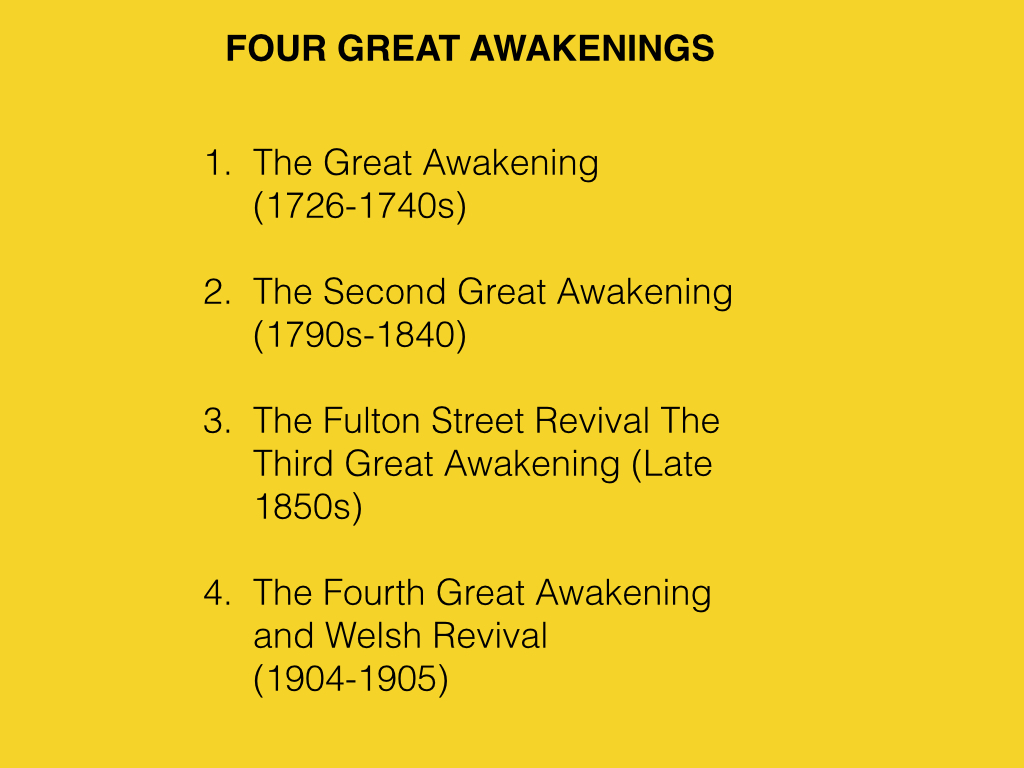
FOUR GREAT AWAKENINGS
1. The Great Awakening (1726-1740s)
A name applied to a widespread religious revival in USA. Beginnings of the movement may be traced among the Dutch Reformed Churches of New Jersey c. 1726; it spread to the *Presbyterians and *Congregationalists in the following decade and reached its zenith in New England in the early 1740s.4
The preaching of Jonathan Edwards and George Whitefield stressed the need for visible evidences of conversion.
2. The Second Great Awakening (Mid-1790s-1840)
Timothy Dwight, president of Yale University, became the unofficial leader of the Awakening in the Northeast as the awakening spread through the great colleges and universities that dotted the landscape.
Later, the revival was continued under the dynamic ministry of a converted lawyer-turned-preacher, Charles Grandison Finney.5 In America, Boston’s Isaac Backus took up the same call to prayer.
In the region around Kentucky, the Second Great Awakening began with James McGready. Camp Meetings held by men like James McGready, Barton Stone, and, later, Peter Cartwright swept thousands into the kingdom.6
3. The Fulton Street Revival and The Third Great Awakening (Late 1850s)
Jeremiah C. Lanphier, a layman, accepted the call of the North Reformed Dutch Church in New York City to begin a full-time program of evangelism. He visited door-to-door, placed posters in boarding houses, and prayed. But the work languished and Lanphier grew discouraged.
As autumn fell over the city, Lanphier decided to try noontime prayer meetings, thinking that businessmen might attend during their lunch hours. He announced the first one for September 23, 1857, at the Old Dutch Church on Fulton Street. When the hour came, Lanphier found himself alone. He sat and waited. Finally, one man showed up, then a few others.
But the next week, twenty came. The third week, forty. Someone suggested the meetings occur daily, and within months the building was overflowing. Other churches opened their doors. The revival spread to other cities. Offices and stores closed for prayer at noon. Newspapers spread the story, even telegraph companies set aside certain hours during which businessmen could wire one another with news of the revival.
The revival—sometimes called “The Third Great Awakening”—lasted nearly two years, and between 500,000 and 1,000,000 people were said to have been converted. Out of it came the largest outlay of money for philanthropic and Christian causes America had yet experienced.7
Major revivals broke out in the Civil War armies. In the Union Army, between 100,000 and 200,000 soldiers were converted. Among Confederate forces, approximately 150,000 troops converted to Christ. Sometimes preaching and praying continued twenty-four hours a day, and chapels couldn’t hold the soldiers who wanted to get inside.
A “Great Revival” occurred among Robert E. Lee’s forces in the fall of 1863 and winter of 1864. Some 7,000 soldiers were converted.*89
4. The Fourth Great Awakening and the Welsh Revival (1904-1905)
The last “Great Awakening” did not happen in America. Instead, it happened in Wales and England. We have not seen a sizable awakening since that time.
There have been great works of God in America since that time:
The Azusa Street Revival in 1906 which was the birth of the modern Pentecostal movement. The ministry of Billy Graham 1940s-2000s which saw waves of mass evangelism. The Jesus Movement of the 1970s which brought many young hippies to Jesus Christ. However, we have not seen an awakening for revival on such a large scale since that time.
One must remember that these Great Awakenings have been American Christian movements. They have historically been Protestant in nature. They represent a time period when Christian was the dominate religion. Many denominations within Christianity flourished, notably the Methodists and the Baptists. In the twentieth century, we saw a shift from revivals and planting churches to mass evangelism. The movement changed from small churches in rural settings being revived and planted to much larger churches being started and existing churches getting larger in size.
In the twenty-first century, we are now seeing a dramatic change in the religious landscape. Mormonism is a unique American religion. Today, it is not uncommon to see a variety of religions in an area. Just taking a drive to Rogers and Bentonville will show you that things have changed. We now live in a religious pluralistic society. It is melting pot of religions, not just a simple soup of Christianity. That will change the nature of a spiritual awakening in America.
The Jews were used to multiculturalism. They had been combatting the drift to following other gods for centuries. God sent them to Babylon and then returned them to their own land. While it ended idol worship, religious legalism took its place. In that religious landscape, the early Christians had to carve out a space among different religions. God used the ministries of the apostles to spread the Gospel in lands where Christianity was the minority. This is the spiritual landscape we find ourselves in. Note how Ezra defines the people of God in these verses:
“Lord God of Israel, You are righteous, for we survive as a remnant today*. Here we are before You with our guilt, though no one can stand in Your presence because of this.*” (Ezra 9:15, HCSB)
Ezra calls God’s people a remnant, the status of a minority. He doesn’t consider God’s people in the majority This is the major difference between the spiritual awakenings in the past and today. We have to view ourselves as a remnant.
So the question is: How will see an awakening of God’s people to their need for Him? It takes confession, weeping of our sin, and falling facedown before God. This cannot be manufactured. This has to come from the heart. If we want to see change in other people, it has come first from us. If we want to see God move in our lives, to heal brokenness and bring healing, it has come first from us. Let us repeat this prayer from Ezra 9:15:
“Lord God of Israel, You are righteous, for we survive as a remnant today*. Here we are before You with our guilt, though no one can stand in Your presence because of this.*” (Ezra 9:15, HCSB)
4. The people of God FORM A BOND OF COMMUNITY and SHARE THEIR FAITH (Ezra 9:15)
As a church, and as a people of God, we are entering a new phase of spiritual awakening. We will pray for a revival of this church. But we must realize that the next spiritual awakening may not look like what we are used to seeing or hearing. Although we are being influenced by both a secular and a digital culture, we need to accept that God may be using new wine and may be using new wineskins. As we see a revival in our own church – which I speak to more precisely next week, we need to be open to spiritual awakenings that may be different from what we have previously encountered.
I want to encourage you to prepare for a spiritual awakening – an awareness that God may use new people, new methods, and new ideas to spread the same Gospel message. We need to open to God about this.
1 Jim Erwin, “Our Sin Is Great, But Your Grace Is Greater,” Ezra 9:5-15, 20 May 2015 Year B, Lectionary Reflections Year B (2014-2015), accessed 13 August 2015.
2* “Patterns of Spiritual Renewal,” Christian History Magazine, Issue 23, p. 7.
3 Robert J. Morgan, Nelson’s Complete Book of Stories, Illustrations, and Quotes, electronic ed. (Nashville: Thomas Nelson Publishers, 2000), 679.
4 F. L. Cross and Elizabeth A. Livingstone, eds., The Oxford Dictionary of the Christian Church (Oxford; New York: Oxford University Press, 2005), 705.
5 Robert J. Morgan, Nelson’s Complete Book of Stories, Illustrations, and Quotes, electronic ed. (Nashville: Thomas Nelson Publishers, 2000), 674.
6 Robert J. Morgan, Nelson’s Complete Book of Stories, Illustrations, and Quotes, electronic ed. (Nashville: Thomas Nelson Publishers, 2000), 674.
7 Robert J. Morgan, Nelson’s Complete Book of Stories, Illustrations, and Quotes, electronic ed. (Nashville: Thomas Nelson Publishers, 2000), 676–677.
8* Christian History Magazine, Issue 33, Vol. XI, No. 1, p. 2.
9 Robert J. Morgan, Nelson’s Complete Book of Stories, Illustrations, and Quotes, electronic ed. (Nashville: Thomas Nelson Publishers, 2000), 677.
Previous Post

August 13, 2015
Cowboys and Aliens (2011)
Next Post
August 18, 2015 Abba's Child by Brennan Manning
Browse Our Archives
Select a Category 1 Chronicles 1 Corinthians 1 John 1 Kings 1 Peter 1 Samuel 1 Thessalonians 1 Timothy 2 Chronicles 2 Corinthians 2 John 2 Kings 2 Peter 2 Samuel 2 Thessalonians 2 Timothy 3 John Acts Advent Amos Book Review Colossians Comics Culture Watch Daniel Deuteronomy Ecclesiastes Ephesians Esther Exodus Ezekiel Ezra Galatians Genesis Guest Post Habakkuk Haggai Hebrews Hosea Humor Inspiritational Isaiah James Jeremiah Job Joel John Jonah Joshua Jude Judges Lamentations Lectionary Lent Leviticus Link Love Luke Malachi Mark Matthew Micah Movie Review Nahum Nehemiah Numbers Philippians Political Watch Prophecy Watch Proverbs Psalm Revelation Reviews Romans Ruth Science Watch Sermon Series Sermons Simple Thoughts Song of Solomon Titus Top Ten Uncategorized Video Review Zechariah Zephaniah
Select a Month May 2026 October 2025 September 2025 June 2025 February 2025 January 2025 November 2024 October 2024 September 2024 July 2024 June 2024 April 2024 March 2024 January 2024 November 2023 October 2023 September 2023 June 2023 May 2023 March 2023 February 2023 January 2023 December 2022 October 2022 September 2022 August 2022 July 2022 June 2022 May 2022 January 2022 June 2021 January 2021 October 2020 July 2020 May 2020 April 2020 March 2020 February 2020 January 2020 December 2019 November 2019 October 2019 September 2019 August 2019 July 2019 June 2019 May 2019 April 2019 March 2019 February 2019 January 2019 December 2018 November 2018 October 2018 September 2018 August 2018 July 2018 June 2018 May 2018 April 2018 March 2018 February 2018 January 2018 December 2017 November 2017 October 2017 September 2017 August 2017 July 2017 June 2017 May 2017 April 2017 March 2017 February 2017 January 2017 December 2016 November 2016 October 2016 September 2016 August 2016 July 2016 June 2016 May 2016 April 2016 March 2016 February 2016 January 2016 December 2015 November 2015 October 2015 September 2015 August 2015 July 2015 June 2015 May 2015 April 2015 March 2015 February 2015 January 2015 December 2014 November 2014 October 2014 September 2014 August 2014 July 2014 June 2014 May 2014 April 2014 March 2014 February 2014 January 2014 December 2013 November 2013 October 2013 September 2013 August 2013 July 2013 June 2013 May 2013 April 2013 February 2013 January 2013 December 2012 November 2012 October 2012 September 2012 August 2012 July 2012 June 2012 May 2012 April 2009 June 2008 October 2007 September 2007 August 2007 July 2007 June 2007 May 2007 April 2007 March 2007 February 2007 January 2007 December 2006 October 2006 September 2006 May 2006 April 2006 March 2006 February 2006 January 2006 December 2005 September 2005
Follow Us!
TAKE THE
Religious Wisdom Quiz
Which prophet confronted King Ahab about his sins?
Select your answer to see how you score.
Elisha Elijah Ezekiel Jeremiah
Related posts from Jim Erwin


The Obedient Servant in Suffering


The Global Mission of the Servant
TRENDING AT PATHEOS Evangelical

Emotion in Early Christianity by Andrew Crislip
Andrew Crislip’s Emotion in Early Christianity examines an often overlooked dimension of...

16 Spiritual Touchstones for a More Grounded Life
After decades of spiritual study, here are 16 principles I try...

Catholic Evangelization: Sharing Your Faith Every Day
Welcome back to the Graceful Awakening mini-series called, “From Faith to Mission.” ...

The Pillar of the Boatmen: the Ancient Monument...
The Pillar of the Boatmen is a Romano-Gaulish sculpture that dates from...

In one sense walking into Westminster Abbey is like walking down the...

'Super Scam Me' Exposes AI Jon Bon Jovi...
Leslie Pickett believed she was in a relationship with Jon Bon Jovi....
view all Evangelical blogs
Ad-Free & Subscriber Log-In Subscription Support
- About Us
- 2026 Calendar
- Videos
- Podcasts
- Library of World Religions
- Faith In Media Tracker
- Advertise With Us
- Write for Us
- Privacy Policy
- Terms of Service
- Do Not Sell My Data
- Contact Us
- Radiant Digital
- Manage Newsletter Subscriptions
- Unsubscribe From Notifications
- Sitemap
Copyright 2008-2026, Patheos. All rights reserved.
Subscription Support Ad-Free & Subscriber Log-In
Follow Patheos