
BuddhistCatholicContemplativeEvangelicalGeneral ChristianHinduJewishLatter-day SaintMuslimNew VisionsProgressive Christian
Beliefs
- Buddhist
- Catholic
- Contemplative
- Evangelical
- General Christian
- Hindu
- Jewish
- Latter-day Saint
- More Voices
- Muslim
- New Visions
- Pagan
- Progressive Christian
Topics
- Religion News
- Food and Religion
- Sports and Religion
- Religious Art
- Religious Music and Entertainment
- Religious Events
- History and Religion
- Style and Religion
- Politics and Religion
- Women in Religion
- Recreation Outdoors and Religion
- Business Finance and Religion
- Careers Workplace and Religion
- Education and Religion
- Family Parenting and Religion
- Health Fitness and Religion
- Home and Religion
- Relationships and Religion
- Technology and Religion
- Travel and Religion
Columnists
- Buddhist Columnists
- Business Finance and Religion Columnists
- Careers Workplace and Religion Columnists
- Catholic Columnists
- Contemplative Columnists
- Education and Religion Columnists
- Evangelists Columnists
- Family Parenting and Religion Columnists
- General Christian Columnists
- Health Fitness and Religion Columnists
- Hindu Columnists
- History and Religion Columnists
- Home and Religion Columnists
- Jewish Columnists
- More Voices Columnists
- Latter Day Columnists
- Muslim Columnists
- New Visions Columnists
- Nonreligious Columnists
- Pagan Columnists
- Politics and Religion Columnists
- Progressive Columnists
- Recreation Outdoors and Religion Columnists
- Relationships and Religion Columnists
- Religion News Columnists
- Religious Art Columnists
- Religious Events Columnists
- Religious Music and Entertainment Columnists
- Sports and Religion Columnists
- Style and Religion Columnists
- Technology and Religion Columnists
- Travel and Religion Columnists
- Women in Religion Columnists
Resource Library
- 2026 Calendar
- Library of World Religions
- The 100 Most Holy Places on Earth
- Patheos Answers
- Podcasts
- Videos
- Faith Leaders Database
- Anglican Episcopalian
- Bahai
- Baptist
- Buddhism
- Christianity
- Confucianism
- Eastern Orthodoxy
- Hinduism
- Holiness and Pentecostal
- ISKCON
- Islam
- Judaism
- Lutheran
- Methodist
- The Church of Jesus Christ of Latter-day Saints
- New Age
- Paganism
- Presbytarian and Reformed
- Protestantism
- Religion Behind the Scenes
- Roman Catholic
- Scientology
- Shia Islam
- Sikhism
- Sufism
- Sunni Islam
- Taoism
- Zen
- See all religions
Research Tools
 Ad-Free & Subscriber Log-In Subscription Support
Ad-Free & Subscriber Log-In Subscription Support
Follow Patheos 

- Trending:
- Forgiveness
- |
- Marriage
- |
- Consciousness
- |
- Death Penalty
- |
- Election
- |
- Halloween

- Home
- Evangelical
- Romans 1:16-32 America May Decline Morally, But God’s Power Remains
Romans 1:16-32 America May Decline Morally, But God’s Power Remains
Last updated on: June 14, 2018 at 10:19 pm by Jim Erwin
Romans 1:16-32 America May Decline Morally, But God’s Power Remains 2018-06-14T22:19:52-05:00 Jim Erwin
Patheos Explore the world's faith through different perspectives on religion and spirituality! Patheos has the views of the prevalent religions and spiritualities of the world.
Romans 1:16-32 America May Decline Morally, But God’s Power Remains
This week saw the sad but unsurprising decision by the Supreme Court to legalize same-sex marriage. Some would say that God’s judgment will come because of this decision. I would say that God’s judgment has come. The sins of one generation becomes the government of the next.
I realize that what I may say today will offend many people. I realize that the decision by the Supreme Court may be a decision with which the majority will agree. While I cannot argue the points of law that the Supreme Court debated, I have a higher Supreme Justice to obey. God is the Supreme Justice, who is higher than the nine appointed judges on the Supreme Court. When I compare their actions with what the Bible teaches, I have to conclude that a majority of the Supreme Court have allowed the moral decline in this country.
When we come to the book of Romans, Paul is explaining to us about the nature of sin and its consequences. He shows the progression of sin in these verses. He shows very clearly that God’s wrath comes out when people suppress the truth. Let me show you what I call God’s spiral of judgment:
God’s spiral of judgment will materialize in America’s moral decline. (Romans 1:18-32)
The spiral begins as we as people, and as a nation do damaging selfish things:
HOW A NATION SPIRALS OUT OF CONTROL
1. Reject the truth – This is the AGNOSTIC approach to denying God. (1:18-20)
Paul explains the fact that God gets angry when we push down His truth:
“For God’s wrath is revealed from heaven against all godlessness and unrighteousness of people who by their unrighteousness suppress the truth,” (Romans 1:18, HCSB)
The truth is that God exists. We observe that God exists through His creation.
“since what can be known about God is evident among them, because God has shown it to them. For His invisible attributes, that is, His eternal power and divine nature, have been clearly seen since the creation of the world, being understood through what He has made. As a result, people are without excuse.” (Romans 1:19–20, HCSB)
Agnostics says we cannot know who God is. They do not have a belief in God, because we can’t know God.1 Etymologically, it means, “not, or no knowledge.” An agnostic is someone who believes human beings simply cannot know anything metaphysical or beyond the physical realm; therefore, they cannot know whether things like spirit, angels or God exist at all.2
Paul says that the unrighteous have “suppressed” the truth primarily through a failure to worship God by both omission (they did not acknowledge God—Rom 1:21, 28) and commission (they engaged in idolatry—Rom 1:23)3
2. Reject God through distorted thinking – This is the ATHEISTIC approach to denying God. (1:21-22)
“For though they knew God, they did not glorify Him as God or show gratitude. Instead, their thinking became nonsense, and their senseless minds were darkened. Claiming to be wise, they became fools” (Romans 1:21–22, HCSB)
Atheists believe that there is no God.
Atheist is someone who believes that God does not exist.4 Even though God exists, an atheist will never give God glory or gratitude.
An atheist, on the one hand, believes that there is no God. Etymologically, the word means “not, or no God.” In the atheist camp you can have a wide variety of reasons for their denial as well as differing levels of certainty. Some will deny emphatically that there is a God and claim to have “proof” of God’s non-existence. Other’s will simply say they do not believe there is a God though they could not prove God does not exist. The common denominator is that they do not believe in God.5
The people mentioned by Paul in our text fell into two great evils, or rather into two forms of one great evil—atheism: the atheism of the heart, and the atheism of the life. They knew God, but they glorified him not as God, neither were they thankful6
RESULT OF SELFISH DENIAL PROCESS: PROMOTION OF THE SELF (1:23)
“and exchanged the glory of the immortal God for images resembling mortal man, birds, four-footed animals, and reptiles.” (Romans 1:23, HCSB)
We have made an idol of mankind and its way of defining life. For a person, this means we make idols to ourselves. For a nation, this means that we promote the self in our country above our God.
The refusal to acknowledge and glorify God results in a downward path: worthless thinking, moral insensitivity, and religious stupidity7
God won’t permit a person or a nation to reject the truth and deny Him forever. There are consequences. At this point, God hands them over to their sinful selfish thoughts. Scholars debate whether God actively does this, or whether he lets the thinking that caused these problems run their natural course. I want you to see that for both the individual and the society, the sin gets worse and the consequences pile up. I also that at each point, God is there ready to forgive. Notice how the speed of the spiral – it increases.
Notice that three times it says that “God gave them over” and three times humanity “exchanges” God for idols.8 There is a repetition of the way in which sin is replaced with judgment.
SPIRAL OF GOD’S JUDGMENT ON THE SIN OF PROMOTING SELF
3. Idolatry through worthless thinking (1:24-25)
“Therefore God delivered them over in the cravings of their hearts to sexual impurity, so that their bodies were degraded among themselves.” (Romans 1:24, HCSB)
Two ways we commit idolatry through worthless thinking. We get desensitized, and we replace Godly thoughts with idolatry.
Desensitizing dirty thoughts
The first spiral of God’s judgment on the sin of promoting self is worthless thinking. This worthless thinking includes sexual impurity which causes shame. You know how you think a dirty sexual act. It brings shame to our minds after we have thought it. When we deny God and refuse to give Him glory and we start to think about ourselves, we will crave that kind of dirty sexual thoughts and we won’t be sensitive to it.
You see it today in the ways in which society has desensitized the culture to sexual thoughts.
“They exchanged the truth of God for a lie, and worshiped and served something created instead of the Creator, who is praised forever. Amen.” (Romans 1:25, HCSB)
Idolatry
When we exchange God’s truth for a lie, it is idolatry, no matter what form that idolatry takes.
4. Sexual immorality and moral perversion (1:26-28)
Same-sex relationships
“This is why God delivered them over to degrading passions. For even their females exchanged natural sexual relations for unnatural ones. The males in the same way also left natural relations with females and were inflamed in their lust for one another. Males committed shameless acts with males and received in their own persons the appropriate penalty of their error.” (Romans 1:26–27, HCSB)
Both females and males are addressed in this passage. Homosexuality and lesbian relationships are addressed as morally insensitive. People say that Christians are morally insensitive when we preach against same-sex marriage. The Bible says that the people who engage in these relationships are morally insensitive to God. Remember, they have denied God and did not glorify Him. So He lets them spiral down the moral staircase.
Among the few passages in the Bible that explicitly address homosexuality, Rom 1:26–27 provides one of the most direct statements on the subject. Elsewhere in his letters Paul seems to allude to same-sex relations in 1 Cor 6:9 and 1 Tim 1:10. His teaching in Rom 1:26–27 relates to two ot passages. First, Paul’s use of the Greek noun aschēmosynē (“shameless deed”) echoes the lxx9 translation of several passages, especially Lev 18 and 20, where over two-thirds of the total references to this term occur (see Dunn 1988a, 65). Second, Paul’s view on sexuality is rooted in the narrative of Gen 1–2, which depicts the male-female relationship as part of the created order (see Gen 1:27; 2:18–23). Thus, for Paul, homosexual conduct violates the ordained design of the Creator and therefore is a form of idolatry. Paul’s creation-based teaching on homosexuality also mirrors the views of Jesus that we find in the canonical Gospels. Jesus’ teaching on sexuality appeals to Gen 1–2 as the standard for all human sexual conduct (Matt 19:4–6; Mark 10:6–9)10
“And because they did not think it worthwhile to acknowledge God, God delivered them over to a worthless mind to do what is morally wrong.” (Romans 1:28, HCSB)
Moral perversion is a result of a worthless mind. It takes thought to follow God. It takes no thought to think about yourself.
The spiral of the sin of promoting that leads to God’s judgment can take many paths. Same-sex behavior is not the only way we sin. Paul may use same-sex relationships to describe how this path may get worse. However other sins can lead us into the same direction. They all lead to one conclusion: a chaotic life and society.
5. Chaotic lives and society (1:29-31)
“They are filled with all unrighteousness, evil, greed, and wickedness. They are full of envy, murder, quarrels, deceit, and malice. They are gossips, slanderers, God-haters, arrogant, proud, boastful, inventors of evil, disobedient to parents, undiscerning, untrustworthy, unloving, and unmerciful.” (Romans 1:29–31, HCSB)
One notices when you look at these verses a set of lists. These lists form a grouping of moral spirals. Paul may have used sexual perversion as his first spiral. He continues to explain that other sins can cause the same moral spiral. Each group of sins listed in these verses can spiral out of control.
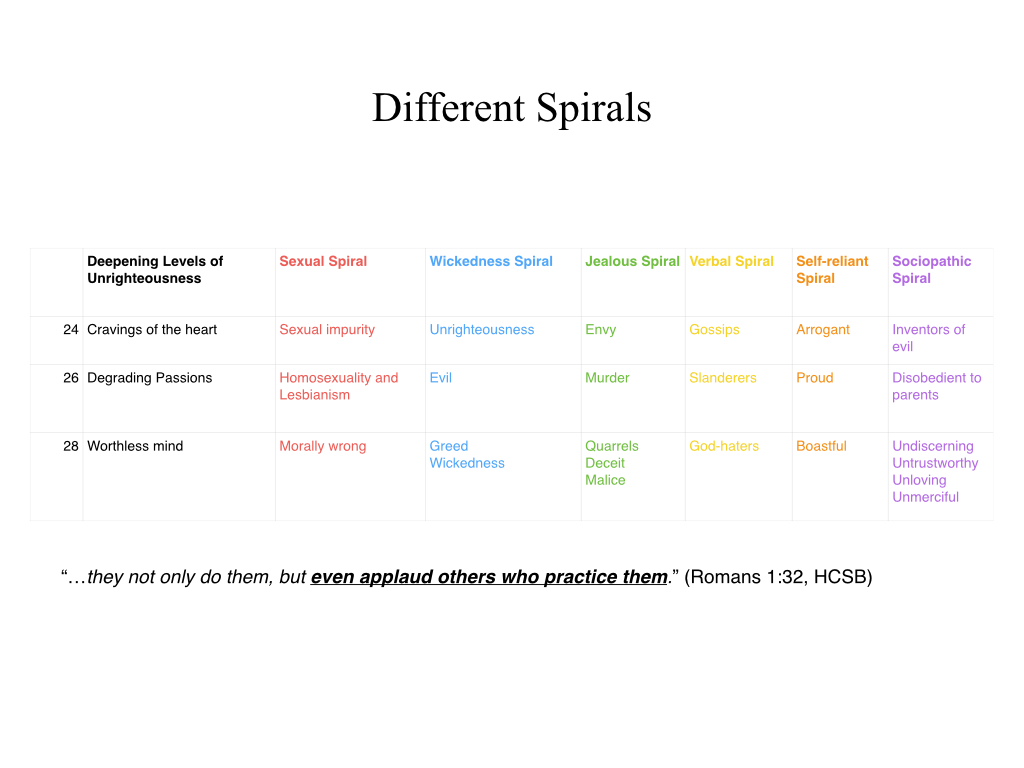
How does this spiral end? It ends with a society that promotes selfish over God’s truth:
6. Complete unrepentant society (1:32)
“Although they know full well God’s just sentence—that those who practice such things deserve to die —they not only do them, but even applaud others who practice them.” (Romans 1:32, HCSB)
It ends with a country that applauds sinful behavior and encourages sinful behavior as not only a legal right, but the moral norm.
One of the effects of sin is that we often think more highly of ourselves than we should. Reading through the list of sins in 1:29–31—and the judgment that goes with them—it’s easy to see it as a “them” issue rather than an “us” or “me” issue. I can readily agree that “those kinds of people” deserve God’s wrath, not unlike the disciples asking Jesus if they should call down fire from heaven (Luke 9:54). It is much easier (and more common) to point the finger of blame at others instead of being convicted ourselves.11
Is that all? Is the country doomed? How do we ever get out of this selfish spiral? The spiral of judgment may continue and worsen, but God’s power in the Gospel remains.
God’s power in the Gospel remains. (Romans 1:16-17)
“For I am not ashamed of the gospel, because it is God’s power for salvation to everyone who believes, first to the Jew, and also to the Greek. For in it God’s righteousness is revealed from faith to faith, just as it is written: The righteous will live by faith.” (Romans 1:16–17, HCSB)
These verses are great to memorize because they identify how Christians should behave in such a morally declining country. God has the power to change anyone. It does not matter what sin they commit, what selfish lifestyle they lead, or how far away they turn from God, God can change them. He has the power to do that.
That is what the Gospel is all about. It is why it is good news. Yes, the country has taken a hit morally. Yes, we are going to see changes in how society behaves and it won’t match up completely to God’s standards. But we have the good news of the power of God through Jesus Christ Who can save everyone who believes. Jesus, through His death, burial, and resurrection – reveals to everyone the right way to God in faith.
That is why we have to continue to follow Christ in faith. The world needs to see that God’s power can make a difference. We can’t be judgmental, but we can still show people the God of love who is also the God of wrath. The choice is ultimately theirs to make. We have to be witnesses of what God’s power can do in our lives.
America may decline morally, but God’s power remains.
1 “Agnostic,” http://www.merriam-webster.com/dictionary/agnostic, accessed 26 June 2015.
2 “Agnostic,” http://www.catholic.com/quickquestions/is-there-a-difference-between-atheists-and-agnostics, accessed on 26 June 2015.
3 Derek R. Brown and E. Tod Twist, Lexham Bible Guide: Romans, ed. Douglas Mangum (Bellingham, WA: Lexham Press, 2014), Ro 1:18–32.
4 “Atheist,” http://www.merriam-webster.com/dictionary/agnostic, accessed on 26 June 2015.
5 “Atheism,” http://www.catholic.com/quickquestions/is-there-a-difference-between-atheists-and-agnostics, accessed on 26 June 2015.
6 C. H. Spurgeon, The Metropolitan Tabernacle Pulpit Sermons, vol. 30 (London: Passmore & Alabaster, 1884), 62.
7 David S. Dockery, “The Pauline Letters,” in Holman Concise Bible Commentary, ed. David S. Dockery (Nashville, TN: Broadman & Holman Publishers, 1998), 545.
8 Douglas A. Campbell, The Deliverance of God: An Apocalyptic Rereading of Justification in Paul (Grand Rapids, MI; Cambridge, U.K.: William B. Eerdmans Publishing Company, 2013), 357.
9lxx An abbreviation for the Septuagint, referring to the Greek translation of the Hebrew Old Testament (Genesis—Malachi) from around 250 bc.
10 Derek R. Brown and E. Tod Twist, Lexham Bible Guide: Romans, ed. Douglas Mangum (Bellingham, WA: Lexham Press, 2014), Ro 1:18–32.
11 Steven E. Runge, High Definition Commentary: Romans (Bellingham, WA: Lexham Press, 2014), 33.
Previous Post

June 28, 2015
Hebrews 11:4-7 Faith of Our Fathers
Next Post

June 30, 2015 Prophecy Watch: Grexit Explained
Browse Our Archives
Select a Category 1 Chronicles 1 Corinthians 1 John 1 Kings 1 Peter 1 Samuel 1 Thessalonians 1 Timothy 2 Chronicles 2 Corinthians 2 John 2 Kings 2 Peter 2 Samuel 2 Thessalonians 2 Timothy 3 John Acts Advent Amos Book Review Colossians Comics Culture Watch Daniel Deuteronomy Ecclesiastes Ephesians Esther Exodus Ezekiel Ezra Galatians Genesis Guest Post Habakkuk Haggai Hebrews Hosea Humor Inspiritational Isaiah James Jeremiah Job Joel John Jonah Joshua Jude Judges Lamentations Lectionary Lent Leviticus Link Love Luke Malachi Mark Matthew Micah Movie Review Nahum Nehemiah Numbers Philippians Political Watch Prophecy Watch Proverbs Psalm Revelation Reviews Romans Ruth Science Watch Sermon Series Sermons Simple Thoughts Song of Solomon Titus Top Ten Uncategorized Video Review Zechariah Zephaniah
Select a Month May 2026 October 2025 September 2025 June 2025 February 2025 January 2025 November 2024 October 2024 September 2024 July 2024 June 2024 April 2024 March 2024 January 2024 November 2023 October 2023 September 2023 June 2023 May 2023 March 2023 February 2023 January 2023 December 2022 October 2022 September 2022 August 2022 July 2022 June 2022 May 2022 January 2022 June 2021 January 2021 October 2020 July 2020 May 2020 April 2020 March 2020 February 2020 January 2020 December 2019 November 2019 October 2019 September 2019 August 2019 July 2019 June 2019 May 2019 April 2019 March 2019 February 2019 January 2019 December 2018 November 2018 October 2018 September 2018 August 2018 July 2018 June 2018 May 2018 April 2018 March 2018 February 2018 January 2018 December 2017 November 2017 October 2017 September 2017 August 2017 July 2017 June 2017 May 2017 April 2017 March 2017 February 2017 January 2017 December 2016 November 2016 October 2016 September 2016 August 2016 July 2016 June 2016 May 2016 April 2016 March 2016 February 2016 January 2016 December 2015 November 2015 October 2015 September 2015 August 2015 July 2015 June 2015 May 2015 April 2015 March 2015 February 2015 January 2015 December 2014 November 2014 October 2014 September 2014 August 2014 July 2014 June 2014 May 2014 April 2014 March 2014 February 2014 January 2014 December 2013 November 2013 October 2013 September 2013 August 2013 July 2013 June 2013 May 2013 April 2013 February 2013 January 2013 December 2012 November 2012 October 2012 September 2012 August 2012 July 2012 June 2012 May 2012 April 2009 June 2008 October 2007 September 2007 August 2007 July 2007 June 2007 May 2007 April 2007 March 2007 February 2007 January 2007 December 2006 October 2006 September 2006 May 2006 April 2006 March 2006 February 2006 January 2006 December 2005 September 2005
Follow Us!
TAKE THE
Religious Wisdom Quiz
What did Jesus say about worrying about tomorrow?
Select your answer to see how you score.
Worry every day Ignore today Do not worry Plan for every detail
Related posts from Jim Erwin


The Obedient Servant in Suffering


The Global Mission of the Servant
TRENDING AT PATHEOS Evangelical

Jad Gillies on New Hillsong Worship Songs and...
For worship leader Jad Gillies, Hillsong Worship’s next chapter is not about...

Looking at the Largest Orthodox Cathedral on Earth
There is often a considerable amount of anger and, shall we...

The Problem with False Prophets
Miller’s Station UMC| 10/18/26| Anchor Verse: Jeremiah 23: 1, 9-23 I...

Emotion in Early Christianity by Andrew Crislip
Andrew Crislip’s Emotion in Early Christianity examines an often overlooked dimension of...

16 Spiritual Touchstones for a More Grounded Life
After decades of spiritual study, here are 16 principles I try...

Catholic Evangelization: Sharing Your Faith Every Day
Welcome back to the Graceful Awakening mini-series called, “From Faith to Mission.” ...
view all Evangelical blogs
Ad-Free & Subscriber Log-In Subscription Support
- About Us
- 2026 Calendar
- Videos
- Podcasts
- Library of World Religions
- Faith In Media Tracker
- Advertise With Us
- Write for Us
- Privacy Policy
- Terms of Service
- Do Not Sell My Data
- Contact Us
- Radiant Digital
- Manage Newsletter Subscriptions
- Unsubscribe From Notifications
- Sitemap
Copyright 2008-2026, Patheos. All rights reserved.
Subscription Support Ad-Free & Subscriber Log-In
Follow Patheos