
BuddhistCatholicContemplativeEvangelicalGeneral ChristianHinduJewishLatter-day SaintMuslimNew VisionsProgressive Christian
Beliefs
- Buddhist
- Catholic
- Contemplative
- Evangelical
- General Christian
- Hindu
- Jewish
- Latter-day Saint
- More Voices
- Muslim
- New Visions
- Pagan
- Progressive Christian
Topics
- Religion News
- Food and Religion
- Sports and Religion
- Religious Art
- Religious Music and Entertainment
- Religious Events
- History and Religion
- Style and Religion
- Politics and Religion
- Women in Religion
- Recreation Outdoors and Religion
- Business Finance and Religion
- Careers Workplace and Religion
- Education and Religion
- Family Parenting and Religion
- Health Fitness and Religion
- Home and Religion
- Relationships and Religion
- Technology and Religion
- Travel and Religion
Columnists
- Buddhist Columnists
- Business Finance and Religion Columnists
- Careers Workplace and Religion Columnists
- Catholic Columnists
- Contemplative Columnists
- Education and Religion Columnists
- Evangelists Columnists
- Family Parenting and Religion Columnists
- General Christian Columnists
- Health Fitness and Religion Columnists
- Hindu Columnists
- History and Religion Columnists
- Home and Religion Columnists
- Jewish Columnists
- More Voices Columnists
- Latter Day Columnists
- Muslim Columnists
- New Visions Columnists
- Nonreligious Columnists
- Pagan Columnists
- Politics and Religion Columnists
- Progressive Columnists
- Recreation Outdoors and Religion Columnists
- Relationships and Religion Columnists
- Religion News Columnists
- Religious Art Columnists
- Religious Events Columnists
- Religious Music and Entertainment Columnists
- Sports and Religion Columnists
- Style and Religion Columnists
- Technology and Religion Columnists
- Travel and Religion Columnists
- Women in Religion Columnists
Resource Library
- 2026 Calendar
- Library of World Religions
- The 100 Most Holy Places on Earth
- Patheos Answers
- Podcasts
- Videos
- Faith Leaders Database
- Anglican Episcopalian
- Bahai
- Baptist
- Buddhism
- Christianity
- Confucianism
- Eastern Orthodoxy
- Hinduism
- Holiness and Pentecostal
- ISKCON
- Islam
- Judaism
- Lutheran
- Methodist
- The Church of Jesus Christ of Latter-day Saints
- New Age
- Paganism
- Presbytarian and Reformed
- Protestantism
- Religion Behind the Scenes
- Roman Catholic
- Scientology
- Shia Islam
- Sikhism
- Sufism
- Sunni Islam
- Taoism
- Zen
- See all religions
Research Tools
 Ad-Free & Subscriber Log-In Subscription Support
Ad-Free & Subscriber Log-In Subscription Support
Follow Patheos 

- Trending:
- Forgiveness
- |
- Marriage
- |
- Consciousness
- |
- Death Penalty
- |
- Election
- |
- Halloween

- Home
- Evangelical
- Sacramental Politics by Brian Kaylor
Sacramental Politics by Brian Kaylor
Last updated on: March 30, 2015 at 5:51 pm by Jim Erwin
Sacramental Politics by Brian Kaylor 2015-03-30T17:51:49-05:00 Jim Erwin
Patheos Explore the world's faith through different perspectives on religion and spirituality! Patheos has the views of the prevalent religions and spiritualities of the world.
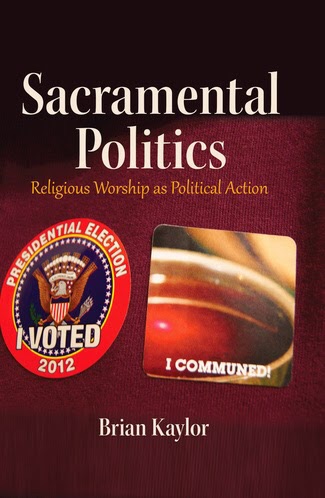
Sacramental Politics by Brian Kaylor
Sacramental Politics by Brian Kaylor is a unique look into the intersection between politics and religious practice. In this book, Kaylor thoroughly explores how religion impacts politics. He first explores how prayers are both a religious and political act (36). He compares and contrasts how both political parties use religious terms in political speeches (41). He shares how the presidential nomination convention take on a religious nature (44-46). Kaylor notes that the prayers served similar purposes (47):
“Like prayers at Republican conventions, those at Democratic ones highlighted key political issues for the Party.”
Prayers used in partisan politics depict political conventions as sacramental acts (47). Kaylor compares the vocabulary used by both parties in their speeches. Republicans used more references to the nation than to God. The country would be considered greater in prayers than God was (49). So public prayer were a way for a political party to promote their agenda.
Kaylor shifts from public prayers to public endorsements of candidates in church services and religious gatherings (58). He makes the proper assessment that endorsing a political candidate in a campaign is still political, even if it is done in a religious worship service (61-62). Pussy Riots’ prayer in the Russian Orthodox Cathredal was an example of political protest against the policies of Vladimir Putin (63).
Kaylor shows how religious talk can also be policy promotion. For example, prayer services were used after 9/11 to declare that the country was unified, while in the prayer service following Katrina service, the leaders prayed that the nation would become unified (91). Kaylor makes an important distinction about unity and public policy (94):
“While the Katrina service brought prayers for unity, the 9/11 service brought declarations that unity
would bring military victory.”
According to Kaylor, the 9/11 prayer service gave President Bush the justification to go to war against the Islamic terrorists (95). It is therefore ironic that President Clinton used the prayer breakfast on September 11, 1998 to confess his sin of adultery and ask for forgiveness (105).
While politicians use religion to promote a political agenda, pastors use politics to promote a religious agenda. Pastor Rick Warren conducted what he called the “Civil Forum on the Presidency” at his church Saddleback Valley Community Church. There, he moderated questions for Barack Obama and John McCain (113). President Obama, like President Bush before him, confessed his faith in Jesus Christ during this summit at Saddleback Church (114). During this forum, Warren shared an interesting evangelical response to the roles of the state and religion (115):
“We believe in the separation of church and state, but we do not believe in the separation of faith and politics because faith is just a worldview and everybody has some kind of worldview.”
By using the phrase “worldview”, Warren is noting the influence of his religious worldview (his religious agenda) on politics. In this case, politics is a subset of religion. Kaylor notes that the issues which Warren addresses in the forum line up closely with the Republican Party. Yet, Warren’s tone was not so blatantly partisan (115). This forum, which was hosted by Pastor Warren illustrates how pastoral power as a leadership model has been used in democratic societies. Kaylor summarizes about the importance of pastoral power (119):
“Unlike the king-leader who merely wields sword, the shepherd-leader guards the path to salvation.”
While I think Kaylor is correct that pastoral power exists, I think it has lost its influence in the most recent elections. Unlike the 1980s, when Pat Robertson and Jerry Falwell influenced the Republican Party, today’s pastors do not wield such power and influence over politics. The fact that both Obama and Romney declined to attend another forum at Warren’s church illustrates the decline of pastor power in politics. Even Catholics are not immune to this decline (121).
One exception perhaps has been Joshua Dubois who wrote The President’s Devotionals. He was the head of the Office of Faith Based Initiatives under President Obama and was considered “pastor-in-chief” (131). Kaylor describes how DuBois used his pastoral power through the use of daily devotions sent to Obama by email. Kaylor shows how these devotionals, which were crafted during important events of the presidency influenced the President’s decisions on a day-to-day basis. One can see how DuBois’s writings influenced the president, illustrating pastoral power. Unlike Warren and the Catholic Church, the place of pastoral power shifted from the church to the Oval Office.
Kaylor shifts prayer as public policy to prayer as a right of religious expression in public places. He notes that Russel Moore of the ERLC of the SBC defends the practice of public prayers (140). Moore recognizes that public prayer that start governmental meetings transforms the space into a religious service (141). Kaylor notes that moving a religious act to a public political space does not remove the religious meaning and function. Instead, it adds a new audience to the religious service (142).
Kaylor ends the book with an analysis of how powerful political power has become upon religious institutions. For example, he notes that the words “liturgy” and “ekklesia” are religious terms which came from political terms (157). Kaylor describes how churches communicate political values even in the way flags are placed in the worship center. According to the United States Flag Code, American flags are placed in “superior prominence” (to the right of the speaker), This communicates that the United States is the superior kingdom to Christ (178). It conveys a message that the United States requires a higher allegiance than Christ. In essence, churches communicate to their worshippers every Sunday that they are bowing down to Caesar. It is an interesting and yet subtle distinction of political loyalty conveyed by design.
Kaylor ends the book with a series of examples of what he calls “religious worship as inherit political action”. He cites three examples. The first example is Election Day Communion, an effort in the 2012 election to bring people together (188-196). The second example is Clarence Jordan. He was an example of a person who risked religious and political outrage for his beliefs (196-202). Jordan founded Koinonia Farms where white and blacks could live and work together in the 1950s. This project became the inspiration for Habitat for Humanity.
Kaylor explains that Jordan also wrote a translation of the Bible entitled “The Cotton Patch Gospel“. He changed the setting from the first century to the twentieth century American South. By changing the setting as well as the language, Jordan was able to make political statements using the sacred text. (I have personally read the Cotton Patch Gospel and I found refreshing in the way it is written. It is a uniquely American translation which speaks to many people in the Southern parts of the United States).
Kaylor cites a third example – religious literature. He explains how religious literature can have a political impact. Prayer books and songbooks all contain political messages (210). From the Book of Common Prayer to the Baptist Hymnal, each piece of literature is influenced by political views and can also influence a person’s political viewpoint. Kaylor notes an interesting change in the Baptist Hymnal from the section of songs under the heading “God and Country” in the 1991 version to “Patriotic” in the 2008 version. This change shows the influence of “American exceptionalism” in the religious-political worldview of the leaders of the Southern Baptist Convention (211).
Kaylor shares a historical example of how Christians can promote religious values and at the same time oppose the government in religious worship. He describes how a confession or creed can act as religious worship even in politics. He shares the story of the Confessing Church and its confession of faith called the “Barmen Declaration.” This creed opposed the Nazi regime and its influence on the Catholic and Lutheran church (222).
Overall, I thought this book was a comprehensive and objective look of the intersection of politics and religion. Kaylor does a good job of showing how intertwined religion and politics are in America. As a pastor, I noted with sadness the decline of pastoral power and influence. Although the Bible teaches us to allow the government to serve as God’s agents (Romans 13:4-6), this book shows that pastors still need to speak in the political arena.
#SpeakeasySacramentalPolitics
Disclosure: This is a personal book review. This review does not constitute the views of the Executive Board of the Missouri Baptist Convention.
Disclosure of Material Connection: I received this book free from the author and/or publisher through the Speakeasy blogging book review network. I was not required to write a positive review. The opinions I have expressed are my own. I am disclosing this in accordance with the Federal Trade Commission’s 16 CFR,Part 255.
Previous Post

March 28, 2015
1 Timothy 3:14-16 Spiritual Bridges
Next Post
March 31, 2015 What Every Christian Should Know About Islam by Rob Phillips
Browse Our Archives
Select a Category 1 Chronicles 1 Corinthians 1 John 1 Kings 1 Peter 1 Samuel 1 Thessalonians 1 Timothy 2 Chronicles 2 Corinthians 2 John 2 Kings 2 Peter 2 Samuel 2 Thessalonians 2 Timothy 3 John Acts Advent Amos Book Review Colossians Comics Culture Watch Daniel Deuteronomy Ecclesiastes Ephesians Esther Exodus Ezekiel Ezra Galatians Genesis Guest Post Habakkuk Haggai Hebrews Hosea Humor Inspiritational Isaiah James Jeremiah Job Joel John Jonah Joshua Jude Judges Lamentations Lectionary Lent Leviticus Link Love Luke Malachi Mark Matthew Micah Movie Review Nahum Nehemiah Numbers Philippians Political Watch Prophecy Watch Proverbs Psalm Revelation Reviews Romans Ruth Science Watch Sermon Series Sermons Simple Thoughts Song of Solomon Titus Top Ten Uncategorized Video Review Zechariah Zephaniah
Select a Month May 2026 October 2025 September 2025 June 2025 February 2025 January 2025 November 2024 October 2024 September 2024 July 2024 June 2024 April 2024 March 2024 January 2024 November 2023 October 2023 September 2023 June 2023 May 2023 March 2023 February 2023 January 2023 December 2022 October 2022 September 2022 August 2022 July 2022 June 2022 May 2022 January 2022 June 2021 January 2021 October 2020 July 2020 May 2020 April 2020 March 2020 February 2020 January 2020 December 2019 November 2019 October 2019 September 2019 August 2019 July 2019 June 2019 May 2019 April 2019 March 2019 February 2019 January 2019 December 2018 November 2018 October 2018 September 2018 August 2018 July 2018 June 2018 May 2018 April 2018 March 2018 February 2018 January 2018 December 2017 November 2017 October 2017 September 2017 August 2017 July 2017 June 2017 May 2017 April 2017 March 2017 February 2017 January 2017 December 2016 November 2016 October 2016 September 2016 August 2016 July 2016 June 2016 May 2016 April 2016 March 2016 February 2016 January 2016 December 2015 November 2015 October 2015 September 2015 August 2015 July 2015 June 2015 May 2015 April 2015 March 2015 February 2015 January 2015 December 2014 November 2014 October 2014 September 2014 August 2014 July 2014 June 2014 May 2014 April 2014 March 2014 February 2014 January 2014 December 2013 November 2013 October 2013 September 2013 August 2013 July 2013 June 2013 May 2013 April 2013 February 2013 January 2013 December 2012 November 2012 October 2012 September 2012 August 2012 July 2012 June 2012 May 2012 April 2009 June 2008 October 2007 September 2007 August 2007 July 2007 June 2007 May 2007 April 2007 March 2007 February 2007 January 2007 December 2006 October 2006 September 2006 May 2006 April 2006 March 2006 February 2006 January 2006 December 2005 September 2005
Follow Us!
TAKE THE
Religious Wisdom Quiz
Where did Elisha multiply oil?
Select your answer to see how you score.
Zarephath Jericho Shunem Samaria
Related posts from Jim Erwin

Could ChatGPT Start a New Religion?

Using ChatGPT in Sermon Preparation

TRENDING AT PATHEOS Evangelical

Letters on Living the Faith by C.S. Lewis
Most of us met C.S. Lewis as a public intellectual. Mere Christianity....

When Halloween Unmasks Married Hearts
Written by Dr. David K. Ewen from Eternal Truth Bible College Behind...

Aristotle. He’s been called the father of logic, the father of the...

Methodist Central Hall and Westminster Abbey
Situated on the same square is Methodist Central Hall and Westminster Abbey. ...

57th Dove Awards Honor Dolly Parton, Crown New...
On gospel music’s biggest night, the 57th annual GMA Dove Awards honored...

The First Eucharistic Controversy: Christ’s Real Presence
For Catholics, the Eucharist is the source and summit of the Christian...
view all Evangelical blogs
Ad-Free & Subscriber Log-In Subscription Support
- About Us
- 2026 Calendar
- Videos
- Podcasts
- Library of World Religions
- Faith In Media Tracker
- Advertise With Us
- Write for Us
- Privacy Policy
- Terms of Service
- Do Not Sell My Data
- Contact Us
- Radiant Digital
- Manage Newsletter Subscriptions
- Unsubscribe From Notifications
- Sitemap
Copyright 2008-2026, Patheos. All rights reserved.
Subscription Support Ad-Free & Subscriber Log-In
Follow Patheos