
BuddhistCatholicContemplativeEvangelicalGeneral ChristianHinduJewishLatter-day SaintMuslimNew VisionsProgressive Christian
Beliefs
- Buddhist
- Catholic
- Contemplative
- Evangelical
- General Christian
- Hindu
- Jewish
- Latter-day Saint
- More Voices
- Muslim
- New Visions
- Pagan
- Progressive Christian
Topics
- Religion News
- Food and Religion
- Sports and Religion
- Religious Art
- Religious Music and Entertainment
- Religious Events
- History and Religion
- Style and Religion
- Politics and Religion
- Women in Religion
- Recreation Outdoors and Religion
- Business Finance and Religion
- Careers Workplace and Religion
- Education and Religion
- Family Parenting and Religion
- Health Fitness and Religion
- Home and Religion
- Relationships and Religion
- Technology and Religion
- Travel and Religion
Columnists
- Buddhist Columnists
- Business Finance and Religion Columnists
- Careers Workplace and Religion Columnists
- Catholic Columnists
- Contemplative Columnists
- Education and Religion Columnists
- Evangelists Columnists
- Family Parenting and Religion Columnists
- General Christian Columnists
- Health Fitness and Religion Columnists
- Hindu Columnists
- History and Religion Columnists
- Home and Religion Columnists
- Jewish Columnists
- More Voices Columnists
- Latter Day Columnists
- Muslim Columnists
- New Visions Columnists
- Nonreligious Columnists
- Pagan Columnists
- Politics and Religion Columnists
- Progressive Columnists
- Recreation Outdoors and Religion Columnists
- Relationships and Religion Columnists
- Religion News Columnists
- Religious Art Columnists
- Religious Events Columnists
- Religious Music and Entertainment Columnists
- Sports and Religion Columnists
- Style and Religion Columnists
- Technology and Religion Columnists
- Travel and Religion Columnists
- Women in Religion Columnists
Resource Library
- 2026 Calendar
- Library of World Religions
- The 100 Most Holy Places on Earth
- Patheos Answers
- Podcasts
- Videos
- Faith Leaders Database
- Anglican Episcopalian
- Bahai
- Baptist
- Buddhism
- Christianity
- Confucianism
- Eastern Orthodoxy
- Hinduism
- Holiness and Pentecostal
- ISKCON
- Islam
- Judaism
- Lutheran
- Methodist
- The Church of Jesus Christ of Latter-day Saints
- New Age
- Paganism
- Presbytarian and Reformed
- Protestantism
- Religion Behind the Scenes
- Roman Catholic
- Scientology
- Shia Islam
- Sikhism
- Sufism
- Sunni Islam
- Taoism
- Zen
- See all religions
Research Tools
 Ad-Free & Subscriber Log-In Subscription Support
Ad-Free & Subscriber Log-In Subscription Support
Follow Patheos 

- Trending:
- Forgiveness
- |
- Marriage
- |
- Consciousness
- |
- Death Penalty
- |
- Election
- |
- Halloween

- Home
- Evangelical
- Act and Being by Dietrich Bonhoeffer
Act and Being by Dietrich Bonhoeffer
Last updated on: December 11, 2014 at 4:56 am by Jim Erwin
Act and Being by Dietrich Bonhoeffer 2014-12-11T04:56:38-05:00 Jim Erwin
Patheos Explore the world's faith through different perspectives on religion and spirituality! Patheos has the views of the prevalent religions and spiritualities of the world.
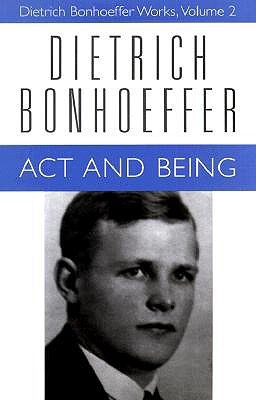
Act and Being by Dietrich Bonhoeffer
Act and Being by Dietrich Bonhoeffer defines its purpose with the subtitle: Transcendental Philosophy and Ontology in Systematic Theology. The purpose may be very complicated. However, Bonhoeffer shows us the purpose of the book with a summary outline of the book (31). Bonhoeffer addresses the interpretation of revelation in Scripture:
“(1) in terms of act, (2) in terms of being, (3) interpretation of act and of being meet and are drawn together, is only understood as the dialectic of faith and the congregation of Christ.”
To confront the philosophies of transcendentalism and idealism, Bonhoeffer calls for an “ecclesiological form of thinking – thinking as the church” (32). The book begins by addressing and confronting these two philosophies which influence culture (not just during his time, but in the opinion of reviewer, also today). Idealism (per Rene Descartes) essentially leads to materialism (40). Transcendentalism (per Immanuel Kant) essentially leads to atheism (44). Bonhoeffer contrasts these two approaches (which promote the self) against what the Bible calls sin (45). Descartes states “I think therefore I am” while Luther states “the heart turned in on itself.”
This contrast is developed throughout the book. In essence, Bonhoeffer speaks to his contemporaries and presents the flaws to their philosophical approach. In today’s terms, one might say that Bonhoeffer presents a way for the church to confront the thinking of the culture. In other words, how to think like a servant in a “selfie” culture. Bonhoeffer makes the important claim that a Christian can only confront and influence the present culture through “Christ existing as community” in the church. This concept was developed in his first book Sanctorum Communio (which I reviewed). Here, Bonhoeffer expands on his thesis and shows how the church should confront the culture.
Bonhoeffer addresses the question of freedom (84-90). The world teaches that I am free. Bonhoeffer counters that God is free (90). Divine election is never a contest between God’s will and man’s freedom. People speak about the difficult theology about election as if God’s will is a burden to man’s freedom. To this “selfie” theology, Bonhoeffer counters with a wonderful explanation about the freedom of God. Of course, he is speaking to people who believe that God is bound to certain expectations about who God is. However, in application, this discussion has much to say to people of the twenty-first century. One cannot put God in a box. God is free to do what He wants no matter what I think about myself or God.
Bonhoeffer spends a great deal of time expounding upon his thought that “Christ exists as community.” He states that Christ in the church is the “whole” person. Bonhoeffer makes the correlation that if Christ exists as community, then revelation happens in the community of faith (113). Unity and individuality both happen within the church community (121).
Christ in the church makes the person whole. Sin on the other hand, turns a person in on him/herself. Sin is the inversion of human will in on itself (144). Every self-seeking act is a sinful one. Only the Word of God can truly point us to sin’s nature and how to overcome it.
Following the definition of sin and his analysis of a “selfie” culture, Bonhoeffer shares about how life is like as a Christian – what he calls being “in Christ” (150):
“Seek yourself only in Christ and not in yourself, and you will find yourself in him eternally.”
Being in Christ has two tenses (1) past and (2) future. The past represents life without Christ, and a person uses the conscience which points to Christ (155-157). In the future tense, Bonhoeffer uses the child as a metaphor to explain the Christian life following conversion. Bonhoeffer compares the new creation of a Christian to being a child and that child moves from exile in the world to home in the church community. The child is born from out of the world and enters the wideness of heaven (161).
In the Editor’s Afterword, Hans-Richard Reuter shares insights into Act and Being and its cultural significance. He summarizes the book’s premise: The problem is the demise of religious humanity and a humiliation of Christianity in culture. The solution is revelation as a “form of thinking” was the way to see the solution to the problem (163). The method of argument in Act and Being is deconstructionism (179). Using this process, Bonhoeffer does an excellent job describing the need for the church to be the community intends them to be. He counters the philosophical trends with practical theological points in order to show that the church can influence the culture without being overcome by it. Any Christian who wants to overcome the present-day “selfie” culture should read this book.
Previous Post

December 10, 2014
Keep Me Dependent On You
Next Post
December 11, 2014 Emotions of the Harvest
Browse Our Archives
Select a Category 1 Chronicles 1 Corinthians 1 John 1 Kings 1 Peter 1 Samuel 1 Thessalonians 1 Timothy 2 Chronicles 2 Corinthians 2 John 2 Kings 2 Peter 2 Samuel 2 Thessalonians 2 Timothy 3 John Acts Advent Amos Book Review Colossians Comics Culture Watch Daniel Deuteronomy Ecclesiastes Ephesians Esther Exodus Ezekiel Ezra Galatians Genesis Guest Post Habakkuk Haggai Hebrews Hosea Humor Inspiritational Isaiah James Jeremiah Job Joel John Jonah Joshua Jude Judges Lamentations Lectionary Lent Leviticus Link Love Luke Malachi Mark Matthew Micah Movie Review Nahum Nehemiah Numbers Philippians Political Watch Prophecy Watch Proverbs Psalm Revelation Reviews Romans Ruth Science Watch Sermon Series Sermons Simple Thoughts Song of Solomon Titus Top Ten Uncategorized Video Review Zechariah Zephaniah
Select a Month May 2026 October 2025 September 2025 June 2025 February 2025 January 2025 November 2024 October 2024 September 2024 July 2024 June 2024 April 2024 March 2024 January 2024 November 2023 October 2023 September 2023 June 2023 May 2023 March 2023 February 2023 January 2023 December 2022 October 2022 September 2022 August 2022 July 2022 June 2022 May 2022 January 2022 June 2021 January 2021 October 2020 July 2020 May 2020 April 2020 March 2020 February 2020 January 2020 December 2019 November 2019 October 2019 September 2019 August 2019 July 2019 June 2019 May 2019 April 2019 March 2019 February 2019 January 2019 December 2018 November 2018 October 2018 September 2018 August 2018 July 2018 June 2018 May 2018 April 2018 March 2018 February 2018 January 2018 December 2017 November 2017 October 2017 September 2017 August 2017 July 2017 June 2017 May 2017 April 2017 March 2017 February 2017 January 2017 December 2016 November 2016 October 2016 September 2016 August 2016 July 2016 June 2016 May 2016 April 2016 March 2016 February 2016 January 2016 December 2015 November 2015 October 2015 September 2015 August 2015 July 2015 June 2015 May 2015 April 2015 March 2015 February 2015 January 2015 December 2014 November 2014 October 2014 September 2014 August 2014 July 2014 June 2014 May 2014 April 2014 March 2014 February 2014 January 2014 December 2013 November 2013 October 2013 September 2013 August 2013 July 2013 June 2013 May 2013 April 2013 February 2013 January 2013 December 2012 November 2012 October 2012 September 2012 August 2012 July 2012 June 2012 May 2012 April 2009 June 2008 October 2007 September 2007 August 2007 July 2007 June 2007 May 2007 April 2007 March 2007 February 2007 January 2007 December 2006 October 2006 September 2006 May 2006 April 2006 March 2006 February 2006 January 2006 December 2005 September 2005
Follow Us!
TAKE THE
Religious Wisdom Quiz
What famous basilica is in Vatican City?
Select your answer to see how you score.
Notre Dame St. Paul's St. Peter's Basilica St. Basil's
Related posts from Jim Erwin


Using ChatGPT in Sermon Preparation


Can I Ask You a Question by Preston...
TRENDING AT PATHEOS Evangelical

57th Dove Awards Honor Dolly Parton, Crown New...
On gospel music’s biggest night, the 57th annual GMA Dove Awards honored...

The First Eucharistic Controversy: Christ’s Real Presence
For Catholics, the Eucharist is the source and summit of the Christian...

What a Stop Sign Can Teach Us About...
How to Make a Decision When You Can't Hear God Main point:...

Archdiocese Hosts Military Marriage Retreat in Germany
RASTATT, Germany — The transient military lifestyle, with its frequent deployments and...

Nearly every morning, I make the drive to Detroit with my high-school-age...

The Real AI Story Is Adoption Without Trust
Artificial intelligence has crossed a political threshold. It is no longer a...
view all Evangelical blogs
Ad-Free & Subscriber Log-In Subscription Support
- About Us
- 2026 Calendar
- Videos
- Podcasts
- Library of World Religions
- Faith In Media Tracker
- Advertise With Us
- Write for Us
- Privacy Policy
- Terms of Service
- Do Not Sell My Data
- Contact Us
- Radiant Digital
- Manage Newsletter Subscriptions
- Unsubscribe From Notifications
- Sitemap
Copyright 2008-2026, Patheos. All rights reserved.
Subscription Support Ad-Free & Subscriber Log-In
Follow Patheos