
BuddhistCatholicContemplativeEvangelicalGeneral ChristianHinduJewishLatter-day SaintMuslimNew VisionsProgressive Christian
Beliefs
- Buddhist
- Catholic
- Contemplative
- Evangelical
- General Christian
- Hindu
- Jewish
- Latter-day Saint
- More Voices
- Muslim
- New Visions
- Pagan
- Progressive Christian
Topics
- Religion News
- Food and Religion
- Sports and Religion
- Religious Art
- Religious Music and Entertainment
- Religious Events
- History and Religion
- Style and Religion
- Politics and Religion
- Women in Religion
- Recreation Outdoors and Religion
- Business Finance and Religion
- Careers Workplace and Religion
- Education and Religion
- Family Parenting and Religion
- Health Fitness and Religion
- Home and Religion
- Relationships and Religion
- Technology and Religion
- Travel and Religion
Columnists
- Buddhist Columnists
- Business Finance and Religion Columnists
- Careers Workplace and Religion Columnists
- Catholic Columnists
- Contemplative Columnists
- Education and Religion Columnists
- Evangelists Columnists
- Family Parenting and Religion Columnists
- General Christian Columnists
- Health Fitness and Religion Columnists
- Hindu Columnists
- History and Religion Columnists
- Home and Religion Columnists
- Jewish Columnists
- More Voices Columnists
- Latter Day Columnists
- Muslim Columnists
- New Visions Columnists
- Nonreligious Columnists
- Pagan Columnists
- Politics and Religion Columnists
- Progressive Columnists
- Recreation Outdoors and Religion Columnists
- Relationships and Religion Columnists
- Religion News Columnists
- Religious Art Columnists
- Religious Events Columnists
- Religious Music and Entertainment Columnists
- Sports and Religion Columnists
- Style and Religion Columnists
- Technology and Religion Columnists
- Travel and Religion Columnists
- Women in Religion Columnists
Resource Library
- 2026 Calendar
- Library of World Religions
- The 100 Most Holy Places on Earth
- Patheos Answers
- Podcasts
- Videos
- Faith Leaders Database
- Anglican Episcopalian
- Bahai
- Baptist
- Buddhism
- Christianity
- Confucianism
- Eastern Orthodoxy
- Hinduism
- Holiness and Pentecostal
- ISKCON
- Islam
- Judaism
- Lutheran
- Methodist
- The Church of Jesus Christ of Latter-day Saints
- New Age
- Paganism
- Presbytarian and Reformed
- Protestantism
- Religion Behind the Scenes
- Roman Catholic
- Scientology
- Shia Islam
- Sikhism
- Sufism
- Sunni Islam
- Taoism
- Zen
- See all religions
Research Tools
 Ad-Free & Subscriber Log-In Subscription Support
Ad-Free & Subscriber Log-In Subscription Support
Follow Patheos 

- Trending:
- Forgiveness
- |
- Marriage
- |
- Consciousness
- |
- Death Penalty
- |
- Election
- |
- Halloween

- Home
- Evangelical
- The Purpose-Driven Church by Rick Warren
The Purpose-Driven Church by Rick Warren
Last updated on: May 8, 2014 at 8:53 pm by Jim Erwin
The Purpose-Driven Church by Rick Warren 2014-05-08T20:53:49-05:00 Jim Erwin
Patheos Explore the world's faith through different perspectives on religion and spirituality! Patheos has the views of the prevalent religions and spiritualities of the world.
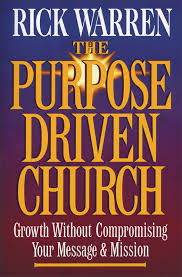 The Purpose-Driven Church by Rick Warren is a book which describes the history and the development of a process for his church’s growth. It is also a handbook for pastors who wish to implement that process in their churches as well. Warren describes the Purpose-Driven Process as essential for church health, not church growth.
Warren shares the history of Saddleback Church, the church he started in California in 1980, followed by the myths of growing churches. The most important principle is that churches grow when they are healthy, and churches are healthy when they balance all five purposes of the church. He defines the purposes of the church from Matthew 28:18-20 (The Great Commission) and Matthew 22:37-40 (The Great Commandment). The purpose-driven church is committed to fulfilling all five tasks that Christ gave His church to accomplish:
Purpose #1: Love the Lord with all your heart (worship)
Purpose #2: Love your neighbor as yourself (ministry)
Purpose #3: Go and make disciples (evangelism)
Purpose #4: Baptizing them (fellowship)
Purpose #5: Teaching them to obey (discipleship)
The best thing about this book is the way Warren communicates his ideas. He communicates his vision of the purpose-driven church visually. For example, he uses two diagrams to illustrate the purposes and how these purposes are kept in balance. The first diagram is a baseball diamond. Using the image of a baseball diamond, he shares the idea that people move through the purposes. A Christian gets to first base in the church through fellowship (baptism). Then that person moves to second base through discipleship (small groups). Next, the person moves to third base through ministry (service). Finally, a person gets to home base and makes home run when they are involved in making disciples through missions (evangelism). All of this is done while we “pitch” our voices to God through worship. While this is a great image, I have personally struggled with how one can truly measure the growth of someone just by “doing these things.” It measures movement in a church well, and also the level of commitment. Yet, it is hard to also measure the “love” of a person using this process.
The second diagram is the concentric circles. Warren uses concentric circles to measure the commitment level of a person as they go forward in their journey with Jesus Christ. Again, these concentric circles match the purposes and they can be aligned with the CLASS structure he uses to move people from one commitment to another. The plan is to move people from the community (the lowest level of commitment to Christ and His church) to the core (the highest level of commitment to Christ and His church.)
Warren spends time in his book helping churches identify their target audience and then developing a strategy to reach the people whom God wants them to reach. He takes to share how a church can work on moving people from community to core. He shares all kinds of ideas to get people moving. Warren shares how a church can do big events to attract the community. He talks about developing a “seeker-sensitive” worship service to draw a crowd. This includes making the music more upbeat, and less traditional. He shares how to plan sermons that gets the attention of the un-churched audience. To move people from attenders to members (congregation), he suggests a having a membership class (CLASS 101 – Discovering Church Membership) and a membership covenant. For members to mature, to become more committed, he suggests developing a class where everyone learns spiritual maturity (CLASS 201 – Discovering Maturity). This includes growing spiritual habits and learning to raise the commitment level. He also includes what he calls a Life Development Process. This life development process includes a series of classes which are taught. To take the congregation and move them to be committed, Warren suggests having everyone going through a SHAPE class (CLASS 301 – Discovering My SHAPE). SHAPE stands for the five ways God shapes a person for ministry (Spiritual gifts, Heart, Abilities, Personality, Experiences). The purpose of finding a person’s SHAPE is to help them become equipped to do ministry in the church. The final commitment level is the core. Warren encourages that churches teach their members about their mission (CLASS 401 – Discovering My Mission).
This book was groundbreaking when it was written. It is still a very relevant textbook for church management. The book has a strong biblical basis, even if some of the methods have since been criticized. This book should be on the bookshelf of every pastor. This should also be the first book read when a pastor wants to consider revitalizing a church. There are books which have been written that may teach a different approach. Yet, the paradigm-shifting idea started with this book. I would recommend the book for that reason alone.
I have also reviewed Warren’s books The Purpose Driven Life here and The Daniel Plan here.
Previous Post

May 7, 2014
A Beauty Pageant with a Purpose
Next Post
May 10, 2014 Proverbs 6:20-23 A Mother's Teaching
Browse Our Archives
Select a Category 1 Chronicles 1 Corinthians 1 John 1 Kings 1 Peter 1 Samuel 1 Thessalonians 1 Timothy 2 Chronicles 2 Corinthians 2 John 2 Kings 2 Peter 2 Samuel 2 Thessalonians 2 Timothy 3 John Acts Advent Amos Book Review Colossians Comics Culture Watch Daniel Deuteronomy Ecclesiastes Ephesians Esther Exodus Ezekiel Ezra Galatians Genesis Guest Post Habakkuk Haggai Hebrews Hosea Humor Inspiritational Isaiah James Jeremiah Job Joel John Jonah Joshua Jude Judges Lamentations Lectionary Lent Leviticus Link Love Luke Malachi Mark Matthew Micah Movie Review Nahum Nehemiah Numbers Philippians Political Watch Prophecy Watch Proverbs Psalm Revelation Reviews Romans Ruth Science Watch Sermon Series Sermons Simple Thoughts Song of Solomon Titus Top Ten Uncategorized Video Review Zechariah Zephaniah
Select a Month May 2026 October 2025 September 2025 June 2025 February 2025 January 2025 November 2024 October 2024 September 2024 July 2024 June 2024 April 2024 March 2024 January 2024 November 2023 October 2023 September 2023 June 2023 May 2023 March 2023 February 2023 January 2023 December 2022 October 2022 September 2022 August 2022 July 2022 June 2022 May 2022 January 2022 June 2021 January 2021 October 2020 July 2020 May 2020 April 2020 March 2020 February 2020 January 2020 December 2019 November 2019 October 2019 September 2019 August 2019 July 2019 June 2019 May 2019 April 2019 March 2019 February 2019 January 2019 December 2018 November 2018 October 2018 September 2018 August 2018 July 2018 June 2018 May 2018 April 2018 March 2018 February 2018 January 2018 December 2017 November 2017 October 2017 September 2017 August 2017 July 2017 June 2017 May 2017 April 2017 March 2017 February 2017 January 2017 December 2016 November 2016 October 2016 September 2016 August 2016 July 2016 June 2016 May 2016 April 2016 March 2016 February 2016 January 2016 December 2015 November 2015 October 2015 September 2015 August 2015 July 2015 June 2015 May 2015 April 2015 March 2015 February 2015 January 2015 December 2014 November 2014 October 2014 September 2014 August 2014 July 2014 June 2014 May 2014 April 2014 March 2014 February 2014 January 2014 December 2013 November 2013 October 2013 September 2013 August 2013 July 2013 June 2013 May 2013 April 2013 February 2013 January 2013 December 2012 November 2012 October 2012 September 2012 August 2012 July 2012 June 2012 May 2012 April 2009 June 2008 October 2007 September 2007 August 2007 July 2007 June 2007 May 2007 April 2007 March 2007 February 2007 January 2007 December 2006 October 2006 September 2006 May 2006 April 2006 March 2006 February 2006 January 2006 December 2005 September 2005
Follow Us!
TAKE THE
Religious Wisdom Quiz
True or False: Boaz was Ruth's brother-in-law who married her.
Select your answer to see how you score.
FALSE TRUE
Related posts from Jim Erwin


Using ChatGPT in Sermon Preparation


Can I Ask You a Question by Preston...
TRENDING AT PATHEOS Evangelical

The First Eucharistic Controversy: Christ’s Real Presence
For Catholics, the Eucharist is the source and summit of the Christian...

What a Stop Sign Can Teach Us About...
How to Make a Decision When You Can't Hear God Main point:...

Archdiocese Hosts Military Marriage Retreat in Germany
RASTATT, Germany — The transient military lifestyle, with its frequent deployments and...

Nearly every morning, I make the drive to Detroit with my high-school-age...

The Real AI Story Is Adoption Without Trust
Artificial intelligence has crossed a political threshold. It is no longer a...

A new article, written by Jeff Lindsay and Gale L. Pooley,...
view all Evangelical blogs
Ad-Free & Subscriber Log-In Subscription Support
- About Us
- 2026 Calendar
- Videos
- Podcasts
- Library of World Religions
- Faith In Media Tracker
- Advertise With Us
- Write for Us
- Privacy Policy
- Terms of Service
- Do Not Sell My Data
- Contact Us
- Radiant Digital
- Manage Newsletter Subscriptions
- Unsubscribe From Notifications
- Sitemap
Copyright 2008-2026, Patheos. All rights reserved.
Subscription Support Ad-Free & Subscriber Log-In
Follow Patheos