
BuddhistCatholicContemplativeEvangelicalGeneral ChristianHinduJewishLatter-day SaintMuslimNew VisionsProgressive Christian
Beliefs
- Buddhist
- Catholic
- Contemplative
- Evangelical
- General Christian
- Hindu
- Jewish
- Latter-day Saint
- More Voices
- Muslim
- New Visions
- Pagan
- Progressive Christian
Topics
- Religion News
- Food and Religion
- Sports and Religion
- Religious Art
- Religious Music and Entertainment
- Religious Events
- History and Religion
- Style and Religion
- Politics and Religion
- Women in Religion
- Recreation Outdoors and Religion
- Business Finance and Religion
- Careers Workplace and Religion
- Education and Religion
- Family Parenting and Religion
- Health Fitness and Religion
- Home and Religion
- Relationships and Religion
- Technology and Religion
- Travel and Religion
Columnists
- Buddhist Columnists
- Business Finance and Religion Columnists
- Careers Workplace and Religion Columnists
- Catholic Columnists
- Contemplative Columnists
- Education and Religion Columnists
- Evangelists Columnists
- Family Parenting and Religion Columnists
- General Christian Columnists
- Health Fitness and Religion Columnists
- Hindu Columnists
- History and Religion Columnists
- Home and Religion Columnists
- Jewish Columnists
- More Voices Columnists
- Latter Day Columnists
- Muslim Columnists
- New Visions Columnists
- Nonreligious Columnists
- Pagan Columnists
- Politics and Religion Columnists
- Progressive Columnists
- Recreation Outdoors and Religion Columnists
- Relationships and Religion Columnists
- Religion News Columnists
- Religious Art Columnists
- Religious Events Columnists
- Religious Music and Entertainment Columnists
- Sports and Religion Columnists
- Style and Religion Columnists
- Technology and Religion Columnists
- Travel and Religion Columnists
- Women in Religion Columnists
Resource Library
- 2026 Calendar
- Library of World Religions
- The 100 Most Holy Places on Earth
- Patheos Answers
- Podcasts
- Videos
- Faith Leaders Database
- Anglican Episcopalian
- Bahai
- Baptist
- Buddhism
- Christianity
- Confucianism
- Eastern Orthodoxy
- Hinduism
- Holiness and Pentecostal
- ISKCON
- Islam
- Judaism
- Lutheran
- Methodist
- The Church of Jesus Christ of Latter-day Saints
- New Age
- Paganism
- Presbytarian and Reformed
- Protestantism
- Religion Behind the Scenes
- Roman Catholic
- Scientology
- Shia Islam
- Sikhism
- Sufism
- Sunni Islam
- Taoism
- Zen
- See all religions
Research Tools
 Ad-Free & Subscriber Log-In Subscription Support
Ad-Free & Subscriber Log-In Subscription Support
Follow Patheos 

- Trending:
- Forgiveness
- |
- Marriage
- |
- Consciousness
- |
- Death Penalty
- |
- Election
- |
- Halloween

- Home
- Evangelical
- Quality Research Papers by Nancy Jean Vyhmeister
Quality Research Papers by Nancy Jean Vyhmeister
Last updated on: April 25, 2014 at 2:09 am by Jim Erwin
Quality Research Papers by Nancy Jean Vyhmeister 2014-04-25T02:09:50-05:00 Jim Erwin
Patheos Explore the world's faith through different perspectives on religion and spirituality! Patheos has the views of the prevalent religions and spiritualities of the world.
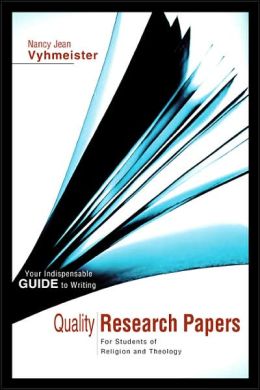
I found this book, Quality Research Papers, a very thorough guide to anyone who plans to do research and write reports. The book walks the reader through every step of the research process. The author describes with examples the types of research papers to write.
As a writer, I found the section on finding resources online very helpful. However, since the book was written, there are probably many more websites and online tools available for use. The author does acknowledge that the Internet as a tool is constantly changing. However, there seems to be no discussion about search engines, and their use as an online research tool. I wonder how the author would address a useful tool such as Google. In the age of the Internet, I also wonder if the traditional card catalog is even worth considering in a library. I doubt many younger readers would be familiar with this research tool.
The author spends valuable time to help the potential research writer. The process of choosing a topic was very clear to understand. I had always heard that the topic should be narrow enough to make the report thorough. This author states it in another way. The goal of doing research is to become a specialist in an area. I agree with this assessment. Specialists are experts on a topic. In order to write a research paper well, the writer must be an expert on the topic. Being an expert means that one has evaluated everything that has been written on the topic.
The chapter entitled “Planning Research” was very thorough. Just as good cookbook shows you how to cook a meal, this chapter outlined every single step needed to plan a good research project. I agreed with the sequence of events in planning research. It is a logical, sequential, and useful process.
Planning good research includes documenting resources. The next chapter about “Preparing Bibliographies” takes the writer through the steps and methods of keeping track of the sources of the research. There are different methods described. I am familiar with the bibliographic card approach. As archaic as it seems, it is still probably the best method.
After a person has defined a topic, and has the system ready for recording resources in a bibliography, the author spends time describing the importance of research thinking. The author describes the usefulness of the scientific method of research for theological papers. While I may have known about these ideas, this book set these ideas out on paper. For example, the author uses biblical examples to illustrate research thinking. The mindset of having objectivity, focus and clear presuppositions may be part of the scientific method, but they also apply to theological papers. The author makes good use of biblical examples to illustrate the point.
In the next chapter, “Reading and Evaluating”, the author gives useful suggestions for reading, and then spends time sharing how to evaluate the resource. A list of fifteen questions helps the writer evaluate the resource. The section on note-taking is useful, but it brings up a problem for the researcher in the age of the Internet. There is the struggle between using the standard form of note-taking, and the useful tools on the Internet designed for the same purpose. There are now many websites that can help the writer organize notes and bibliographic citations all in the same place. However, it seems that the research writer would be using two different systems to accomplish the same purpose. While I think that the standard note card idea is archaic and clumsy, I must concur with the author on the methods described.
After spending time finding the resources, and then organizing the notes, a writer needs to organize the sources into bibliographies, as well as use the correct forms for footnotes or endnotes. In the chapter entitled “Reference Notes and Bibliographical Entries”, each type of source is listed, along with the form it takes as a footnote and as a bibliographic note. Unlike printed media, the author suggests that when the writer references electronic media, steps must be taken to “track” the source. For example, a date must be inserted to show when the source was accessed on the Internet. It is also suggested that a hard copy of the article be printed and saved for reference until the dissertation is approved. The fact that a copy must be made is the only disadvantage for using Internet sources.
As the book shifted focus from what to research for the paper, to how to write the paper, I was impressed with the chapter entitled “Writing the Paper.” In the section on the writing process, I concur that there needs to be a first and second draft. However, I find that actually writing on paper is not necessary. I believe a person should learn to write their drafts on the computer. While I realize that literally putting pen to paper helps some people. I find that it wastes time that can be used in research. It is necessary in writing a first draft that the document file should be saved often. A word processor can help the writer with grammatical errors and spelling mistakes.
The chapter entitled “Formatting the Paper” describes a summary of the format used in theological papers. There is also a helpful example of a research paper with the proper formatting. With the use of Microsoft Word, the document can be easily designed to use the “Turabian” format.
The book ends by describing the ways to write a variety of theological research papers. Biblical exegesis, descriptive research, case studies, papers on theological issues in ministry, critical reviews, theses and dissertations, and D.Min. papers are all described in the final chapters of the book. Along with instructions and examples of these types of papers, there is an important chapter on the use of statistics, tables, and graphs. Beyond anything else in the book, these chapters were the most helpful. The D.Min. projects listed as examples of dissertations seem to be limited.
The book provides enormous benefits for the writer of theological papers. This book is helpful supplement to the standard reference for writing theological papers, A Manual for Writers by Kate L. Turabian. The book is well-organized, and filled with helpful examples. The book also answers questions that the writer of theological papers ask, and Turabian does not answer completely.
Previous Post

April 25, 2014
A Rulebook for Arguments by Anthony Weston
Next Post
April 25, 2014 Thinking Naughty Thoughts by Johan van der Merwe
Browse Our Archives
Select a Category 1 Chronicles 1 Corinthians 1 John 1 Kings 1 Peter 1 Samuel 1 Thessalonians 1 Timothy 2 Chronicles 2 Corinthians 2 John 2 Kings 2 Peter 2 Samuel 2 Thessalonians 2 Timothy 3 John Acts Advent Amos Book Review Colossians Comics Culture Watch Daniel Deuteronomy Ecclesiastes Ephesians Esther Exodus Ezekiel Ezra Galatians Genesis Guest Post Habakkuk Haggai Hebrews Hosea Humor Inspiritational Isaiah James Jeremiah Job Joel John Jonah Joshua Jude Judges Lamentations Lectionary Lent Leviticus Link Love Luke Malachi Mark Matthew Micah Movie Review Nahum Nehemiah Numbers Philippians Political Watch Prophecy Watch Proverbs Psalm Revelation Reviews Romans Ruth Science Watch Sermon Series Sermons Simple Thoughts Song of Solomon Titus Top Ten Uncategorized Video Review Zechariah Zephaniah
Select a Month May 2026 October 2025 September 2025 June 2025 February 2025 January 2025 November 2024 October 2024 September 2024 July 2024 June 2024 April 2024 March 2024 January 2024 November 2023 October 2023 September 2023 June 2023 May 2023 March 2023 February 2023 January 2023 December 2022 October 2022 September 2022 August 2022 July 2022 June 2022 May 2022 January 2022 June 2021 January 2021 October 2020 July 2020 May 2020 April 2020 March 2020 February 2020 January 2020 December 2019 November 2019 October 2019 September 2019 August 2019 July 2019 June 2019 May 2019 April 2019 March 2019 February 2019 January 2019 December 2018 November 2018 October 2018 September 2018 August 2018 July 2018 June 2018 May 2018 April 2018 March 2018 February 2018 January 2018 December 2017 November 2017 October 2017 September 2017 August 2017 July 2017 June 2017 May 2017 April 2017 March 2017 February 2017 January 2017 December 2016 November 2016 October 2016 September 2016 August 2016 July 2016 June 2016 May 2016 April 2016 March 2016 February 2016 January 2016 December 2015 November 2015 October 2015 September 2015 August 2015 July 2015 June 2015 May 2015 April 2015 March 2015 February 2015 January 2015 December 2014 November 2014 October 2014 September 2014 August 2014 July 2014 June 2014 May 2014 April 2014 March 2014 February 2014 January 2014 December 2013 November 2013 October 2013 September 2013 August 2013 July 2013 June 2013 May 2013 April 2013 February 2013 January 2013 December 2012 November 2012 October 2012 September 2012 August 2012 July 2012 June 2012 May 2012 April 2009 June 2008 October 2007 September 2007 August 2007 July 2007 June 2007 May 2007 April 2007 March 2007 February 2007 January 2007 December 2006 October 2006 September 2006 May 2006 April 2006 March 2006 February 2006 January 2006 December 2005 September 2005
Follow Us!
TAKE THE
Religious Wisdom Quiz
How many Psalms are attributed to David?
Select your answer to see how you score.
100 73 40 50
Related posts from Jim Erwin


Using ChatGPT in Sermon Preparation


Can I Ask You a Question by Preston...
TRENDING AT PATHEOS Evangelical

The Dangers of Gradual Accommodation (Winking at Sin)
Recently, the “law of gradualness” resurfaced during the opening of a weeklong,...

The Iron Gates and the Lion of the...
Yesterday, I didn't finish my report about, well, yesterday. So I'll...

Dolly Parton’s Last Song Wins Dove Award with...
Bluegrass band The Grascals, speaking on the red carpet at the 57th...

The Image: On the Horror of Capitalism and...
The Image Then went the Pharisees, and took counsel how they might...

We are approaching the date of our new American national holiday: October...

Letters on Living the Faith by C.S. Lewis
Most of us met C.S. Lewis as a public intellectual. Mere Christianity....
view all Evangelical blogs
Ad-Free & Subscriber Log-In Subscription Support
- About Us
- 2026 Calendar
- Videos
- Podcasts
- Library of World Religions
- Faith In Media Tracker
- Advertise With Us
- Write for Us
- Privacy Policy
- Terms of Service
- Do Not Sell My Data
- Contact Us
- Radiant Digital
- Manage Newsletter Subscriptions
- Unsubscribe From Notifications
- Sitemap
Copyright 2008-2026, Patheos. All rights reserved.
Subscription Support Ad-Free & Subscriber Log-In
Follow Patheos