
BuddhistCatholicContemplativeEvangelicalGeneral ChristianHinduJewishLatter-day SaintMuslimNew VisionsProgressive Christian
Beliefs
- Buddhist
- Catholic
- Contemplative
- Evangelical
- General Christian
- Hindu
- Jewish
- Latter-day Saint
- More Voices
- Muslim
- New Visions
- Pagan
- Progressive Christian
Topics
- Religion News
- Food and Religion
- Sports and Religion
- Religious Art
- Religious Music and Entertainment
- Religious Events
- History and Religion
- Style and Religion
- Politics and Religion
- Women in Religion
- Recreation Outdoors and Religion
- Business Finance and Religion
- Careers Workplace and Religion
- Education and Religion
- Family Parenting and Religion
- Health Fitness and Religion
- Home and Religion
- Relationships and Religion
- Technology and Religion
- Travel and Religion
Columnists
- Buddhist Columnists
- Business Finance and Religion Columnists
- Careers Workplace and Religion Columnists
- Catholic Columnists
- Contemplative Columnists
- Education and Religion Columnists
- Evangelists Columnists
- Family Parenting and Religion Columnists
- General Christian Columnists
- Health Fitness and Religion Columnists
- Hindu Columnists
- History and Religion Columnists
- Home and Religion Columnists
- Jewish Columnists
- More Voices Columnists
- Latter Day Columnists
- Muslim Columnists
- New Visions Columnists
- Nonreligious Columnists
- Pagan Columnists
- Politics and Religion Columnists
- Progressive Columnists
- Recreation Outdoors and Religion Columnists
- Relationships and Religion Columnists
- Religion News Columnists
- Religious Art Columnists
- Religious Events Columnists
- Religious Music and Entertainment Columnists
- Sports and Religion Columnists
- Style and Religion Columnists
- Technology and Religion Columnists
- Travel and Religion Columnists
- Women in Religion Columnists
Resource Library
- 2026 Calendar
- Library of World Religions
- The 100 Most Holy Places on Earth
- Patheos Answers
- Podcasts
- Videos
- Faith Leaders Database
- Anglican Episcopalian
- Bahai
- Baptist
- Buddhism
- Christianity
- Confucianism
- Eastern Orthodoxy
- Hinduism
- Holiness and Pentecostal
- ISKCON
- Islam
- Judaism
- Lutheran
- Methodist
- The Church of Jesus Christ of Latter-day Saints
- New Age
- Paganism
- Presbytarian and Reformed
- Protestantism
- Religion Behind the Scenes
- Roman Catholic
- Scientology
- Shia Islam
- Sikhism
- Sufism
- Sunni Islam
- Taoism
- Zen
- See all religions
Research Tools
 Ad-Free & Subscriber Log-In Subscription Support
Ad-Free & Subscriber Log-In Subscription Support
Follow Patheos 

- Trending:
- Forgiveness
- |
- Marriage
- |
- Consciousness
- |
- Death Penalty
- |
- Election
- |
- Halloween

- Home
- Evangelical
- How to Read a Book
How to Read a Book
Last updated on: June 16, 2018 at 9:57 pm by Jim Erwin
How to Read a Book 2018-06-16T21:57:30-05:00 Jim Erwin
Patheos Explore the world's faith through different perspectives on religion and spirituality! Patheos has the views of the prevalent religions and spiritualities of the world.
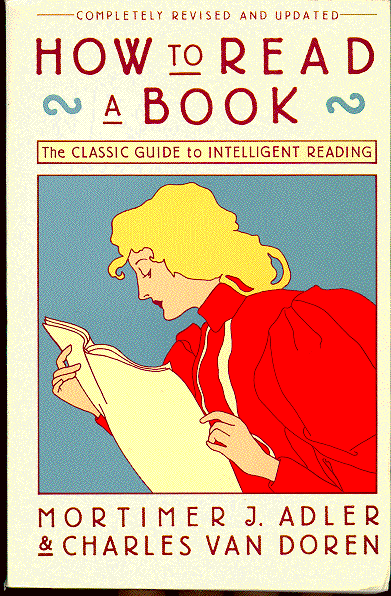
How to Read a Book by Mortimer J. Adler and Charles Van Doren
How to Read a Book by Mortimer J. Adler and Charles Van Doren is a book that gives the reader a guide to intelligent reading.
The book entitled How to Read a Book is a useful analysis about how to read a variety of books well. The book describes the four levels of reading that a person must use in order to get the most of every book you read. I understand that the point of this book was to show me how to thoroughly digest a book before I use it as a resource in writing a research paper.
As someone who has written a book, I found some of the points very interesting. I sensed that I could use this information later when I write another book. The book helped me see how I can “converse” with the reader. As a potential doctoral student, this book revealed what I needed to do to get the most out of every book I would use.
Part One defines the art of reading, and then proceeds to the levels of reading. The book essentially states that in order for a book to be well-read, it needs to be read at least four different times, in four different ways. The first level of reading is called “elemental reading.” The book spends too many pages in my opinion on the subject “how we learn to read” when it speaks of elemental reading. The book digresses into an analytical history of the teaching of elementary reading in chapter three. It then spends time describing how a child learns to read. To help the reader from getting confused, the book makes the distinction between the levels of reading and the “stages” of reading (which are all included in the elementary level.) The second level of reading is called inspectional reading. Inspectional reading is the kind in which we look at all parts of a book to get an idea about the type of book we are reading. I agree that this is very helpful in research, as it can help the researcher sift out bad source material before investing too much time reading the material.
Before proceeding to the third level of reading, the authors presents four questions that should be asked when reading any book. They are: (1) What is the book about as a whole? (2) What is being said in detail and how? (3) Is the book true, in whole or part? (4) What of it?
Each of these questions will be used later in the book as a guide to discover useful information about any book a person may read. Answering these four questions is the essence of what this book is about. If a reader can answer these four questions to a book, then they have gathered the most important information they need from that book.
Part Two discusses about the third level of reading, called analytical reading. For seven chapters, the authors provides ideas and techniques about how to really understand what a book is all about. Such techniques such as pigeonholing (classifying a book into practical and theoretical books) and x-raying a book (finding the unity of a book, and then outlining the book) help a reader get the most information out of book that can be used for research and writing. Analytical reading includes learning how to come to terms with an author, find the author’s message, criticizing the book, and as well as agreeing or disagreeing with the author.
Part Two ends with a chapter entitled “Aids to Reading”. This was for me the most useful chapter of the entire book. The authors describe ways to use commentaries, abstracts, dictionaries and encyclopedias. Of course, one could now use these same resources on the Internet. But no matter which form these resources take, they can be very helpful in writing papers.
Part Three lists the approaches to different kinds of reading matter. It describes how to read books ranging from practical books, to books about philosophy and social science. This section contained many helpful hints on what to look for when reading these kinds of books. The same four questions that are presented in general to answer book in Part One are applied to practical books, imaginative literature, stories, plays, poems, as well as book about history, science, mathematics philosophy, and social science.
Part Four discusses the fourth level of reading synoptic reading. The ultimate goal of reading, which is the growth of the mind, happens best at this level. The idea of synoptic reading is interesting, but its use would be limited mostly to researchers of a specific topic. As a research writer, I agree that synoptic reading in time would be helpful in accumulating a large set of sources about a topic. The idea of a synopticon, a reference book that indexes all of the books in a topical fashion, could be useful. However, I doubt that it could be accomplished. There are simply too many books to index.
The authors present reading as the legitimate alternative to radio and television for the growth of the mind. A mind is active they say, when a person is reading a book. Therefore, a person will learn more from a book, than from something in another medium. However, since this book was written, many studies have been made about learning styles. Some people learn and remember more from a visual medium – like television, and some people learn better and remember more from an audio medium – like radio. So I wonder if a person could learn just as much from a documentary on television, or an interview on the radio, without having to consult a book.
While reading this book, I wanted to give it the title How Long It Takes to Read a Book. Not only was it a very difficult book to read, but I found the levels of reading a laborious process to understand. I understand that the authors are basically saying that we need to take different approaches and methods to read the book. Yet, it would have been better to say this idea in fewer words. Using these levels will help the research thoroughly understand the book. However, I found the writer took too many words to describe this process.
The recommended reading list in Appendix A is a good resource. For the general reader, this appendix is a great resource. I think it can benefit anyone who likes to read books. For the researcher, the four questions to use when reading a book will be useful. The techniques on how to use these questions for all kinds of books will help a researcher get the most out of their source material. However, other than that, the benefits of reading this book are limited. A person has to really like to read, and be able to read books well in order to benefit from the ideas presented in this book. Of course, this book is useful for doctoral students. But it may also benefit the general university student who needs to learn how to do real research using books as primary source material.
Previous Post

April 24, 2014
Goal Analysis by Robert F. Mager
Next Post
April 25, 2014 A Rulebook for Arguments by Anthony Weston
Browse Our Archives
Select a Category 1 Chronicles 1 Corinthians 1 John 1 Kings 1 Peter 1 Samuel 1 Thessalonians 1 Timothy 2 Chronicles 2 Corinthians 2 John 2 Kings 2 Peter 2 Samuel 2 Thessalonians 2 Timothy 3 John Acts Advent Amos Book Review Colossians Comics Culture Watch Daniel Deuteronomy Ecclesiastes Ephesians Esther Exodus Ezekiel Ezra Galatians Genesis Guest Post Habakkuk Haggai Hebrews Hosea Humor Inspiritational Isaiah James Jeremiah Job Joel John Jonah Joshua Jude Judges Lamentations Lectionary Lent Leviticus Link Love Luke Malachi Mark Matthew Micah Movie Review Nahum Nehemiah Numbers Philippians Political Watch Prophecy Watch Proverbs Psalm Revelation Reviews Romans Ruth Science Watch Sermon Series Sermons Simple Thoughts Song of Solomon Titus Top Ten Uncategorized Video Review Zechariah Zephaniah
Select a Month May 2026 October 2025 September 2025 June 2025 February 2025 January 2025 November 2024 October 2024 September 2024 July 2024 June 2024 April 2024 March 2024 January 2024 November 2023 October 2023 September 2023 June 2023 May 2023 March 2023 February 2023 January 2023 December 2022 October 2022 September 2022 August 2022 July 2022 June 2022 May 2022 January 2022 June 2021 January 2021 October 2020 July 2020 May 2020 April 2020 March 2020 February 2020 January 2020 December 2019 November 2019 October 2019 September 2019 August 2019 July 2019 June 2019 May 2019 April 2019 March 2019 February 2019 January 2019 December 2018 November 2018 October 2018 September 2018 August 2018 July 2018 June 2018 May 2018 April 2018 March 2018 February 2018 January 2018 December 2017 November 2017 October 2017 September 2017 August 2017 July 2017 June 2017 May 2017 April 2017 March 2017 February 2017 January 2017 December 2016 November 2016 October 2016 September 2016 August 2016 July 2016 June 2016 May 2016 April 2016 March 2016 February 2016 January 2016 December 2015 November 2015 October 2015 September 2015 August 2015 July 2015 June 2015 May 2015 April 2015 March 2015 February 2015 January 2015 December 2014 November 2014 October 2014 September 2014 August 2014 July 2014 June 2014 May 2014 April 2014 March 2014 February 2014 January 2014 December 2013 November 2013 October 2013 September 2013 August 2013 July 2013 June 2013 May 2013 April 2013 February 2013 January 2013 December 2012 November 2012 October 2012 September 2012 August 2012 July 2012 June 2012 May 2012 April 2009 June 2008 October 2007 September 2007 August 2007 July 2007 June 2007 May 2007 April 2007 March 2007 February 2007 January 2007 December 2006 October 2006 September 2006 May 2006 April 2006 March 2006 February 2006 January 2006 December 2005 September 2005
Follow Us!
TAKE THE
Religious Wisdom Quiz
Which Psalm opens with "Blessed is the man"?
Select your answer to see how you score.
Psalm 119 Psalm 51 Psalm 1 Psalm 23
Related posts from Jim Erwin


Using ChatGPT in Sermon Preparation


Can I Ask You a Question by Preston...
TRENDING AT PATHEOS Evangelical

Emotion in Early Christianity by Andrew Crislip
Andrew Crislip’s Emotion in Early Christianity examines an often overlooked dimension of...

16 Spiritual Touchstones for a More Grounded Life
After decades of spiritual study, here are 16 principles I try...

Catholic Evangelization: Sharing Your Faith Every Day
Welcome back to the Graceful Awakening mini-series called, “From Faith to Mission.” ...

The Pillar of the Boatmen: the Ancient Monument...
The Pillar of the Boatmen is a Romano-Gaulish sculpture that dates from...

In one sense walking into Westminster Abbey is like walking down the...

'Super Scam Me' Exposes AI Jon Bon Jovi...
Leslie Pickett believed she was in a relationship with Jon Bon Jovi....
view all Evangelical blogs
Ad-Free & Subscriber Log-In Subscription Support
- About Us
- 2026 Calendar
- Videos
- Podcasts
- Library of World Religions
- Faith In Media Tracker
- Advertise With Us
- Write for Us
- Privacy Policy
- Terms of Service
- Do Not Sell My Data
- Contact Us
- Radiant Digital
- Manage Newsletter Subscriptions
- Unsubscribe From Notifications
- Sitemap
Copyright 2008-2026, Patheos. All rights reserved.
Subscription Support Ad-Free & Subscriber Log-In
Follow Patheos