
BuddhistCatholicContemplativeEvangelicalGeneral ChristianHinduJewishLatter-day SaintMuslimNew VisionsProgressive Christian
Beliefs
- Buddhist
- Catholic
- Contemplative
- Evangelical
- General Christian
- Hindu
- Jewish
- Latter-day Saint
- More Voices
- Muslim
- New Visions
- Pagan
- Progressive Christian
Topics
- Religion News
- Food and Religion
- Sports and Religion
- Religious Art
- Religious Music and Entertainment
- Religious Events
- History and Religion
- Style and Religion
- Politics and Religion
- Women in Religion
- Recreation Outdoors and Religion
- Business Finance and Religion
- Careers Workplace and Religion
- Education and Religion
- Family Parenting and Religion
- Health Fitness and Religion
- Home and Religion
- Relationships and Religion
- Technology and Religion
- Travel and Religion
Columnists
- Buddhist Columnists
- Business Finance and Religion Columnists
- Careers Workplace and Religion Columnists
- Catholic Columnists
- Contemplative Columnists
- Education and Religion Columnists
- Evangelists Columnists
- Family Parenting and Religion Columnists
- General Christian Columnists
- Health Fitness and Religion Columnists
- Hindu Columnists
- History and Religion Columnists
- Home and Religion Columnists
- Jewish Columnists
- More Voices Columnists
- Latter Day Columnists
- Muslim Columnists
- New Visions Columnists
- Nonreligious Columnists
- Pagan Columnists
- Politics and Religion Columnists
- Progressive Columnists
- Recreation Outdoors and Religion Columnists
- Relationships and Religion Columnists
- Religion News Columnists
- Religious Art Columnists
- Religious Events Columnists
- Religious Music and Entertainment Columnists
- Sports and Religion Columnists
- Style and Religion Columnists
- Technology and Religion Columnists
- Travel and Religion Columnists
- Women in Religion Columnists
Resource Library
- 2026 Calendar
- Library of World Religions
- The 100 Most Holy Places on Earth
- Patheos Answers
- Podcasts
- Videos
- Faith Leaders Database
- Anglican Episcopalian
- Bahai
- Baptist
- Buddhism
- Christianity
- Confucianism
- Eastern Orthodoxy
- Hinduism
- Holiness and Pentecostal
- ISKCON
- Islam
- Judaism
- Lutheran
- Methodist
- The Church of Jesus Christ of Latter-day Saints
- New Age
- Paganism
- Presbytarian and Reformed
- Protestantism
- Religion Behind the Scenes
- Roman Catholic
- Scientology
- Shia Islam
- Sikhism
- Sufism
- Sunni Islam
- Taoism
- Zen
- See all religions
Research Tools
 Ad-Free & Subscriber Log-In Subscription Support
Follow Patheos 

- Trending:
- Advent
- |
- Forgiveness
- |
- Thanksgiving
- |
- Election
- |
- Seasonal Holidays
- |
- Marriage

- Home
- Evangelical
- A Rulebook for Arguments by Anthony Weston
A Rulebook for Arguments by Anthony Weston
Last updated on: April 25, 2014 at 1:41 am by Jim Erwin
A Rulebook for Arguments by Anthony Weston 2014-04-25T01:41:00-05:00 Jim Erwin
Patheos Explore the world's faith through different perspectives on religion and spirituality! Patheos has the views of the prevalent religions and spiritualities of the world.
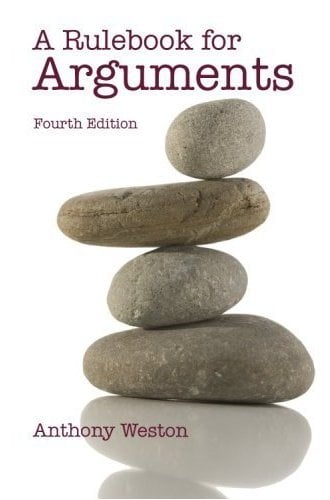
A Rulebook for Arguments by Anthony Weston
This book entitled A Rulebook for Arguments, is literally a book of rules. The book written by Anthony Weston, is all about how to make good arguments. The book is divided into ten chapters in two sections. The first section include short arguments. In this section, the author describes the following forms of arguments: (1) composing a short argument (general rules), (2) arguments by example, (3) arguments by analogy, (4) arguments from authority, (5) arguments about causes, (6) deductive arguments. The second section describe how to compose an argumentative essay by (1) exploring the issue, (2) the main points of an essay, and (3) writing the essay. The final chapter is a brief explanation about fallacies. The second edition of this book also contains an appendix which is a chapter on definition.
Short Arguments (General Rules)
When composing an argument, there are some general rules. Weston offers seven general rules to consider. These rules may seem like common sense, but they are necessary. In composing a short argument, first one must distinguish premises and conclusion. The conclusion is the statement for which one is giving reasons. The statements which give these reasons are called premises. Second, one must present ideas in a natural order. The ideas must unfold in an order that is natural to the reader. For example, one can put the conclusion first, followed by the reasons. While it may take work to present the argument in the correct order (with many drafts and corrections), it helps to present the argument in a logical and clear fashion. Third, in order for the argue from your premises, they must be reliable. The premise must be plausible and reliable. Fourth, when writing the argument, use definite, specific, concrete language. Fifth, loaded language should be avoided. In general, one should not language whose only function is to sway the emotions of your readers or hearers, either for or against the view you are discussing. Sixth, the terms used should be consistent. Stick to a single set of terms for each idea. While using various synonyms in writing is generally, in the case of arguments, it can make the reader lose the train of thought. There must be a tight connection between the individual premises and the conclusion. Otherwise the reader will be lost.
Seventh, when writing an argument, one should stick to one meaning for each term. While in the previous rule, one should use the same term consistently throughout the argument, one also needs to make sure that the same term has the same meaning as well. The terms one uses should not change during the argument. A good way to avoid this problem is to carefully define any key terms at their introduction. Then they should be used just as they have have defined.
Specific Arguments
While there are a few general rules for composing arguments, there are also rules for composing specific arguments. For example, there are rules for arguments by example. One can argue: “Is there more than one example?” A single example can sometimes for used for the sake of illustration. However, one will need to use more than one example will lend better support for a generalization in an argument one is trying to prove. One could give many examples and still misrepresent the set being generalized about in the argument. Therefore, one needs to expand the examples to a representative samples of various groups of people. This representative sample should be random, unbiased, and be large and diverse enough to get better data for the argument. When developing an argument by example, one also often needs to get background information before one assesses a set of examples. Generalizations can be checked not only with background information, but also using counterexamples. This helps to strengthen the argument one is trying to build, or help disprove another person’s argument one is trying to tear down.
Arguments by analogy argue from one specific case or example to another example. These arguments reason that because two examples are alike in many ways they are also alike in one further specific way. One can see this argument because the word “like” is used as the connector between the examples. The first premise of an argument by analogy makes a claim about the example used as an analogy. As a rule, analogies requires a relevantly similar example.
Arguments can also come from authority. Often we must rely on others to find out and tell us what we cannot find out on our own. As with any form of argument, it can be risky to use arguments from authority. Therefore, one must consider a set of requirements when one desires to use this form of argument. First, sources should be cited. Citation helps to establish the reliability of the premise. The other purpose of a citation is precisely to allow the reader or hearer to find the information on his or her own. Second, when using an argument from authority, the sources should be informed. Sources must be qualified to make the statements they make. In other words, one cannot use a source in one discipline is who is more qualified to be used in another discipline. Third, the sources need to be impartial. One should not rely on someone who has the most at stake in a dispute. For example, one should not rely on the President if the issue is the effectiveness of the Administration’s policies. Instead, the sources need to be independent, neutral and objective in their view of the position being argued. Fourth, sources need to be cross-checked. When experts disagree, the researcher cannot rely on them. One should check to make sure that other equally qualified and impartial people or organizations agree. Fifth, sources are disqualified if they engage in personal attacks. One has to disprove a source by showing that the judgments are misinformed. Attacking the person of an authority (which is an “ad hominem” fallacy) does not disqualify the source.
One can also use arguments about causes. In this case, there are also rules to apply. For example, the argument needs to explain how the cause leads to the effect. There must be a correlation. However, most events have many possible causes. As a result, one must show that the conclusion proposes the most likely cause. How does one know which explanation is the most likely one? Researchers should prefer explanations which are compatible with best-established beliefs. When several competing “natural” explanations all fit the evidence, one must consider an additional set of rules for these causes. First, correlated events are not necessarily related. Some correlations are just coincidental. Correlated events may have a common cause. Some correlation are not relations between cause and effect but represent two effects of some other cause. Another explanation is that either of the two correlated events may cause the other. Correlation does not necessarily establish the direction of causality. Finally, one must keep in mind that some causes may be complex. As a result, correlation may be hard to determine.
Another type of specific argument is the deductive argument. When the premise is unclear, deductive arguments offer an effective way of organizing an argument. There are six common forms of deductive arguments. They first two are “modus ponens” (the mode of putting – put p and get q), “modus tollens” (the mode of taking – take q, take p). These forms of arguments was made famous by Sherlock Holmes. The third form is called the hypothetical syllogism. This is known as the “if/then” form of argument. This form offers a good model for explaining the connection between cause and effect. The fourth form is known as the disjunctive syllogism. This form is used in the exclusive sense of “or” in an argument (e.i. “a or b” means that either a or b is true, but not both). The fifth valid form of argument is known as the dilemma. This argument links a series of causes and effects together. Every effect may become the subsequent cause. The final effect is the culmination of all of the causes. There is also the deductive argument known as “reductio ad absurdum.” Strictly speaking, it is a form of modus tollens. This is used however to make the denial of the conclusion so absurd that one must accept the conclusion provided.
When one has finally decided on the form(s) of arguments to use in presenting their case, the argumentative essay must be composed. This includes many steps. The first step is to explore the issue. A researcher must explore the arguments on all sides of the issue. Which argument works best – analogy, deductive, or some other form? Once the researcher has found the right kind of argument to be used, the argument’s premise should be questioned and defended as well. Any claim liable to reasonable question needs at least some defense. After the premise has been questioned, revise and rethink the arguments as they emerge. This exploration of the proper argument requires a process. So one should not rush this process.
The second step in composing an argumentative essay is to develop the main points of the essay. Begin by stating the question one is answering. Then a definite claim or proposal should be made. The arguments come after the claim is made to defend the claim. After the argument is developed, objections to the argument or the claim should be considered. Alternatives to the claim or proposal should be considered. It is not enough to show that the proposal will solve the problem. One must show that it is better than other plausible ways of solving the problem.
The third and final step in composing an argumentative essay is to write it. There are several steps needed to write out the essay. First, one should follow the outline. Following the outline keeps the writer from wandering. Second, one should keep the introduction brief. Third, give one argument at a time. As a general rule, you should make one point per paragraph. Placing too many points in a single paragraph only confuses the reader. Fourth, take the time clarify what you mean. This may require editing to make sure the reader understands what you have written. Fifth, support objections with arguments. One needs to answer in the paper why someone would object to your premise and conclusion. Responding to the objections will make your paper clearer to the reader. Finally, the writer should not claim more than you have shown. Being clear and concise will help make your argument seem valid and appropriate.
Review
The rules are sound and they can be helpful in providing ways to explain one’s point of view (or how a researcher arrived at his or her answer). In several places the existence of God was questioned. Some Christians may have trouble with that analysis. However, in this postmodern world, a Christian must be ready to argue the case for God. Therefore, this book provided a fresh perspective in which an open-minded Christian researcher can use in arguing for God.
Previous Post

April 25, 2014
How to Read a Book
Next Post
April 25, 2014 Quality Research Papers by Nancy Jean Vyhmeister
Browse Our Archives
Select a Category 1 Chronicles 1 Corinthians 1 John 1 Kings 1 Peter 1 Samuel 1 Thessalonians 1 Timothy 2 Chronicles 2 Corinthians 2 John 2 Kings 2 Peter 2 Samuel 2 Thessalonians 2 Timothy 3 John Acts Advent Amos Book Review Colossians Comics Culture Watch Daniel Deuteronomy Ecclesiastes Ephesians Esther Exodus Ezekiel Ezra Galatians Genesis Guest Post Habakkuk Haggai Hebrews Hosea Humor Inspiritational Isaiah James Jeremiah Job Joel John Jonah Joshua Jude Judges Lamentations Lectionary Lent Leviticus Link Love Luke Malachi Mark Matthew Micah Movie Review Nahum Nehemiah Numbers Philippians Political Watch Prophecy Watch Proverbs Psalm Revelation Reviews Romans Ruth Sacratopia Science Watch Sermon Series Sermons Simple Thoughts Song of Solomon Titus Top Ten Uncategorized Video Review Zechariah Zephaniah
Select a Month November 2026 August 2026 July 2026 June 2026 May 2026 October 2025 September 2025 June 2025 February 2025 January 2025 November 2024 October 2024 September 2024 July 2024 June 2024 April 2024 March 2024 January 2024 November 2023 October 2023 September 2023 June 2023 May 2023 March 2023 February 2023 January 2023 December 2022 October 2022 September 2022 August 2022 July 2022 June 2022 May 2022 January 2022 June 2021 January 2021 October 2020 July 2020 May 2020 April 2020 March 2020 February 2020 January 2020 December 2019 November 2019 October 2019 September 2019 August 2019 July 2019 June 2019 May 2019 April 2019 March 2019 February 2019 January 2019 December 2018 November 2018 October 2018 September 2018 August 2018 July 2018 June 2018 May 2018 April 2018 March 2018 February 2018 January 2018 December 2017 November 2017 October 2017 September 2017 August 2017 July 2017 June 2017 May 2017 April 2017 March 2017 February 2017 January 2017 December 2016 November 2016 October 2016 September 2016 August 2016 July 2016 June 2016 May 2016 April 2016 March 2016 February 2016 January 2016 December 2015 November 2015 October 2015 September 2015 August 2015 July 2015 June 2015 May 2015 April 2015 March 2015 February 2015 January 2015 December 2014 November 2014 October 2014 September 2014 August 2014 July 2014 June 2014 May 2014 April 2014 March 2014 February 2014 January 2014 December 2013 November 2013 October 2013 September 2013 August 2013 July 2013 June 2013 May 2013 April 2013 February 2013 January 2013 December 2012 November 2012 October 2012 September 2012 August 2012 July 2012 June 2012 May 2012 April 2009 June 2008 October 2007 September 2007 August 2007 July 2007 June 2007 May 2007 April 2007 March 2007 February 2007 January 2007 December 2006 October 2006 September 2006 May 2006 April 2006 March 2006 February 2006 January 2006 December 2005 September 2005
Follow Us!
TAKE THE
Religious Wisdom Quiz
Which prophet was exiled to Babylon and saw a vision of four living creatures?
Select your answer to see how you score.
Joel Hosea Ezekiel Jeremiah
Related posts from Jim Erwin


Using ChatGPT in Sermon Preparation

Can I Ask You a Question by Preston...
TRENDING AT PATHEOS Evangelical

Blue Christmas: Making Room for Grief at Church
A Blue Christmas service makes room for grief, remembrance, and hope. Explore...

We Can Trust That God Will Use Our...
A Jesus-loving young friend who is going through deep suffering sent me...

Everything is worship for Quakers. The Quakers emphasize contemplation, equality, pacifism and...

Happy Thanksgiving! I published this Thanksgiving column back in 2017 in...

More Than a Meal: A Messianic Thanksgiving
A Messianic Thanksgiving What if Thanksgiving became more than a meal to...

The Darkening of the Sun, Moon, and Stars
The darkening of the sun and moon and the falling of stars...
view all Evangelical blogs
Ad-Free & Subscriber Log-In Subscription Support
- About Us
- 2026 Calendar
- Videos
- Podcasts
- Library of World Religions
- Faith In Media Tracker
- Advertise With Us
- Write for Us
- Privacy Policy
- Terms of Service
- Do Not Sell My Data
- Contact Us
- Radiant Digital
- Manage Newsletter Subscriptions
- Unsubscribe From Notifications
- Sitemap
Copyright 2008-2026, Patheos, part of the Radiant Digital network of media brands. All rights reserved.
Subscription Support Ad-Free & Subscriber Log-In
Follow Patheos