
BuddhistCatholicContemplativeEvangelicalGeneral ChristianHinduJewishLatter-day SaintMuslimNew VisionsProgressive Christian
Beliefs
- Buddhist
- Catholic
- Contemplative
- Evangelical
- General Christian
- Hindu
- Jewish
- Latter-day Saint
- More Voices
- Muslim
- New Visions
- Pagan
- Progressive Christian
Topics
- Religion News
- Food and Religion
- Sports and Religion
- Religious Art
- Religious Music and Entertainment
- Religious Events
- History and Religion
- Style and Religion
- Politics and Religion
- Women in Religion
- Recreation Outdoors and Religion
- Business Finance and Religion
- Careers Workplace and Religion
- Education and Religion
- Family Parenting and Religion
- Health Fitness and Religion
- Home and Religion
- Relationships and Religion
- Technology and Religion
- Travel and Religion
Columnists
- Buddhist Columnists
- Business Finance and Religion Columnists
- Careers Workplace and Religion Columnists
- Catholic Columnists
- Contemplative Columnists
- Education and Religion Columnists
- Evangelists Columnists
- Family Parenting and Religion Columnists
- General Christian Columnists
- Health Fitness and Religion Columnists
- Hindu Columnists
- History and Religion Columnists
- Home and Religion Columnists
- Jewish Columnists
- More Voices Columnists
- Latter Day Columnists
- Muslim Columnists
- New Visions Columnists
- Nonreligious Columnists
- Pagan Columnists
- Politics and Religion Columnists
- Progressive Columnists
- Recreation Outdoors and Religion Columnists
- Relationships and Religion Columnists
- Religion News Columnists
- Religious Art Columnists
- Religious Events Columnists
- Religious Music and Entertainment Columnists
- Sports and Religion Columnists
- Style and Religion Columnists
- Technology and Religion Columnists
- Travel and Religion Columnists
- Women in Religion Columnists
Resource Library
- 2026 Calendar
- Library of World Religions
- The 100 Most Holy Places on Earth
- Patheos Answers
- Podcasts
- Videos
- Faith Leaders Database
- Anglican Episcopalian
- Bahai
- Baptist
- Buddhism
- Christianity
- Confucianism
- Eastern Orthodoxy
- Hinduism
- Holiness and Pentecostal
- ISKCON
- Islam
- Judaism
- Lutheran
- Methodist
- The Church of Jesus Christ of Latter-day Saints
- New Age
- Paganism
- Presbytarian and Reformed
- Protestantism
- Religion Behind the Scenes
- Roman Catholic
- Scientology
- Shia Islam
- Sikhism
- Sufism
- Sunni Islam
- Taoism
- Zen
- See all religions
Research Tools
 Ad-Free & Subscriber Log-In Subscription Support
Ad-Free & Subscriber Log-In Subscription Support
Follow Patheos 

- Trending:
- Forgiveness
- |
- Marriage
- |
- Consciousness
- |
- Death Penalty
- |
- Election
- |
- Halloween

- Home
- Evangelical
- Perimeters of Light by Elmer Towns and Ed Stetzer
Perimeters of Light by Elmer Towns and Ed Stetzer
Last updated on: June 2, 2018 at 12:44 pm by Jim Erwin
Perimeters of Light by Elmer Towns and Ed Stetzer 2018-06-02T12:44:55-05:00 Jim Erwin
Patheos Explore the world's faith through different perspectives on religion and spirituality! Patheos has the views of the prevalent religions and spiritualities of the world.
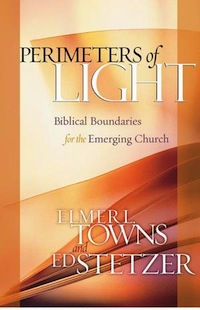
Perimeters of Light by Elmer Towns and Ed Stetzer
The core thought of this book, Perimeters of Light: Biblical Boundaries for the Emerging Church by Elmer Towns and Ed Stetzer, is that a Christian should live at the perimeter between the church and the world. The authors make the distinction between boundaries, the perimeter of those boundaries, and where one person could determine the edge of those boundaries. What is inside the boundaries define a Christian. The question that the authors address is “Where is the edge?” (28, 35).
The authors make a distinction between the edge of error (doctrinal purity) and the edge of culture. Christians should not go near the edge of error, but Christians should step up to the edge of the culture without going too far (31).
The edge of culture is difficult to walk because if one goes too far on one side, we lose our influence. If we steer too far to the other side, we lose our relevance. Contextualization seems to be the key. The best a church can do is to stay faithful to the message, but place the message a context in which the culture will accept and understand.
The authors address contextualization with a scale (57). They suggest that church plants in North America should be indigenous (or native). In essence, pastors and church planters should address North America in the same way we address international missions (57).
The book ends by identifying a list of five perimeters of Christianity: (1) Jesus, (2) the Gospel, (3) Bible doctrine, (4) Christian experience, and (5) God’s blessing. These five “edges” form the boundaries of Christianity. Perhaps the entire book could be summarized with the following quote: “the indigenous church should be contextualized, but not compromised” (59). The authors apply the boundary or perimeter metaphor to the nature of the church, worship, music, preaching, and evangelism. This metaphor seems consistent and it is biblical. The hermeneutical lense through which the writers use seems to be the truth in Jesus’ statement that the church should be “in the world, but not of the world” (John 17).
The authors suggest an appropriate way to contextualize the message of Jesus Christ. They suggest the church should find the (1) meaning, then the (2) cultural form, the (3) Christian redeemed form which brings (4) glory to God. In essence, any cultural form which has meaning can be redeemed for God’s glory. In other words, the church can use the cultural form as long as it brings God His glory (44, 105). As a result, the church can use various styles of music (98-106), various forms of preaching (125), and various forms and processes of evangelism (139-148).
The brief explanation about the post-modern culture, especially the definition of post-modernism (159), helps put these issues into the right context. However, the authors spent far too much time explaining the metaphor of the boundaries, perimeters and edges. At the end of the book they finally defined the edge of Christianity. The cultural forms which they suggest can be used in the church seems to be based upon a subjective basis (the culture). The authors suggest that as long as the truth of Jesus Christ is still shared with the culture, and is not omitted, then the cultural form can be used in its redeemed form. While I would agree with this assessment, experience has proven to me that culture seems to influence the church more than the church has influenced the culture.
This book goes along with many books on church planting by addressing the underlying philosophical challenge that all churches in North America will face: post-modernism. It is not just that we have to contextualize to North Americans (whether they are bikers, cowboys, nerds, or yuppies). The philosophical basis of the new cultures needs to be addressed in our church. The authors suggest that the church should not ignore, attack, nor adopt the post-modern culture. Instead, we should present the true church (162) up to the edge of the post-modern culture. As such, this book is a welcome addition that can help many pastors and church planters in their work in this new post-modern world.
Previous Post

April 21, 2014
1 Peter 2:18-25 Christ-Like Influence
Next Post
April 24, 2014 Developing Critical Thinkers by Stephen D. Brookfield
Browse Our Archives
Select a Category 1 Chronicles 1 Corinthians 1 John 1 Kings 1 Peter 1 Samuel 1 Thessalonians 1 Timothy 2 Chronicles 2 Corinthians 2 John 2 Kings 2 Peter 2 Samuel 2 Thessalonians 2 Timothy 3 John Acts Advent Amos Book Review Colossians Comics Culture Watch Daniel Deuteronomy Ecclesiastes Ephesians Esther Exodus Ezekiel Ezra Galatians Genesis Guest Post Habakkuk Haggai Hebrews Hosea Humor Inspiritational Isaiah James Jeremiah Job Joel John Jonah Joshua Jude Judges Lamentations Lectionary Lent Leviticus Link Love Luke Malachi Mark Matthew Micah Movie Review Nahum Nehemiah Numbers Philippians Political Watch Prophecy Watch Proverbs Psalm Revelation Reviews Romans Ruth Science Watch Sermon Series Sermons Simple Thoughts Song of Solomon Titus Top Ten Uncategorized Video Review Zechariah Zephaniah
Select a Month May 2026 October 2025 September 2025 June 2025 February 2025 January 2025 November 2024 October 2024 September 2024 July 2024 June 2024 April 2024 March 2024 January 2024 November 2023 October 2023 September 2023 June 2023 May 2023 March 2023 February 2023 January 2023 December 2022 October 2022 September 2022 August 2022 July 2022 June 2022 May 2022 January 2022 June 2021 January 2021 October 2020 July 2020 May 2020 April 2020 March 2020 February 2020 January 2020 December 2019 November 2019 October 2019 September 2019 August 2019 July 2019 June 2019 May 2019 April 2019 March 2019 February 2019 January 2019 December 2018 November 2018 October 2018 September 2018 August 2018 July 2018 June 2018 May 2018 April 2018 March 2018 February 2018 January 2018 December 2017 November 2017 October 2017 September 2017 August 2017 July 2017 June 2017 May 2017 April 2017 March 2017 February 2017 January 2017 December 2016 November 2016 October 2016 September 2016 August 2016 July 2016 June 2016 May 2016 April 2016 March 2016 February 2016 January 2016 December 2015 November 2015 October 2015 September 2015 August 2015 July 2015 June 2015 May 2015 April 2015 March 2015 February 2015 January 2015 December 2014 November 2014 October 2014 September 2014 August 2014 July 2014 June 2014 May 2014 April 2014 March 2014 February 2014 January 2014 December 2013 November 2013 October 2013 September 2013 August 2013 July 2013 June 2013 May 2013 April 2013 February 2013 January 2013 December 2012 November 2012 October 2012 September 2012 August 2012 July 2012 June 2012 May 2012 April 2009 June 2008 October 2007 September 2007 August 2007 July 2007 June 2007 May 2007 April 2007 March 2007 February 2007 January 2007 December 2006 October 2006 September 2006 May 2006 April 2006 March 2006 February 2006 January 2006 December 2005 September 2005
Follow Us!
TAKE THE
Religious Wisdom Quiz
Who said, "I am not worthy to untie the strap of his sandals"?
Select your answer to see how you score.
Peter Paul Thomas John the Baptist
Related posts from Jim Erwin


Using ChatGPT in Sermon Preparation


Can I Ask You a Question by Preston...
TRENDING AT PATHEOS Evangelical

In one sense walking into Westminster Abbey is like walking down the...

'Super Scam Me' Exposes AI Jon Bon Jovi...
Leslie Pickett believed she was in a relationship with Jon Bon Jovi....

The Brazilian Remake of Kendricks' 'Flywheel' Opens in...
“Flywheel,” the story that launched the Kendrick Brothers’ filmmaking career is getting...

The Dangers of Gradual Accommodation (Winking at Sin)
Recently, the “law of gradualness” resurfaced during the opening of a weeklong,...

The Iron Gates and the Lion of the...
Yesterday, I didn't finish my report about, well, yesterday. So I'll...

The Image: On the Horror of Capitalism and...
The Image Then went the Pharisees, and took counsel how they might...
view all Evangelical blogs
Ad-Free & Subscriber Log-In Subscription Support
- About Us
- 2026 Calendar
- Videos
- Podcasts
- Library of World Religions
- Faith In Media Tracker
- Advertise With Us
- Write for Us
- Privacy Policy
- Terms of Service
- Do Not Sell My Data
- Contact Us
- Radiant Digital
- Manage Newsletter Subscriptions
- Unsubscribe From Notifications
- Sitemap
Copyright 2008-2026, Patheos. All rights reserved.
Subscription Support Ad-Free & Subscriber Log-In
Follow Patheos