
BuddhistCatholicContemplativeEvangelicalGeneral ChristianHinduJewishLatter-day SaintMuslimNew VisionsProgressive Christian
Beliefs
- Buddhist
- Catholic
- Contemplative
- Evangelical
- General Christian
- Hindu
- Jewish
- Latter-day Saint
- More Voices
- Muslim
- New Visions
- Pagan
- Progressive Christian
Topics
- Religion News
- Food and Religion
- Sports and Religion
- Religious Art
- Religious Music and Entertainment
- Religious Events
- History and Religion
- Style and Religion
- Politics and Religion
- Women in Religion
- Recreation Outdoors and Religion
- Business Finance and Religion
- Careers Workplace and Religion
- Education and Religion
- Family Parenting and Religion
- Health Fitness and Religion
- Home and Religion
- Relationships and Religion
- Technology and Religion
- Travel and Religion
Columnists
- Buddhist Columnists
- Business Finance and Religion Columnists
- Careers Workplace and Religion Columnists
- Catholic Columnists
- Contemplative Columnists
- Education and Religion Columnists
- Evangelists Columnists
- Family Parenting and Religion Columnists
- General Christian Columnists
- Health Fitness and Religion Columnists
- Hindu Columnists
- History and Religion Columnists
- Home and Religion Columnists
- Jewish Columnists
- More Voices Columnists
- Latter Day Columnists
- Muslim Columnists
- New Visions Columnists
- Nonreligious Columnists
- Pagan Columnists
- Politics and Religion Columnists
- Progressive Columnists
- Recreation Outdoors and Religion Columnists
- Relationships and Religion Columnists
- Religion News Columnists
- Religious Art Columnists
- Religious Events Columnists
- Religious Music and Entertainment Columnists
- Sports and Religion Columnists
- Style and Religion Columnists
- Technology and Religion Columnists
- Travel and Religion Columnists
- Women in Religion Columnists
Resource Library
- 2026 Calendar
- Library of World Religions
- The 100 Most Holy Places on Earth
- Patheos Answers
- Podcasts
- Videos
- Faith Leaders Database
- Anglican Episcopalian
- Bahai
- Baptist
- Buddhism
- Christianity
- Confucianism
- Eastern Orthodoxy
- Hinduism
- Holiness and Pentecostal
- ISKCON
- Islam
- Judaism
- Lutheran
- Methodist
- The Church of Jesus Christ of Latter-day Saints
- New Age
- Paganism
- Presbytarian and Reformed
- Protestantism
- Religion Behind the Scenes
- Roman Catholic
- Scientology
- Shia Islam
- Sikhism
- Sufism
- Sunni Islam
- Taoism
- Zen
- See all religions
Research Tools
 Ad-Free & Subscriber Log-In Subscription Support
Ad-Free & Subscriber Log-In Subscription Support
Follow Patheos 

- Trending:
- Forgiveness
- |
- Marriage
- |
- Consciousness
- |
- Death Penalty
- |
- Election
- |
- Halloween

- Home
- Evangelical
- Developing Critical Thinkers by Stephen D. Brookfield
Developing Critical Thinkers by Stephen D. Brookfield
Last updated on: June 16, 2018 at 9:33 pm by Jim Erwin
Developing Critical Thinkers by Stephen D. Brookfield 2018-06-16T21:33:24-05:00 Jim Erwin
Patheos Explore the world's faith through different perspectives on religion and spirituality! Patheos has the views of the prevalent religions and spiritualities of the world.
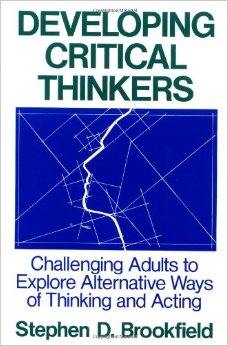
Developing Critical Thinkers by Stephen D. Brookfield
Critical thinking is defined in this book is composed of two processes: identifying and challenging assumptions, and then imagining and exploring alternatives. When I think critically, my perceived truth, or my understanding of absolute truth, changes. By questioning what I have always understood to be true, I can come to a better position, or find a better solution to a problem that I have encountered. This is the premise of the book. Not only should I learn to think differently about what I have learned, but I should learn to explore new ways of solving problems.
Part One (chapter one through four) spends time defining the concept of critical thinking, and then presents the benefits of critical thinking. Critical thinking means that a person does not blindly accept everything they have learned. A critical thinker learns to understand what is being told to them, and then broadens their learning experience beyond just their immediate environment. A critical thinker considers other alternatives in their world than the ones they have always been given. For real positive change to happen, critical thinking is necessary.
This book teaches that people can learn to be facilitators of critical thinking. A facilitator (or helper) guides people through the critical thinking process. While the concepts seem to be useful for professional counselors, I saw immediate application for leaders, pastors and teachers. The principles used to facilitate critical thinking are very similar to the principles of good leadership.
Part Two (chapters five, six, and seven) deals with practical approaches for developing critical thinkers. The book shares in chapter six how to help other people examine the assumptions underlying their thoughts and actions. The author teaches how to ask questions in a way that allow a person to challenge what they have always done. For example, critical questioning is a way in which someone learns to “think back” to an event, and then re-evaluate the event. In role-playing how they could have done something differently, a person learns to think critically, and improve on their assumptions. This will lead to another form of critical thinking – developing alternative ways of thinking.
The theme of chapter seven is to “think outside of the box.” The chapter describes changing the frameworks of understanding through which a person makes sense of the world. Paradigm is another way of saying the “box” in which we think. The challenge of helpers (mentors, pastors, counselors, and teachers) is to help people think outside the box. The author contends that in the twenty-first century, people will learn to be process persons. People now understand that change is the one certain element in life. I was amazed at this prediction. For I agree with the author that post-modern people are process people, and that they handle change easier. So the role of a pastor would have to change from one of expert to facilitator. The new leadership role of a pastor would be to help facilitate these people to think critically. Thinking outside of the box would require thinking creatively.
The chapters present some very good exercises that help people think creatively. Brainstorming (probably the most famous and most common), envisioning alternative futures, developing preferred scenarios, futures invention, and esthetic triggers (left-brain activities) all help people to think creatively, and thus critically. The application for the church I found amazing. For I believe that we do not allow our members to think creatively. Take for example, esthetic triggers. We don’t create these activities. We are unfamiliar with creating poetry, drama, fantasy, photography, theatre or songwriting in the church. We may use these resources, such as songs and drama, but we use them very little. We primarily still use the right-brain forms for worship. We listen to a sermon that is didactically presented. We absorb, but we do not participate. So the idea of thinking creatively struck me as an opportunity for the church.
Part Three (chapters eight through twelve) addresses how people can learn to think critically in different arenas of life. This section of the book applies the principle of critical thinking to the workplace, the political arena, the media, and in personal relationships.
With respect to the media, viewers are encouraged to have skepticism for what they see on the television screen. This I think applies just as well to not only secular media, but also the religious media. The critical thinker needs to be able to interpret political spin, or any other type of spin that is made from a media source. The most important skill in learning from the media is the ability to decode what was encoded to a viewer in the media. The author suggests that a person or group of people can use the VCR as a tool to do this. A group can take broadcasts and programs, and by reviewing the images and the news, they can deconstruct what was said. The advents of cable television, the Internet and YouTube have made this task even simpler. The prediction of being able to “talk back” to the television screen in chapter ten was quite prophetic. This prediction of internet forums, blogs, and social networks as a form of media literacy was quite profound. Thinking critically has become possible and been made easier with these new tools.
Chapter eleven describes ways in which learning can be encouraged through personal relationships. It is in this chapter that I found the most relevant information for change in the church. Specifically, I agreed with the author that friendships will be the key to overcoming difficulties in marriage, family, and life in general. Fostering friendships as relaxed relationships and a haven for people can be very beneficial.
Chapter twelve describes the role of the facilitator as a helper for learning. I took this form of leadership would make small groups in the church the most effective. There is much that the church can learn from this idea. Instead of having a group of people adheres to an expert teacher for learning, the facilitator would be there to help the group learn. The suggestions in this chapter and in the epilogue could be very valuable for a small group ministry in the church. I agree wholeheartedly with this approach.
This book would benefit many churches – especially church leaders, Sunday School teachers, and small group leaders. However, the greatest hurdle in using the book is in first understanding the book. The problem is that a person must first have been exposed to critical thinking in order to understand the concepts in the book. Otherwise, a person will discard the book after reading the title.
Previous Post

April 24, 2014
Perimeters of Light by Elmer Towns and Ed Stetzer
Next Post
April 24, 2014 Goal Analysis by Robert F. Mager
Browse Our Archives
Select a Category 1 Chronicles 1 Corinthians 1 John 1 Kings 1 Peter 1 Samuel 1 Thessalonians 1 Timothy 2 Chronicles 2 Corinthians 2 John 2 Kings 2 Peter 2 Samuel 2 Thessalonians 2 Timothy 3 John Acts Advent Amos Book Review Colossians Comics Culture Watch Daniel Deuteronomy Ecclesiastes Ephesians Esther Exodus Ezekiel Ezra Galatians Genesis Guest Post Habakkuk Haggai Hebrews Hosea Humor Inspiritational Isaiah James Jeremiah Job Joel John Jonah Joshua Jude Judges Lamentations Lectionary Lent Leviticus Link Love Luke Malachi Mark Matthew Micah Movie Review Nahum Nehemiah Numbers Philippians Political Watch Prophecy Watch Proverbs Psalm Revelation Reviews Romans Ruth Science Watch Sermon Series Sermons Simple Thoughts Song of Solomon Titus Top Ten Uncategorized Video Review Zechariah Zephaniah
Select a Month May 2026 October 2025 September 2025 June 2025 February 2025 January 2025 November 2024 October 2024 September 2024 July 2024 June 2024 April 2024 March 2024 January 2024 November 2023 October 2023 September 2023 June 2023 May 2023 March 2023 February 2023 January 2023 December 2022 October 2022 September 2022 August 2022 July 2022 June 2022 May 2022 January 2022 June 2021 January 2021 October 2020 July 2020 May 2020 April 2020 March 2020 February 2020 January 2020 December 2019 November 2019 October 2019 September 2019 August 2019 July 2019 June 2019 May 2019 April 2019 March 2019 February 2019 January 2019 December 2018 November 2018 October 2018 September 2018 August 2018 July 2018 June 2018 May 2018 April 2018 March 2018 February 2018 January 2018 December 2017 November 2017 October 2017 September 2017 August 2017 July 2017 June 2017 May 2017 April 2017 March 2017 February 2017 January 2017 December 2016 November 2016 October 2016 September 2016 August 2016 July 2016 June 2016 May 2016 April 2016 March 2016 February 2016 January 2016 December 2015 November 2015 October 2015 September 2015 August 2015 July 2015 June 2015 May 2015 April 2015 March 2015 February 2015 January 2015 December 2014 November 2014 October 2014 September 2014 August 2014 July 2014 June 2014 May 2014 April 2014 March 2014 February 2014 January 2014 December 2013 November 2013 October 2013 September 2013 August 2013 July 2013 June 2013 May 2013 April 2013 February 2013 January 2013 December 2012 November 2012 October 2012 September 2012 August 2012 July 2012 June 2012 May 2012 April 2009 June 2008 October 2007 September 2007 August 2007 July 2007 June 2007 May 2007 April 2007 March 2007 February 2007 January 2007 December 2006 October 2006 September 2006 May 2006 April 2006 March 2006 February 2006 January 2006 December 2005 September 2005
Follow Us!
TAKE THE
Religious Wisdom Quiz
What city is known as the Holy City, sacred to Jews, Christians, and Muslims?
Select your answer to see how you score.
Jerusalem Cairo Athens Rome
Related posts from Jim Erwin


Using ChatGPT in Sermon Preparation


Can I Ask You a Question by Preston...
TRENDING AT PATHEOS Evangelical

In one sense walking into Westminster Abbey is like walking down the...

'Super Scam Me' Exposes AI Jon Bon Jovi...
Leslie Pickett believed she was in a relationship with Jon Bon Jovi....

The Brazilian Remake of Kendricks' 'Flywheel' Opens in...
“Flywheel,” the story that launched the Kendrick Brothers’ filmmaking career is getting...

The Dangers of Gradual Accommodation (Winking at Sin)
Recently, the “law of gradualness” resurfaced during the opening of a weeklong,...

The Iron Gates and the Lion of the...
Yesterday, I didn't finish my report about, well, yesterday. So I'll...

The Image: On the Horror of Capitalism and...
The Image Then went the Pharisees, and took counsel how they might...
view all Evangelical blogs
Ad-Free & Subscriber Log-In Subscription Support
- About Us
- 2026 Calendar
- Videos
- Podcasts
- Library of World Religions
- Faith In Media Tracker
- Advertise With Us
- Write for Us
- Privacy Policy
- Terms of Service
- Do Not Sell My Data
- Contact Us
- Radiant Digital
- Manage Newsletter Subscriptions
- Unsubscribe From Notifications
- Sitemap
Copyright 2008-2026, Patheos. All rights reserved.
Subscription Support Ad-Free & Subscriber Log-In
Follow Patheos