
BuddhistCatholicContemplativeEvangelicalGeneral ChristianHinduJewishLatter-day SaintMuslimNew VisionsProgressive Christian
Beliefs
- Buddhist
- Catholic
- Contemplative
- Evangelical
- General Christian
- Hindu
- Jewish
- Latter-day Saint
- More Voices
- Muslim
- New Visions
- Pagan
- Progressive Christian
Topics
- Religion News
- Food and Religion
- Sports and Religion
- Religious Art
- Religious Music and Entertainment
- Religious Events
- History and Religion
- Style and Religion
- Politics and Religion
- Women in Religion
- Recreation Outdoors and Religion
- Business Finance and Religion
- Careers Workplace and Religion
- Education and Religion
- Family Parenting and Religion
- Health Fitness and Religion
- Home and Religion
- Relationships and Religion
- Technology and Religion
- Travel and Religion
Columnists
- Buddhist Columnists
- Business Finance and Religion Columnists
- Careers Workplace and Religion Columnists
- Catholic Columnists
- Contemplative Columnists
- Education and Religion Columnists
- Evangelists Columnists
- Family Parenting and Religion Columnists
- General Christian Columnists
- Health Fitness and Religion Columnists
- Hindu Columnists
- History and Religion Columnists
- Home and Religion Columnists
- Jewish Columnists
- More Voices Columnists
- Latter Day Columnists
- Muslim Columnists
- New Visions Columnists
- Nonreligious Columnists
- Pagan Columnists
- Politics and Religion Columnists
- Progressive Columnists
- Recreation Outdoors and Religion Columnists
- Relationships and Religion Columnists
- Religion News Columnists
- Religious Art Columnists
- Religious Events Columnists
- Religious Music and Entertainment Columnists
- Sports and Religion Columnists
- Style and Religion Columnists
- Technology and Religion Columnists
- Travel and Religion Columnists
- Women in Religion Columnists
Resource Library
- 2026 Calendar
- Library of World Religions
- The 100 Most Holy Places on Earth
- Patheos Answers
- Podcasts
- Videos
- Faith Leaders Database
- Anglican Episcopalian
- Bahai
- Baptist
- Buddhism
- Christianity
- Confucianism
- Eastern Orthodoxy
- Hinduism
- Holiness and Pentecostal
- ISKCON
- Islam
- Judaism
- Lutheran
- Methodist
- The Church of Jesus Christ of Latter-day Saints
- New Age
- Paganism
- Presbytarian and Reformed
- Protestantism
- Religion Behind the Scenes
- Roman Catholic
- Scientology
- Shia Islam
- Sikhism
- Sufism
- Sunni Islam
- Taoism
- Zen
- See all religions
Research Tools
 Ad-Free & Subscriber Log-In Subscription Support
Ad-Free & Subscriber Log-In Subscription Support
Follow Patheos 

- Trending:
- Forgiveness
- |
- Marriage
- |
- Consciousness
- |
- Death Penalty
- |
- Election
- |
- Halloween

- Home
- Evangelical
- Evangelism Outside the Box by Rick Richardson
Evangelism Outside the Box by Rick Richardson
Last updated on: February 25, 2014 at 10:15 pm by Jim Erwin
Evangelism Outside the Box by Rick Richardson 2014-02-25T22:15:15-05:00 Jim Erwin
Patheos Explore the world's faith through different perspectives on religion and spirituality! Patheos has the views of the prevalent religions and spiritualities of the world.
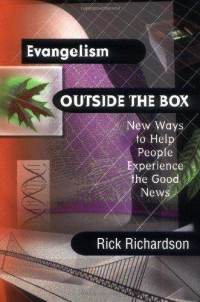
The premise of this book is that lost people matter to God and He wants partners in the search party. However, it has been difficult for churches to continue their effort in engaging the lost. The book begins with a helpful illustration of the “boxes” we live in, and how to start “thinking outside the box.” God is responsible for changing people. However, He expects us to partner with Him. The world has changed (from modernism to post-modernism) and this book does a very good job explaining that difference (32-34).
The fact that the church has become a barrier to evangelism because of our arrogance and benevolence (36) is very true. As a result, we have to look at the questions the world is now asking, instead of responding with answers to questions which are outdated. The book does a very good job explaining our answers are to out-dated questions with a brief history of the major transitions in history. (42-44). Specifically, the explanation of the differences between medieval, modern, and post-modern are a very helpful primer for today’s church who wants to engage the culture and reach new people for Jesus Christ (45).
The explanation of the type of truth that the post-modern world is seeking should be very helpful. For example, I agree with the insight that truth should be integrated, and not just propositional. The post-modern world is looking for truth which is not universal, but real. This does not deny that God’s truth is universal. Instead, it reveals that culture is not interested in universal truth as an answer to their questions. The post-modern culture is interested in a pragmatic, yet experiential solution to their concerns.
The answer is still Jesus Christ and the Bible as God revealed it, but the way in which it answers their questions will be different. As a result, the pastor will have to use a different set of tools to address these questions and point these people to Christ. In the past, being an expert and having all the answers were what gained the church credibility and a hearing. Today, the post-modern culture does not want experts, nor do they need them. Instead, the post-modern culture desires that their leaders share the same questions, struggles, and hurts. Being authentic builds credibility and this gains the church a hearing. The post-modernist become convinced about moral and spiritual choices as an artist, not as a scientist. They do not respond to logical verbal arguments, but by visual stories (47-49).
This changes the way evangelism should work. Experience comes before explanation, belonging comes before believing, and image comes before word (51-52). Since the order and process of salvation has changed. This reviewer agrees with the assessment that effective soul-awaking events and efforts are the weakest links in the attempts to reach people in today’s world (55). The writer of this book uses a different presentation, “A Circle of Belonging” (132-140), as a way to explain the gospel. He also suggests that transformation is more than just saying yes to Jesus. To this reviewer, transformation requires that the Christian also says no to “ungodliness” (Titus 2:11-12). We don’t just repent, but we must also renounce our false identities (144). Even after a person becomes a Christian, there are barriers to living the Christian life. Eliminating these barriers is a post-modern form of discipleship.
The book addresses the methods of Jesus (84) and Paul (88). The hermeneutical foundation is solid. We are to use the Bible to answer the questions. The book suggests and alternative approach. Instead of starting with what the Bible says is true, the authors suggest that a pastor should look to the culture to address a need, and then answer that need with how God answers that need in the Bible (88). The authors suggest that we should argue to our truth basis, not from our truth basis (93). As a result, the biblical foundation stays the same, but the way in which we approach the Bible will be different. We need to address the people like Paul in Acts 17, and less like Peter in Acts 2.
The book spends enormous energy challenging the church to engage the post-modern culture. Then as a caveat (in an appendix no less), the authors state: “reports of the demise of modernism are premature ad exaggerated” (168). This is only true to the diminishing number of modernists. Modernism is on its deathbed. Post-modernism is the new resurrected form. The church needs to engage the resurrected form with a resurrected Christ. Trying to reach people who subscribe to modernism will become increasingly wasteful.
This book spends time describing the nature of the post-modern world which we are called to reach. Other books such as Stanley Grenz’s A Primer on Post-Modernism, Leonard Sweet’s SoulTsunami, Ed Stetzer’s Planting New Churches in a Post-Modern Age, and Rex Miller’s The Millennium Matrix compliment this text.
Previous Post

February 25, 2014
Churches with Roots by Johan Lukasse
Next Post
February 27, 2014 Breaking the Missional Code by Ed Stetzer and David Putman
Browse Our Archives
Select a Category 1 Chronicles 1 Corinthians 1 John 1 Kings 1 Peter 1 Samuel 1 Thessalonians 1 Timothy 2 Chronicles 2 Corinthians 2 John 2 Kings 2 Peter 2 Samuel 2 Thessalonians 2 Timothy 3 John Acts Advent Amos Book Review Colossians Comics Culture Watch Daniel Deuteronomy Ecclesiastes Ephesians Esther Exodus Ezekiel Ezra Galatians Genesis Guest Post Habakkuk Haggai Hebrews Hosea Humor Inspiritational Isaiah James Jeremiah Job Joel John Jonah Joshua Jude Judges Lamentations Lectionary Lent Leviticus Link Love Luke Malachi Mark Matthew Micah Movie Review Nahum Nehemiah Numbers Philippians Political Watch Prophecy Watch Proverbs Psalm Revelation Reviews Romans Ruth Science Watch Sermon Series Sermons Simple Thoughts Song of Solomon Titus Top Ten Uncategorized Video Review Zechariah Zephaniah
Select a Month May 2026 October 2025 September 2025 June 2025 February 2025 January 2025 November 2024 October 2024 September 2024 July 2024 June 2024 April 2024 March 2024 January 2024 November 2023 October 2023 September 2023 June 2023 May 2023 March 2023 February 2023 January 2023 December 2022 October 2022 September 2022 August 2022 July 2022 June 2022 May 2022 January 2022 June 2021 January 2021 October 2020 July 2020 May 2020 April 2020 March 2020 February 2020 January 2020 December 2019 November 2019 October 2019 September 2019 August 2019 July 2019 June 2019 May 2019 April 2019 March 2019 February 2019 January 2019 December 2018 November 2018 October 2018 September 2018 August 2018 July 2018 June 2018 May 2018 April 2018 March 2018 February 2018 January 2018 December 2017 November 2017 October 2017 September 2017 August 2017 July 2017 June 2017 May 2017 April 2017 March 2017 February 2017 January 2017 December 2016 November 2016 October 2016 September 2016 August 2016 July 2016 June 2016 May 2016 April 2016 March 2016 February 2016 January 2016 December 2015 November 2015 October 2015 September 2015 August 2015 July 2015 June 2015 May 2015 April 2015 March 2015 February 2015 January 2015 December 2014 November 2014 October 2014 September 2014 August 2014 July 2014 June 2014 May 2014 April 2014 March 2014 February 2014 January 2014 December 2013 November 2013 October 2013 September 2013 August 2013 July 2013 June 2013 May 2013 April 2013 February 2013 January 2013 December 2012 November 2012 October 2012 September 2012 August 2012 July 2012 June 2012 May 2012 April 2009 June 2008 October 2007 September 2007 August 2007 July 2007 June 2007 May 2007 April 2007 March 2007 February 2007 January 2007 December 2006 October 2006 September 2006 May 2006 April 2006 March 2006 February 2006 January 2006 December 2005 September 2005
Follow Us!
TAKE THE
Religious Wisdom Quiz
Which book in the New Testament is the shortest?
Select your answer to see how you score.
Philemon Jude 3 John 2 John
Related posts from Jim Erwin


How to Embrace the Call to “Go”


Using ChatGPT in Sermon Preparation
TRENDING AT PATHEOS Evangelical

Methodist Central Hall and Westminster Abbey
Situated on the same square is Methodist Central Hall and Westminster Abbey. ...

57th Dove Awards Honor Dolly Parton, Crown New...
On gospel music’s biggest night, the 57th annual GMA Dove Awards honored...

The First Eucharistic Controversy: Christ’s Real Presence
For Catholics, the Eucharist is the source and summit of the Christian...

What a Stop Sign Can Teach Us About...
How to Make a Decision When You Can't Hear God Main point:...

Archdiocese Hosts Military Marriage Retreat in Germany
RASTATT, Germany — The transient military lifestyle, with its frequent deployments and...

Nearly every morning, I make the drive to Detroit with my high-school-age...
view all Evangelical blogs
Ad-Free & Subscriber Log-In Subscription Support
- About Us
- 2026 Calendar
- Videos
- Podcasts
- Library of World Religions
- Faith In Media Tracker
- Advertise With Us
- Write for Us
- Privacy Policy
- Terms of Service
- Do Not Sell My Data
- Contact Us
- Radiant Digital
- Manage Newsletter Subscriptions
- Unsubscribe From Notifications
- Sitemap
Copyright 2008-2026, Patheos. All rights reserved.
Subscription Support Ad-Free & Subscriber Log-In
Follow Patheos