
BuddhistCatholicContemplativeEvangelicalGeneral ChristianHinduJewishLatter-day SaintMuslimNew VisionsProgressive Christian
Beliefs
- Buddhist
- Catholic
- Contemplative
- Evangelical
- General Christian
- Hindu
- Jewish
- Latter-day Saint
- More Voices
- Muslim
- New Visions
- Pagan
- Progressive Christian
Topics
- Religion News
- Food and Religion
- Sports and Religion
- Religious Art
- Religious Music and Entertainment
- Religious Events
- History and Religion
- Style and Religion
- Politics and Religion
- Women in Religion
- Recreation Outdoors and Religion
- Business Finance and Religion
- Careers Workplace and Religion
- Education and Religion
- Family Parenting and Religion
- Health Fitness and Religion
- Home and Religion
- Relationships and Religion
- Technology and Religion
- Travel and Religion
Columnists
- Buddhist Columnists
- Business Finance and Religion Columnists
- Careers Workplace and Religion Columnists
- Catholic Columnists
- Contemplative Columnists
- Education and Religion Columnists
- Evangelists Columnists
- Family Parenting and Religion Columnists
- General Christian Columnists
- Health Fitness and Religion Columnists
- Hindu Columnists
- History and Religion Columnists
- Home and Religion Columnists
- Jewish Columnists
- More Voices Columnists
- Latter Day Columnists
- Muslim Columnists
- New Visions Columnists
- Nonreligious Columnists
- Pagan Columnists
- Politics and Religion Columnists
- Progressive Columnists
- Recreation Outdoors and Religion Columnists
- Relationships and Religion Columnists
- Religion News Columnists
- Religious Art Columnists
- Religious Events Columnists
- Religious Music and Entertainment Columnists
- Sports and Religion Columnists
- Style and Religion Columnists
- Technology and Religion Columnists
- Travel and Religion Columnists
- Women in Religion Columnists
Resource Library
- 2026 Calendar
- Library of World Religions
- The 100 Most Holy Places on Earth
- Patheos Answers
- Podcasts
- Videos
- Faith Leaders Database
- Anglican Episcopalian
- Bahai
- Baptist
- Buddhism
- Christianity
- Confucianism
- Eastern Orthodoxy
- Hinduism
- Holiness and Pentecostal
- ISKCON
- Islam
- Judaism
- Lutheran
- Methodist
- The Church of Jesus Christ of Latter-day Saints
- New Age
- Paganism
- Presbytarian and Reformed
- Protestantism
- Religion Behind the Scenes
- Roman Catholic
- Scientology
- Shia Islam
- Sikhism
- Sufism
- Sunni Islam
- Taoism
- Zen
- See all religions
Research Tools
 Ad-Free & Subscriber Log-In Subscription Support
Ad-Free & Subscriber Log-In Subscription Support
Follow Patheos 

- Trending:
- Forgiveness
- |
- Marriage
- |
- Consciousness
- |
- Death Penalty
- |
- Election
- |
- Halloween

- Home
- Evangelical
- Churches with Roots by Johan Lukasse
Churches with Roots by Johan Lukasse
Last updated on: June 2, 2018 at 12:26 pm by Jim Erwin
Churches with Roots by Johan Lukasse 2018-06-02T12:26:19-05:00 Jim Erwin
Patheos Explore the world's faith through different perspectives on religion and spirituality! Patheos has the views of the prevalent religions and spiritualities of the world.
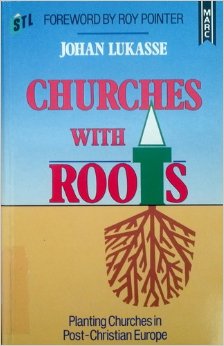
Churches with Roots by Johan Lukasse
This reviewer has found this book, Churches with Roots: Planting Churches in Post-Christian Europe, very helpful. Many of the insights gained from this book matched the reviewer’s experience as a pastor of an English-speaking church in Germany. At many points, this reviewer found himself nodding in agreement. Yet, there were many new insights that were informative and helpful.
The book begins with an assessment of the spiritual state of Europe. The author stated that secularism was a modern form of paganism (18). As a result, Europe was returning, (or perhaps in many ways has never left) their roots from which it sprang. The book recounts a staggering decline in the number of Christians in Europe. While this book is dated (written in 1990), the trend has held true despite the fall of Communism. Europe has lost not just a large number of Christians. The church in Europe has lost its influence (20). This statement is prophetic not just for the church in Europe, but this reviewer found this statement true also for North America.
The steps for starting a church were informative and helpful. The fact is that a church can only begin with receptive people. While the temptation to dilute the gospel to reach more people is strong, it must be avoided (41). This reviewer agreed with the need for cell groups. While these groups may come in a different form, they were very popular in Europe during our time there. This reviewer believes the same can happen in North America. The author is right that the goal of conversion is to make disciples, and that it should not be seen as two steps (46). Conversion of people is only the first part of discipleship. The author shared a story about how he delegated the task of answering questions for those who still had questions to other members of the group (48). This reveals that the nature of discipleship is more about mentoring than knowledge. This step also freed the church planter from becoming the expert. While the author did not expressly state this, the implication was clear. This is an important insight for every church planter.
The chart that describes innovators, early adopters, late adopters, and procrastinators was very helpful. This reviewer had always wondered whether the congregation could be charted using a bell-curve. The author has shared a wonderful leadership insight on the importance of influence in a congregation (128-130).
The insight is the fact that a church which does not listen to God and His activity into the world will decline. Jesus is more involved in the church than we think. The fact that Jesus told Saul that he was not persecuting the church, but Himself is very helpful to any church planter (152). Our work is not our work, but God’s work. The church is dependent upon Jesus Christ. Sometimes as clergy, we lose sight of that fact.
The book addresses many biblical ideas related to the church. The hermeneutical foundation is as one would expect evangelistic in nature. Evangelism is the foundation of healthy church growth in this view. The book spends an entire chapter on starting a church (34-54), and then addresses dead churches (55-66). The book spends considerable time defining the forms of evangelism: presence, proclamation, persuasion, and confrontation (71-80). The book provides a way to present Christ to non-Christians. The “five evenings” is an approach in which someone is introduced to the entire central themes of the Bible in a non-threatening manner. In this way, someone who is searching for answers can take time to have their questions answered as they discover how the Bible shows them the way to God (80-84). This approach is followed up by using the bridge illustration which is shared step-by-step by the author in the appendix (213-224).
I had no disagreement with the facts or approaches in this book. In fact, I found many insights which would be transferable to a church plant setting in North America. The “five evenings” approach I would use in a new church plant setting.
This book complemented many of the church planting books which have been printed in the past twenty years. Many books state the condition of a post-Christian world in prophetic terms and have shared techniques which should be used with the present generation. Unlike these books, Churches with Roots share principles which have worked with a post-modern, and a post-Christian context. In this sense, the book should be on the shelf of every church planter.
Previous Post

February 25, 2014
How Did They Do It by Charles S. Kelley Jr.
Next Post
February 25, 2014 Evangelism Outside the Box by Rick Richardson
Browse Our Archives
Select a Category 1 Chronicles 1 Corinthians 1 John 1 Kings 1 Peter 1 Samuel 1 Thessalonians 1 Timothy 2 Chronicles 2 Corinthians 2 John 2 Kings 2 Peter 2 Samuel 2 Thessalonians 2 Timothy 3 John Acts Advent Amos Book Review Colossians Comics Culture Watch Daniel Deuteronomy Ecclesiastes Ephesians Esther Exodus Ezekiel Ezra Galatians Genesis Guest Post Habakkuk Haggai Hebrews Hosea Humor Inspiritational Isaiah James Jeremiah Job Joel John Jonah Joshua Jude Judges Lamentations Lectionary Lent Leviticus Link Love Luke Malachi Mark Matthew Micah Movie Review Nahum Nehemiah Numbers Philippians Political Watch Prophecy Watch Proverbs Psalm Revelation Reviews Romans Ruth Science Watch Sermon Series Sermons Simple Thoughts Song of Solomon Titus Top Ten Uncategorized Video Review Zechariah Zephaniah
Select a Month May 2026 October 2025 September 2025 June 2025 February 2025 January 2025 November 2024 October 2024 September 2024 July 2024 June 2024 April 2024 March 2024 January 2024 November 2023 October 2023 September 2023 June 2023 May 2023 March 2023 February 2023 January 2023 December 2022 October 2022 September 2022 August 2022 July 2022 June 2022 May 2022 January 2022 June 2021 January 2021 October 2020 July 2020 May 2020 April 2020 March 2020 February 2020 January 2020 December 2019 November 2019 October 2019 September 2019 August 2019 July 2019 June 2019 May 2019 April 2019 March 2019 February 2019 January 2019 December 2018 November 2018 October 2018 September 2018 August 2018 July 2018 June 2018 May 2018 April 2018 March 2018 February 2018 January 2018 December 2017 November 2017 October 2017 September 2017 August 2017 July 2017 June 2017 May 2017 April 2017 March 2017 February 2017 January 2017 December 2016 November 2016 October 2016 September 2016 August 2016 July 2016 June 2016 May 2016 April 2016 March 2016 February 2016 January 2016 December 2015 November 2015 October 2015 September 2015 August 2015 July 2015 June 2015 May 2015 April 2015 March 2015 February 2015 January 2015 December 2014 November 2014 October 2014 September 2014 August 2014 July 2014 June 2014 May 2014 April 2014 March 2014 February 2014 January 2014 December 2013 November 2013 October 2013 September 2013 August 2013 July 2013 June 2013 May 2013 April 2013 February 2013 January 2013 December 2012 November 2012 October 2012 September 2012 August 2012 July 2012 June 2012 May 2012 April 2009 June 2008 October 2007 September 2007 August 2007 July 2007 June 2007 May 2007 April 2007 March 2007 February 2007 January 2007 December 2006 October 2006 September 2006 May 2006 April 2006 March 2006 February 2006 January 2006 December 2005 September 2005
Follow Us!
TAKE THE
Religious Wisdom Quiz
What Christian group commonly practices foot washing as a religious act?
Select your answer to see how you score.
Methodists Mennonites Presbyterians Episcopalians
Related posts from Jim Erwin


Using ChatGPT in Sermon Preparation


Can I Ask You a Question by Preston...
TRENDING AT PATHEOS Evangelical

Methodist Central Hall and Westminster Abbey
Situated on the same square is Methodist Central Hall and Westminster Abbey. ...

57th Dove Awards Honor Dolly Parton, Crown New...
On gospel music’s biggest night, the 57th annual GMA Dove Awards honored...

The First Eucharistic Controversy: Christ’s Real Presence
For Catholics, the Eucharist is the source and summit of the Christian...

What a Stop Sign Can Teach Us About...
How to Make a Decision When You Can't Hear God Main point:...

Archdiocese Hosts Military Marriage Retreat in Germany
RASTATT, Germany — The transient military lifestyle, with its frequent deployments and...

Nearly every morning, I make the drive to Detroit with my high-school-age...
view all Evangelical blogs
Ad-Free & Subscriber Log-In Subscription Support
- About Us
- 2026 Calendar
- Videos
- Podcasts
- Library of World Religions
- Faith In Media Tracker
- Advertise With Us
- Write for Us
- Privacy Policy
- Terms of Service
- Do Not Sell My Data
- Contact Us
- Radiant Digital
- Manage Newsletter Subscriptions
- Unsubscribe From Notifications
- Sitemap
Copyright 2008-2026, Patheos. All rights reserved.
Subscription Support Ad-Free & Subscriber Log-In
Follow Patheos