
BuddhistCatholicContemplativeEvangelicalGeneral ChristianHinduJewishLatter-day SaintMuslimNew VisionsProgressive Christian
Beliefs
- Buddhist
- Catholic
- Contemplative
- Evangelical
- General Christian
- Hindu
- Jewish
- Latter-day Saint
- More Voices
- Muslim
- New Visions
- Pagan
- Progressive Christian
Topics
- Religion News
- Food and Religion
- Sports and Religion
- Religious Art
- Religious Music and Entertainment
- Religious Events
- History and Religion
- Style and Religion
- Politics and Religion
- Women in Religion
- Recreation Outdoors and Religion
- Business Finance and Religion
- Careers Workplace and Religion
- Education and Religion
- Family Parenting and Religion
- Health Fitness and Religion
- Home and Religion
- Relationships and Religion
- Technology and Religion
- Travel and Religion
Columnists
- Buddhist Columnists
- Business Finance and Religion Columnists
- Careers Workplace and Religion Columnists
- Catholic Columnists
- Contemplative Columnists
- Education and Religion Columnists
- Evangelists Columnists
- Family Parenting and Religion Columnists
- General Christian Columnists
- Health Fitness and Religion Columnists
- Hindu Columnists
- History and Religion Columnists
- Home and Religion Columnists
- Jewish Columnists
- More Voices Columnists
- Latter Day Columnists
- Muslim Columnists
- New Visions Columnists
- Nonreligious Columnists
- Pagan Columnists
- Politics and Religion Columnists
- Progressive Columnists
- Recreation Outdoors and Religion Columnists
- Relationships and Religion Columnists
- Religion News Columnists
- Religious Art Columnists
- Religious Events Columnists
- Religious Music and Entertainment Columnists
- Sports and Religion Columnists
- Style and Religion Columnists
- Technology and Religion Columnists
- Travel and Religion Columnists
- Women in Religion Columnists
Resource Library
- 2026 Calendar
- Library of World Religions
- The 100 Most Holy Places on Earth
- Patheos Answers
- Podcasts
- Videos
- Faith Leaders Database
- Anglican Episcopalian
- Bahai
- Baptist
- Buddhism
- Christianity
- Confucianism
- Eastern Orthodoxy
- Hinduism
- Holiness and Pentecostal
- ISKCON
- Islam
- Judaism
- Lutheran
- Methodist
- The Church of Jesus Christ of Latter-day Saints
- New Age
- Paganism
- Presbytarian and Reformed
- Protestantism
- Religion Behind the Scenes
- Roman Catholic
- Scientology
- Shia Islam
- Sikhism
- Sufism
- Sunni Islam
- Taoism
- Zen
- See all religions
Research Tools
 Ad-Free & Subscriber Log-In Subscription Support
Ad-Free & Subscriber Log-In Subscription Support
Follow Patheos 

- Trending:
- Forgiveness
- |
- Marriage
- |
- Consciousness
- |
- Death Penalty
- |
- Election
- |
- Halloween

- Home
- Evangelical
- How to Multiply Your Church by Ralph Moore
How to Multiply Your Church by Ralph Moore
Last updated on: February 10, 2014 at 10:15 pm by Jim Erwin
How to Multiply Your Church by Ralph Moore 2014-02-10T22:15:35-05:00 Jim Erwin
Patheos Explore the world's faith through different perspectives on religion and spirituality! Patheos has the views of the prevalent religions and spiritualities of the world.
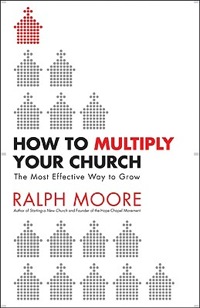
The author, Ralph Moore used the metaphor of the American forces during Word War II in 1942 to explain the need for church multiplication. Just as those soldiers needed to make a paradigm shift to win the war, the church today has to make a paradigm shift – from growth by addition to growth by multiplication. The primary insight from this book is the fact that churches should grow by multiplication and not just by addition. As this student was reading the book, one was enlightened by the fact the Bible does teach multiplication through conversion growth (80). There is more than one way to grow a church. The best way Ralph Moore contends is to multiply the church. The biblical insight that the apostles never left Jerusalem and that it took persecution to get other disciples to go and multiply God’s kingdom is astounding. The church today is really no different now than at the time of the apostles. The apostles were very much like us. They were involved in a new church. When Jesus told them to go, they did not do it voluntarily. God had to send persecution to make them do it. Even then, apostles stayed. That is an astounding claim. The apostles stayed and it took other people to multiply the church (81). God clearly showed the apostles that they were disobedient and that it was His will (just as Jesus said in Acts 1:8) to take the Gospel out to the world. This shows that church tradition can set in so quickly that a church may even resist the idea that multiplication is God’s will. This reviewer also believes that this is one of the reasons that the Gospel was transferred to the Gentiles. The Jewish apostles were resistant to do God’s will and it took people willing to reach Gentiles to accomplish it. God used multiplication to spread the Gospel to the entire Roman world. If the church would understand that truth today, we would spend less time trying to build bigger buildings and spend more time trying to start new churches.
Another insight was the natural need for a church to multiply. The Bible says to “be fruitful and multiply.” As part of being a fruitful church, it must multiply itself. This is necessary because the church goes through a life cycle (49-52). A church is (1) conceived and born, goes through (2) childhood and adolescence, (3) begins to reproduce and rear children, (4) enters middle age and empty nesting, and finally (5) decline and death. For a church to survive, it must multiply.
Moore shares a variety of metaphors to emphasize the importance of multiplication: seeds, a vine, and a vineyard, a body, a family, and a household (not necessarily the house, but the people living in the house), and a flock of sheep (42-43). The New Testament uses each of these metaphors for the church and they have one thing in common: reproduction. Later in the book, the author compares multiplication to a healthy mother (43-44) who has many children and grandchildren. A church which multiplies is also compared to the body which exhales. The church needs to exhale some active and fruitful members to another church (73).
Moore shares many insights about how difficult it is for a church to multiply itself. Using the illustration of the Allied forces who had to overcome roadblocks to win World War II, churches also encounter similar roadblocks. These roadblocks include: buildings, bucks, and brains. Churches (who believe in the church growth mentality) tend to focus their emphasis on building bigger buildings to accommodate additional growth. Another barrier includes the cost of a full-time pastor. Moore suggests that most church plants should start with a bi-vocational pastor. This will also help overcome the third roadblock: brains. The author suggests that a new model is needed to develop leaders in church plants. Christianity must shift from training leaders in a seminary to using an apprenticeship process. Seminary has become an obstacle to church growth because it is used as a pathway to leadership. The leadership should come from the membership. Informal training methods should serve that purpose, and not formal training which costs extra money. Moore lists many other roadblocks to church multiplication, but in the end, he suggests running over these roadblocks and pressing on to plant new churches.
While Moore begins with a metaphor to illustrate his truth, he does spend time grounding the truth in Scripture. Moore examines the Great Commission (67), and then spends four chapters examining the methods used in the New Testament (chapters 9-12). For example, he says that Jesus Christ was the first church planter. He contends that Jesus is our model. Jesus taught the apostles, who shared that model with Paul (107). Jesus started with twelve disciples, which multiplied to seventy-two, and finally multiplied to 120 disciples at His ascension. Jesus accomplished this using various keys: (1) accept your calling, (2) recruit by revelation, (3) communicate broadly with Holy Spirit power, (4) make disciples, and (5) commission and empower your disciples. Moore explains that the goal and the strategy for the church is the same. Only the tactics change. For example, the goal for the church is to make disciples (and he would contend that means by multiplication, not by just addition). The strategy to accomplish this multiplication is through the five keys described above. However, the tactics, or methods which are used may change depending upon the location and language of the church (113-121).
This suggests that the hermeneutical foundation for multiplication is very strong. Moore stresses that the Jerusalem church failed to follow the methods of Jesus and His “Great Commission” – to go, be fruitful and multiply. Therefore, the growth of the Christian faith moved through the work of the Antioch church. The Jerusalem church was a come-and-see church, while Antioch was a go-and-tell church. This is why the church at Antioch was so successful in church planting.
Moore provides so many insights and helpful tips for churches to multiply. This reviewer has very little with which to disagree. As a result, this book fit nicely with other books on the same topic. For example, this book compliments another book by Ralph Moore: Starting a New Church. Other books that address church multiplication include: Spin-Off Churches, Connections, and Planting Growing Churches for the 21st Century. While this book does not necessarily contradict other books on church growth, it adds the level of growth that most church growth books do not address: multiplication.
This reviewer would recommend this book for the simple fact that many pastors do not think about multiplication. However, it would be clear that multiplication would take more energy than just growing by addition. For the church to accomplish the Great Commission, multiplication is the necessary strategy.
Previous Post

February 10, 2014
Let the Nations Be Glad by John Piper
Next Post
February 11, 2014 Confessions of a Bible Thumper by Michael Camp
Browse Our Archives
Select a Category 1 Chronicles 1 Corinthians 1 John 1 Kings 1 Peter 1 Samuel 1 Thessalonians 1 Timothy 2 Chronicles 2 Corinthians 2 John 2 Kings 2 Peter 2 Samuel 2 Thessalonians 2 Timothy 3 John Acts Advent Amos Book Review Colossians Comics Culture Watch Daniel Deuteronomy Ecclesiastes Ephesians Esther Exodus Ezekiel Ezra Galatians Genesis Guest Post Habakkuk Haggai Hebrews Hosea Humor Inspiritational Isaiah James Jeremiah Job Joel John Jonah Joshua Jude Judges Lamentations Lectionary Lent Leviticus Link Love Luke Malachi Mark Matthew Micah Movie Review Nahum Nehemiah Numbers Philippians Political Watch Prophecy Watch Proverbs Psalm Revelation Reviews Romans Ruth Science Watch Sermon Series Sermons Simple Thoughts Song of Solomon Titus Top Ten Uncategorized Video Review Zechariah Zephaniah
Select a Month May 2026 October 2025 September 2025 June 2025 February 2025 January 2025 November 2024 October 2024 September 2024 July 2024 June 2024 April 2024 March 2024 January 2024 November 2023 October 2023 September 2023 June 2023 May 2023 March 2023 February 2023 January 2023 December 2022 October 2022 September 2022 August 2022 July 2022 June 2022 May 2022 January 2022 June 2021 January 2021 October 2020 July 2020 May 2020 April 2020 March 2020 February 2020 January 2020 December 2019 November 2019 October 2019 September 2019 August 2019 July 2019 June 2019 May 2019 April 2019 March 2019 February 2019 January 2019 December 2018 November 2018 October 2018 September 2018 August 2018 July 2018 June 2018 May 2018 April 2018 March 2018 February 2018 January 2018 December 2017 November 2017 October 2017 September 2017 August 2017 July 2017 June 2017 May 2017 April 2017 March 2017 February 2017 January 2017 December 2016 November 2016 October 2016 September 2016 August 2016 July 2016 June 2016 May 2016 April 2016 March 2016 February 2016 January 2016 December 2015 November 2015 October 2015 September 2015 August 2015 July 2015 June 2015 May 2015 April 2015 March 2015 February 2015 January 2015 December 2014 November 2014 October 2014 September 2014 August 2014 July 2014 June 2014 May 2014 April 2014 March 2014 February 2014 January 2014 December 2013 November 2013 October 2013 September 2013 August 2013 July 2013 June 2013 May 2013 April 2013 February 2013 January 2013 December 2012 November 2012 October 2012 September 2012 August 2012 July 2012 June 2012 May 2012 April 2009 June 2008 October 2007 September 2007 August 2007 July 2007 June 2007 May 2007 April 2007 March 2007 February 2007 January 2007 December 2006 October 2006 September 2006 May 2006 April 2006 March 2006 February 2006 January 2006 December 2005 September 2005
Follow Us!
TAKE THE
Religious Wisdom Quiz
What does "Shiloh" (where the Tabernacle stood) mean?
Select your answer to see how you score.
House of Prayer Well of Water Place of Peace Land of Bread
Related posts from Jim Erwin


Using ChatGPT in Sermon Preparation


Can I Ask You a Question by Preston...
TRENDING AT PATHEOS Evangelical

Looking at the Largest Orthodox Cathedral on Earth
There is often a considerable amount of anger and, shall we...

The Problem with False Prophets
Miller’s Station UMC| 10/18/26| Anchor Verse: Jeremiah 23: 1, 9-23 I...

Emotion in Early Christianity by Andrew Crislip
Andrew Crislip’s Emotion in Early Christianity examines an often overlooked dimension of...

16 Spiritual Touchstones for a More Grounded Life
After decades of spiritual study, here are 16 principles I try...

Catholic Evangelization: Sharing Your Faith Every Day
Welcome back to the Graceful Awakening mini-series called, “From Faith to Mission.” ...

The Pillar of the Boatmen: the Ancient Monument...
The Pillar of the Boatmen is a Romano-Gaulish sculpture that dates from...
view all Evangelical blogs
Ad-Free & Subscriber Log-In Subscription Support
- About Us
- 2026 Calendar
- Videos
- Podcasts
- Library of World Religions
- Faith In Media Tracker
- Advertise With Us
- Write for Us
- Privacy Policy
- Terms of Service
- Do Not Sell My Data
- Contact Us
- Radiant Digital
- Manage Newsletter Subscriptions
- Unsubscribe From Notifications
- Sitemap
Copyright 2008-2026, Patheos. All rights reserved.
Subscription Support Ad-Free & Subscriber Log-In
Follow Patheos