
BuddhistCatholicContemplativeEvangelicalGeneral ChristianHinduJewishLatter-day SaintMuslimNew VisionsProgressive Christian
Beliefs
- Buddhist
- Catholic
- Contemplative
- Evangelical
- General Christian
- Hindu
- Jewish
- Latter-day Saint
- More Voices
- Muslim
- New Visions
- Pagan
- Progressive Christian
Topics
- Religion News
- Food and Religion
- Sports and Religion
- Religious Art
- Religious Music and Entertainment
- Religious Events
- History and Religion
- Style and Religion
- Politics and Religion
- Women in Religion
- Recreation Outdoors and Religion
- Business Finance and Religion
- Careers Workplace and Religion
- Education and Religion
- Family Parenting and Religion
- Health Fitness and Religion
- Home and Religion
- Relationships and Religion
- Technology and Religion
- Travel and Religion
Columnists
- Buddhist Columnists
- Business Finance and Religion Columnists
- Careers Workplace and Religion Columnists
- Catholic Columnists
- Contemplative Columnists
- Education and Religion Columnists
- Evangelists Columnists
- Family Parenting and Religion Columnists
- General Christian Columnists
- Health Fitness and Religion Columnists
- Hindu Columnists
- History and Religion Columnists
- Home and Religion Columnists
- Jewish Columnists
- More Voices Columnists
- Latter Day Columnists
- Muslim Columnists
- New Visions Columnists
- Nonreligious Columnists
- Pagan Columnists
- Politics and Religion Columnists
- Progressive Columnists
- Recreation Outdoors and Religion Columnists
- Relationships and Religion Columnists
- Religion News Columnists
- Religious Art Columnists
- Religious Events Columnists
- Religious Music and Entertainment Columnists
- Sports and Religion Columnists
- Style and Religion Columnists
- Technology and Religion Columnists
- Travel and Religion Columnists
- Women in Religion Columnists
Resource Library
- 2026 Calendar
- Library of World Religions
- The 100 Most Holy Places on Earth
- Patheos Answers
- Podcasts
- Videos
- Faith Leaders Database
- Anglican Episcopalian
- Bahai
- Baptist
- Buddhism
- Christianity
- Confucianism
- Eastern Orthodoxy
- Hinduism
- Holiness and Pentecostal
- ISKCON
- Islam
- Judaism
- Lutheran
- Methodist
- The Church of Jesus Christ of Latter-day Saints
- New Age
- Paganism
- Presbytarian and Reformed
- Protestantism
- Religion Behind the Scenes
- Roman Catholic
- Scientology
- Shia Islam
- Sikhism
- Sufism
- Sunni Islam
- Taoism
- Zen
- See all religions
Research Tools
 Ad-Free & Subscriber Log-In Subscription Support
Ad-Free & Subscriber Log-In Subscription Support
Follow Patheos 

- Trending:
- Forgiveness
- |
- Marriage
- |
- Consciousness
- |
- Death Penalty
- |
- Election
- |
- Halloween

- Home
- Evangelical
- Exegetical Fallacies by D.A. Carson
Exegetical Fallacies by D.A. Carson
Last updated on: February 6, 2014 at 3:18 am by Jim Erwin
Exegetical Fallacies by D.A. Carson 2014-02-06T03:18:19-05:00 Jim Erwin
Patheos Explore the world's faith through different perspectives on religion and spirituality! Patheos has the views of the prevalent religions and spiritualities of the world.
Introduction
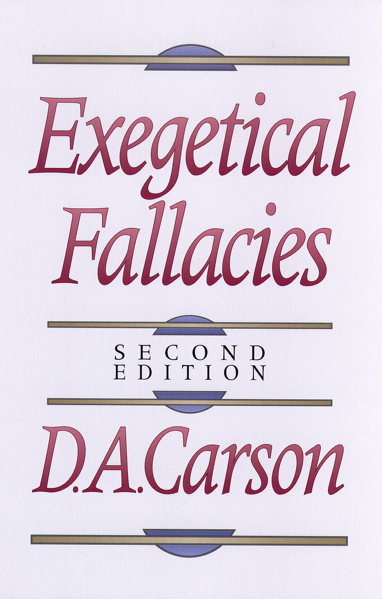
The book Exegetical Fallacies is a fine book which shares with the reader a set of mistakes that pastors can make in interpreting the biblical text. These mistakes, called fallacies, are grouped into categories (word study, grammatical, logical, historical). Within each category, a list of fallacies are given, along with many examples about how these fallacies can happen. The author clearly explains why these are fallacies and how they can be avoided.
Word Study Fallacies
There are sixteen fallacies under this category. First, there are common fallacies in semantics, which has to do with the meaning of language. Since the Bible is written in Hebrew and Greek, there are many word study fallacies. All of these fallacies concern mistakes with the language. First, one can make a root fallacy where one completely misinterprets the meaning of the word in the original language. This second word study fallacy is called semantic anachronism. For example, the Greek word “dynamis” does not have the same meaning as the modern English word dynamite. The third fallacy, semantic obsolescence is similar to semantic anachronism. In the case of obsolescence, a word drops out of use.
Sometimes, a researcher can make the fallacy of suggesting an unknown or unlikely meaning for a word. In this case, a person decided to use someone else’s use of a word as the basis for their definition. Instead of checking primary sources, one uses secondary sources – sources who do not know the background of the word. A similar fallacy is when one careless appeal to the background material. In other words, the researcher does sloppy work in finding the meaning of a word. As a result, one misinterprets the text.
Biblical scholars also tend to add parallels of questionable worth to a word. This verbal parallelomania, or extreme desire to see parallels where non exist is a common fallacy. Stating that Adam is a king because kings had a garden and Adam had a garden is one such example. It is verbal nonsense, according to the author.
Another fallacy is to attach language exclusively to a cultural mentality. The thinking process of a culture (how they view time, nature, and words, etc.) becomes the only way to understand the words in a language. Another fallacy is to attach only one meaning to a word no matter where it is found in the context. Since one can understand the word to have only one meaning, it cannot mean something else.
There can be problems surrounding synonyms and compound analysis. People make a semantic difference in one context but not in another context. The perfect case of this mistake is the fact that in John 21:15-17, theologians want to slice “agape,” and “phileo” love apart into two different pieces. However, no one makes the same distinction between “feeding lambs,” shepherding sheep,” and “feeding sheep” in the same context.
Another fallacy occurs when one “picks and chooses” the evidence that one wants to interpret the text. Instead of listening to the Word of God, one makes up what the text means.
Grammatical Fallacies
There are word study fallacies because many pastors look up words. However, not many pastors will look the exact tense of a certain word found in a certain text of Scripture. As a result, they make fewer grammatical fallacies. Most fallacies of this type are connected with the various tenses and moods. For example, some pastors will make the mistake of interpreting the “aorist” tense in a rigid sense, of only as a “completed action in the future.” However, the problem with this analysis, (as the author tries to repeat throughout the chapter) is that the language is fluid. One can only know the true intent of a word by the context. Not only that, the meaning of that word has to be relatively time-stamped for the New Testament. For example, many scholars (including Scagg) assumed that because the New Testament was written in Greek, it was the same Greek as earlier extra-biblical manuscripts written before the New Testament was penned. They would assume that the meaning of the New Testament Greek was the same as classical Greek texts from a much earlier time. That has been proven to be incorrect.
Fallacies with various syntactical units are also common. These include fallacies concerning conditionals. For example, people begin many sentences with “Since” instead of “If” because they assume the condition to be true. The problem is that the protasis assumed may or may not be true. It is also a fallacy to hold that the third-class conditions plus the subjunctive have a built-in fulfillment. The reason this is a fallacy is because the fulfillment may not be true. Third, it is a fallacy to assume that verb tenses are primarily time-based in the indicative.
The article in the Greek language is very hard to classify. Only context and the feel gained by experience in the Greek text can help the student decide the article. This is made more complicated by the Granville Sharp rule, where two pronouns are linked by a singular definite article. Many people misuse the Granville Sharp rule in places where it was never designed. There is also the Colwell rule which governs the article as well. How does one define the noun in “the Word was God” in John 1:1? Is it indefinite (a god) or definite (God) after the verb? The rule can easily be abused. Just because a predicate noun preceding a copulative verb is anarthrous, it does not mean that it will be definite. Statistically, there will be no difference between whether it will be an indefinite or definite article.
Logical Fallacies
Eighteen logical fallacies are listed in the book. In each of these examples, the problem is with the way something is presented and argued. One such logical fallacy is a false disjunction. This fallacy is an improper appeal to the law of the excluded middle. In other words, one argues for an “either/or” requirement when it is just as acceptable to see the words as complementary. For example, when God says: “I desire mercy and not sacrifice: in Hosea 6:6, He does not mean that the sacrificial system should be eliminated. Instead, God is emphasizing the importance of mercy.
Another logical fallacy is the failure to recognize distinctions. In this case, one argues that because x and y are alike in certain respects they are alike in all respects. Just because there is no distinction between male and female in Christ (Galatians 3:28), it does not follow that women and men can and should do everything equally. As the author pointed out “Who is going to bear the babies” – are men also required to fulfill this function? This is not the case because biologically, men and women are not the same. One must look at the context to see the meaning.
Another fallacy which is related to the failure to recognize distinctions is the selective use of evidence in such a way that other evidence is wrongly excluded. The more complex and emotional an issue, the author notes, the greater is the tendency to select only part of the evidence. In other words, one supports a view (say God’s sovereignty) and excludes another view (man’s responsibility) as valid. Although the Bible speaks about both related issues, theologians will tend to support only one “side.” The Bible however, keeps what seems to be opposing views in tension (much like a tug-o-war).
Another fallacy is to improperly handle syllogisms. In this case, one states a major premise, a minor premise, and then a conclusion. The problem is that the counter examples of these syllogisms disprove the syllogisms. It is a flaw of logical argumentation. Another form of syllogism which is incorrectly used is the negative inference. In other words, the conclusion could be true, but the way one reaches the conclusion is improper because one infers a negative conclusion.
Other fallacies in this categories remain. For example, one could have world-view confusion. In this case, one incorrectly thinks that one’s own experience and interpretation of reality are the proper framework for interpreting the biblical text. Theologians “read into” the text their experience and come up with a conclusion. A subset of this fallacy is the way we frame questions. Someone who asks “When did you stop beating your wife?” is asking an improper question because the questioner is imposing his ideas into the question.
Another fallacy is confusing truth with precision. In this case, we dismiss truth because it does not seem to be precise. One can insert one’s worldview, and diminish truth because it does not seem so “precise.” Others may use an emotive appeal. While emotion can make the appeal for truth more sincere, the emotion cannot be a substitute for reason.
In other cases, some theologians may take a particular case and extend it to a generalization just because it suits the case. Sometimes, they can make unwarranted associative jumps. For example, a word or phrase may trigger an associated idea which has no relation to the word. One “goes on a tangent” to prove the text.
Sometimes people simply make false statements, or they make conclusions which do not follow (also known as non sequitur). Others may simply dismiss the argument when it needs a rebuttal. Other arguments are not faulty, but they claim to deliver more than they can. For example, there is a form of argumentation which some people which uses the ambiguous language. By doing so, the person gains the widest possible agreement. The author cites as one example the statements of the World Council of Churches.
The final logical fallacy is using inadequate analogies. Analogies are good when they are used to paint a picture and provide continuity to a thought or theme. However, these analogies must properly work. Many people use analogies which “break down.” Many times when one uses an inadequate analogy, one does not really understand the issue. Instead, the person plods through with an analogy to best explain a concept that is not really grasped. Illustrations by definition are used to illustrate an idea, not explain one. One must understand analogies in order to use them properly.
Using expressions such as “obviously” or other expressions cannot add substance to an argument. These expressions are used to give clarity, but never substance. The final fallacy in logic is appealing to an authority as the way to interpret the text. One should judge what is said, not for who advances such a view, but for the reasons they advance it.
Presuppositional or Historical Fallacies
Many times people read their own theology into the text (eisegesis). One must understand their own prejudices to the biblical text and make allowances for them. Other people may make interpretations that ignore the Bible’s story-line. The Bible does contain a meta-narrative, which cannot be ignored. Some postmodern theologians seem to ignore this “grand story.” They interpret the books of the Bible and specific passages in isolation. As a result, many views are brought to the table, and therefore all interpretations are equally valid. The Bible is a puzzle which needs to be put together, not studied in pieces.
Another fallacy (which is related to ignoring the Biblical story-line) is the insistence on working outside the Bible’s “givens.” Instead of truly understanding what the Bible says about a subject, one inserts the current social agenda as the basis for Biblical interpretation. In this case, God is taken out of the Bible. To put it another way, some theologians want to “color” their interpretations “outside of the Biblical hermeneutical lines” of interpretation.
Another set of fallacies are related to the history of the Biblical text. For example, one can “reconstruct” the historical background of the text and give it more weight than other parts to exegesis. One must be ready to state that outside of the New Testament, there is not much further evidence for a view. Instead of “stretching” the historical truth, one should be content with what is unknown.
Another fallacy is to place a cause into a scenario or set of events when that has not happened. Event B happened after event A and therefore it happened because of event A. One does not know this clearly and therefore cannot assume a cause. Fallacies of motivation (a subset of causation) can also occur. In this case, one tends to psychoanalyze the participant of the event without conclusive evidence from the biblical record.
Conceptual parallelomania is when one who relates the Bible to a particular discipline such as psychology, sociology, history, philosophy, and education. One can make applications form the Bible to these disciplines. However, to use these disciplines to interpret the text is damaging.
Concluding Reflections
The strength of this book is the fact there is one. D. A. Carson has made an important contribution to the work of a pastor who studies and preaches the Word of God. He presents a book that lists beforehand the mistakes one can make in interpreting the biblical text. This can be extremely helpful for pastors who are trying to interpret the text and who need to know the pitfalls in interpretation. The examples of fallacies given come from a wide variety of scholars. As a result, the pastor can gain experience by learning from the mistakes of other scholars. Even scholars have made these mistakes and the pastor can take comfort in knowing this.
As one reads through the book, one can clearly see that the author has real problems with exegesis by consensus (119). He desires individual conclusions.
One minor problem has to do with tools that one uses in interpretation. The author mentions GRAMCORD as a computer program which can help the pastor in his research. Since the writing of this book, the program has gone through many changes and distributors. The program has now been incorporated into the Accordance Bible program for the Apple Macintosh. BibleWorks is a similar program for Windows computers. Although they are equivalent in the way they operate, the Accordance program has a more intuitive user interface. Perhaps an appendix describing new various options would be helpful, or a bibliographical reference to such programs should be included.
Previous Post

February 5, 2014
The Cross in the Closet by Tim Kurek
Next Post
February 9, 2014 Isaiah 58:1-14 Give Me Your Heart (Time)
Browse Our Archives
Select a Category 1 Chronicles 1 Corinthians 1 John 1 Kings 1 Peter 1 Samuel 1 Thessalonians 1 Timothy 2 Chronicles 2 Corinthians 2 John 2 Kings 2 Peter 2 Samuel 2 Thessalonians 2 Timothy 3 John Acts Advent Amos Book Review Colossians Comics Culture Watch Daniel Deuteronomy Ecclesiastes Ephesians Esther Exodus Ezekiel Ezra Galatians Genesis Guest Post Habakkuk Haggai Hebrews Hosea Humor Inspiritational Isaiah James Jeremiah Job Joel John Jonah Joshua Jude Judges Lamentations Lectionary Lent Leviticus Link Love Luke Malachi Mark Matthew Micah Movie Review Nahum Nehemiah Numbers Philippians Political Watch Prophecy Watch Proverbs Psalm Revelation Reviews Romans Ruth Science Watch Sermon Series Sermons Simple Thoughts Song of Solomon Titus Top Ten Uncategorized Video Review Zechariah Zephaniah
Select a Month May 2026 October 2025 September 2025 June 2025 February 2025 January 2025 November 2024 October 2024 September 2024 July 2024 June 2024 April 2024 March 2024 January 2024 November 2023 October 2023 September 2023 June 2023 May 2023 March 2023 February 2023 January 2023 December 2022 October 2022 September 2022 August 2022 July 2022 June 2022 May 2022 January 2022 June 2021 January 2021 October 2020 July 2020 May 2020 April 2020 March 2020 February 2020 January 2020 December 2019 November 2019 October 2019 September 2019 August 2019 July 2019 June 2019 May 2019 April 2019 March 2019 February 2019 January 2019 December 2018 November 2018 October 2018 September 2018 August 2018 July 2018 June 2018 May 2018 April 2018 March 2018 February 2018 January 2018 December 2017 November 2017 October 2017 September 2017 August 2017 July 2017 June 2017 May 2017 April 2017 March 2017 February 2017 January 2017 December 2016 November 2016 October 2016 September 2016 August 2016 July 2016 June 2016 May 2016 April 2016 March 2016 February 2016 January 2016 December 2015 November 2015 October 2015 September 2015 August 2015 July 2015 June 2015 May 2015 April 2015 March 2015 February 2015 January 2015 December 2014 November 2014 October 2014 September 2014 August 2014 July 2014 June 2014 May 2014 April 2014 March 2014 February 2014 January 2014 December 2013 November 2013 October 2013 September 2013 August 2013 July 2013 June 2013 May 2013 April 2013 February 2013 January 2013 December 2012 November 2012 October 2012 September 2012 August 2012 July 2012 June 2012 May 2012 April 2009 June 2008 October 2007 September 2007 August 2007 July 2007 June 2007 May 2007 April 2007 March 2007 February 2007 January 2007 December 2006 October 2006 September 2006 May 2006 April 2006 March 2006 February 2006 January 2006 December 2005 September 2005
Follow Us!
TAKE THE
Religious Wisdom Quiz
Which prophet confronted David about his sin with Bathsheba?
Select your answer to see how you score.
Gad Abiathar Samuel Nathan
Related posts from Jim Erwin


Using ChatGPT in Sermon Preparation


Can I Ask You a Question by Preston...
TRENDING AT PATHEOS Evangelical

When Halloween Unmasks Married Hearts
Written by Dr. David K. Ewen from Eternal Truth Bible College Behind...

Aristotle. He’s been called the father of logic, the father of the...

Methodist Central Hall and Westminster Abbey
Situated on the same square is Methodist Central Hall and Westminster Abbey. ...

57th Dove Awards Honor Dolly Parton, Crown New...
On gospel music’s biggest night, the 57th annual GMA Dove Awards honored...

The First Eucharistic Controversy: Christ’s Real Presence
For Catholics, the Eucharist is the source and summit of the Christian...

What a Stop Sign Can Teach Us About...
How to Make a Decision When You Can't Hear God Main point:...
view all Evangelical blogs
Ad-Free & Subscriber Log-In Subscription Support
- About Us
- 2026 Calendar
- Videos
- Podcasts
- Library of World Religions
- Faith In Media Tracker
- Advertise With Us
- Write for Us
- Privacy Policy
- Terms of Service
- Do Not Sell My Data
- Contact Us
- Radiant Digital
- Manage Newsletter Subscriptions
- Unsubscribe From Notifications
- Sitemap
Copyright 2008-2026, Patheos. All rights reserved.
Subscription Support Ad-Free & Subscriber Log-In
Follow Patheos