
BuddhistCatholicContemplativeEvangelicalGeneral ChristianHinduJewishLatter-day SaintMuslimNew VisionsProgressive Christian
Beliefs
- Buddhist
- Catholic
- Contemplative
- Evangelical
- General Christian
- Hindu
- Jewish
- Latter-day Saint
- More Voices
- Muslim
- New Visions
- Pagan
- Progressive Christian
Topics
- Religion News
- Food and Religion
- Sports and Religion
- Religious Art
- Religious Music and Entertainment
- Religious Events
- History and Religion
- Style and Religion
- Politics and Religion
- Women in Religion
- Recreation Outdoors and Religion
- Business Finance and Religion
- Careers Workplace and Religion
- Education and Religion
- Family Parenting and Religion
- Health Fitness and Religion
- Home and Religion
- Relationships and Religion
- Technology and Religion
- Travel and Religion
Columnists
- Buddhist Columnists
- Business Finance and Religion Columnists
- Careers Workplace and Religion Columnists
- Catholic Columnists
- Contemplative Columnists
- Education and Religion Columnists
- Evangelists Columnists
- Family Parenting and Religion Columnists
- General Christian Columnists
- Health Fitness and Religion Columnists
- Hindu Columnists
- History and Religion Columnists
- Home and Religion Columnists
- Jewish Columnists
- More Voices Columnists
- Latter Day Columnists
- Muslim Columnists
- New Visions Columnists
- Nonreligious Columnists
- Pagan Columnists
- Politics and Religion Columnists
- Progressive Columnists
- Recreation Outdoors and Religion Columnists
- Relationships and Religion Columnists
- Religion News Columnists
- Religious Art Columnists
- Religious Events Columnists
- Religious Music and Entertainment Columnists
- Sports and Religion Columnists
- Style and Religion Columnists
- Technology and Religion Columnists
- Travel and Religion Columnists
- Women in Religion Columnists
Resource Library
- 2026 Calendar
- Library of World Religions
- The 100 Most Holy Places on Earth
- Patheos Answers
- Podcasts
- Videos
- Faith Leaders Database
- Anglican Episcopalian
- Bahai
- Baptist
- Buddhism
- Christianity
- Confucianism
- Eastern Orthodoxy
- Hinduism
- Holiness and Pentecostal
- ISKCON
- Islam
- Judaism
- Lutheran
- Methodist
- The Church of Jesus Christ of Latter-day Saints
- New Age
- Paganism
- Presbytarian and Reformed
- Protestantism
- Religion Behind the Scenes
- Roman Catholic
- Scientology
- Shia Islam
- Sikhism
- Sufism
- Sunni Islam
- Taoism
- Zen
- See all religions
Research Tools
 Ad-Free & Subscriber Log-In Subscription Support
Ad-Free & Subscriber Log-In Subscription Support
Follow Patheos 

- Trending:
- Forgiveness
- |
- Marriage
- |
- Consciousness
- |
- Death Penalty
- |
- Election
- |
- Halloween

- Home
- Evangelical
- Leviticus 25:1-55 The Path to Positive Money Management
Leviticus 25:1-55 The Path to Positive Money Management
Last updated on: August 10, 2013 at 1:07 am by Jim Erwin
Leviticus 25:1-55 The Path to Positive Money Management 2013-08-10T01:07:58-05:00 Jim Erwin
Patheos Explore the world's faith through different perspectives on religion and spirituality! Patheos has the views of the prevalent religions and spiritualities of the world.
Leviticus 25:1-55 The Path to Positive Money Management
The Stewardship Continuum (Leviticus 25:1-55)
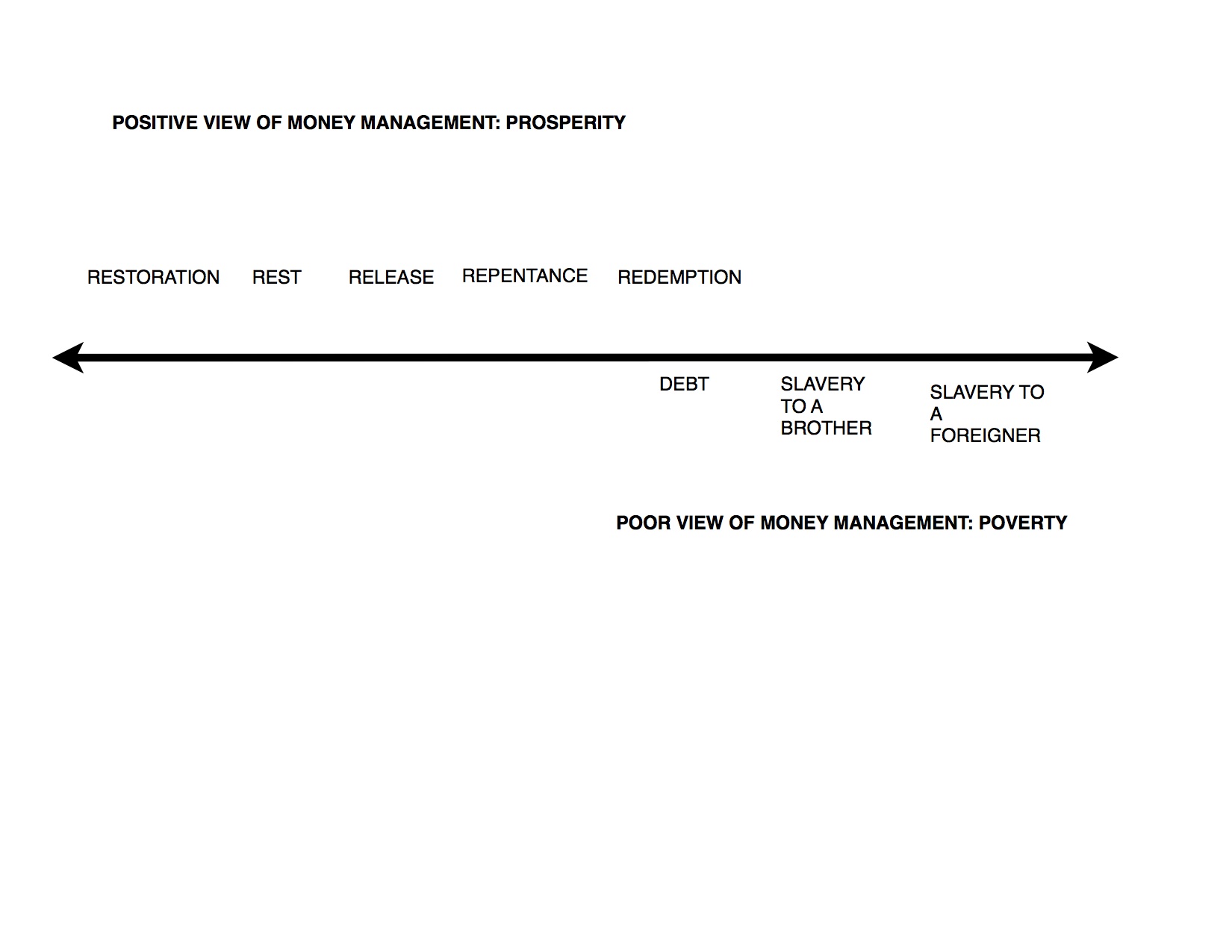
Let’s start with the middle of the continuum. At this point, it can go two different directions. These directions are based on our view of money management, or stewardship. One can have a poor view of stewardship, which ends in slavery. One can have a positive view of stewardship which leads to release, rest and restoration.
Let’s start with the poor view of stewardship. This is illustrated with the phrase:
POOR VIEW OF MONEY MANAGEMENT: POVERTY
A poor view of money management, or stewardship leads a person to become poor. There are three possible situations which can cause someone to become poor. The first situation is that a person becomes destitute, or gets into debt.
DEBT
““If your brother becomes destitute and cannot sustain himself among you, you are to support him as a foreigner or temporary resident, so that he can continue to live among you.” (Leviticus 25:35, HCSB)
This verse tells us that some people become poor. They become poor because of a variety of reasons, but the end result is that they cannot sustain themselves. The Bible teaches that if they are brothers, the church is called to support these people. This may include widows, or people who are temporarily in a financial bind.
As a church, we make an effort to help these people. We have a benevolence fund for this purpose. We help people. The first priority are “brothers,” or people in God’s family.
At the same time, notice that for various reasons people get into debt. Depending on how they approach money management, they can go from being in temporary destitution to financial slavery.
Let’s look at the next step down into poor money management. This is when I go from being temporarily in debt, to being a slave in debt to someone else.
The Bible warns us that how we treat people who have financial difficulties should involve mercy and grace. We are not responsible with what people do with our help. However, we do have an obligation to help others whom God puts in our paths.
“Do not profit or take interest from him, but fear your God and let your brother live among you. You are not to lend him your silver with interest or sell him your food for profit.” (Leviticus 25:36–37, HCSB)
The reason is because God was gracious to help us when we were in debt to Him.
“I am Yahweh your God, who brought you out of the land of Egypt to give you the land of Canaan and to be your God.” (Leviticus 25:38, HCSB)
As a side note, the journey from poor money management to positive money management parallels the journey of the children of God from Egypt to Canaan. Egypt was the land of slavery. Canaan is the land of salvation and promise.
SLAVERY TO A BROTHER
““If your brother among you becomes destitute and sells himself to you, you must not force him to do slave labor.” (Leviticus 25:39, HCSB)
God’s laws didn’t establish slavery; they regulated it and actually made it more humane.1 Although we have abolished slavery for decades, many people are still slaves, they are just slaves to corporations. One of the ways, we can help people overcome their slavery to debt is to give them dignity.
We don’t force people to be slaves to us financially. We don’t enable people to continue in financial slavery. Instead, we help them get where they need to be in positive money management.
The problem here is that there is an enormous amount of shame inflicted with this kind of slavery. This is why God developed this “Year of Jubilee” process for the people of Israel. It prevented the country from becoming what we have today in America: the 99% versus the 1%.
Some people have done more than just get into some debt. Some people are not just indebted to their family. Many people are indebted to foreigners.
SLAVERY TO A FOREIGNER
““If a foreigner or temporary resident living among you prospers, but your brother living near him becomes destitute and sells himself to the foreigner living among you, or to a member of the foreigner’s clan,” (Leviticus 25:47, HCSB)
As a country, we have developed this mentality for years. We have encouraged people to get into debt to have what they want now. We have encouraged this poor view of money management. We have people who struggle trying to pay their bills. We have people who have tried to find a solution outside of God’s provision. They have used foreign sources of provision and this has led them to poverty.
In summary, the Jubilee Year would prevent the massive accumulation of wealth by a small portion of the population. If a member of the community lost family land and freedom by falling into debt, restoration was granted in the Jubilee Year. 2
The Jubilee Year teaches us the idea of a positive view of money management.
POSITIVE VIEW OF MONEY MANAGEMENT: PROSPERITY
The first key to a positive view of money management, which was illustrated through the Year of Jubilee and fulfilled through Jesus Christ, is the idea of redemption.
REDEMPTION
Redemption, or to buy back, is the way to get out of debt. Spiritually speaking, Jesus said He would do this for His people.
“The Spirit of the Lord is on Me, because He has anointed Me to preach good news to the poor. He has sent Me to proclaim freedom to the captives and recovery of sight to the blind, to set free the oppressed, to proclaim the year of the Lord’s favor.” (Luke 4:18–19, HCSB)
Jesus was called to bring people out of poverty. He knew that the poor would always be around.
“For you always have the poor with you, but you do not always have Me.”” (John 12:8, HCSB)
Yet as a principle of financial stability, one must learn to pay back what one has borrowed.
Redemption by a family redeemer:
“If your brother becomes destitute and sells part of his property, his nearest relative may come and redeem what his brother has sold.” (Leviticus 25:25, HCSB)
At times, one has to rely on a member of the family to pay back a debt. The prosperity of a family member helps me get out of debt.
How man of us have had a family member help us out in a bind. This is the principle behind this idea.
Spiritually, our family redeemer is Jesus Christ. As established in the Book of Ruth, only a close relative could help a family and pay their debt to make them free. Jesus paid our debt to sin to make us free. There is also a second way redemption can happen.
Redemption by prosperity:
“If a man has no family redeemer, but he prospers and obtains enough to redeem his land, he may calculate the years since its sale, repay the balance to the man he sold it to, and return to his property.” (Leviticus 25:26–27, HCSB)
Definition of prosperity
Let me illustrate my point in another way. One day a man was in the desert and was very thirsty. It had been a long time since he’d found anything to drink. Up ahead of him, he saw a small hut next to a well. The man knew that he would die soon if he did not get some water.
A small jar rested next to the well with a note beside it. The note read,
Stranger, the water in the jar is not to drink. It is to prime the pump
of the well. When you prime the pump, you will get more water than
you can ever drink. When you are done drinking, leave the jar full of
water for the next person.
The man was in a catch-22. He could drink the water in the jar and survive for a few more days. Or he could risk losing the water altogether if he tried to prime the pump and it didn’t work. But if the pump worked, he would have more than enough water to survive as long as he needed it.
After thinking it over, the man decided to pour the water into the pump. This would expand the leather of the pump, allowing it to grip and begin producing water. When he began to pour the water in, though, nothing happened. He poured more water and still nothing happened. The man began to break out into a cold sweat because he was pouring down a hole the very thing that could save him.
Then just before he was about to run out of water altogether, he saw water begin to gush out of the pump. The man was able to fill up anything and everything he could find that would hold water because the pump never ran dry.
Friend, God has more resources and money than you could ever need. He has a well that is bigger than your wildest dreams. Yet, He is asking you one thing: Are you going to prime the pump with what He’s given you? Or are you going to keep it for yourself? You are allowed to keep it for yourself if you want. It’s just that—when it’s gone—it’s gone. But if you prime the pump by giving back to God what is already His, He will supply more than enough for you.3
The difference between prosperity and riches
Prosperity includes material gain but is not limited to it. It includes balanced growth and multiplication in all areas of life.
The accumulation of wealth is something that you can do without God. You can engage in the various means of acquiring worldly goods and leave God out of the process. You only need to look around at our world today to see that many people are doing just this.
But you cannot be prosperous without God. You cannot have a fully balanced, fruitful, and joyful life without God. To be truly prosperous, you must be spiritually prosperous—your faith and relationship with God must be growing and fruitful. That can’t happen apart from God.
Both rich people and poor people are miserable without God. But prosperous people—whether they start out with five talents or one talent—are joyful, productive, and enthusiastic people. Why? Because prosperous people are growing. They have a sense of accomplishment. They are bearing good fruit. They have balanced lives and therefore have a sense of fulfillment and satisfaction.4
When we shift our money management into this positive direction, there are advantages which we will see.
Once we have paid back our debts, we learn to repent of our habits of poor money management.
REPENTANCE
“Then you are to sound a trumpet loudly in the seventh month, on the tenth day of the month; you will sound it throughout your land on the Day of Atonement.” (Leviticus 25:9, HCSB)
The day of atonement, known today in the Jewish Calendar as Yom Kippur, is the one special day when the people would repent of their sins for the previous year. This idea of repentance is also important if we are to develop a path to positive money management. We must repent of our attitudes about money management. We have to decide to change and let God lead us in our financial decisions.
RELEASE
“You are to consecrate the fiftieth year and proclaim freedom in the land for all its inhabitants. It will be your Jubilee, when each of you is to return to his property and each of you to his clan.” (Leviticus 25:10, HCSB)
““In this Year of Jubilee, each of you will return to his property.” (Leviticus 25:13, HCSB)
At the start of the Year of Jubilee, the people were commanded to release their indentured servants so that they might return to their own lands and families. 5 In the same way, we must be willing to release ourselves from financial slavery. If we are loaded down with credit card debt, it is hard to get released from financial bondage. There are things which we must release ourselves from in order to have positive money management. We need to release ourselves of the temptations for wants which we don’t need.
Since Scripture is clear that God’s original idea was to severely curtail lending, and especially consumer lending, it follows that his original idea was also to severely curtail borrowing. This fact speaks volumes to today’s commercial credit lifestyles. It is clear that God never meant us to live on other people’s money, but to live on our own. Consumer borrowing as a way of life and consumer lending as a business have no basis in Scripture. Living on credit cards and time payment plans or long easy terms or the like are devices that never existed for God’s people in biblical times. And these devices are a snare today. They are the means of producing an illusion of wealth, a fiction, a belief that we can own or do own those things which, in reality, we do not truly own or cannot obtain. These are the sparkling instruments of pride and vanity. They are the ultimate temptation: wealth without money and appearance without reality—demons in the garb of angels.6
REST
“The fiftieth year will be your Jubilee; you are not to sow, reap what grows by itself, or harvest its untended vines. It is to be holy to you because it is the Jubilee; you may only eat its produce directly from the field.” (Leviticus 25:11–12, HCSB)
Like the Sabbatical Year, it was a year of rest to the soil (Leviticus 25:11). Thus two idle years came together every fifty years, and God promised by special providence to give such a plentiful harvest during the sixth year that there should be enough until the harvest of the ninth year could be gathered 7
Think of this. You plant every six years. On the seventh year, you let your soil rest and you live on the produce of year six. You had to trust that there would be enough produce in the sixth year to make it to year eight.
Now imagine that it is the forty-eight year. God tells you there is a Sabbath year coming up to celebrate (the forty-ninth year.) Following that year is the Year of Jubilee, another year of rest for the land. Think of this, in year forty-eight, you are being asked to trust God essentially for three years. God says, let the land rest and I will take care of you.
““This will be the sign for you: This year you will eat what grows on its own, and in the second year what grows from that. But in the third year sow and reap, plant vineyards and eat their fruit.” (2 Kings 19:29, HCSB)
You know what happened with the Jews? They never trusted God in this way. This was the reason they were sent to Babylon for seventy years. Because they did not let the land rest for seventy years, they were forcibly removed to let the land rest.
“This whole land will become a desolate ruin, and these nations will serve the king of Babylon for 70 years. When the 70 years are completed, I will punish the king of Babylon and that nation’—this is the Lord’s declaration—‘the land of the Chaldeans, for their guilt, and I will make it a ruin forever.” (Jeremiah 25:11–12, HCSB)
“This fulfilled the word of the Lord through Jeremiah and the land enjoyed its Sabbath rest all the days of the desolation until 70 years were fulfilled.” (2 Chronicles 36:21, HCSB)
So the Jews could not or would not trust God. God punished them for the inability to trust Him. So the question is: Will you rest in God’s provision?
This takes us to the next step in positive money management:
RESTORATION
“You are not to cheat one another, but fear your God, for I am Yahweh your God.” (Leviticus 25:17, HCSB)
For parents to care for their families, they had to have land to cultivate, and the private ownership of property gave stability to the economy. The Lord owned the land and only loaned it to His people. He wanted them to have a sense of proprietorship and responsibility in caring for His property. People usually take care of what they themselves own.8
Two maxims underlie the Bible’s principles of financial responsibility: the earth and its resources belong to God (Lev. 25:23; Job 41:11; Pss. 24:1; 89:11; Hag. 2:8), and they have been entrusted to people to use wisely (Gen. 1:29–30; 9:1–4). The overall message of the Bible regarding finances is one of personal thrift combined with generosity toward others. 9
The financial principle is that you take care of what God gives you. You give back to Him some of what He gave you. This is the tithe. Then you take care of what God gives you. You become as productive as you can to make the money necessary to take care of your family.
Footnotes:
1 Warren W. Wiersbe, Be Holy, “Be” Commentary Series (Wheaton, IL: Victor Books, 1996), 129.
2 Gary W. Demarest and Lloyd J. Ogilvie, Leviticus, vol. 3, The Preacher’s Commentary Series (Nashville, TN: Thomas Nelson Inc, 1990), 247.
3 Tony Evans, Living in Financial Victory (Chicago, IL: Moody Publishers, 2013).
4 Charles F. Stanley, Understanding Financial Stewardship (Nashville, TN: Thomas Nelson, 1996).
5 Warren W. Wiersbe, Be Holy, “Be” Commentary Series (Wheaton, IL: Victor Books, 1996), 125.
6 H. Wayne House, Christian Ministries and the Law: Revised Edition (Grand Rapids, MI: Kregel, 1999), 190.
7 James M. Freeman and Harold J. Chadwick, Manners & Customs of the Bible (North Brunswick, NJ: Bridge-Logos Publishers, 1998), 160.
8 Warren W. Wiersbe, Be Holy, “Be” Commentary Series (Wheaton, IL: Victor Books, 1996), 126.
9 Paul H. Wright, “Financial Responsibility,” ed. Chad Brand et al., Holman Illustrated Bible Dictionary (Nashville, TN: Holman Bible Publishers, 2003), 575.
Previous Post

August 8, 2013
You Will Be My Witnesses to Your Generation
Next Post
August 10, 2013 Nahum 1:1-7 Our Responsibility to God
Browse Our Archives
Select a Category 1 Chronicles 1 Corinthians 1 John 1 Kings 1 Peter 1 Samuel 1 Thessalonians 1 Timothy 2 Chronicles 2 Corinthians 2 John 2 Kings 2 Peter 2 Samuel 2 Thessalonians 2 Timothy 3 John Acts Advent Amos Book Review Colossians Comics Culture Watch Daniel Deuteronomy Ecclesiastes Ephesians Esther Exodus Ezekiel Ezra Galatians Genesis Guest Post Habakkuk Haggai Hebrews Hosea Humor Inspiritational Isaiah James Jeremiah Job Joel John Jonah Joshua Jude Judges Lamentations Lectionary Lent Leviticus Link Love Luke Malachi Mark Matthew Micah Movie Review Nahum Nehemiah Numbers Philippians Political Watch Prophecy Watch Proverbs Psalm Revelation Reviews Romans Ruth Science Watch Sermon Series Sermons Simple Thoughts Song of Solomon Titus Top Ten Uncategorized Video Review Zechariah Zephaniah
Select a Month May 2026 October 2025 September 2025 June 2025 February 2025 January 2025 November 2024 October 2024 September 2024 July 2024 June 2024 April 2024 March 2024 January 2024 November 2023 October 2023 September 2023 June 2023 May 2023 March 2023 February 2023 January 2023 December 2022 October 2022 September 2022 August 2022 July 2022 June 2022 May 2022 January 2022 June 2021 January 2021 October 2020 July 2020 May 2020 April 2020 March 2020 February 2020 January 2020 December 2019 November 2019 October 2019 September 2019 August 2019 July 2019 June 2019 May 2019 April 2019 March 2019 February 2019 January 2019 December 2018 November 2018 October 2018 September 2018 August 2018 July 2018 June 2018 May 2018 April 2018 March 2018 February 2018 January 2018 December 2017 November 2017 October 2017 September 2017 August 2017 July 2017 June 2017 May 2017 April 2017 March 2017 February 2017 January 2017 December 2016 November 2016 October 2016 September 2016 August 2016 July 2016 June 2016 May 2016 April 2016 March 2016 February 2016 January 2016 December 2015 November 2015 October 2015 September 2015 August 2015 July 2015 June 2015 May 2015 April 2015 March 2015 February 2015 January 2015 December 2014 November 2014 October 2014 September 2014 August 2014 July 2014 June 2014 May 2014 April 2014 March 2014 February 2014 January 2014 December 2013 November 2013 October 2013 September 2013 August 2013 July 2013 June 2013 May 2013 April 2013 February 2013 January 2013 December 2012 November 2012 October 2012 September 2012 August 2012 July 2012 June 2012 May 2012 April 2009 June 2008 October 2007 September 2007 August 2007 July 2007 June 2007 May 2007 April 2007 March 2007 February 2007 January 2007 December 2006 October 2006 September 2006 May 2006 April 2006 March 2006 February 2006 January 2006 December 2005 September 2005
Follow Us!
TAKE THE
Religious Wisdom Quiz
True or False: The church in Jerusalem sent Barnabas to investigate what was happening in Antioch.
Select your answer to see how you score.
TRUE FALSE
Related posts from Jim Erwin


The Obedient Servant in Suffering


The Global Mission of the Servant
TRENDING AT PATHEOS Evangelical

In one sense walking into Westminster Abbey is like walking down the...

'Super Scam Me' Exposes AI Jon Bon Jovi...
Leslie Pickett believed she was in a relationship with Jon Bon Jovi....

The Brazilian Remake of Kendricks' 'Flywheel' Opens in...
“Flywheel,” the story that launched the Kendrick Brothers’ filmmaking career is getting...

The Dangers of Gradual Accommodation (Winking at Sin)
Recently, the “law of gradualness” resurfaced during the opening of a weeklong,...

The Iron Gates and the Lion of the...
Yesterday, I didn't finish my report about, well, yesterday. So I'll...

The Image: On the Horror of Capitalism and...
The Image Then went the Pharisees, and took counsel how they might...
view all Evangelical blogs
Ad-Free & Subscriber Log-In Subscription Support
- About Us
- 2026 Calendar
- Videos
- Podcasts
- Library of World Religions
- Faith In Media Tracker
- Advertise With Us
- Write for Us
- Privacy Policy
- Terms of Service
- Do Not Sell My Data
- Contact Us
- Radiant Digital
- Manage Newsletter Subscriptions
- Unsubscribe From Notifications
- Sitemap
Copyright 2008-2026, Patheos. All rights reserved.
Subscription Support Ad-Free & Subscriber Log-In
Follow Patheos