
BuddhistCatholicContemplativeEvangelicalGeneral ChristianHinduJewishLatter-day SaintMuslimNew VisionsProgressive Christian
Beliefs
- Buddhist
- Catholic
- Contemplative
- Evangelical
- General Christian
- Hindu
- Jewish
- Latter-day Saint
- More Voices
- Muslim
- New Visions
- Pagan
- Progressive Christian
Topics
- Religion News
- Food and Religion
- Sports and Religion
- Religious Art
- Religious Music and Entertainment
- Religious Events
- History and Religion
- Style and Religion
- Politics and Religion
- Women in Religion
- Recreation Outdoors and Religion
- Business Finance and Religion
- Careers Workplace and Religion
- Education and Religion
- Family Parenting and Religion
- Health Fitness and Religion
- Home and Religion
- Relationships and Religion
- Technology and Religion
- Travel and Religion
Columnists
- Buddhist Columnists
- Business Finance and Religion Columnists
- Careers Workplace and Religion Columnists
- Catholic Columnists
- Contemplative Columnists
- Education and Religion Columnists
- Evangelists Columnists
- Family Parenting and Religion Columnists
- General Christian Columnists
- Health Fitness and Religion Columnists
- Hindu Columnists
- History and Religion Columnists
- Home and Religion Columnists
- Jewish Columnists
- More Voices Columnists
- Latter Day Columnists
- Muslim Columnists
- New Visions Columnists
- Nonreligious Columnists
- Pagan Columnists
- Politics and Religion Columnists
- Progressive Columnists
- Recreation Outdoors and Religion Columnists
- Relationships and Religion Columnists
- Religion News Columnists
- Religious Art Columnists
- Religious Events Columnists
- Religious Music and Entertainment Columnists
- Sports and Religion Columnists
- Style and Religion Columnists
- Technology and Religion Columnists
- Travel and Religion Columnists
- Women in Religion Columnists
Resource Library
- 2026 Calendar
- Library of World Religions
- The 100 Most Holy Places on Earth
- Patheos Answers
- Podcasts
- Videos
- Faith Leaders Database
- Anglican Episcopalian
- Bahai
- Baptist
- Buddhism
- Christianity
- Confucianism
- Eastern Orthodoxy
- Hinduism
- Holiness and Pentecostal
- ISKCON
- Islam
- Judaism
- Lutheran
- Methodist
- The Church of Jesus Christ of Latter-day Saints
- New Age
- Paganism
- Presbytarian and Reformed
- Protestantism
- Religion Behind the Scenes
- Roman Catholic
- Scientology
- Shia Islam
- Sikhism
- Sufism
- Sunni Islam
- Taoism
- Zen
- See all religions
Research Tools
 Ad-Free & Subscriber Log-In Subscription Support
Ad-Free & Subscriber Log-In Subscription Support
Follow Patheos 

- Trending:
- Forgiveness
- |
- Marriage
- |
- Consciousness
- |
- Death Penalty
- |
- Election
- |
- Halloween

- Home
- Evangelical
- King of the Jews Versus Son of God
King of the Jews Versus Son of God
Last updated on: June 14, 2018 at 1:35 pm by Jim Erwin
King of the Jews Versus Son of God 2018-06-14T13:35:13-05:00 Jim Erwin
Patheos Explore the world's faith through different perspectives on religion and spirituality! Patheos has the views of the prevalent religions and spiritualities of the world.
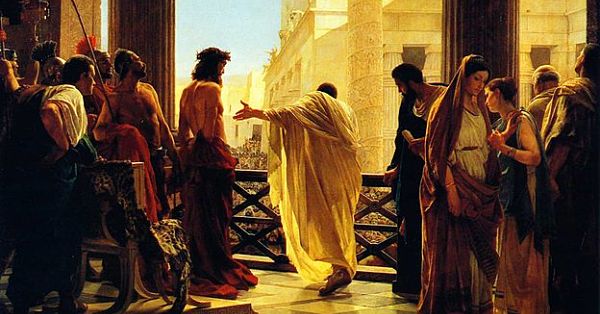
King of the Jews Versus Son of God
““We have a law,” the Jews replied to him, “and according to that law He must die, because He made Himself the Son of God.” When Pilate heard this statement, he was more afraid than ever.” (John 19:7–8, HCSB)
Up to this point, Pilate really doesn’t care about Jesus. He is willing to have Him punished in some way. First, he orders Jesus to be scourged because he thought that was the appropriate judgment for the crime. But when the Jews insisted that Jesus was committing blasphemy according to Jewish law, Pilate became scared. Why would this concern Pilate so much? Why would the idea that Jesus is the Son of God be such a threat to him?
In an earlier conversation, Jesus described His origin in spiritual terms:
““My kingdom is not of this world,” said Jesus. “If My kingdom were of this world, My servants would fight, so that I wouldn’t be handed over to the Jews. As it is, My kingdom does not have its origin here.” “You are a king then?” Pilate asked. “You say that I’m a king,” Jesus replied. “I was born for this, and I have come into the world for this: to testify to the truth. Everyone who is of the truth listens to My voice.””
(John 18:36–37, HCSB)
Pilate realized then that Jesus claimed kingship. In the conversation, Jesus describes Himself as the true King. He even opens the door for Pilate to hear the Gospel in this conversation. Jesus is essentially saying that He is the ultimate King and that there are people who will submit and obey to His rule. Jesus speaks about truth (an objective reality that says that there is only one King.) Pilate replies with the following:
““What is truth?” said Pilate. After he had said this, he went out to the Jews again and told them, “I find no grounds for charging Him.” (John 18:38, HCSB)
Pilate did not think that he needed to submit to Jesus. An objective source of truth is not the door for him to believe in Jesus. Pilate believes in power, and since he has his own “kingdom”, Pilate doesn’t believe that he needs to follow another ruler. Pilate obeys Caesar, the sovereign of the Roman Empire.
When one claims to be a god, that is another matter. Pilate may follow Caesar as king, but ultimately he follows the gods. Pilate’s wife may have hinted at Jesus’ divinity when she comes to warn Pilate about Jesus.
“While he was sitting on the judge’s bench, his wife sent word to him, “Have nothing to do with that righteous man, for today I’ve suffered terribly in a dream because of Him!”” (Matthew 27:19, HCSB)
Kings never speak to their subjects in dreams, but gods do. This changes the entire power game in Pilate’s mind. When the Jews come saying that Jesus is the “Song of God,” it really scared Pilate. For if Jesus were a god, then He is to be honored.
Pilate is now so afraid of the implications that he goes back in to confirm if Jesus really is a god:
“He went back into the headquarters and asked Jesus, “Where are You from?” But Jesus did not give him an answer.” (John 19:9, HCSB)
Why does Pilate ask Jesus where He comes from? Pilate wants to know if He is descending in human form like one of the Greek gods. Jesus doesn’t answer. The tension builds as Pilate in desperation makes a threat to Jesus:
“So Pilate said to Him, “You’re not talking to me? Don’t You know that I have the authority to release You and the authority to crucify You?”” (John 19:10, HCSB)
The answer to this question confirms Pilates fears:
““You would have no authority over Me at all,” Jesus answered him, “if it hadn’t been given you from above. This is why the one who handed Me over to you has the greater sin.”” (John 19:11, HCSB)
Jesus claims to be the son of a god in the worst way to Pilate. Pilate obviously is spiritual because Jesus attacks the source of his authority as a governor. Jesus claims that Pilate’s authority as a ruler comes from heaven. In the same breath, Jesus tells Pilate that other people are more liable for this act of treason against God. Once Pilate sees that this “Son of God” is not going to punish him, Pilate tries to have Jesus pardoned.
“From that moment Pilate made every effort to release Him. But the Jews shouted, “If you release this man, you are not Caesar’s friend. Anyone who makes himself a king opposes Caesar!”” (John 19:12, HCSB)
Yet the Jews attack Pilate with his only weakness – politics. He may believe in the Greek gods, he may be spiritual, but he has to obey his earthly, political authority – Caesar. The Jews are cunning in their political maneuvers. They use “guilt by association” on Pilate. Pilate releases Jesus. Jesus claims to be king. Therefore, Jesus is an enemy of Caesar, and Pilate because he released Jesus must be a friend of Jesus, and at the same a foe of Caesar. This is very tricky hardball for Pilate.
As Pilate makes his decision, he publicly argues for Jesus to be king of the Jews. He won’t acknowledge to them that Jesus could be the Son of God. Although it is clear after his conversation with Jesus that Pilate believes that Jesus is the Son of a god. Pilate obviously believes that Jesus is divine. At the same time, if Pilate were to claim that Jesus was a god, the Jews would use it against Pilate. So Pilate strikes a compromise for himself and the Jews.
“It was the preparation day for the Passover, and it was about six in the morning. Then he told the Jews, “Here is your king!” But they shouted, “Take Him away! Take Him away! Crucify Him!” Pilate said to them, “Should I crucify your king?” “We have no king but Caesar!” the chief priests answered.” (John 19:14–15, HCSB)
Pilate would acknowledge that Jesus is the king of the Jews. The Jews would deny it and say that Caesar is their only king. The Jews commit blasphemy and Pilate is off the hook for a greater crime. To the very end, Pilate publicly as king.
“Pilate also had a sign lettered and put on the cross. The inscription was: JESUS THE NAZARENE
THE KING OF THE JEWS.” (John 19:19, HCSB)
Pilate instructs the soldiers to have a sign made which says that Jesus is the King of the Jews. The Jews object and want to sign to say that Jesus claims to be King of the Jews. (This is called first-century political spin.) Although Pilate gives in to having Jesus crucified, he doesn’t give in on calling Jesus a king.
“So then, because of them, he handed Him over to be crucified. Therefore they took Jesus away.” (John 19:16, HCSB)
“So the chief priests of the Jews said to Pilate, “Don’t write, ‘The King of the Jews,’ but that He said, ‘I am the King of the Jews.’ ” Pilate replied, “What I have written, I have written.”” (John 19:21–22, HCSB)
Pilate lets Jesus be known as the King of the Jews, a truth he can live with because it is convenient. Pilate doesn’t have to change his life by calling Jesus sovereign. However, he knows that he has crucified the Son of God.
Previous Post
December 12, 2012
Learning to Follow Directions
Next Post

December 17, 2012 The Ruler of Bethlehem and the Rebellion from Assyria
Browse Our Archives
Select a Category 1 Chronicles 1 Corinthians 1 John 1 Kings 1 Peter 1 Samuel 1 Thessalonians 1 Timothy 2 Chronicles 2 Corinthians 2 John 2 Kings 2 Peter 2 Samuel 2 Thessalonians 2 Timothy 3 John Acts Advent Amos Book Review Colossians Comics Culture Watch Daniel Deuteronomy Ecclesiastes Ephesians Esther Exodus Ezekiel Ezra Galatians Genesis Guest Post Habakkuk Haggai Hebrews Hosea Humor Inspiritational Isaiah James Jeremiah Job Joel John Jonah Joshua Jude Judges Lamentations Lectionary Lent Leviticus Link Love Luke Malachi Mark Matthew Micah Movie Review Nahum Nehemiah Numbers Philippians Political Watch Prophecy Watch Proverbs Psalm Revelation Reviews Romans Ruth Science Watch Sermon Series Sermons Simple Thoughts Song of Solomon Titus Top Ten Uncategorized Video Review Zechariah Zephaniah
Select a Month May 2026 October 2025 September 2025 June 2025 February 2025 January 2025 November 2024 October 2024 September 2024 July 2024 June 2024 April 2024 March 2024 January 2024 November 2023 October 2023 September 2023 June 2023 May 2023 March 2023 February 2023 January 2023 December 2022 October 2022 September 2022 August 2022 July 2022 June 2022 May 2022 January 2022 June 2021 January 2021 October 2020 July 2020 May 2020 April 2020 March 2020 February 2020 January 2020 December 2019 November 2019 October 2019 September 2019 August 2019 July 2019 June 2019 May 2019 April 2019 March 2019 February 2019 January 2019 December 2018 November 2018 October 2018 September 2018 August 2018 July 2018 June 2018 May 2018 April 2018 March 2018 February 2018 January 2018 December 2017 November 2017 October 2017 September 2017 August 2017 July 2017 June 2017 May 2017 April 2017 March 2017 February 2017 January 2017 December 2016 November 2016 October 2016 September 2016 August 2016 July 2016 June 2016 May 2016 April 2016 March 2016 February 2016 January 2016 December 2015 November 2015 October 2015 September 2015 August 2015 July 2015 June 2015 May 2015 April 2015 March 2015 February 2015 January 2015 December 2014 November 2014 October 2014 September 2014 August 2014 July 2014 June 2014 May 2014 April 2014 March 2014 February 2014 January 2014 December 2013 November 2013 October 2013 September 2013 August 2013 July 2013 June 2013 May 2013 April 2013 February 2013 January 2013 December 2012 November 2012 October 2012 September 2012 August 2012 July 2012 June 2012 May 2012 April 2009 June 2008 October 2007 September 2007 August 2007 July 2007 June 2007 May 2007 April 2007 March 2007 February 2007 January 2007 December 2006 October 2006 September 2006 May 2006 April 2006 March 2006 February 2006 January 2006 December 2005 September 2005
Follow Us!
TAKE THE
Religious Wisdom Quiz
Which language is the official language of the Roman Catholic Mass worldwide since Vatican II?
Select your answer to see how you score.
Local vernacular Latin Greek French
Related posts from Jim Erwin

The Challenge of Pastoral Burnout

Could ChatGPT Start a New Religion?

Benefits of Reading the Bible In a Year

Ideas for More Engaging Sermons
TRENDING AT PATHEOS Evangelical

The Problem with False Prophets
Miller’s Station UMC| 10/18/26| Anchor Verse: Jeremiah 23: 1, 9-23 I...

Emotion in Early Christianity by Andrew Crislip
Andrew Crislip’s Emotion in Early Christianity examines an often overlooked dimension of...

16 Spiritual Touchstones for a More Grounded Life
After decades of spiritual study, here are 16 principles I try...

Catholic Evangelization: Sharing Your Faith Every Day
Welcome back to the Graceful Awakening mini-series called, “From Faith to Mission.” ...

The Pillar of the Boatmen: the Ancient Monument...
The Pillar of the Boatmen is a Romano-Gaulish sculpture that dates from...

In one sense walking into Westminster Abbey is like walking down the...
view all Evangelical blogs
Ad-Free & Subscriber Log-In Subscription Support
- About Us
- 2026 Calendar
- Videos
- Podcasts
- Library of World Religions
- Faith In Media Tracker
- Advertise With Us
- Write for Us
- Privacy Policy
- Terms of Service
- Do Not Sell My Data
- Contact Us
- Radiant Digital
- Manage Newsletter Subscriptions
- Unsubscribe From Notifications
- Sitemap
Copyright 2008-2026, Patheos. All rights reserved.
Subscription Support Ad-Free & Subscriber Log-In
Follow Patheos