
BuddhistCatholicContemplativeEvangelicalGeneral ChristianHinduJewishLatter-day SaintMuslimNew VisionsProgressive Christian
Beliefs
- Buddhist
- Catholic
- Contemplative
- Evangelical
- General Christian
- Hindu
- Jewish
- Latter-day Saint
- More Voices
- Muslim
- New Visions
- Pagan
- Progressive Christian
Topics
- Religion News
- Food and Religion
- Sports and Religion
- Religious Art
- Religious Music and Entertainment
- Religious Events
- History and Religion
- Style and Religion
- Politics and Religion
- Women in Religion
- Recreation Outdoors and Religion
- Business Finance and Religion
- Careers Workplace and Religion
- Education and Religion
- Family Parenting and Religion
- Health Fitness and Religion
- Home and Religion
- Relationships and Religion
- Technology and Religion
- Travel and Religion
Columnists
- Buddhist Columnists
- Business Finance and Religion Columnists
- Careers Workplace and Religion Columnists
- Catholic Columnists
- Contemplative Columnists
- Education and Religion Columnists
- Evangelists Columnists
- Family Parenting and Religion Columnists
- General Christian Columnists
- Health Fitness and Religion Columnists
- Hindu Columnists
- History and Religion Columnists
- Home and Religion Columnists
- Jewish Columnists
- More Voices Columnists
- Latter Day Columnists
- Muslim Columnists
- New Visions Columnists
- Nonreligious Columnists
- Pagan Columnists
- Politics and Religion Columnists
- Progressive Columnists
- Recreation Outdoors and Religion Columnists
- Relationships and Religion Columnists
- Religion News Columnists
- Religious Art Columnists
- Religious Events Columnists
- Religious Music and Entertainment Columnists
- Sports and Religion Columnists
- Style and Religion Columnists
- Technology and Religion Columnists
- Travel and Religion Columnists
- Women in Religion Columnists
Resource Library
- 2026 Calendar
- Library of World Religions
- The 100 Most Holy Places on Earth
- Patheos Answers
- Podcasts
- Videos
- Faith Leaders Database
- Anglican Episcopalian
- Bahai
- Baptist
- Buddhism
- Christianity
- Confucianism
- Eastern Orthodoxy
- Hinduism
- Holiness and Pentecostal
- ISKCON
- Islam
- Judaism
- Lutheran
- Methodist
- The Church of Jesus Christ of Latter-day Saints
- New Age
- Paganism
- Presbytarian and Reformed
- Protestantism
- Religion Behind the Scenes
- Roman Catholic
- Scientology
- Shia Islam
- Sikhism
- Sufism
- Sunni Islam
- Taoism
- Zen
- See all religions
Research Tools
 Ad-Free & Subscriber Log-In Subscription Support
Ad-Free & Subscriber Log-In Subscription Support
Follow Patheos 

- Trending:
- Forgiveness
- |
- Marriage
- |
- Consciousness
- |
- Death Penalty
- |
- Election
- |
- Halloween

- Home
- Jewish
- God Told a Lie
God Told a Lie
Last updated on: October 21, 2021 at 7:24 pm by Guest Contributor
God Told a Lie 2021-10-21T19:24:54+00:00 Guest Contributor
Patheos Explore the world's faith through different perspectives on religion and spirituality! Patheos has the views of the prevalent religions and spiritualities of the world.
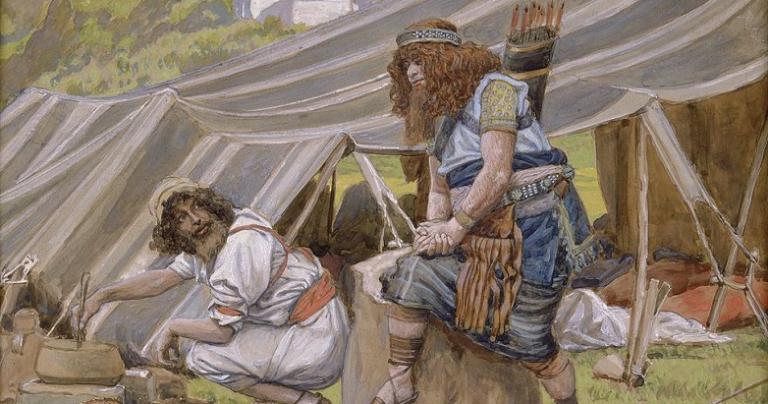
James Tissot, Public domain, via Wikimedia Commons
By Solomon Huriash
A Liar?
Wow! Your innards explode with anger, shock, challenge and now you demand – “Tell me! When?”
Very well, I’ll tell you. But first, allow me to explain why I even mentioned it. After all, it’s not nice, nor even smart, to say bad things about God. And calling Him a liar is a no-no.
Some Background First
The reason has to do with the story of the maligned man Jacob, the son of Isaac, who was the son of Abraham. Jacob holds the revered position of being the third patriarch that founded Judaism.
This particular story starts with Rebecca, the wife of Isaac, giving birth to twins. As they both struggled within Rebecca’s womb, she cried out to the Lord in pain, “…why do I exist?” God answered and told her that her children’s futures were such that “the older shall serve the younger” (Genesis 25:23). Esau was the first one out of the womb and, as the firstborn, rightful heir to the birthright, but the fate of the two brothers appeared to have been predetermined.
Rebecca knew from the start the fate of Jacob and Esau. Indeed, the route to becoming this third patriarch would have its twists and turns.
Although twins, the personalities of Esau and Jacob were total opposites. Isaac favored and admired Esau, who was a skilled hunter and outdoorsman. Esau had endeared himself to his father by bringing him game from the field that Isaac enjoyed. On the other hand, Jacob was a scholarly homebody who enjoyed spiritual pursuits, and mother Rebecca favored him.
One day Jacob was at home cooking a lentil stew. Esau came home from the field where he was unsuccessful and told Jacob he was famished and wanted “some of the red stuff to gulp down.”
Jacob then asked Esau to sell him his birthright in exchange for the stew. Esau’s reply was, “I am at the point of death, so of what use is my birthright to me?” He had missed a meal because he did not get any game, and he walked home and was quick to give away his birthright for some stew.
Although Esau said he relinquished his right of the firstborn, Jacob wanted to make sure that the transaction (lentil for the birthright) was legal. So he requested Esau to “swear to me first.” During this period, an oath was a sacred act making an agreement irrevocable. And so it was done.
When Rebecca learned that Isaac asked Esau to go to the field to bring him back game, and after that, he would give Esau his “innermost blessing,” she told Jacob of this and instructed him to dress as his brother and pretend to be him – he would then get a blessing from his blind father. Rebecca would then assume the responsibility for this deceptive pretense.
Jacob did as his mother instructed and pretended to be Esau, such that Isaac was fooled, and he subsequently gave Jacob the blessing. Jacob now had taken two things for himself, the birthright and the blessing.
Birthright vs. Blessing
“Birthright” was an honor given to the firstborn, thus placing him as head of the household and giving him the right to inherit the father’s estate. Although Esau had sold his birthright, he was still entitled to a blessing, despite the custom that the one receiving the birthright also received the greater blessing.
While the birthright belonged to the first son, a father could give a blessing to anyone. At that time, the blessing acted as a last will and testament and was highly prized because it represented God’s will.
Recriminations
To this day are lots of nasty recriminations for Jacob for stealing the blessings of the firstborn. Jacob is considered among the unforgiven. But had Jacob and his mother been truly guilty of wrongdoing? Let’s take a look at the other side of the coin.
There is no argument about the birthright: Esau sold it fair and square.
But let’s examine the blessing. The usual course of a blessing went to the one receiving the birthright. And, as noted, a blessing was the indication of God’s will for the person.
Rebecca was influential in this drama of fooling Isaac. She knew that Jacob was meant to continue the covenant of Abraham because God had already told her that the older (Esau) would serve the younger (Jacob). Esau was a man of violence who had so despised his birthright that he had sold it for a bowl of soup. No such person could be trusted with the guardianship of the covenant. Moreover, Esau had married Hittite women, which was a source of grief to both Isaac and Rebecca (see Genesis 26:34).
But, why didn’t Rebecca just go to Isaac and point out all those factors, and have him, by his own will, give the blessing to Jacob? It’s reasonable to assume that Rebecca would have had a powerful influence on Isaac, given they had an unusual love affair. Isaac had taken no other wife, and he had no concubines (live-in girlfriends), which was very unusual for men of that period.
Then it would appear that the only reason for the charade conducted by Rebecca and Jacob was that they did not want to hurt their husband and father. Isaac’s feelings would be shattered by telling him how Esau felt about his birthright.
He would have gone to his grave feeling he had failed, especially since he felt so strongly about Esau.
Today’s critics of Jacob would have preferred Jacob be forthright and stand before his father and say, “Dad, your favorite son Esau sold me his birthright privileges because he thought so little of carrying on the tradition of Grandpa Abraham. Yes, he sold it to me for a bowl of soup! Ma, back me up.”
Then Rebecca would have stepped forward and said, “Sweetheart, that’s happened. Too bad you have to lie back down and now think about Esau’s betrayal of us for the rest of the time you’ll still be hanging around. So, just give the blessing to Jacob!”
Dear Reader,
If you had a choice, would you tell Isaac straightforward the reasons he should give the blessing to Jacob and let him endure the emotional trauma of knowing his son Esau was a loser?
Or, would you have played charades and allowed him to remain blissfully ignorant? (He eventually did learn that he had been deceived, but that’s beside the point.)
Being deceived obviously would not have caused the same heartbreak and suffering of feeling like a failure-dad that knowing the truth would, in my opinion. Actually, it is prohibited to say anything that would embarrass another person, and there is a precedent for sidestepping the truth to spare a person’s feelings.
The Precedent to Lie Set by God
God himself established that precedent when He lied to spare Abraham’s feelings.
In Genesis 18:9 and on, God told Abraham through His emissaries that he and Sarah would have a son. Sarah overheard this and laughed, commenting that her husband was too old to produce a baby. God then told Abraham that when Sarah learned of her becoming a mother, she laughed and said that she was the one who was too old to bear a child.
So God essentially lied to Abraham to spare his feelings. Let’s let it go at that.

About Solomon Huriash
Dr. Huriash is a former adjunct associate professor of business administration. For the past 15 years he has been doing Biblical research projects. He is the author of “Science Proving Creationism,” the only work proving the Biblical story of creation is in sync with the concepts of modern science. See www.landpublishing.com. You can read more about the author here.
Previous Post

January 15, 2021
Did False Prophets Motivate Events at the US Capitol?
Next Post

March 11, 2022 Devout Jews in Ukraine stay to pray and await 'apocalypse'
Browse Our Archives
Select a Category answers Uncategorized
Select a Month February 2025 August 2022 April 2022 March 2022 October 2021 January 2021 May 2020 April 2020 February 2020 December 2019 November 2019 August 2019 May 2019 April 2019 March 2019 December 2018 November 2018 October 2018 June 2018 March 2018 February 2018
TAKE THE
Religious Wisdom Quiz
Which king's prayer during a deadly illness resulted in 15 more years of life?
Select your answer to see how you score.
Josiah Hezekiah Ahab Solomon
Related posts from Jewish Voices
Unitarian Universalism and the B’nei Anusim Jews

Ukraine in Prophecy: The Jeremiah Factor

Devout Jews in Ukraine stay to pray and...

Did False Prophets Motivate Events at the US...
TRENDING AT PATHEOS Jewish

Yom Kippur : Is There Always Room for...
Making Room for Forgiveness Every year as Yom Kippur approaches, I find...

This Rosh Hashanah: Can I Find New Meaning?
A Sunrise, a New Year, and a Question On our way to...

Killing Amalek: The Torah’s Most Misunderstood Commandment
Few passages of the Torah have provoked more confusion, polemic, and misuse...

I have never trusted a first draft. I don’t mean that...

Back to School, Back to Reality—and a New...
A New School Year Begins… Back to Reality A new school year...

Out-Crowleying Crowley: The Emptiness of the O9A
O9A Neo-Crowley Racial Cosplay and Edgelord Atrocitism Aleister Crowley did not create...
view all Jewish blogs
Ad-Free & Subscriber Log-In Subscription Support
- About Us
- 2026 Calendar
- Videos
- Podcasts
- Library of World Religions
- Faith In Media Tracker
- Advertise With Us
- Write for Us
- Privacy Policy
- Terms of Service
- Do Not Sell My Data
- Contact Us
- Radiant Digital
- Manage Newsletter Subscriptions
- Unsubscribe From Notifications
- Sitemap
Copyright 2008-2026, Patheos. All rights reserved.
Subscription Support Ad-Free & Subscriber Log-In
Follow Patheos