
BuddhistCatholicContemplativeEvangelicalGeneral ChristianHinduJewishLatter-day SaintMuslimNew VisionsProgressive Christian
Beliefs
- Buddhist
- Catholic
- Contemplative
- Evangelical
- General Christian
- Hindu
- Jewish
- Latter-day Saint
- More Voices
- Muslim
- New Visions
- Pagan
- Progressive Christian
Topics
- Religion News
- Food and Religion
- Sports and Religion
- Religious Art
- Religious Music and Entertainment
- Religious Events
- History and Religion
- Style and Religion
- Politics and Religion
- Women in Religion
- Recreation Outdoors and Religion
- Business Finance and Religion
- Careers Workplace and Religion
- Education and Religion
- Family Parenting and Religion
- Health Fitness and Religion
- Home and Religion
- Relationships and Religion
- Technology and Religion
- Travel and Religion
Columnists
- Buddhist Columnists
- Business Finance and Religion Columnists
- Careers Workplace and Religion Columnists
- Catholic Columnists
- Contemplative Columnists
- Education and Religion Columnists
- Evangelists Columnists
- Family Parenting and Religion Columnists
- General Christian Columnists
- Health Fitness and Religion Columnists
- Hindu Columnists
- History and Religion Columnists
- Home and Religion Columnists
- Jewish Columnists
- More Voices Columnists
- Latter Day Columnists
- Muslim Columnists
- New Visions Columnists
- Nonreligious Columnists
- Pagan Columnists
- Politics and Religion Columnists
- Progressive Columnists
- Recreation Outdoors and Religion Columnists
- Relationships and Religion Columnists
- Religion News Columnists
- Religious Art Columnists
- Religious Events Columnists
- Religious Music and Entertainment Columnists
- Sports and Religion Columnists
- Style and Religion Columnists
- Technology and Religion Columnists
- Travel and Religion Columnists
- Women in Religion Columnists
Resource Library
- 2026 Calendar
- Library of World Religions
- The 100 Most Holy Places on Earth
- Patheos Answers
- Podcasts
- Videos
- Faith Leaders Database
- Anglican Episcopalian
- Bahai
- Baptist
- Buddhism
- Christianity
- Confucianism
- Eastern Orthodoxy
- Hinduism
- Holiness and Pentecostal
- ISKCON
- Islam
- Judaism
- Lutheran
- Methodist
- The Church of Jesus Christ of Latter-day Saints
- New Age
- Paganism
- Presbytarian and Reformed
- Protestantism
- Religion Behind the Scenes
- Roman Catholic
- Scientology
- Shia Islam
- Sikhism
- Sufism
- Sunni Islam
- Taoism
- Zen
- See all religions
Research Tools
 Ad-Free & Subscriber Log-In Subscription Support
Ad-Free & Subscriber Log-In Subscription Support
Follow Patheos 

- Trending:
- Forgiveness
- |
- Marriage
- |
- Consciousness
- |
- Death Penalty
- |
- Election
- |
- Halloween

- Home
- Jewish
- This Passover, Ask Your Seder Guests to Name Today’s Ten Plagues
This Passover, Ask Your Seder Guests to Name Today’s Ten Plagues
Last updated on: March 18, 2019 at 5:06 pm by Jan Zauzmer
This Passover, Ask Your Seder Guests to Name Today’s Ten Plagues 2019-03-18T17:06:55+00:00 Jan Zauzmer
Patheos Explore the world's faith through different perspectives on religion and spirituality! Patheos has the views of the prevalent religions and spiritualities of the world.
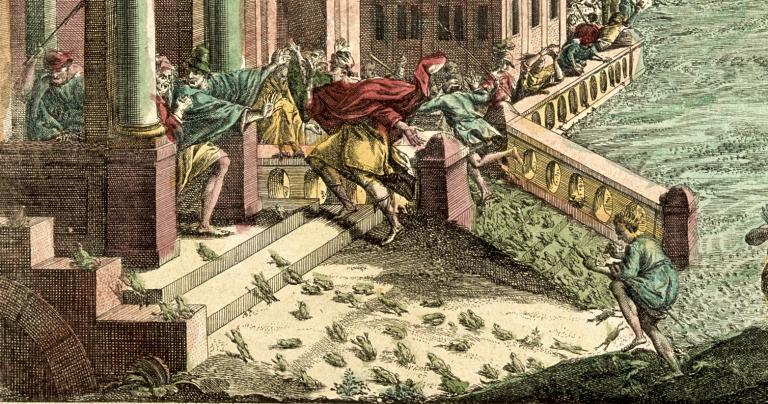 Every Passover, Jews recite the ten plagues that led to the deliverance of the Israelites from slavery in Egypt. This year, however, it is not enough to dot our plates with the ten symbolic drops of wine and move on. In the most Jewish of traditions, we must wrestle modern-day meaning from our ritual.
This year, as we witness the daily barrage of alarming afflictions across our landscape, why don’t we challenge our Seder guests to draw present-day parallels to the plagues visited upon the land of Pharaoh? By analogizing the ancient plagues to the ills all around us, we renew the Haggadah’s relevance in our generation and rouse ourselves to help fulfill the promise of freedom that this holiday represents.
Many creative Haggadot that have sprung up in recent years provide contemporary connections for us, but let’s go further in these troubled times by coming up with our own ideas. To start the Seder table conversation, consider the following examples:
Blood
The Biblical plague of blood in the Nile can stand for today’s rampant xenophobia against groups outside our own bloodlines. As the current debate over immigration rages between those who would welcome the stranger and those who would deport the stranger, let us recall the central narrative of Passover: “You shall not wrong nor oppress a stranger, for you were strangers in the land of Egypt” (Exodus 22:20).
Frogs
Let’s use the Biblical plague of frogs to symbolize those in the highest levels of government who leapfrog over the truth when it is in their own political or financial interests to do so. As we are fed a daily diet of falsehoods and attacks on the free press, may we hold fast to the Ninth Commandment’s insistence on the truth: “You shall not bear false witness against your neighbor” (Exodus 20:13).
Lice
The Biblical plague of lice can serve as a reminder that anyone who mocks people with disabilities is a louse. As lawmakers propose budgets that strip away vital protections for those with disabilities, let us take a cue from one of the most compelling of all Torah verses: “You shall not curse the deaf, nor put a stumbling block before the blind” (Leviticus 19:14).
Beasts
The Biblical plague of beasts can motivate us to oppose beastly bullying. In tweets, at rallies, and everywhere else, let us reject coarse and destructive intimidation in favor of constructive civil discourse. It couldn’t be clearer than this fundamental precept: “You shall love your neighbor as yourself” (Leviticus 19:18).
Cattle Disease
The Biblical plague of cattle disease can prod us to support programs providing food assistance for millions of food-insecure Americans. Let us take to heart the Passover Seder’s timeless call to action: “Let all who are hungry come and eat.”
Boils
It is only too easy to associate the Biblical plague of boils with the repeated efforts to shrink affordable healthcare options for the downtrodden. Let us make real the Haggadah’s follow-up charge: “Let all who are in need share the hope of Passover.”
Hail
It takes little imagination to connect the Biblical plague of hail to the reality of climate change in our era. While we alone cannot solve the problem of global warming, we are neither free to ignore scientific evidence nor free to assume that our actions do not matter to the planet: “You are not obligated to complete the work, but neither are you free to desist from it” (Pirkei Avot 2:21).
Locusts
Let’s draw on the Biblical plague of locusts to represent the swarm of sexual harassment, abuse, and assault throughout our society. No longer can we tolerate those who victimize their fellow human beings. Hillel said it best: “What is hateful to you, do not do to your neighbor. That is the whole Torah; the rest is just commentary” (Talmud Shabbat 31a).
Darkness
The Biblical plague of darkness can stand for the darkness of homophobia, racism, sexism, anti-Semitism, and all other forms of prejudice and discrimination. Stirring us to embrace tolerance and love over bigotry and hate, Hillel shined a light with this famous question: “If I am only for myself, what am I?” (Pirkei Avot 1:14).
Death of the Firstborn
The Biblical death of the firstborn can bring to mind the death of the thousands upon thousands of victims of gun violence. We must express outrage at lawmakers who yield to the gun lobby, for the Torah teaches, “Do not stand idly by while your neighbor’s blood is shed” (Leviticus 19:16). If we do not vote out those who lack the moral backbone to enact strong gun control laws, then the only liturgy left to quote will be the Mourner’s Kaddish.
These are just examples. Encourage your guests to identify plagues in our midst. Then charge everyone to go forth from that Seder, as we have done from generation to generation, to strive for a future in which the plagues belong to the past.
Jan Zauzmer, a graduate of Princeton University and Stanford Law School, is a past president of a large and vibrant Reform Jewish congregation and an internal communications specialist. She can be reached at [email protected] and followed on Twitter at @JanZauzmer.
Image: Close-up from “The plague of frogs.” Colored etching. Wellcome Library, London. Published: [1775-1779] available under Creative Commons Attribution only license CC BY 4.0
Previous Post

February 27, 2018
God's Gift of Converts for Purim
Next Post
March 27, 2018 First to Jump Into the Reed Sea
Browse Our Archives
Select a Category answers Uncategorized
Select a Month February 2025 August 2022 April 2022 March 2022 October 2021 January 2021 May 2020 April 2020 February 2020 December 2019 November 2019 August 2019 May 2019 April 2019 March 2019 December 2018 November 2018 October 2018 June 2018 March 2018 February 2018
TAKE THE
Religious Wisdom Quiz
Like a sheep led to slaughter, silent before shearers, this servant was pierced for our transgressions. What chapter foretells this suffering?
Select your answer to see how you score.
Isaiah 61 Isaiah 53 Isaiah 7 Isaiah 9
Related posts from Jewish Voices

Unitarian Universalism and the B’nei Anusim Jews

Ukraine in Prophecy: The Jeremiah Factor

Devout Jews in Ukraine stay to pray and...
TRENDING AT PATHEOS Jewish

Yom Kippur : Is There Always Room for...
Making Room for Forgiveness Every year as Yom Kippur approaches, I find...

This Rosh Hashanah: Can I Find New Meaning?
A Sunrise, a New Year, and a Question On our way to...

Killing Amalek: The Torah’s Most Misunderstood Commandment
Few passages of the Torah have provoked more confusion, polemic, and misuse...

I have never trusted a first draft. I don’t mean that...

Back to School, Back to Reality—and a New...
A New School Year Begins… Back to Reality A new school year...

Out-Crowleying Crowley: The Emptiness of the O9A
O9A Neo-Crowley Racial Cosplay and Edgelord Atrocitism Aleister Crowley did not create...
view all Jewish blogs
Ad-Free & Subscriber Log-In Subscription Support
- About Us
- 2026 Calendar
- Videos
- Podcasts
- Library of World Religions
- Faith In Media Tracker
- Advertise With Us
- Write for Us
- Privacy Policy
- Terms of Service
- Do Not Sell My Data
- Contact Us
- Radiant Digital
- Manage Newsletter Subscriptions
- Unsubscribe From Notifications
- Sitemap
Copyright 2008-2026, Patheos. All rights reserved.
Subscription Support Ad-Free & Subscriber Log-In
Follow Patheos