
BuddhistCatholicContemplativeEvangelicalGeneral ChristianHinduJewishLatter-day SaintMuslimNew VisionsProgressive Christian
Beliefs
- Buddhist
- Catholic
- Contemplative
- Evangelical
- General Christian
- Hindu
- Jewish
- Latter-day Saint
- More Voices
- Muslim
- New Visions
- Pagan
- Progressive Christian
Topics
- Religion News
- Food and Religion
- Sports and Religion
- Religious Art
- Religious Music and Entertainment
- Religious Events
- History and Religion
- Style and Religion
- Politics and Religion
- Women in Religion
- Recreation Outdoors and Religion
- Business Finance and Religion
- Careers Workplace and Religion
- Education and Religion
- Family Parenting and Religion
- Health Fitness and Religion
- Home and Religion
- Relationships and Religion
- Technology and Religion
- Travel and Religion
Columnists
- Buddhist Columnists
- Business Finance and Religion Columnists
- Careers Workplace and Religion Columnists
- Catholic Columnists
- Contemplative Columnists
- Education and Religion Columnists
- Evangelists Columnists
- Family Parenting and Religion Columnists
- General Christian Columnists
- Health Fitness and Religion Columnists
- Hindu Columnists
- History and Religion Columnists
- Home and Religion Columnists
- Jewish Columnists
- More Voices Columnists
- Latter Day Columnists
- Muslim Columnists
- New Visions Columnists
- Nonreligious Columnists
- Pagan Columnists
- Politics and Religion Columnists
- Progressive Columnists
- Recreation Outdoors and Religion Columnists
- Relationships and Religion Columnists
- Religion News Columnists
- Religious Art Columnists
- Religious Events Columnists
- Religious Music and Entertainment Columnists
- Sports and Religion Columnists
- Style and Religion Columnists
- Technology and Religion Columnists
- Travel and Religion Columnists
- Women in Religion Columnists
Resource Library
- 2026 Calendar
- Library of World Religions
- The 100 Most Holy Places on Earth
- Patheos Answers
- Podcasts
- Videos
- Faith Leaders Database
- Anglican Episcopalian
- Bahai
- Baptist
- Buddhism
- Christianity
- Confucianism
- Eastern Orthodoxy
- Hinduism
- Holiness and Pentecostal
- ISKCON
- Islam
- Judaism
- Lutheran
- Methodist
- The Church of Jesus Christ of Latter-day Saints
- New Age
- Paganism
- Presbytarian and Reformed
- Protestantism
- Religion Behind the Scenes
- Roman Catholic
- Scientology
- Shia Islam
- Sikhism
- Sufism
- Sunni Islam
- Taoism
- Zen
- See all religions
Research Tools
 Ad-Free & Subscriber Log-In Subscription Support
Ad-Free & Subscriber Log-In Subscription Support
Follow Patheos 

- Trending:
- Forgiveness
- |
- Marriage
- |
- Consciousness
- |
- Death Penalty
- |
- Election
- |
- Halloween
 Jesus Creed
- Home
- Evangelical
- You Were in Eden (RJS)
You Were in Eden (RJS)
Last updated on: October 13, 2019 at 1:10 pm by RJS
You Were in Eden (RJS) 2019-10-13T13:10:25-05:00 RJS
Patheos Explore the world's faith through different perspectives on religion and spirituality! Patheos has the views of the prevalent religions and spiritualities of the world.
It is dangerous to read the Bible. I mean the whole Bible cover to cover. It may not live up to your expectations. Of course, if we take Scripture seriously, we should read and consider the whole rather than focus on favored passages. Because I’ve committed to reading (or listening) to the whole thing, I’ve happened upon passages that challenge preconceptions and introduce new ideas. One of these is found in the lament against the king of Tyre in Ezekiel 28 (vv.11-19).
The word of the Lord came to me: “Son of man, take up a lament concerning the king of Tyre and say to him: ‘This is what the Sovereign Lord says:
“‘You were the seal of perfection,
full of wisdom and perfect in beauty.
You were in Eden,
the garden of God;
…
You were on the holy mount of God;
you walked among the fiery stones.
You were blameless in your ways
from the day you were created
till wickedness was found in you.
Through your widespread trade
you were filled with violence,
and you sinned.
So I drove you in disgrace from the mount of God,
and I expelled you, guardian cherub,
from among the fiery stones.
The king of Tyre is described by the sovereign Lord as blameless in the garden of Eden until he fell. What are we to make of this? The entire passage is quoted at the end of this post.
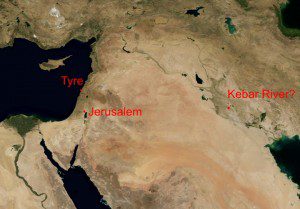 Ezekiel was a priest from Jerusalem, taken to Babylon in the first wave of exile. He wrote from the banks of the Kebar river in Babylon, 1:1). His visions are impressive. This is one of a number of prophecies against various peoples and rulers. Generally they are among the passages that seem less important. With the exception of a few lasting images (e.g. wheels within wheels and a valley of dry bones) the book of Ezekiel is not often the subject of sermons, or even of bible studies. It contains some fairly graphic sexual imagery in describing the failures of Judah, fantastic apocalyptic imagery, the repeated notion that the righteous can fall away and the wicked can turn to God with a change in final status, a massive rebuilt temple at the end of the book. There are echoes of some of these themes in the New Testament, especially in Revelation. It would seem that any interpretation of The Apocalypse of John that doesn’t take into account the Jewish context, including the book of Ezekiel, will probably miss some important points.
Ezekiel is admittedly a hard book to understand. Daniel Bodi in Ezekiel & Daniel (Zondervan Illustrated Bible Background Commentary) comments that “Calvin never finished his commentary on Ezekiel and Luther put forth no major effort toward its interpretation.” (p. 403, I have the hard cover edition that includes the prophets from Isaiah to Daniel and page numbers are from this version.)
The king = Satan? According to the word of the Lord in this passage the king of Tyre was in Eden, the garden of God. Clearly this is a problem for any kind of literal interpretation of the passage. Some commentators (only a few) have assumed that the passage must be referring to Satan. After all, the garden was a real place some 3500 years earlier. The only “persons” in the garden were Adam, Eve, and Satan. It isn’t reasonable to assume the passage refers to Adam, therefore it must reference the fall of Satan. Ezekiel 28 along with a passage in Isaiah 14 “How you have fallen from heaven, morning star, son of the dawn! You have been cast down to the earth, you who once laid low the nations!” are the primary references for this idea. It is highly unlikely that this is an appropriate interpretation of either passage, and it is a particularly strained interpretation of Ezekiel 28.
Most commentators I’ve found (and I haven’t been able to consult too many) agree that the passage refers to the king of Tyre and is a prophecy against Tyre and its king for their violence and greed. Daniel Block (NICOT: Ezekiel Chapters 25-48) comments on both the judgement speech against the king of Tyre in verses 1-10 and the lament in 11-19. These cannot be separated and both refer to the actual king and kingdom of Tyre (see also ch. 26-27). The king of Tyre was guilty of hubris evidenced, among other things, in dishonest trade. Application of this passage to the fall of Satan can only be made if it is ripped out of context and taken in isolation. Block quotes part of John Calvin’s commentary on Isaiah 14 and applies it to this passage as well: “But when passages of Scripture are taken up at random, and when no attention is paid to the context, we need not wonder that mistakes of this kind frequently arise. … But as these inventions have no probability whatever, let us pass them by as useless.” (p. 119)
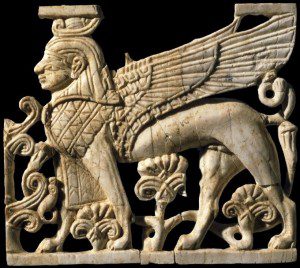
The image of a garden and the cherub and similar winged human-animals are common in the ancient Near East with a number of parallels. Bodi notes:
Such parallels imply that in the description of a paradise-like garden, Ezekiel is drawing on stereotypical formulas, stock phrases, and traditional themes. The advantage of such a procedure is that it facilitates communication. His audience will quickly grasp the allusions made in Ezekiel’s message. (p. 467)
 He also comments:
The growing collection of Phoenician ivories attests to the prominence of the cherub motif in Phoenician art and iconography. Especially noteworthy is the carving of a king-cherub, whose face appears to be a portrait of the king and under whose feet are seen alternating patterns of stylized tulip flower gardens and mountains. (p. 467)
There are better images of the cherub motif (human head, winged bull or lion body) I have found in books, but the one above is the best available image for use (credit British Museum), Phoenician origin, found in Nimrud with Egyptian influences, ca. 900 BC to 700 BC. Cherub motifs are not uncommon in the ancient Near East.
Ezekiel apparently has the Israelite story of the garden of the Lord in mind. There are multiple allusions back to Genesis 3. “In placing the king of Tyre in Eden Ezekiel is adapting a well-known biblical tradition of the garden of God as a utopian realm of prosperity and joy.” (Block p. 106) The king was (like adam) created by God, divinely authorized to rule, was not satisfied with his role and “fell,” he was punished by humiliation and death (paraphrasing Block pp. 117-118).
Joseph Blenkinsopp in Interpretation: Ezekiel comments on the garden of Eden (and points out that it is possible that both Genesis 3 and Ezekiel 28 point to some other then well known, but now lost to us, story):
It would be natural to assume that this lament draws on the familiar story of the Garden of Eden in Genesis, but it is equally possible to read both as distinct forms of an ancient mythic narrative well known in the ancient Near East. Whereas here it serves to convey a political message, the Genesis version is given universal significance precisely by being placed at the beginning of the biblical story. In this, as in other instances, the first question to ask is not, Did it really happen? but, What does it mean? It invites attention to its symbolic meaning as a diagnosis of the human situation from a perspective that is both theologically and psychologically profound. Leaving aside the fate of Tyre, a matter of past history, what both versions convey is that sin emerges out of our interaction with the environment and in society … Both speak, in different ways, of the corruption of wisdom (see Ezek. 28:17), let us say of the human capacity for knowledge, mastery, and the quest for fullness of life. Both take seriously the consequences of deviating from the original purpose of creation while affirming the possibility of restoration. (pp. 124-125)
Ezekiel uses the imagery of the garden of God and Eden in chapter 31 as well, comparing Assyria and Egypt with mighty and beautiful trees, the cedars of Lebanon and trees in the garden. This use of Eden raises fewer questions because it is clearly meant as an analogy. However, it provides additional evidence for the importance of this imagery in Ezekiel’s community.
So What? Whether Ezekiel has Genesis 3 in mind, or both Genesis 3 and Ezekiel build on another story, this passage tells us something about the way the ancient Israelites viewed their stories of origin recorded for us in the first 11 chapters of Genesis, in particular in this case Genesis 3. There was not a wooden literalism here. Although it can offend our expectations, it didn’t contradict their understanding of the stories, or the imagery contained in the stories, to place the King of Tyre as a guardian cherub in the garden of Eden. Wow!
Note as well, that this passage in Ezekiel isn’t a story with a message. Nor is it a historical account told from the perspective of the Israelites as we find in the books of Samuel, Kings, and Chronicles (where other written sources were also used and acknowledged). This is the word of the Lord given to Ezekiel. If we take the inspiration of Scripture seriously this can’t be brushed away easily. Many claim Scripture as the word of God and then assert that “God does not lie” to drive home particular preferred interpretations. I have often been confronted with just such an argument when discussing the proper interpretation of the early chapters of Genesis. Of course, it is also said that we should let Scripture interpret Scripture. Genesis 3 and Ezekiel 28 should help us understand what this means and help guide our understanding of the forms and genres that can be used to convey the word of God.
In so far as we are able, we need to read the stories with ancient, not modern, eyes.
What do you make of the king of Tyre in Eden, the garden of God?
How should we interpret such passages?
If you wish to contact me directly you may do so at rjs4mail[at]att.net.
If interested you can subscribe to a full text feed of my posts at Musings on Science and Theology.
(This is a repost – but worth our consideration.)
Ezekiel 28:11-19
The word of the Lord came to me: “Son of man, take up a lament concerning the king of Tyre and say to him: ‘This is what the Sovereign Lord says:
“‘You were the seal of perfection,
full of wisdom and perfect in beauty.
You were in Eden,
the garden of God;
every precious stone adorned you:
carnelian, chrysolite and emerald,
topaz, onyx and jasper,
lapis lazuli, turquoise and beryl.
Your settings and mountings were made of gold;
on the day you were created they were prepared.
You were anointed as a guardian cherub,
for so I ordained you.
You were on the holy mount of God;
you walked among the fiery stones.
You were blameless in your ways
from the day you were created
till wickedness was found in you.
Through your widespread trade
you were filled with violence,
and you sinned.
So I drove you in disgrace from the mount of God,
and I expelled you, guardian cherub,
from among the fiery stones.
Your heart became proud
on account of your beauty,
and you corrupted your wisdom
because of your splendor.
So I threw you to the earth;
I made a spectacle of you before kings.
By your many sins and dishonest trade
you have desecrated your sanctuaries.
So I made a fire come out from you,
and it consumed you,
and I reduced you to ashes on the ground
in the sight of all who were watching.
All the nations who knew you
are appalled at you;
you have come to a horrible end
and will be no more.’”
Previous Post

October 10, 2019
Bible Project: The Gospel
Next Post
October 11, 2019 Just Sit There (Mike Glenn)
Browse Our Archives
Select a Category Acts of the Apostles Adam Advent Anabaptism Angels Anglican Apologetics Atonement Baptism BCP Prayers Bible Biblical Studies Birds Blogging Bloglossary Bonhoeffer Books Calvinism Christianity Church Church History Coffee Colossians Commentary Recs Conversion Creation Creeds Culture Death Ecclesiastes Economics Education Embracing Grace Emergent Emerging Movement Eschatology Essays Ethics Eucharist Evangelicalism Family Fasting Fathers Fellowship of Differents Footsteps Tour Fun and Whimsical Gospel Grace Happiness Heaven Hell Holy Spirit Irenaeus James Jesus Jesus Creed Job Justification Kingdom of God Law Lectures Lent Liberalism Love and Marriage Mabanteneni Manhood Mary Miracles Missio Alliance MissioLife Missional Missional Jesus Movies and Film New Perspective Northern Seminary OneLife Origins Project Orthodox Parables Pastor's Spouse Pastoring and Leading Pastoring and Preaching Patristics Paul Paul-John Tour Pharisees Pietism Political Theology Prayer and Formation Preaching Problems for Faith Psalm 119 Psalms Public Issues Purgatory Religions Resurrection Revelation Romans Rule of JCreed Science and Faith Sermon on the Mount Sports Ten Commandments Theology Third Way Top Ten Lists Translations Uncategorized Universalism University Ministry Way Out Weekly Meanderings Wisdom Women and Ministry Work Worship Writing & Blogging Youth Ministry
Select a Month July 2021 January 2020 December 2019 November 2019 October 2019 September 2019 August 2019 July 2019 June 2019 May 2019 April 2019 March 2019 February 2019 January 2019 December 2018 November 2018 October 2018 September 2018 August 2018 July 2018 June 2018 May 2018 April 2018 March 2018 February 2018 January 2018 December 2017 November 2017 October 2017 September 2017 August 2017 July 2017 June 2017 May 2017 April 2017 March 2017 February 2017 January 2017 December 2016 November 2016 October 2016 September 2016 August 2016 July 2016 June 2016 May 2016 April 2016 March 2016 February 2016 January 2016 December 2015 November 2015 October 2015 September 2015 August 2015 July 2015 June 2015 May 2015 April 2015 March 2015 February 2015 January 2015 December 2014 November 2014 October 2014 September 2014 August 2014 July 2014 June 2014 May 2014 April 2014 March 2014 February 2014 January 2014 December 2013 November 2013 October 2013 September 2013 August 2013 July 2013 June 2013 May 2013 April 2013 March 2013 February 2013 January 2013 December 2012 November 2012 October 2012 September 2012 August 2012 July 2012 June 2012 May 2012 April 2012 March 2012 February 2012 January 2012 December 2011 November 2011 October 2011 September 2011 August 2011 July 2011 June 2011 May 2011 April 2011 March 2011 February 2011 January 2011 December 2010 November 2010 October 2010 September 2010 August 2010 July 2010 June 2010 May 2010 April 2010 March 2010 February 2010 January 2010 December 2009 November 2009 October 2009 September 2009 August 2009 July 2009 June 2009 May 2009 April 2009 March 2009 February 2009 January 2009 December 2008 November 2008 October 2008 September 2008 August 2008 July 2008 June 2008 May 2008 April 2008 March 2008 February 2008 January 2008 December 2007 November 2007 October 2007 September 2007 August 2007 July 2007 June 2007 May 2007 April 2007 March 2007 February 2007 January 2007 December 2006 November 2006 October 2006 September 2006 August 2006 July 2006 June 2006 May 2006 April 2006 March 2006 February 2006 January 2006 December 2005 November 2005 October 2005 September 2005 August 2005 July 2005 June 2005 May 2005 April 2005 0000
Follow Us!
TAKE THE
Religious Wisdom Quiz
I was made a watchman for the house of Israel. If I failed to warn the wicked, whose blood would be required?
Select your answer to see how you score.
The people's No one's The wicked person's The watchman's
Related posts from Jesus Creed


The Gospel of With Us and Through Us

Northern Seminary Announces: Nijay Gupta Joins Faculty

The Gundrys and Me: Ruth Tucker
TRENDING AT PATHEOS Evangelical

How the author of the world's best hymn...
I've been working with John Newton for a while now. This makes...

Long before this Lectio Divina, Psalm 130 - the song - started...

What About the Trees? Another Living Parable
After I finished writing the last article about falling leaves as a...

Why Classical Education Is a Conversation, Not a...
Come and Read: Joy in Classical Education When I was a little...

Falling Leaves: A Living Parable on Letting Go
I’ve spent the vast majority of my life in the southeast corner...

Cornell University has received a great deal of negative publicity and intense...
view all Evangelical blogs
Ad-Free & Subscriber Log-In Subscription Support
- About Us
- 2026 Calendar
- Videos
- Podcasts
- Library of World Religions
- Faith In Media Tracker
- Advertise With Us
- Write for Us
- Privacy Policy
- Terms of Service
- Do Not Sell My Data
- Contact Us
- Radiant Digital
- Manage Newsletter Subscriptions
- Unsubscribe From Notifications
- Sitemap
Copyright 2008-2026, Patheos. All rights reserved.
Subscription Support Ad-Free & Subscriber Log-In
Follow Patheos