
BuddhistCatholicContemplativeEvangelicalGeneral ChristianHinduJewishLatter-day SaintMuslimNew VisionsProgressive Christian
Beliefs
- Buddhist
- Catholic
- Contemplative
- Evangelical
- General Christian
- Hindu
- Jewish
- Latter-day Saint
- More Voices
- Muslim
- New Visions
- Pagan
- Progressive Christian
Topics
- Religion News
- Food and Religion
- Sports and Religion
- Religious Art
- Religious Music and Entertainment
- Religious Events
- History and Religion
- Style and Religion
- Politics and Religion
- Women in Religion
- Recreation Outdoors and Religion
- Business Finance and Religion
- Careers Workplace and Religion
- Education and Religion
- Family Parenting and Religion
- Health Fitness and Religion
- Home and Religion
- Relationships and Religion
- Technology and Religion
- Travel and Religion
Columnists
- Buddhist Columnists
- Business Finance and Religion Columnists
- Careers Workplace and Religion Columnists
- Catholic Columnists
- Contemplative Columnists
- Education and Religion Columnists
- Evangelists Columnists
- Family Parenting and Religion Columnists
- General Christian Columnists
- Health Fitness and Religion Columnists
- Hindu Columnists
- History and Religion Columnists
- Home and Religion Columnists
- Jewish Columnists
- More Voices Columnists
- Latter Day Columnists
- Muslim Columnists
- New Visions Columnists
- Nonreligious Columnists
- Pagan Columnists
- Politics and Religion Columnists
- Progressive Columnists
- Recreation Outdoors and Religion Columnists
- Relationships and Religion Columnists
- Religion News Columnists
- Religious Art Columnists
- Religious Events Columnists
- Religious Music and Entertainment Columnists
- Sports and Religion Columnists
- Style and Religion Columnists
- Technology and Religion Columnists
- Travel and Religion Columnists
- Women in Religion Columnists
Resource Library
- 2026 Calendar
- Library of World Religions
- The 100 Most Holy Places on Earth
- Patheos Answers
- Podcasts
- Videos
- Faith Leaders Database
- Anglican Episcopalian
- Bahai
- Baptist
- Buddhism
- Christianity
- Confucianism
- Eastern Orthodoxy
- Hinduism
- Holiness and Pentecostal
- ISKCON
- Islam
- Judaism
- Lutheran
- Methodist
- The Church of Jesus Christ of Latter-day Saints
- New Age
- Paganism
- Presbytarian and Reformed
- Protestantism
- Religion Behind the Scenes
- Roman Catholic
- Scientology
- Shia Islam
- Sikhism
- Sufism
- Sunni Islam
- Taoism
- Zen
- See all religions
Research Tools
 Ad-Free & Subscriber Log-In Subscription Support
Ad-Free & Subscriber Log-In Subscription Support
Follow Patheos 

- Trending:
- Forgiveness
- |
- Marriage
- |
- Consciousness
- |
- Death Penalty
- |
- Election
- |
- Halloween
 Jesus Creed
- Home
- Evangelical
- Reviewing David Bentley Hart
Reviewing David Bentley Hart
Last updated on: October 2, 2019 at 7:39 pm by Scot McKnight
Reviewing David Bentley Hart 2019-10-02T19:39:00-05:00 Scot McKnight
Patheos Explore the world's faith through different perspectives on religion and spirituality! Patheos has the views of the prevalent religions and spiritualities of the world.
[Abstract of this review by Geoff Holsclaw] My fundamental concern is that our humanity is at stake—our dignity (not just our freedom). And this is the reason moderates—and progressives—should reject David Bentley Hart’s universalism: he loses the unique beauty (and disaster) of the human person in his relentless pursuit of metaphysical clarity and coherence.
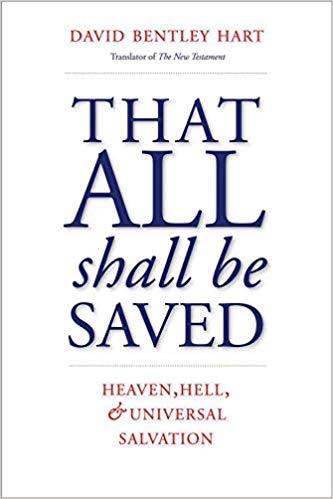
There are several reasons why a person like me would be interested in David Bentley Hart’s new book universalism, That All Shall Be Saved. And I’m going to outline those reasons, and explore Hart’s arguments in this review (for all the details, see my extended summary here).
What Exactly Are We Talking About?
Christian universalism, as espoused by Hart, is the view that hell is not eternal (it will only last for as long as it takes to purge evil from all of creation), and that all will achieve union with God so that God might be “all in all.” I’ll unpack that in a moment. But Christian universalism is to be distinguished from universalism in general, which says that “all roads lead back to God” because all religions really takes us on the same spiritual journey in the end. Hart, and most Christian universalists, claim that Christ’s life, death, and resurrection, are fundamentally necessary for the redemption of all things—and indeed, because Christ is the victor over sin and death, all things will eventually be reconciled to God (even if passing through the fires of hell, which are none other than the purifying glory of God).  Hart, however, is not very clear about his opponents in the book. Hart treats 1) “infernalists” (his label for the “eternal conscious torment by God” view), 2) “hell is the place of our own making” (C. S. Lewis), and 3) conditional immortality/annihilation as if they were all the same view. In the end his book really only manages to land serious blows against the infernalists, leaving the other two options mostly intact. If you were hoping to read Hart as a way to get up to speed on the various debates about universalism, the different options or streams involved, or a detailed review of the biblical arguments for or against universalism, you will be sorely disappointed.
Why Am I Interested in This Book (and why should you be)?
I would consider myself a theological moderate or centrist, but evangelical nonetheless (even if that is a meaningless term these days). I’m interested in Hart’s perspective because
- I have friends wondering about or drawn to universalism.
- My friends have friends drawn to universalism, and they aren’t sure what to think or how to respond.
- As a strong advocate of the Christus Victor view of the atonement, I’m wondering if this also entails a final victory over sin that would be universalist in nature.
- I’m curious how the same arguments I’ve used to criticize aggressive views of Penal Substitutionary Atonement and Predestination are used by Hart to argue for universalism.
In a sense, I’m wondering whether or not the shifts in my theological matrix (much less Reformed, less literal view of hell, and Christus Victor) should drive me toward universalism.
Why Moderates Will Like Hart’s Book
As a theological moderate I can see why others, and certainly why theological progressives, will love this book.
- It offers merciless criticism of Reformed theology.
- It seems to exposes the faulty (moral) logic of eternal damnation.
- It gives the highest academic and intellectual firepower to a militantly universalist position.
- And it seems to cover the essentials: God and creation, scriptural arguments, humanity, and freedom
Instant Classic? Probably (for the wrong reasons)
Many have already claimed Hart’s book will become an instant classic. And it probably will be, but for all the wrong reasons—or rather for all the right reasons when it comes to diatribe. The book is unrelentingly pugilistic in tone (Hart loves using big words. Outside of using “pugilistic” just now [which means “one who boxes/fights”], I will refrain from such a pedantic practice). Hart constantly beats down opponents through cheap shots and emotional appeals. Hart is fond of pointing out every supposed “communal self-deception” and “collective derangement” promoted by “moral idiocy” disguised as “spiritual subtlety,” all of which would be discarded as so much “degrading nonsense” and “sentimental obscurantism” if we all weren’t so committed to the fantasy of an eternal hell. But thankfully all who already agree with Hart have “a properly functioning moral intelligence”, and all opposed probably have “one or two emotional pathologies”, or they are full blown “religious sociopaths” who are “psychologically diseased.” It will be tempting for progressives (and moderates) to give in to these emotional appeals and calls to moral outrage. But as I hope to show, rather than being the proof that we have retained a shred of humanity, to follow Hart as he darts down the universalist hole is ultimately to lose the humanity created in God’s image.
Four Meditations, but Really Only Two Arguments
After two introductory chapters (“Framing the Questions” and “Doubting the Answers”), Hart begins four meditations on universal reconciliation (again, see this for the details). #1 Who is God? The Moral meaning of Creatio ex Nihilo This meditation asks, Can we really call God good if God created even one finite being who is destined for infinite suffering? No, Hart answers, God would not be good if even one part of creation is damned. Rather, God would be a moral monster. #2 What is Judgment? A Reflection on Biblical Eschatology This meditation asks, Is hell as eternal conscious torment inflicted by God really in the Bible? No, Hart answers, it is a distortion and projection to find hell in the Bible. #3 What is a Person? A Reflection on the Divine Image This meditation asks, Can any human be saved if even one is damned? No, Hart answers, all of humanity must be saved in Christ or none of will be, for all are collectively created in/by/for Christ and this creation (of humanity) will have failed if even one is damned. #4 What is Freedom? A Reflection on the Rational Will This meditation asks, Can a rational agent freely reject God forever and therefore rightfully receive eternal damnation? No, Hart argues, it is incoherent for a rational agent to always reject its own good end, and God is humanity’s good end. Therefore we will eventually find our rest in the goodness of God, no matter how far or for how long we wander in sin away from that Good. These four meditation require quite a bit of metaphysical unpacking to get at their theological freight—and would cause this post to be much longer than it already is. But thankfully Hart’s four meditations boil down to just two main arguments.
The Two Arguments Hart Makes:
First Main Argument: God is good. Therefore, all creation will come to its good end (or, no evil part will remain eternally in creation). Expanded a little: If God is good then creation is good. But if any part of creation remains evil forever (or is annihilated), then God cannot be entirely good (only mostly good). But God’s goodness must be displayed through everything so that God might be “all in all.” This argument assumes all creation was created for the ultimate end of divine union (Hart’s first meditation), and that humanity in particular cannot find rest apart from divine union (this is our created purpose according to Hart’s third meditation). Second Main Argument: Every rational nature (humanity) is only truly free when it wills its own good end. Therefore, every rational nature will eventually will its own good end, which is found only in God (even if it takes the rational nature an extended stay in hell to purge encrusted layers of sin and evil). Expanded a little: Because every rational nature will ultimately rest in God, eternal conscious torment is impossible (Hart’s fourth meditation). And happily the Bible confirms this by not talking about hell as an eternal place of conscious torment (Hart’s second meditation). In both arguments Hart demands maximal metaphysical coherence and clarity. For Hart, to follow the premises of God’s goodness and human freedom is to arrive on the shores of universal redemption. We will leave Hart’s demand for perfect logical coherence and clarity to the side for now (except to say that usually it is heretics who demand such coherence and clarity, and that orthodoxy usually holds two truths together, like one God and three persons [Trinity] or one person and two natures [Christology]). I will even concede that Hart’s logic is indeed impeccable, given the terms of the debate. But it is the terms of the debate that I reject. And it is why moderates (and progressives) should reject Hart’s universalism. Hart loses the personal in the midst his logical metaphysical, which is all the more ironic given Hart’s antipathy for the Western style of theology that supposedly emphasizes natures over persons. Or said differently, Hart offers an inverted Calvinism where God determines that all will and must be saved, to the loss of human dignity and agency.
The One Main Problem: Image of God Lost
Hart gets humanity tragically wrong. We should understand our theological anthropology (imago dei) through a biblical grid of what “image” means in Genesis. But instead of this Hart runs his version of the “image of God” through Gregory of Nyssa’s (neo)platonic grid which reduces humanity’s goal and destiny to divine union (which is not wrong, but it is incomplete). As Catherine McDowell’s The Image of God in the Garden of Eden has clearly shown (see also Middleton’s The Liberating Image), the imago dei is a two-fold reality (in a popular read, my wife and I also explore the journey of imago dei through the entire story of the Bible in Does God Really Like Me?). First, the divine image speaks of presence. We were made for union with God as the divine “idols” placed within the garden/creation temple of God. We are made for divine union. Hart gets this part right. Second, the divine image speaks of purpose. We were made to rule in and extend the kingdom of God. Are are authorized co-rulers, even co-creators, of God’s kingdom. We are made for kingdom extension. Hart gets this part wrong, and therefore gets it all wrong. Hart collapses human purpose into divine presence making his ontological commitments much more like cosmic monism (that everything lives/exists as an extension of the divine essence). But a Christian theological anthropology (and doctrine of creation) must hold out extensive room for human co-creation.
Why It Matters: Lost Dignity
Universalism (and salvation for that matter) is not about God’s goodness or human freedom (the terms on which Hart, and many infernalists, set the debate). It is about persons laboring with God or against God. If humans are co-creators and co-rulers with God, then this changes all of Hart’s arguments. It is about persons—and the dignity of a human being. As When Helping Hurts and other works have made abundantly clear, removing all agency destroys dignity (and Hart is not really shy from admitting to determinism—once the ‘proper’ metaphysics is acknowledged). But God didn’t just come to save us from the disease of sin, or to destroy death (which it true). God also came to restore humanity a co-laborer in the kingdom, creative contributors to God’s cosmos. Hart demands that all be saved or God is not good. But this demand destroys the respect and dignity that God gave humanity—to create something, to add something to God’s creation that wasn’t there.
De-Creationg, Hell, and Annihilation
The possibility that the Bible holds out (but that Hart’s platonized metaphysical monism disallows) the possibility of co-creating with God, humanity could also create a zone of de-creation (anti-creation, anti-kingdom). This is the creation of sin and evil. Big picture, the ultimate horizon of this de-creation within God’s good creation seems to be either total implosion (annihilation) or a quarantining of this de-creation (hell of one’s own choosing). Either could be viewed as God’s respect for the dignity of humanity’s ability to create.
Aligning Presence and Purpose: Heaven and Hell
Ultimately God will always align or bless the image of God in us by aligning our presence and our purposes. On the one hand God will align our desire for God’s presence (divine union) and co-laboring in God’s purposes (kingdom extension). This is salvation in Christ, by the Spirit, within the Father’s family. This aligning will be a blessing, and salvation. On the other hand, God will also align us with our desire to be away from God’s presence (divine absence) and to follow our own purposes (self-loving kingdom). This is the “hell of one’s own creation” or “annihilation” (and the former could still be called “eternal conscious torment”). This aligning will feels like a curse, and damnation. It seems just as plausible that God will respect our dignity (not just our freedom) in judging our ultimate destinies. And because of this, something like hell seems to be part of the Christian story—as unseemly as we might think it to be. By Geoff Holsclaw: a theology professor at Northern Seminary and pastor Vineyard North.
Previous Post

October 1, 2019
Do Christians Hate Us? (RJS)
Next Post
October 2, 2019 Forgiveness
Browse Our Archives
Select a Category Acts of the Apostles Adam Advent Anabaptism Angels Anglican Apologetics Atonement Baptism BCP Prayers Bible Biblical Studies Birds Blogging Bloglossary Bonhoeffer Books Calvinism Christianity Church Church History Coffee Colossians Commentary Recs Conversion Creation Creeds Culture Death Ecclesiastes Economics Education Embracing Grace Emergent Emerging Movement Eschatology Essays Ethics Eucharist Evangelicalism Family Fasting Fathers Fellowship of Differents Footsteps Tour Fun and Whimsical Gospel Grace Happiness Heaven Hell Holy Spirit Irenaeus James Jesus Jesus Creed Job Justification Kingdom of God Law Lectures Lent Liberalism Love and Marriage Mabanteneni Manhood Mary Miracles Missio Alliance MissioLife Missional Missional Jesus Movies and Film New Perspective Northern Seminary OneLife Origins Project Orthodox Parables Pastor's Spouse Pastoring and Leading Pastoring and Preaching Patristics Paul Paul-John Tour Pharisees Pietism Political Theology Prayer and Formation Preaching Problems for Faith Psalm 119 Psalms Public Issues Purgatory Religions Resurrection Revelation Romans Rule of JCreed Science and Faith Sermon on the Mount Sports Ten Commandments Theology Third Way Top Ten Lists Translations Uncategorized Universalism University Ministry Way Out Weekly Meanderings Wisdom Women and Ministry Work Worship Writing & Blogging Youth Ministry
Select a Month July 2021 January 2020 December 2019 November 2019 October 2019 September 2019 August 2019 July 2019 June 2019 May 2019 April 2019 March 2019 February 2019 January 2019 December 2018 November 2018 October 2018 September 2018 August 2018 July 2018 June 2018 May 2018 April 2018 March 2018 February 2018 January 2018 December 2017 November 2017 October 2017 September 2017 August 2017 July 2017 June 2017 May 2017 April 2017 March 2017 February 2017 January 2017 December 2016 November 2016 October 2016 September 2016 August 2016 July 2016 June 2016 May 2016 April 2016 March 2016 February 2016 January 2016 December 2015 November 2015 October 2015 September 2015 August 2015 July 2015 June 2015 May 2015 April 2015 March 2015 February 2015 January 2015 December 2014 November 2014 October 2014 September 2014 August 2014 July 2014 June 2014 May 2014 April 2014 March 2014 February 2014 January 2014 December 2013 November 2013 October 2013 September 2013 August 2013 July 2013 June 2013 May 2013 April 2013 March 2013 February 2013 January 2013 December 2012 November 2012 October 2012 September 2012 August 2012 July 2012 June 2012 May 2012 April 2012 March 2012 February 2012 January 2012 December 2011 November 2011 October 2011 September 2011 August 2011 July 2011 June 2011 May 2011 April 2011 March 2011 February 2011 January 2011 December 2010 November 2010 October 2010 September 2010 August 2010 July 2010 June 2010 May 2010 April 2010 March 2010 February 2010 January 2010 December 2009 November 2009 October 2009 September 2009 August 2009 July 2009 June 2009 May 2009 April 2009 March 2009 February 2009 January 2009 December 2008 November 2008 October 2008 September 2008 August 2008 July 2008 June 2008 May 2008 April 2008 March 2008 February 2008 January 2008 December 2007 November 2007 October 2007 September 2007 August 2007 July 2007 June 2007 May 2007 April 2007 March 2007 February 2007 January 2007 December 2006 November 2006 October 2006 September 2006 August 2006 July 2006 June 2006 May 2006 April 2006 March 2006 February 2006 January 2006 December 2005 November 2005 October 2005 September 2005 August 2005 July 2005 June 2005 May 2005 April 2005 0000
Follow Us!
TAKE THE
Religious Wisdom Quiz
Who wrote most of the New Testament letters?
Select your answer to see how you score.
James Peter John Paul
Related posts from Jesus Creed


The Gospel of With Us and Through Us

Northern Seminary Announces: Nijay Gupta Joins Faculty

The Gundrys and Me: Ruth Tucker
TRENDING AT PATHEOS Evangelical

The REST of Your Life: A Creative Wrestles...
This week I had a conversation with a good friend from church....

How the author of the world's best hymn...
I've been working with John Newton for a while now. This makes...

Long before this Lectio Divina, Psalm 130 - the song - started...

What About the Trees? Another Living Parable
After I finished writing the last article about falling leaves as a...

Why Classical Education Is a Conversation, Not a...
Come and Read: Joy in Classical Education When I was a little...

Cornell University has received a great deal of negative publicity and intense...
view all Evangelical blogs
Ad-Free & Subscriber Log-In Subscription Support
- About Us
- 2026 Calendar
- Videos
- Podcasts
- Library of World Religions
- Faith In Media Tracker
- Advertise With Us
- Write for Us
- Privacy Policy
- Terms of Service
- Do Not Sell My Data
- Contact Us
- Radiant Digital
- Manage Newsletter Subscriptions
- Unsubscribe From Notifications
- Sitemap
Copyright 2008-2026, Patheos. All rights reserved.
Subscription Support Ad-Free & Subscriber Log-In
Follow Patheos